Copper Deficiency: What It Is, Symptoms, Causes, and Treatment

Updated: 2 days ago
Medically reviewed by Dr. Baraa Alnahhal, MD · Last reviewed: October 2026
Quick Answer
Copper deficiency is a rare nutritional deficiency that occurs when you don't get enough copper or your body cannot use it properly. It causes fatigue, frequent infections, numbness in the hands and feet and early gray hair. Causes include Crohn's disease, celiac disease and zinc overload. Blood tests diagnose it, and copper supplements usually improve symptoms. [1]
What the research says
Copper deficiency is more common than once thought. A review notes that adults need 0.9 mg of copper a day, that deficiency is mostly acquired, that it mainly shows up as anemia and myeloneuropathy (spinal cord and nerve damage), and that severe deficiency after bariatric bypass surgery has become frequent (Altarelli et al., Nutrition in Clinical Practice, 2019) [2].
It can mimic other blood and nerve diseases. A hematology review describes copper deficiency as an under-recognized cause of reversible refractory anemia and low white cells (neutropenia), often misdiagnosed as myelodysplastic syndrome, with nerve damage indistinguishable from vitamin B12 deficiency; it advises measuring copper and ceruloplasmin in these patients (Lazarchick, Current Opinion in Hematology, 2012) [3].
Too much zinc can cause it, and nerve symptoms may only partly recover. Among 338 people with Wilson's disease treated with zinc, 3 developed copper deficiency, and a literature review found 17 more cases, all after more than a decade of zinc therapy; adjusting treatment corrected the low blood counts, but neurological symptoms improved only partially (Chevalier et al., Movement Disorders Clinical Practice, 2023) [4].
What Is Copper Deficiency?
Copper deficiency is a rare nutritional deficiency that happens when you don't get enough copper from food, or when your body can't use the mineral like it should. [1]
Copper is a trace mineral found throughout your body. It sits inside enzymes that act as important building blocks and support your immune system. It also helps build your red blood cells and bones. [1]
You can develop the condition during your lifetime. Some people are also born with an inherited disorder that affects how their bodies process copper, such as Menkes disease. [1]
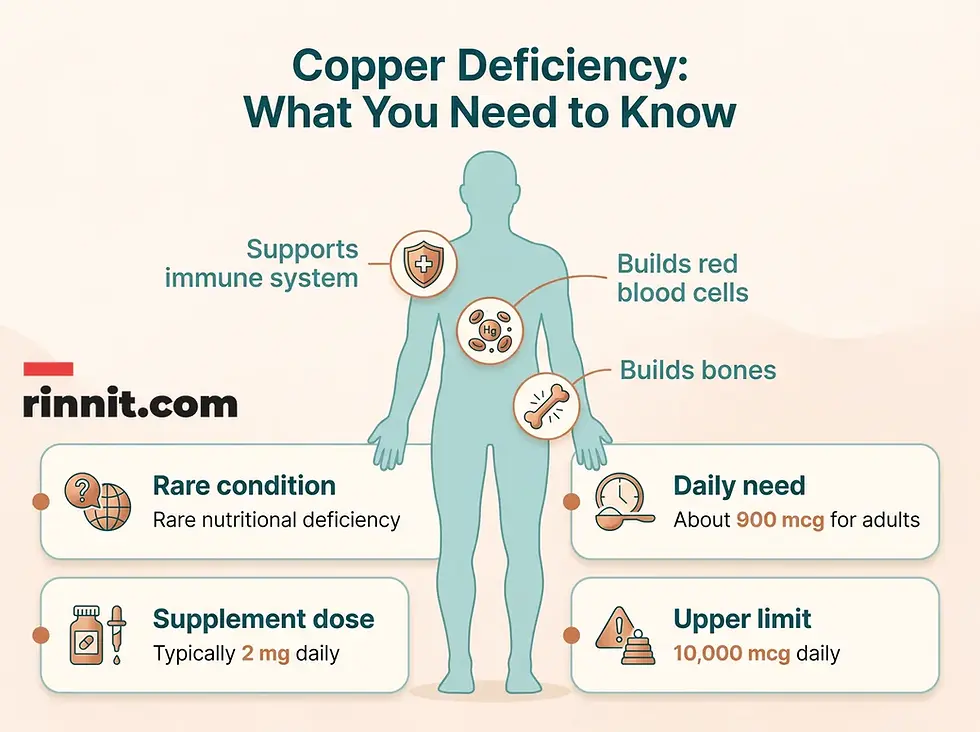
Copper deficiency at a glance: what copper does in the body, the daily need, the typical supplement dose, and the upper limit.
Key Fact | Detail |
Definition | A rare nutritional deficiency from not getting enough copper or not using it properly |
How it develops | Poor intake, malabsorption, or impaired processing |
Inherited form | Some people are born with a copper-processing disorder (Menkes disease) |
Role of copper | Supports the immune system; helps build red blood cells and bones |
Adult daily need | About 900 micrograms (mcg) |
How Common Is Copper Deficiency?
Copper deficiency is described as a rare condition. Because it is rare, many healthcare providers consider it an overlooked diagnosis, which is why symptoms are sometimes attributed to other causes first. [1]
People who are more likely to develop it include those with digestive conditions that block nutrient absorption, those who have had certain surgeries, and those on total parenteral nutrition. [1]
What Are the Symptoms of Copper Deficiency?
Symptoms vary depending on the cause. If you develop copper deficiency, you may experience the following: [1]
Symptom | What It Looks Like |
Fatigue | Feeling exhausted no matter how much rest you get |
Frequent infections | Getting sick more often than usual |
Numbness or tingling | Pins-and-needles sensations in hands and feet |
Pallor | Skin paleness |
Broken vertebrae | Compression fractures in the spine |
Early gray hair | Developing gray hair at a younger age |
If you have persistent fatigue and a pins-and-needles feeling in your hands and feet, copper deficiency may be the reason, or you may have another issue. Either way, getting a diagnosis sooner rather than later is a good idea. [1]
What Causes Copper Deficiency?
Several things may cause copper deficiency. The four main causes are: [1]
Cause | How It Leads to Low Copper |
Malabsorption syndrome | Conditions that affect the body's ability to absorb nutrients from food, for example Crohn's disease or celiac disease; can also develop after bariatric surgery |
Macronutrient undernutrition | Food eaten does not meet the body's needs for vitamins and minerals, including copper; a type of malnutrition |
Total parenteral nutrition | Nutrients received intravenously when surgery or illness means you can't use your digestive system; needed after surgeries like bowel resection or gastrectomy |
Zinc overload | Large zinc supplement doses or zinc-containing denture adhesives block the body's ability to absorb copper |

The four main causes of copper deficiency.
What Are the Complications of Copper Deficiency?
When copper levels stay low, the condition can lead to several complications: [1]
Complication | What It Is |
Anemia | A condition involving low red blood cells |
Hyperlipidemia | High levels of cholesterol in the blood |
Osteoporosis | Weakened, brittle bones |
Peripheral neuropathy | Nerve damage, often in the hands and feet |
Neutropenia | Low levels of neutrophils, a type of white blood cell |
Because copper helps build red blood cells and supports the immune system, it is not surprising that low copper can lead to anemia and frequent infections.
How Is Copper Deficiency Diagnosed?
A healthcare provider starts with a physical examination and a review of your medical history. They will ask whether you've had bariatric surgery, an inflammatory bowel disorder, or an autoimmune disease that could lead to copper deficiency. They may also ask whether you take zinc supplements. Blood tests then help confirm the diagnosis: [1]
Test | What It Shows |
Ceruloplasmin test | Measures a protein that helps copper move through your body; low levels mean your body is not using copper efficiently |
Complete blood count (CBC) | Checks your red and white blood cell levels |
Vitamin B12 test | Rules out B12 deficiency, which causes similar symptoms to copper deficiency |
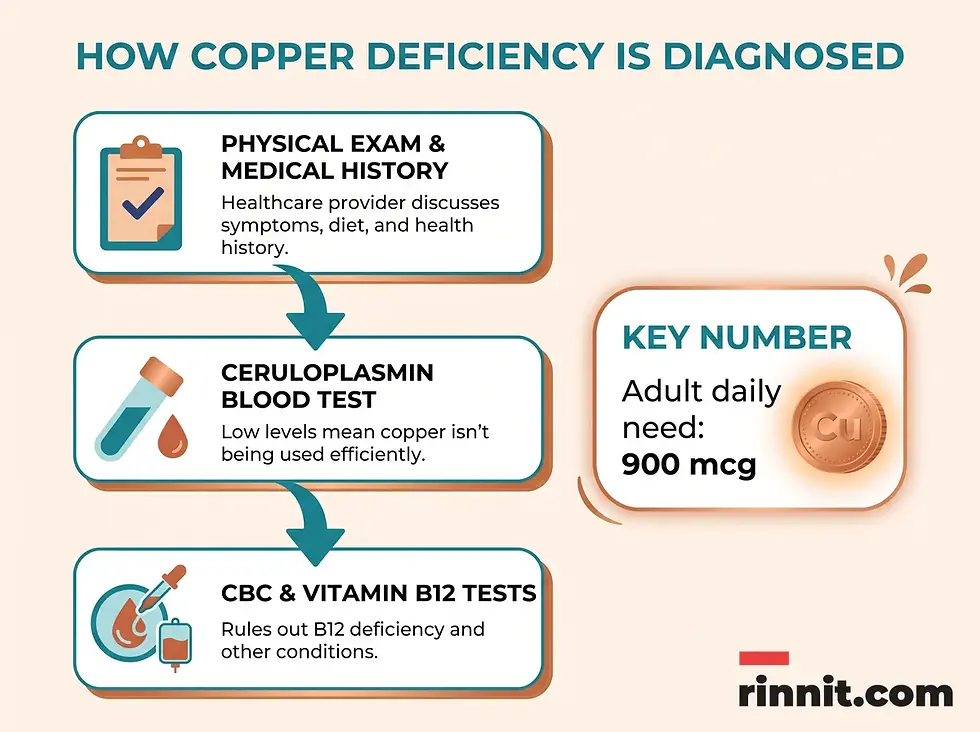
The testing pathway for copper deficiency, with the adult daily need of 900 mcg.
How Is Copper Deficiency Treated?
Healthcare providers prescribe copper supplements to boost the amount of copper in your body. The exact amount varies depending on your overall health and symptoms. In general, providers prescribe 2 milligrams of copper supplement daily, about double the amount of copper you would get from food. [1]
Treatment Aspect | What to Expect |
Main treatment | Copper supplements, typically 2 mg daily |
Dosage logic | About double the copper you would get from food |
Duration | No set time; depends on your symptoms |
Example timeline | One study found about six weeks of supplements cured the anemia causing fatigue |
How Long Do You Need Supplements?
There is no set treatment time; how long you take supplements depends on your symptoms. In one published study of a copper deficiency case, taking copper supplements for about six weeks cured the anemia that was causing fatigue. Your provider will explain what you can expect. [1]
What Is the Outlook?
If tests show you have a copper deficiency, taking supplements as prescribed should increase the copper in your body and eliminate your symptoms. However, some symptoms may go away faster than others, so ask your provider what you can expect. [1]
Can Copper Deficiency Be Prevented?
If your overall health is good, adding certain foods to your meals will help prevent copper deficiency. Adults need about 900 micrograms (mcg) of copper daily. [1]
Copper-Rich Food | Type |
Pan-fried beef liver | Animal protein |
Baking chocolate | Plant-based |
Unpeeled potatoes | Plant-based |
Your digestive system absorbs more copper from animal protein like beef liver or turkey giblets than from other proteins like tofu or salmon. Your provider or a dietitian may have additional suggestions. [1]
How Do You Take Care of Yourself?
You should add copper-rich food to your menu and take supplements as directed. But remember: a little copper goes a long way. [1]
Safety Rule | Limit |
Upper limit for copper from all sources | 10,000 mcg daily |
Risk of exceeding the limit | Copper toxicity that may damage your liver |
When Should You See Your Healthcare Provider?
If you're receiving treatment for copper deficiency, contact your provider if your symptoms don't seem to be getting better. There may be another reason why you're not feeling well despite increasing the amount of copper in your system. [1]
What should you ask your healthcare provider about copper deficiency?
Copper deficiency is rare, so you may want to know more about it. Here are questions you may want to ask: [1]
Question | Why It Matters |
Why do I have a copper deficiency? | Identifies the underlying cause in your case |
How long will I need to take copper supplements? | Sets expectations for treatment duration |
When will my symptoms go away? | Some symptoms resolve faster than others |
What happens if my symptoms get worse? | Prepares you for next steps |
Conclusion
Copper deficiency is a rare but real condition in which the body doesn't get enough of the trace mineral copper, or can't use it properly. Because copper supports your immune system and helps build red blood cells and bones, low levels can cause fatigue, frequent infections, numbness or tingling in the hands and feet, skin paleness, and even compression fractures. It most often stems from malabsorption conditions, undernutrition, total parenteral nutrition, or too much zinc. Diagnosis relies on blood tests like the ceruloplasmin test, and treatment with copper supplements, typically about 2 milligrams daily, usually resolves symptoms.
If you're experiencing unexplained fatigue or pins-and-needles sensations, talk to a healthcare provider about checking your copper levels.
Frequently Asked Questions
What is copper deficiency in simple terms?
Copper deficiency is a rare nutritional deficiency that happens when you don't get enough copper from food or your body can't use the mineral properly. It causes fatigue, frequent infections, and numbness or tingling in the hands and feet.
What does copper do in the body?
Copper is a trace mineral found throughout the body. It sits in enzymes that support the immune system and helps build red blood cells and bones. Low copper can lead to conditions like anemia.
What are the symptoms of copper deficiency?
Symptoms include fatigue, frequent infections, numbness or tingling in the hands and feet, skin paleness (pallor), compression fractures (broken vertebrae), and developing gray hair at a younger age. Symptoms vary depending on the cause.
What causes copper deficiency?
Main causes include malabsorption syndromes (such as Crohn's disease or celiac disease, or after bariatric surgery), macronutrient undernutrition, total parenteral nutrition after surgeries like bowel resection, and zinc overload from supplements or denture adhesives.
Does too much zinc cause copper deficiency?
Yes. Taking large amounts of zinc supplements or using denture adhesives that contain zinc can affect the body's ability to absorb copper, leading to deficiency.
How is copper deficiency diagnosed?
Providers perform a physical exam and review your medical history, then order blood tests including a ceruloplasmin test (low levels mean the body isn't using copper efficiently), a complete blood count, and a vitamin B12 test to rule out B12 deficiency, which causes similar symptoms.
How is copper deficiency treated?
Healthcare providers prescribe copper supplements, typically 2 milligrams daily, about double what you'd get from food. In one study, about six weeks of supplements cured the anemia causing fatigue. Treatment length depends on your symptoms.
How much copper do adults need daily?
Adults need about 900 micrograms (mcg) of copper daily from food. Copper-rich foods include pan-fried beef liver, baking chocolate, and unpeeled potatoes.
Can you get too much copper?
Yes. The upper limit for copper from all sources is 10,000 mcg daily. Taking in more than that can cause copper toxicity that may damage your liver, so a little copper goes a long way.
Can copper deficiency be inherited?
You can develop copper deficiency during life, but some people are born with an inherited disorder that affects how their bodies process copper, such as Menkes disease.
What happens if symptoms don't improve with treatment?
If you're receiving treatment and your symptoms don't seem to be getting better, contact your provider. There may be another reason why you're not feeling well despite increasing your copper intake.
Related Reading
Ceruloplasmin Test: Wilson Disease, Copper and What Results Mean explains the copper-carrying protein blood test used to check for Wilson disease.
References
Cleveland Clinic. Copper Deficiency. Cleveland Clinic. Medically reviewed; last updated October 23, 2025. https://my.clevelandclinic.org/health/diseases/copper-deficiency
Altarelli M, Ben-Hamouda N, Schneider A, et al. Copper deficiency: causes, manifestations, and treatment. Nutrition in Clinical Practice. 2019;34(4):504-513. PMID 31209935. https://doi.org/10.1002/ncp.10328
Lazarchick J. Update on anemia and neutropenia in copper deficiency. Current Opinion in Hematology. 2012;19(1):58-60. PMID 22080848. https://doi.org/10.1097/MOH.0b013e32834da9d2
Chevalier K, Obadia MA, Djebrani-Oussedik N, et al. Can patients with Wilson's disease develop copper deficiency? Movement Disorders Clinical Practice. 2023;10(9):1306-1316. PMID 37772303. https://doi.org/10.1002/mdc3.13813
Medical disclaimer
This article is for general educational purposes only and is not a substitute for professional medical advice, diagnosis or treatment. Do not start copper supplements without guidance from a healthcare provider, since too much copper can harm the liver.



Comments