What Is Cleft Lip and Cleft Palate? Symptoms, Causes, Diagnosis and Treatment

Updated: 3 days ago
Medically reviewed by Dr. Baraa Alnahhal, MD · Last reviewed: October 2026
Quick Answer: What are cleft lip and cleft palate?
Cleft lip and cleft palate are congenital openings in the upper lip or the roof of the mouth that form when these tissues fail to join during fetal development [4] [5]. They are common in the U.S., and most are found on the 20-week ultrasound or at birth [4] [5]. Staged surgery is usually successful, and most children have a normal childhood [5].
Key takeaways
Clefts are congenital birth defects. They form in the uterus when lip and palate tissues don't join properly [5].
They're relatively common. In the U.S., about 1 in 1,031 babies is born with cleft lip with or without cleft palate, and about 1 in 1,563 with cleft palate alone [4].
Most cases have no known cause. A mix of genetic and environmental factors is believed to be involved [4] [5].
Clefts can affect feeding, speech, hearing, teeth and self-esteem. A coordinated care team addresses each area.
Treatment is staged from infancy through childhood. Lip repair at 3–6 months, palate repair at 12 months, further surgeries and dental care as the child grows [5].
Surgery is usually successful and low-risk. Most children have a normal childhood [5].
What the research says
Smoking during pregnancy is linked to a modestly higher chance of orofacial clefts. A systematic review of 172 articles (173,687 malformed cases and 11.7 million controls) found an odds ratio of 1.28 (95% CI 1.20 to 1.36) for orofacial clefts among women who smoked during pregnancy (Hackshaw et al., Hum Reprod Update, 2011 [1]). A later meta-analysis of studies on cleft lip and/or palate reported a summary odds ratio of 1.42 (95% CI 1.27 to 1.59) and a population attributable fraction of 4% (95% CI 3% to 5%), while noting that the quality of the included observational studies was poor (Fell et al., Cleft Palate Craniofac J, 2022 [2]). These are associations, not proof that smoking causes clefts in an individual pregnancy.
The best age for palate surgery is still being tested. The TOPS trial is randomizing infants with non-syndromic isolated cleft palate to surgery at either 6 or 12 months of age (corrected for gestational age). Its primary outcome is perceived insufficient velopharyngeal function at 5 years of age, and the protocol aims to follow 300 participants per arm. This article cites the published trial protocol, not results, so check for the trial's findings as they are published (Shaw et al., BMJ Open, 2019 [3]).
What Are Cleft Lip and Cleft Palate?

Cleft lip and cleft palate are openings in a baby's upper lip or the roof of their mouth (palate). They're congenital abnormalities (birth defects) that form while a fetus develops in the uterus [5]. Cleft lips and cleft palates happen when tissues of the upper lip and roof of the mouth don't join together properly during fetal development [5]. Surgery can repair a cleft lip and/or cleft palate.
What Is a Cleft Lip?
Our lips form between weeks four and seven of fetal development [4] [5]. Tissues from each side of the head join together at the center of the face to make the lips and mouth. A cleft lip happens when the tissues that make the lips don't join completely [5].
As a result, an opening or gap forms between the two sides of the upper lip. The cleft can range from a small indentation to a large gap that reaches the nose, and this separation can include the gums or the palate (roof of the mouth).
What Is a Cleft Palate?
The roof of the mouth (palate) forms between six and nine weeks of pregnancy [4] [5]. A cleft palate is a split or opening in the roof of the mouth that forms during fetal development. A cleft palate can include the hard palate (the bony front portion of the roof of the mouth) and/or the soft palate (the soft back portion of the roof of the mouth).
Cleft lip and cleft palate can occur on one or both sides of the mouth. Because the lip and the palate develop separately, it's possible to have the following combinations:
Combination | Notes |
Cleft lip without a cleft palate | The lip is split; the palate is intact. |
Cleft palate without a cleft lip | The palate is split; the lip is intact. |
Both a cleft lip and cleft palate | The most common combination [5]. |
How Common Is It?
Cleft lip and cleft palate are common congenital disorders in the U.S [5]. According to the U.S. Centers for Disease Control and Prevention (CDC), as of its January 2026 review:
Cleft lip (either with or without a cleft palate) is more common in male babies, while cleft palate (without a cleft lip) is more common in female babies [5].
Cleft Lip and Cleft Palate Symptoms and Complications
Because clefts are visible at birth (or before birth), the "symptoms" are really the complications that can develop as a child grows. Babies born with a cleft lip or cleft palate may have difficulties eating (both from the breast and a bottle), may have trouble speaking, often have fluid behind their eardrum that can affect hearing, and some have issues with their teeth [4] [5].

Complication | What happens |
Eating problems | With a separation in the palate, food and liquids can pass from the mouth back through the nose; some babies can't create enough suction to breastfeed or take a bottle. |
Hearing loss | Children with cleft palate are more prone to fluid buildup in their middle ears (glue ear); if left untreated, this causes hearing loss [5]. |
Speech problems | Voices may not carry well and speech may be hard to understand — not all children have these problems, and surgery may solve them. |
Dental problems | Children with clefts are prone to cavities and missing, malformed or displaced teeth [5]. |
Alveolar ridge defects | Defects in the bony upper gum can displace, tip or rotate permanent teeth, prevent permanent teeth from appearing, prevent the alveolar ridge from forming, or cause premature loss of erupting canine and incisor teeth. |
Emotional or social problems | Children may feel self-conscious about their appearance even at a young age, affecting confidence and school adjustment [5]. |
What Causes Cleft Lip and Cleft Palate?
In most cases, there's no known cause of cleft lip or cleft palate, and parents can't prevent it [4] [5]. Most scientists believe a combination of genetic (inherited) and environmental factors causes clefts [4] [5]. There seems to be a greater chance of a newborn having a cleft if a sibling, parent or other relative has one [5].
What Are the Risk Factors?
You may have a greater chance of having a baby with a cleft if you take certain medications during pregnancy, or if certain other factors apply:
Risk factor | Detail |
Antiseizure medications | |
Acne treatment containing Accutane | Acne medications containing this drug [5]. |
Methotrexate | A drug used for treating cancer, arthritis and psoriasis. |
Folic acid deficiency | Insufficient folic acid during pregnancy [5]. |
Diabetes before pregnancy | Type 1 or type 2 diabetes is among the factors CDC research has linked to orofacial clefts [4]. |
Obesity | Having obesity raises risk [5]. |
Smoking or tobacco use | |
Substance use disorder | Substance use during pregnancy [5]. |
Viruses or chemicals | Exposure to certain viruses or chemicals during pregnancy [5]. |
Is Cleft Lip/Cleft Palate Genetic?
Some studies suggest cleft lips and cleft palates have a genetic component. If you or your partner were born with a cleft lip or palate, your chance of having a baby with a cleft is around 2% to 8% [5]. If you've already had a child with a cleft lip or palate, your chances of having another child with the condition are slightly higher.
How Are Cleft Lip and Cleft Palate Diagnosed?
Prenatal ultrasound can diagnose most clefts of the lip [4] [5] because these clefts cause physical changes in the fetus's face. Isolated cleft palate (with no cleft lip present) is harder to detect this way — only 7% of these appear on a prenatal ultrasound [5].
Most healthcare providers detect cleft lip at the 20-week ultrasound (anatomy scan), which occurs between 18 and 22 weeks of pregnancy, and providers may discover it as early as 12 weeks [5]. It's more challenging to detect cleft palate on an ultrasound.
If an ultrasound doesn't detect a cleft before birth, a physical exam of the mouth, nose and palate can diagnose cleft lip or cleft palate after birth. In some cases, your provider may recommend amniocentesis to check for associated genetic conditions — a procedure to remove amniotic fluid from the amniotic sac [5].
Diagnostic method | When it's used |
Prenatal ultrasound (18–22 weeks) | Detects most cleft lips; rarely detects isolated cleft palate (only 7%). |
Physical exam after birth | Examines the mouth, nose and palate if ultrasound missed the cleft. |
Amniocentesis | Checks for associated genetic conditions when recommended. |
Cleft Lip and Cleft Palate Treatment Options
Treatment for cleft lip and cleft palate begins at birth, and surgical treatment begins as early as 3 months and can last until the teen years [5]. Surgery treats cleft lip and/or cleft palate and takes place at a hospital under general anesthesia, so the child is asleep during the procedure [5]. The exact details of treatment depend on the extent of the cleft, the child's age and other special needs or health conditions.
Cleft Lip Repair
A cleft lip repair may require one or two surgeries. The first surgery usually occurs when the baby is between 3 and 6 months old and closes the lip [5]; a second surgery, if necessary, is usually done around 6 months.
Several noninvasive techniques can improve outcomes when used before surgery, dramatically changing the shape of the baby's lip, nose and mouth:
Cleft Palate Repair
Cleft palate surgery usually occurs when the baby is 12 months old [5]. It creates a working palate and reduces the chances that fluid will develop in the middle ears. To prevent fluid buildup, children with cleft palate usually need special tubes placed in their eardrums (ear tubes/tympanostomy) to help drain fluid, and healthcare providers will check their hearing once a year [5].
Up to 40% of children with a cleft palate will need further surgeries [5] to help improve their speech. A speech pathologist will assess the child's speech between ages 4 and 5, sometimes using a nasopharyngeal scope to check palate and throat movement; speech surgery usually occurs around age 5.
Children with a cleft involving the gum line may need a bone graft between ages 6 and 10 — a procedure that fills in the upper gum line so it can support permanent teeth and stabilize the upper jaw [5]. Once permanent teeth grow in, children often need braces to straighten their teeth and a palate expander to widen the palate.
Additional surgeries may be needed to improve the appearance of the lip and nose, close openings between the mouth and nose, improve breathing, or stabilize and straighten the jaw.
Possible risks of surgery include bleeding, infection and damage to nerves, tissues or other structures. Cleft lip and cleft palate surgery is usually successful, and risks are low [5]; cleft lip surgery leaves a small pink scar that should become less noticeable as the child grows [5].
Nonsurgical Treatments
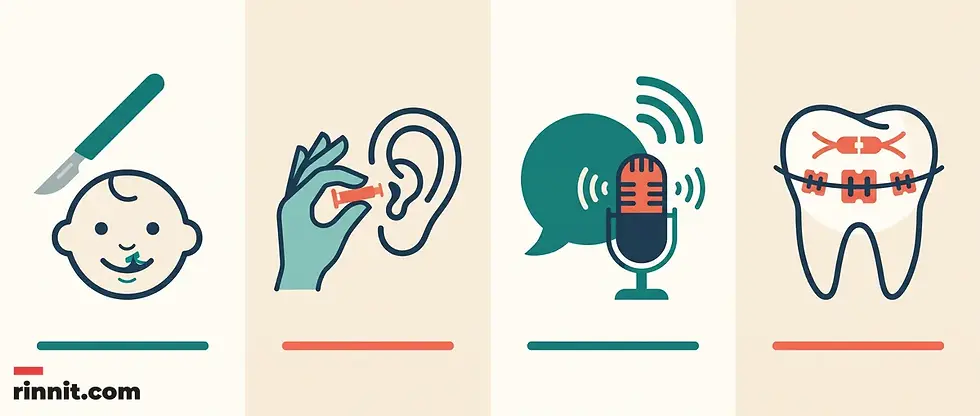
Children often need treatment beyond surgery, including speech therapy and orthodontic treatment.
The Care Team
Because of the number of oral health and medical problems associated with a cleft lip or cleft palate, it takes a team of healthcare providers working together to develop a comprehensive care plan [4] [5]. Treatment usually begins in infancy and often continues through early adulthood.
Team member | Role |
Pediatric plastic surgeon | Performs lip and palate repair surgeries. |
Pediatrician | Oversees general child health. |
Otolaryngologist | Ear, nose and throat specialist. |
Lactation support providers | Help with feeding early in life. |
Orthodontist | Straightens and repositions teeth. |
Dentist / pediatric dentist | Routine dental care. |
Prosthodontist | Makes artificial teeth and dental appliances. |
Speech-language pathologist (SLP) | Assesses and treats speech problems. |
Audiologist | Checks and monitors hearing. |
Social worker / psychologist | Supports the family and notes adjustment problems. |
Genetic counselor | Helps parents understand the chances of future children having a cleft. |
Outlook and Prognosis
Treatment may take many years and require several surgeries, but most children affected by these conditions have a normal childhood [5]. Treatment helps improve speech and feeding issues. Some people may be self-conscious about the shape of their lips or scarring — talking to your child's healthcare providers about how to offer support over the years is important.
Prevention
You can't fully prevent your baby from having a cleft lip or cleft palate. However, you may be able to lower the risk by not using cigarettes, alcohol and certain medications during pregnancy [5]. Talk to your healthcare provider to learn more.
Living With Cleft Lip and Cleft Palate
Can Babies With a Cleft Breastfeed?
It's possible to breastfeed your baby if they have a cleft lip and/or cleft palate, but you'll need support from trained healthcare providers [5]. Breastfeeding success depends on several factors:
Factor | Impact |
Type, size and location of the cleft | Determines whether suction is possible. |
Breastfeeding position | Certain positions work better. |
Associated syndrome | Other features may affect the baby's ability to breastfeed. |
Lactation education and support | Skilled support improves success. |
Babies use suction to latch onto the breast and remove milk, and clefts can interfere with this ability. Some babies who only have a cleft lip can create enough suction to breastfeed successfully, and babies with small clefts affecting only the soft palate may also manage. However, creating suction is typically harder for babies who have a cleft lip and palate together, or larger clefts affecting the soft and/or hard palate [5], because there isn't enough separation between the inside of the nose and the inside of the mouth.
If a baby can't suction well, the effort of trying can make them very tired, and they may experience nasal regurgitation or reflux. Some babies can't remove enough milk, which can lead to problems with nutrition and growth.
Lactation support providers — including lactation consultants and breastfeeding medicine specialists — can help identify whether breastfeeding is possible, manage milk supply, teach hand expression or pumping, find the best positions, ensure hydration, monitor weight gain, manage supplemental feedings, and support breastfeeding after surgery. Setting up an appointment as early as possible, even during pregnancy, is recommended.
When direct breastfeeding isn't possible, providers can help with breast milk feeding — removing milk by hand or pump and giving it to the baby with a spoon, cup, bottle or syringe, including specially designed bottles. Breast milk may also lower the baby's risk of ear infections, which are common among babies with clefts [5]. Holding your baby to your chest helps maintain milk supply and supports bonding.
What Dental Care Will Your Child Need?
Children with clefts generally have the same dental needs as other children, but may also have missing, misshapen or poorly positioned teeth.
Dental care area | Recommendation |
Early dental care | Good nutrition, proper teeth cleaning and fluoride treatment; start brushing with a small soft-bristled brush as soon as teeth appear; a dentist may recommend a mouthwash-soaked soft sponge. |
Orthodontic care | After permanent teeth appear, an orthodontist evaluates short- and long-term needs; most children with a cleft palate require palatal expansion around age 6 or 7 [5]; braces follow after all permanent teeth erupt; orthodontic care also prepares for jaw surgery. |
Prosthodontic care | A prosthodontist may make a dental bridge to replace missing teeth, or "speech bulbs" or "palatal lifts" to help close the nose from the mouth to improve speech. |
Conclusion
Cleft lip and cleft palate are among the most common birth defects, affecting thousands of babies each year in the U.S. — yet the story doesn't end at diagnosis. What begins as a gap in a tiny lip or palate becomes a well-charted journey of care: lip repair in the first months of life, palate surgery around the first birthday, ear tubes and hearing checks, speech assessment and surgery in the preschool years, and dental and orthodontic support through childhood. A multidisciplinary team surrounds the family at every step, from lactation consultants helping with feeding in those early days to genetic counselors helping plan for the future. Surgery is usually successful with low risk, and most children go on to lead normal childhoods. Understanding the timeline and the team behind it turns an overwhelming diagnosis into a manageable, hopeful path.
If you want to turn pediatric care timelines into clear, shareable visuals, Rinnit's infographic templates help you make that guidance easy for any family to follow.
Frequently Asked Questions
What is a cleft lip?
An opening or gap between the two sides of the upper lip that forms when the lip tissues don't join completely during fetal development.
What is a cleft palate?
A split or opening in the roof of the mouth (palate) that forms during fetal development.
What causes cleft lip and cleft palate?
In most cases there's no known cause; scientists believe a combination of genetic and environmental factors is involved.
Are cleft lip and cleft palate birth defects?
Yes — they're congenital abnormalities that form while the baby develops in the uterus.
When do clefts form during pregnancy?
The lips form between weeks 4 and 7, and the palate between weeks 6 and 9 of pregnancy.
Can you have a cleft lip without a cleft palate?
Yes — it's possible to have a cleft lip alone, a cleft palate alone, or both together.
Which combination is most common?
Both a cleft lip and cleft palate together is the most common.
How common is cleft lip and cleft palate?
According to the CDC, about 1 in 1,031 babies in the U.S. is born with cleft lip with or without cleft palate, and about 1 in 1,563 is born with cleft palate alone.
Are clefts more common in boys or girls?
Cleft lip (with or without cleft palate) is more common in boys; cleft palate alone is more common in girls.
Can cleft lip and cleft palate be prevented?
Not completely — but avoiding cigarettes, alcohol and certain medications during pregnancy may lower risk.
Do clefts run in families?
Some studies suggest a genetic component — your chances are higher if a sibling, parent or relative has a cleft.
What are my chances of having a baby with a cleft if my partner has one?
Around 2% to 8% if you or your partner were born with a cleft lip or palate.
What medications during pregnancy increase cleft risk?
Antiseizure medications, acne treatments containing Accutane, and methotrexate.
Does folic acid deficiency increase cleft risk?
Yes — folic acid deficiency is one of the risk factors.
Does smoking during pregnancy increase cleft risk?
Yes — smoking or tobacco use during pregnancy raises the risk.
Does diabetes before pregnancy increase cleft risk?
CDC research has found that having type 1 or type 2 diabetes before pregnancy is among the factors that increase the risk of having a baby with an orofacial cleft.
Does obesity increase cleft risk?
Yes — having obesity during pregnancy is a risk factor.
Can clefts be seen on ultrasound?
Most cleft lips can be diagnosed with prenatal ultrasound, but isolated cleft palate is harder to detect — only 7% show on ultrasound.
At what week can you see a cleft lip on ultrasound?
Most cleft lips are detected at the 20-week anatomy scan (18–22 weeks), sometimes as early as 12 weeks.
How is a cleft palate diagnosed if ultrasound misses it?
A physical exam of the mouth, nose and palate after birth can diagnose it.
What is amniocentesis for clefts?
A procedure to remove amniotic fluid to check for associated genetic conditions, recommended in some cases.
Do babies with clefts have trouble eating?
Yes — they may have difficulty breastfeeding or bottle-feeding because they can't create enough suction, and food can pass back through the nose.
Can a baby with a cleft breastfeed?
It's possible, especially with a cleft lip alone or a small cleft of the soft palate, but it requires trained lactation support.
Why is breastfeeding harder with a cleft?
Babies need suction to latch and remove milk, and clefts — especially involving both lip and palate — can prevent enough separation between the nose and mouth.
What happens if a baby can't suction well?
They may get very tired, experience nasal regurgitation or reflux, and risk nutrition and growth problems.
Do clefts affect hearing?
Yes — children with cleft palate are more prone to fluid buildup in the middle ears (glue ear), which can cause hearing loss if untreated.
Do children with clefts need speech therapy?
Often — and up to 40% of children with a cleft palate need further surgeries to improve speech.
Do clefts affect teeth?
Yes — children with clefts are prone to cavities and missing, malformed or displaced teeth, and may have alveolar ridge defects.
Do clefts affect self-esteem?
They can — children may feel self-conscious about their appearance even at a young age, affecting confidence and school adjustment.
When is cleft lip repair surgery done?
Usually when the baby is between 3 and 6 months old, with a second surgery around 6 months if necessary.
When is cleft palate repair surgery done?
Usually when the baby is 12 months old.
What is a NAM device?
A nasal-alveolar molding device used before surgery to mold lip tissues into a more favorable position for repair.
What are ear tubes for?
Special tubes placed in the eardrums (tympanostomy) to drain fluid and prevent fluid buildup; hearing is checked once a year.
What is speech surgery for a cleft?
Surgery around age 5 to improve speech, after a speech pathologist assesses the child between ages 4 and 5.
What is a bone graft for a cleft?
A procedure between ages 6 and 10 that fills in the upper gum line so it can support permanent teeth and stabilize the upper jaw.
Do children with clefts need braces?
Often — once permanent teeth grow in, braces straighten teeth and a palate expander widens the palate.
Are cleft surgeries risky?
Risks like bleeding, infection and nerve or tissue damage exist, but surgery is usually successful and risks are low.
Does cleft lip surgery leave a scar?
It leaves a small pink scar that should become less noticeable as the child grows.
What nonsurgical treatments help?
Speech therapy and orthodontic treatment.
Who treats children with clefts?
A multidisciplinary team: pediatric plastic surgeon, pediatrician, otolaryngologist, lactation providers, orthodontist, dentists, prosthodontist, speech-language pathologists, audiologist, social worker/psychologist, and genetic counselors.
How long does treatment take?
It begins at birth, with surgery starting as early as 3 months and care continuing through the teen years and early adulthood.
Will my child need more than one surgery?
Often — cleft lip repair may take one or two surgeries, and up to 40% of children with cleft palate need further speech surgeries.
What is glue ear?
Fluid buildup in the middle ears that children with cleft palate are prone to; untreated, it can cause hearing loss.
What is a speech bulb or palatal lift?
A dental appliance made by a prosthodontist that helps close the nose from the mouth to improve speech.
What is orthognathic surgery?
Jaw surgery that children with clefts may need, prepared for with orthodontic care.
What's the outlook for children with clefts?
Most children have a normal childhood, and treatment improves speech and feeding issues.
Can clefts be detected at 12 weeks of pregnancy?
Providers may discover a cleft lip as early as 12 weeks, though most are detected at the 20-week scan.
What happens if my baby has nutrition problems from feeding difficulty?
Lactation providers help with expressed milk feeding via spoon, cup, bottle or syringe, including specially designed bottles.
Does breast milk help babies with clefts?
It may lower the risk of ear infections, which are common among babies with clefts.
When should I start cleaning my child's teeth?
As soon as teeth appear, with a small soft-bristled brush; a dentist may recommend a mouthwash-soaked sponge instead.
When do children with cleft palate need palatal expansion?
Most require it around age 6 or 7, after permanent teeth start appearing.
Should I see a genetic counselor if I have a cleft?
It can help you understand the chances of having future children with a cleft lip or palate.
Can surgery fix speech problems completely?
Not always — up to 40% need further surgeries, and speech therapy plays an ongoing role.
Is surgery done under anesthesia?
Yes — surgery takes place at a hospital under general anesthesia so the child is asleep during the procedure.
What additional surgeries might my child need?
Surgeries to improve the appearance of the lip and nose, close openings between mouth and nose, improve breathing, or stabilize and straighten the jaw.
How can I support my child emotionally?
Talk to your child's healthcare providers about offering support over the years, especially around appearance and scarring concerns.
Related Reading
What Are Birth Defects? Symptoms, Causes, Diagnosis, and Care Explained
Cancer: Symptoms, Causes, Stages, and Treatment in One Complete Guide
What Is Arthritis? A Plain-Language Guide to the Most Common Joint Problem in the World
Psoriasis: Complete Guide to Symptoms, Types, Causes, and Treatment
Antiseizure Medications: A Comprehensive Guide to Anticonvulsants
Obesity: Symptoms, Causes, Complications and Treatment — A Complete Guide
Drug Addiction (Substance Use Disorder): Symptoms, Causes & Treatment — Complete Guide
Understanding Amniotic Fluid: Functions, Composition, and Health Roles
Myringotomy: Relieving Middle Ear Pressure and Restoring Hearing
Widening the Upper Jaw: What to Expect from a Palate Expander
Understanding the Role of a Plastic Surgeon: Expertise, Training, and Care
Kangaroo Care: Essential Benefits of Skin-to-Skin Contact for Your Baby
20-Week Ultrasound (Anatomy Scan): What It Checks, How to Prepare and What Results Mean explains the mid-pregnancy scan that can detect signs of this condition before birth.
References
Hackshaw A, Rodeck C, Boniface S. Maternal smoking in pregnancy and birth defects: a systematic review based on 173 687 malformed cases and 11.7 million controls. Hum Reprod Update. 2011;17(5):589-604. PMID: 21747128. https://doi.org/10.1093/humupd/dmr022
Fell M, Dack K, Chummun S, et al. Maternal cigarette smoking and cleft lip and palate: a systematic review and meta-analysis. Cleft Palate Craniofac J. 2022;59(9):1185-1200. PMID: 34569861. https://doi.org/10.1177/10556656211040015
Shaw W, Semb G, Lohmander A, et al. Timing Of Primary Surgery for cleft palate (TOPS): protocol for a randomised trial of palate surgery at 6 months versus 12 months of age. BMJ Open. 2019;9(7):e029780. PMID: 31300507. https://doi.org/10.1136/bmjopen-2019-029780
Centers for Disease Control and Prevention. Cleft Lip/Cleft Palate. Birth Defects. Last reviewed January 9, 2026; accessed October 15, 2026. https://www.cdc.gov/birth-defects/about/cleft-lip-cleft-palate.html
Cleveland Clinic. Cleft Lip/Cleft Palate. Medically reviewed; last updated January 25, 2024; accessed October 15, 2026. https://my.clevelandclinic.org/health/diseases/10947-cleft-lip-cleft-palate
Medical disclaimer
This article is for informational purposes only and is not a substitute for professional medical advice, diagnosis, or treatment. Always seek the advice of a qualified healthcare provider with any questions about a medical condition or before making decisions about treatment. Never disregard professional medical advice or delay seeking it because of something you have read here.



Comments