Understanding Amniotic Fluid: Functions, Composition, and Health Roles

Updated: 2 days ago
Medically reviewed by Dr. Baraa Alnahhal, MD · Last reviewed: October 2026
Quick Answer
Amniotic fluid is a water-like substance that surrounds and protects a fetus during pregnancy. It cushions the fetus, regulates temperature and prevents umbilical cord compression [1]. It is made mainly of water and fetal urine and contains hormones and antibodies [1]. Normally clear or pale yellow, changes in its color or volume can signal complications, so levels are monitored in prenatal care [1].
What the research says
Isolated low fluid at term is linked to more interventions and slightly higher short-term newborn risks. A systematic review and meta-analysis of 12 studies (35,999 women, 2,414 of them with isolated oligohydramnios) found higher rates of labor induction (odds ratio 7.56; 95% CI 4.58 to 12.48), cesarean section (OR 2.07; 95% CI 1.77 to 2.41), Apgar score below 7 at 5 minutes (OR 2.01; 95% CI 1.3 to 3.09) and neonatal intensive care admission (OR 1.47; 95% CI 1.17 to 1.84). There were no significant differences in cord pH below 7.1 or meconium-stained fluid (PubMed: Shrem et al., Fetal Diagn Ther, 2016) [2].
Drinking more fluid may raise amniotic fluid volume, but the benefit for babies is not established. A systematic review and meta-analysis of maternal hydration trials found that in isolated oligohydramnios, oral hydration was more effective than intravenous hydration and hypotonic fluids worked better than isotonic fluids, with improvement depending more on the duration of hydration than the daily amount. The authors noted that perinatal outcome data were fragmentary and heterogeneous, so the real clinical value of hydration could not be defined (PubMed: Gizzo et al., PLoS One, 2015) [3].
Measuring fluid with the single deepest pocket led to fewer diagnoses of low fluid without worse outcomes. A systematic review and meta-analysis of six randomized studies (4,278 women) found that using the maximum vertical pocket instead of the amniotic fluid index reduced the diagnosis of oligohydramnios (pooled relative risk 0.38; 95% CI 0.27 to 0.53) and lowered rates of non-reassuring fetal heart tracings, cesarean delivery for fetal distress and labor induction for oligohydramnios, with no differences in overall cesarean rate, meconium, cord pH below 7.1, 5-minute Apgar below 7 or NICU admission (PubMed: Sekhon et al., J Matern Fetal Neonatal Med, 2021) [4].
What is amniotic fluid?
Amniotic fluid is a specialized liquid contained within the amniotic sac that provides a controlled environment for fetal growth. It serves as more than just a protective barrier; it is an active participant in the physiological development of the fetus, facilitating the maturation of various organ systems before birth.
Throughout pregnancy, healthcare providers monitor the volume and quality of this fluid to assess fetal well-being [1]. Samples can also be collected through procedures like amniocentesis to screen for genetic conditions [1].
What does amniotic fluid do?
Amniotic fluid performs several vital tasks that prepare the fetus for life outside the uterus. Its presence ensures that the developmental environment remains stable and supportive.

Key functions include:
Physical Protection: Acts as a shock absorber, shielding the fetus from external impact or sudden maternal movements [1].
Developmental Support: Facilitates the growth of muscles and bones by allowing the fetus to move freely [1]. It also helps develop the respiratory and digestive systems as the fetus swallows and breathes the fluid [1].
Infection Prevention: Contains antibodies that strengthen the fetal immune system and protect against potential infections [1].
Temperature Regulation: Maintains a consistent body temperature for the fetus [1].
Umbilical Cord Safety: Prevents the umbilical cord from being compressed, ensuring a steady flow of oxygen and nutrients [1].
What is amniotic fluid made of, and what does it look like?
The makeup of amniotic fluid changes as pregnancy progresses. During the first half, it consists primarily of water from the mother's body [1]. By the 20th week, fetal urine becomes the primary component as the fetus begins to swallow and excrete the liquid [1].
In addition to water and urine, the fluid contains essential biological materials [1]:
Hormones
Antibodies
Lipids and carbohydrates
Other vital nutrients
Normal Appearance and Smells
Healthy amniotic fluid is typically clear or has a pale, straw-like yellow tint and is completely odorless [1]. Deviations from this can indicate underlying issues. For example, a brown or green tint suggests the presence of meconium (the fetus's first stool), which can lead to complications if inhaled [1]. A foul odor may signal an infection or the presence of meconium [1].
How are amniotic fluid levels monitored?
The volume of amniotic fluid increases steadily, peaking at approximately 34 to 36 weeks of pregnancy at just under one liter (about four cups) [1]. After this peak, the volume slowly decreases as the due date approaches [1].

Healthcare providers use two primary methods to estimate fluid levels:
Prenatal Ultrasound: The most accurate method for measuring fluid volume.
Fundal Height: A physical measurement of the uterus used during routine visits to estimate if fluid levels are adequate [1].
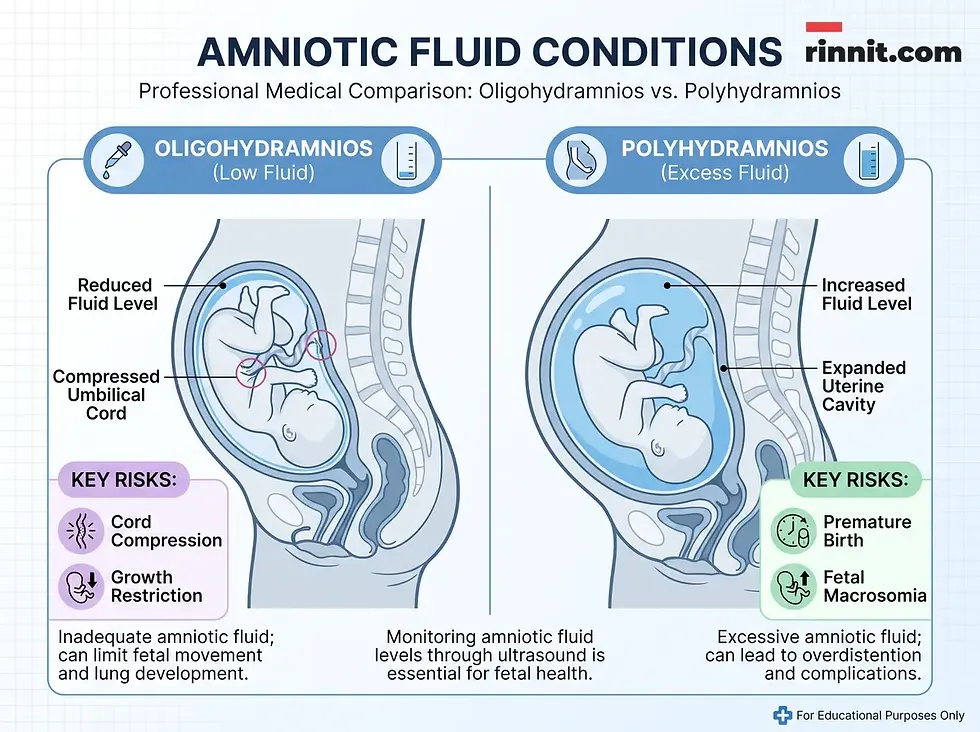
Condition | Description | Potential Complications |
Oligohydramnios | Low amniotic fluid levels | Miscarriage, deformities, premature birth, or cord compression [1]. |
Polyhydramnios | Excessive amniotic fluid levels | Swollen feet, breathlessness, premature birth, or macrosomia [1]. |
Chorioamnionitis | Bacterial infection of the fluid | Serious pregnancy complications if not treated with antibiotics [1]. |
PROM | Prelabor rupture of membranes | Increased risk of infection if labor does not start promptly [1]. |
How are amniotic fluid problems managed, and what is the outlook?
Maintaining appropriate hydration is often recommended by healthcare providers, although the direct impact of water intake on fluid levels is not fully established [1]. If levels are found to be abnormal, increased monitoring through additional ultrasounds is common [1].
The outlook for most pregnancies affected by fluid irregularities is positive when managed with close medical supervision. Recognizing signs of leaking fluid and attending all prenatal appointments are critical steps for maternal and fetal health.
Conclusion
Amniotic fluid is a fundamental component of a healthy pregnancy, providing the necessary cushion and biological tools for fetal maturation. From regulating temperature to supporting lung development, its roles are diverse and essential. While imbalances can occur, modern prenatal monitoring allows for early detection and management, ensuring the best possible outcome for both mother and child.
If you experience any unusual fluid leakage or have concerns about your pregnancy symptoms, contact your healthcare provider immediately. Regular prenatal checkups are the best way to ensure your amniotic fluid levels remain within a healthy range for your stage of pregnancy.
Frequently Asked Questions
1. What exactly is amniotic fluid?
Amniotic fluid is a water-like substance that surrounds and protects a fetus during pregnancy. It plays a critical role in developing the fetus's muscles, lungs, and digestive system while acting as a cushion against physical impact.
2. What is amniotic fluid made of?
Initially, the fluid is mostly water from the mother's body. After about 20 weeks, fetal urine becomes the main component. It also contains hormones, antibodies, lipids, carbohydrates, and other essential nutrients.
3. What does healthy amniotic fluid look like?
Healthy amniotic fluid is typically clear or a very pale yellow, similar to the color of straw. It should be odorless. A brown or green tint or a foul smell can indicate complications like meconium passage or infection.
4. How much amniotic fluid is considered normal?
The amount varies by stage, peaking at 34 to 36 weeks with a little less than one liter. The volume then gradually decreases as the pregnancy reaches full term at 40 weeks.
5. What happens if amniotic fluid levels are too low?
Low levels, known as oligohydramnios, can be dangerous, especially in the first six months. Risks include miscarriage, physical deformities, premature birth, umbilical cord compression, or restricted fetal growth.
6. What are the risks of having too much amniotic fluid?
Excessive fluid, or polyhydramnios, can cause maternal symptoms like breathlessness and swollen feet. It also increases the risk of premature birth, stillbirth, or the fetus growing larger than average (macrosomia).
7. Can an infection affect the amniotic fluid?
Yes, a condition called chorioamnionitis occurs when bacteria infect the fluid. This requires prompt treatment with antibiotics to prevent serious complications for both the mother and the fetus.
8. How do doctors measure amniotic fluid?
Healthcare providers primarily use prenatal ultrasounds to measure volume. During routine visits, they may also use fundal height measurements to estimate if the fluid levels are appropriate for the stage of pregnancy.
9. Can drinking water increase amniotic fluid levels?
While not definitively proven, many healthcare providers recommend increasing water intake if levels are low. There is generally no harm in staying well-hydrated during pregnancy, but medical advice should always be followed.
10. What is the outlook for fluid-related conditions?
The outlook is generally excellent with proper medical monitoring. If levels are abnormal, providers will monitor the pregnancy more closely with frequent ultrasounds to ensure the safety and health of the fetus.
Related Reading
Understanding Polyhydramnios: Managing Excess Amniotic Fluid explains why too much amniotic fluid builds up and how it is managed.
What Is Oligohydramnios? Causes, Signs, and Treatment covers low amniotic fluid, its causes and how providers monitor it.
Premature Rupture of Membranes (PROM): Symptoms, Risks, and Management explains what happens when the water breaks before labor starts.
Amniocentesis: Why It's Done, What Happens, Risks and What Your Results Mean describes how a sample of amniotic fluid is taken and tested.
References
Cleveland Clinic. Amniotic Fluid: Color, Smell, Function & Disorders. Cleveland Clinic. Oct. 30, 2024. https://my.clevelandclinic.org/health/body/23310-amniotic-fluid
Shrem G, Nagawkar SS, Hallak M, et al. Isolated oligohydramnios at term as an indication for labor induction: a systematic review and meta-analysis. Fetal Diagn Ther. 2016;40(3):161-173. PMID 27160748. https://doi.org/10.1159/000445948
Gizzo S, Noventa M, Vitagliano A, et al. An update on maternal hydration strategies for amniotic fluid improvement in isolated oligohydramnios and normohydramnios: evidence from a systematic review of literature and meta-analysis. PLoS One. 2015;10(12):e0144334. PMID 26658482. https://doi.org/10.1371/journal.pone.0144334
Sekhon S, Rosenbloom JI, Doering M, et al. Diagnostic utility of maximum vertical pocket versus amniotic fluid index in assessing amniotic fluid volume for the prediction of adverse maternal and fetal outcomes: a systematic review and meta-analysis. J Matern Fetal Neonatal Med. 2021;34(22):3730-3739. PMID 31709861. https://doi.org/10.1080/14767058.2019.1691988
Medical Disclaimer
This article is for informational purposes only and does not constitute medical advice. Always seek the advice of your physician or other qualified health provider with any questions you may have regarding a medical condition. Never disregard professional medical advice or delay in seeking it because of something you have read here.



Comments