Premature Rupture of Membranes (PROM): Symptoms, Risks, and Management

Updated: 3 hours ago
Medically reviewed by Dr. Baraa Alnahhal, MD · Last reviewed: September 2026
Premature rupture of membranes (PROM) occurs when the amniotic sac breaks before labor begins, commonly known as "water breaking." While it often leads to spontaneous labor at term, rupture before 37 weeks (PPROM) requires careful medical management to balance the risks of premature birth against potential infections. Immediate consultation with a healthcare provider is essential for any suspected leak or gush of fluid during pregnancy.
Quick answer: Premature rupture of membranes (PROM), or prelabor rupture of membranes, is the leaking of amniotic fluid before labor starts. It occurs in up to 10% of pregnancies. If it happens before 37 weeks, it is termed preterm PROM (PPROM). Diagnosis involves clinical exams and pH testing. Treatment depends on gestational age, focusing on preventing infection and managing delivery timing to ensure the safety of both the mother and the fetus.
Premature rupture of membranes (PROM) represents a significant clinical event where the protective amniotic sac surrounding the fetus ruptures prior to the onset of active labor. Often referred to by the preferred clinical term "prelabor rupture of membranes," this condition can occur at any stage of pregnancy. When the membranes break, the amniotic fluid that cushions the fetus and protects against infection begins to leak or gush out through the vagina. This loss of fluid necessitates immediate medical evaluation, as the amniotic sac serves as a critical barrier against external pathogens and supports fetal muscular and skeletal development.
Understanding Classifications and Prevalence
The management of membrane rupture is heavily influenced by the gestational age at which the event occurs. While term PROM is often a precursor to natural labor, preterm occurrences introduce complex medical considerations regarding fetal maturity and infection control.
Classification | Gestational Age | Prevalence and Characteristics |
Term PROM | 37 weeks or later | Occurs in up to 10% of pregnancies; 95% of births occur within 28 hours. |
Preterm PROM (PPROM) | Before 37 weeks | Occurs in approximately 3% of pregnancies; more common in twin pregnancies. |
Late Preterm PROM | 34 to 37 weeks | Requires weighing prematurity risks against infection risks. |
Early Preterm PROM | Less than 34 weeks | Focuses on prolonging pregnancy through bed rest and medication. |
Symptoms and Identification
Identifying the rupture of membranes is not always straightforward, as the experience can range from a sudden, unmistakable gush to a subtle, continuous trickle. Distinguishing amniotic fluid from other common pregnancy-related fluids is a vital first step for expectant parents.
Amniotic fluid is typically clear and odorless. In contrast, urine often presents as yellow with a distinct odor, and vaginal discharge is generally thicker and increases naturally as pregnancy progresses. Because the release of amniotic fluid cannot be controlled like urination, any persistent dampness or unexplained fluid loss should be reported to a pregnancy care provider immediately for professional diagnosis.

Triggers and Risk Factors
While term PROM is often caused by the natural weakening of the membranes due to the pressure of early, unfelt contractions, PPROM is frequently associated with specific medical complications or underlying conditions.
Trigger Category | Potential Causes and Factors |
Natural Weakening | Pressure from uterine contractions and cervical thinning (effacement). |
Medical Conditions | Vaginal bleeding, cervical insufficiency, or congenital disorders like Ehlers-Danlos syndrome. |
Pregnancy Type | Higher incidence rates observed in twin or multiple pregnancies. |
Unknown Factors | Many cases of PPROM occur without a clearly identifiable cause. |
Diagnostic Evaluation
Healthcare providers use several sterile and specialized tests to confirm whether the membranes have ruptured. These evaluations are designed to be highly accurate while minimizing the risk of introducing bacteria into the uterine environment.
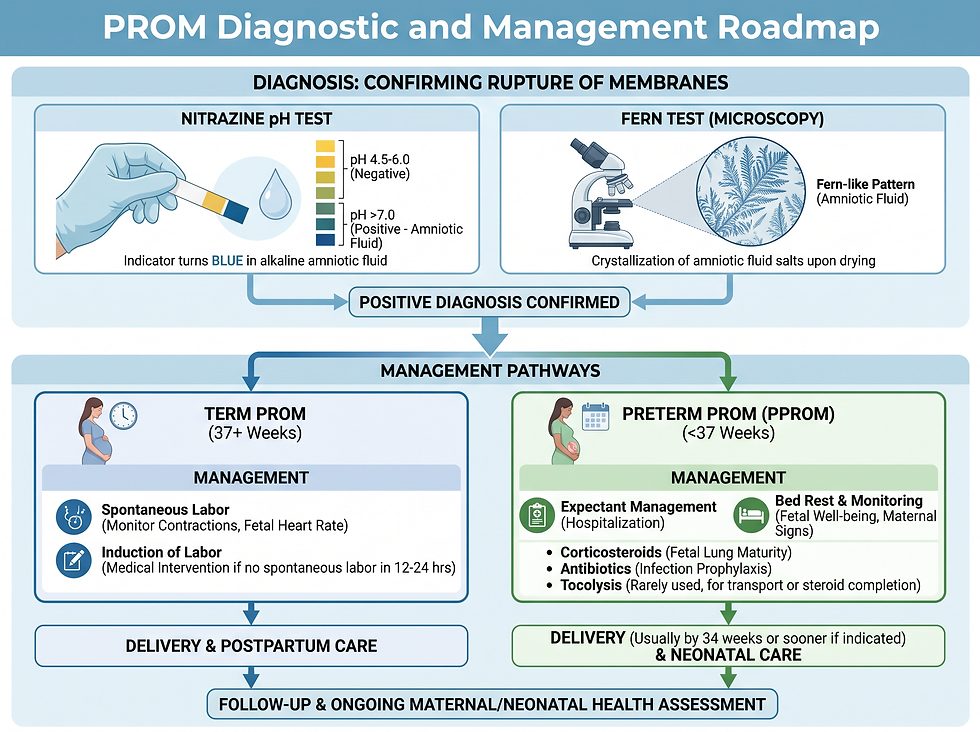
The diagnostic process typically begins with a sterile speculum exam to visually inspect the cervix for fluid pooling. Providers may also use Nitrazine paper to measure the pH level of the vaginal fluid; amniotic fluid has a higher pH (greater than 6.0) than normal vaginal secretions, causing the paper to turn blue. Additionally, a "fern test" may be performed, where a sample of the fluid is examined under a microscope to look for a characteristic fern-like crystallization pattern that forms as amniotic fluid dries.
Management and Treatment Strategies
The primary goal of treatment is to ensure the safety of both the mother and the baby by balancing the risks of infection against the complications associated with premature birth.
For pregnancies at term (37 weeks or later), delivery is generally recommended within 24 hours to minimize the risk of infection. If labor does not start spontaneously, providers may induce it using specialized medications. For preterm cases occurring before 34 weeks, the focus shifts to expectant management, which aims to delay labor to allow for further fetal development. This often involves hospitalization, bed rest, and the administration of corticosteroids to accelerate fetal lung maturity, antibiotics to prevent infection, and magnesium sulfate for fetal brain protection.

Conclusion
Premature rupture of membranes is a critical turning point in a pregnancy that requires prompt medical attention and expert management. Whether it occurs at term or prematurely, the focus remains on preventing infection and ensuring the healthiest possible outcome for the delivery. By understanding the signs and following professional guidance, expectant parents can navigate this challenge with the support of their clinical team.
Next Steps
If you suspect your water has broken or if you notice any unusual leaking of fluid, contact your healthcare provider or visit an emergency labor and delivery unit immediately. Early intervention is the most effective way to manage the risks associated with PROM and protect your baby's health.
Frequently Asked Questions
What exactly is PROM?
It is the rupture of the amniotic sac before the onset of labor, regardless of how far along the pregnancy is.
How does PPROM differ from PROM?
PPROM refers specifically to the rupture of membranes occurring before 37 weeks of gestation.
Is "water breaking" always a large gush?
No, it can also manifest as a slow, continuous trickle or a feeling of persistent dampness.
Can I control the flow of amniotic fluid?
Unlike urination, you cannot hold in or stop the flow of amniotic fluid once the membranes have ruptured.
How common is this condition?
PROM occurs in approximately 10% of all pregnancies, while PPROM affects about 3%.
What is the most significant risk of PROM?
The primary risks are maternal or fetal infection (chorioamnionitis) and premature birth.
What causes the membranes to break at term?
It is usually caused by the natural weakening of the sac due to the pressure of contractions and cervical changes.
Are twin pregnancies at higher risk for PPROM?
Yes, studies indicate that PPROM is more likely to occur in twin or multiple pregnancies.
How do doctors test for amniotic fluid?
They use speculum exams, pH (Nitrazine) tests, and microscopic "fern" tests to confirm a rupture.
Can an ultrasound diagnose PROM?
An ultrasound is used to check the volume of amniotic fluid remaining and the position of the fetus.
What is the treatment for PROM at 37 weeks?
Delivery is usually recommended, often within 24 hours, to reduce the risk of infection.
How is PPROM managed before 34 weeks?
Management focuses on bed rest and medications to prolong the pregnancy and support fetal development.
What medications are used for PPROM?
Common treatments include corticosteroids for lung maturity, antibiotics, and magnesium sulfate.
Is delivery always necessary if an infection develops?
Yes, if an infection is detected in the uterus, delivery becomes necessary regardless of the gestational age.
Can a baby survive if the water breaks early?
Yes, survival is possible, though the outlook depends on the gestational age and the presence of any complications.
References
Medical Disclaimer: The information provided in this article is for educational purposes only and should not be considered medical advice. Always seek the guidance of a qualified healthcare professional regarding any medical condition or treatment.
Comments