What Is Arthritis? A Plain-Language Guide to the Most Common Joint Problem in the World

Updated: 3 days ago
Medically reviewed by Dr. Baraa Alnahhal, MD. Last reviewed October 17, 2026. This content is for educational purposes and is not medical advice.
Quick Answer
Arthritis is a disease that damages the joints through wear-and-tear degeneration, inflammation or both, causing pain, stiffness, swelling and reduced range of motion [1]. Causes vary by type, including aging, gout and rheumatoid arthritis. It is extremely common [1]. There is no cure, but medicines, injections, therapy, low-impact exercise and, for severe cases, surgery manage symptoms [1] [2].
What the research says
Osteoarthritis affects hundreds of millions of people, and there is no cure. The Global Burden of Disease Study 2021 estimated that 595 million people (95% uncertainty interval 535 to 656 million) had osteoarthritis in 2020. That is 7.6% of the global population and 132.2% more cases than in 1990. The knee was the most common site, and high body mass index was estimated to contribute to 20.4% of osteoarthritis (uncertainty interval −1.7 to 36.6) (GBD 2021 Osteoarthritis Collaborators, The Lancet Rheumatology, 2023) [6].
Exercise reduces knee osteoarthritis pain and improves physical function. A Cochrane review of 54 randomized trials found that land-based exercise reduced pain (standardized mean difference −0.49; 95% CI −0.59 to −0.39; 44 trials, 3,537 participants), equal to about 12 points on a 0 to 100 scale. It also improved physical function (standardized mean difference −0.52; 95% CI −0.64 to −0.39; 44 trials, 3,913 participants), about 10 points. The benefit lasted at least 2 to 6 months after formal treatment ended, and no study reported a serious adverse event (Fransen et al., Cochrane Database of Systematic Reviews, 2015) [7].
Gout is far more common in men, and body weight plays a large role. The Global Burden of Disease Study 2021 estimated that 55.8 million people worldwide had gout in 2020, and prevalence was 3.26 times higher in males than in females. High body mass index accounted for 34.3% of the years lived with disability from gout (95% uncertainty interval 27.7 to 40.6) (GBD 2021 Gout Collaborators, The Lancet Rheumatology, 2024) [8].
What Is Arthritis, Exactly?
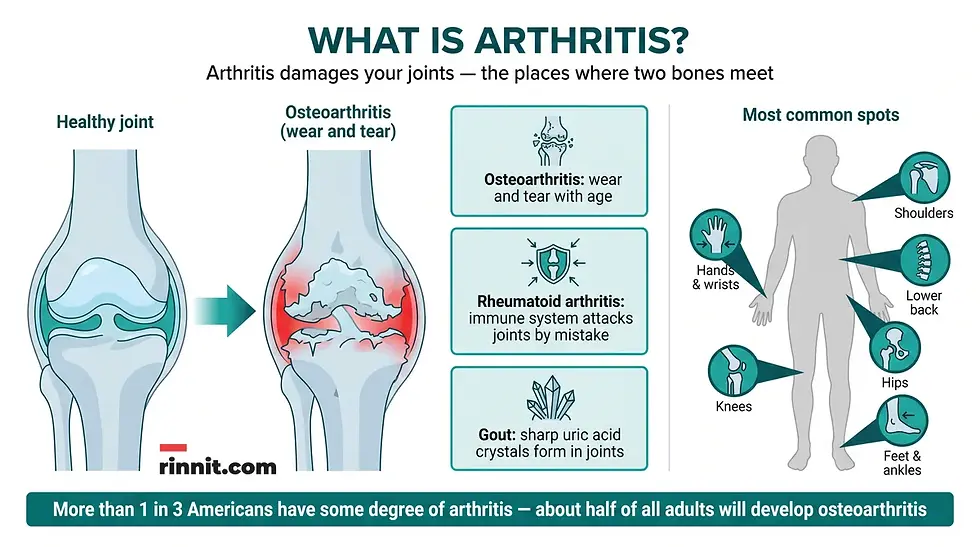
Arthritis is a disease that causes damage in your joints. Joints are the places in your body where two bones meet [1].
Some joints naturally wear down as you age, and lots of people develop arthritis after that normal, lifelong wear and tear. Other types happen after injuries that damage a joint, and certain health conditions also cause arthritis [1].
Arthritis can affect any joint, but it is most common in the hands and wrists, knees, hips, feet and ankles, shoulders, and lower back (lumbar spine) [1]. Depending on which type you have, arthritis can break down the natural tissue in your joint (degeneration) or cause inflammation (swelling), and some types cause inflammation that eventually leads to degeneration [1].
How Common Is Arthritis?
Arthritis is extremely common. Experts estimate that more than one-third of Americans have some degree of arthritis in their joints [1].
Osteoarthritis is the most common type [1] [2]. Studies have found that around half of all adults will develop osteoarthritis at some point [1].
What Are the More Than 100 Types of Arthritis?
There are more than 100 different types of arthritis [1] [3] [5]. The table below covers the most common ones.
Type | What it is |
Osteoarthritis | Wear-and-tear arthritis; the most common type |
Rheumatoid arthritis | Arthritis that happens when your immune system mistakenly damages your joints |
Gout | Arthritis that causes sharp uric acid crystals to form in your joints |
Ankylosing spondylitis | Arthritis that affects joints near your lower back |
Psoriatic arthritis | Arthritis that affects people who have psoriasis (a skin condition) |
Juvenile arthritis | Arthritis in kids and teens younger than 16 |
What Does Arthritis Feel Like?
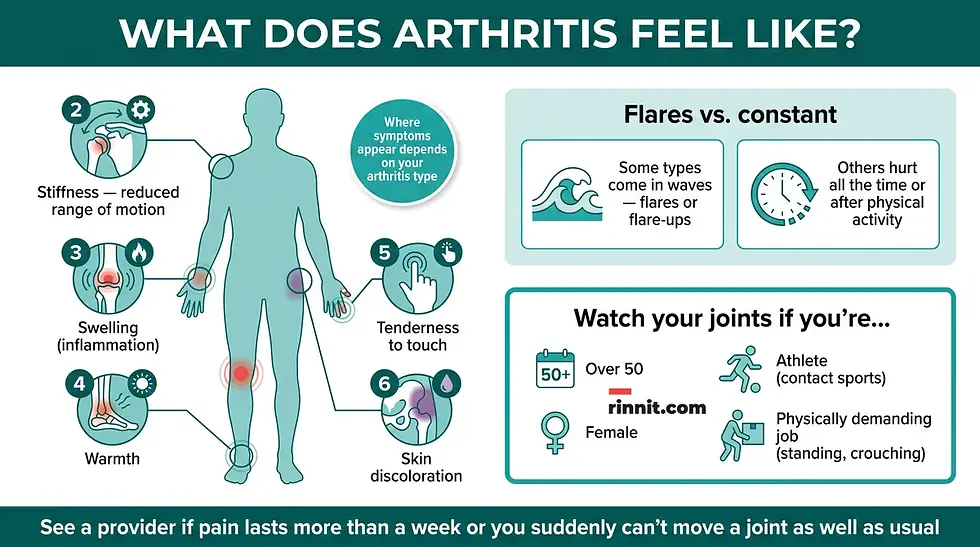
The most common arthritis symptoms and signs usually affect your joints and your ability to use them [1]:
Sign or symptom | What it looks like |
Joint pain | Aching in one or more joints |
Stiffness or reduced range of motion | How far you can move a joint is limited |
Swelling (inflammation) | The joint looks or feels puffy |
Skin discoloration | The skin around the joint changes color |
Tenderness | Sensitivity to touch around the joint |
Warmth | A feeling of heat near your joints |
Where you experience symptoms depends on which type of arthritis you have and which of your joints it affects [1].
Some types of arthritis cause symptoms in waves that come and go, called flares or flare-ups. Others make your joints feel painful or stiff all the time, or after being physically active [1].
What Causes Arthritis?
What causes arthritis varies depending on which type you have [1]:
Cause | The type it creates |
Normal, lifelong wear and tear | Osteoarthritis. A lifetime of using your joints eventually wears down their cartilage (the cushioning tissue) |
Too much uric acid in your blood (hyperuricemia) | Gout. Sharp uric acid crystals form in your joints |
Immune system damages your joints by mistake | Rheumatoid arthritis and other autoimmune types |
Viral infections (including COVID-19) | Viral arthritis |
No known cause or trigger | Idiopathic arthritis, which is providers’ word for “we don’t know why” |
Injuries that damage a joint | Post-traumatic arthritis, which doesn’t develop until after the joints are injured |
Who Is Most at Risk of Arthritis?
Risk factor | Why it matters |
Tobacco use | Smoking and other tobacco products increase your risk |
Family history | People whose biological family members have arthritis are more likely to develop it |
Activity level | You might be more likely to have arthritis if you aren’t physically active regularly |
Other health conditions | Autoimmune diseases, obesity, or any condition that affects your joints raises the odds |
Some groups face a higher arthritis risk overall: people older than 50, females, athletes (especially those who play contact sports), and people with physically demanding jobs, such as long periods of standing, crouching, or being on your hands and knees [1].
At What Age Does Arthritis Usually Start?
Arthritis can develop at any age. When it starts depends on which type you have and what’s causing it. In general, osteoarthritis affects adults older than 50, while rheumatoid arthritis usually develops in adults age 30 to 60 [1].
Types with a direct trigger start closer to that trigger. For example, post-traumatic arthritis doesn’t develop until after your joints are injured, and gout doesn’t develop until after you’ve had high uric acid levels for at least several months [1].
How Do Healthcare Providers Diagnose Arthritis?
A healthcare provider will diagnose arthritis with a physical exam. They’ll examine your affected joints and ask about your symptoms. Tell your provider when you first noticed pain and stiffness, and if any activities or times of day make them worse [1].
Your provider will probably check your range of motion (how far you can move a joint) and may compare one joint’s range of motion to other, similar joints, such as your other knee, ankle, or fingers [1].
Imaging tests can take pictures of your joints and help your provider see damage inside them, as well as rule out other injuries that cause similar symptoms, like bone fractures (broken bones) [1]:
Test | What it’s for |
X-ray | Basic pictures of the bones inside your joints |
Ultrasound | Sound-wave images of joint structures |
MRI (magnetic resonance imaging) | Detailed images using radio waves and a strong magnet |
CT (computed tomography) scan | Detailed cross-section images using multiple X-rays |
Your provider may also use blood tests to check your uric acid levels if they think you have gout [1]. Blood tests can also show signs of infections or autoimmune diseases [1].

How Is Arthritis Treated?
There’s no cure for arthritis, but your healthcare provider will help you find treatments that manage your symptoms [1] [2]. Which treatments you need depend on what’s causing the arthritis, which type you have, and which joints it affects.
The most common arthritis treatments include [1]:
Treatment | What it involves |
Over-the-counter (OTC) medicines | Anti-inflammatory medicine like NSAIDs or acetaminophen |
Corticosteroids | Prescription anti-inflammatory medicine, including cortisone shots |
DMARDs | Disease-modifying antirheumatic drugs, for rheumatoid or psoriatic arthritis |
Physical or occupational therapy | Improves your strength, range of motion, and confidence while you’re moving |
Surgery | Usually only if nonsurgical treatments don’t relieve your symptoms |
What Types of Arthritis Surgery Are There?
You may need surgery if you have severe arthritis and other treatments don’t work. The two most common types are joint fusion and joint replacement [1].
Joint fusion is exactly what it sounds like: surgically joining bones together. It’s most common for bones in your spine (spinal fusion) or your ankle (ankle fusion) [1].
Arthroplasty (joint replacement) is for damaged joints or bone loss. Your surgeon removes your damaged natural joint and replaces it with a prosthesis (an artificial joint). You might need a partial or total joint replacement [1]. Your provider or surgeon will tell you which type of surgery you’ll need and what to expect.
What Is the Fastest Way to Relieve Arthritis Pain?
Everyone’s body responds differently to different treatments, so there’s no one answer that works for everyone. Your provider will help you find a combination of treatments that relieves your pain. You might take over-the-counter or prescription medicine as soon as you feel symptoms flaring up, and some people take arthritis medicine regularly to help prevent pain before it affects day-to-day activities [1].
Staying active is one of the best ways to relieve arthritis symptoms. Don’t force yourself to do anything that causes severe pain, but stretching and moving your body can reduce pain and stiffness and keep them from getting worse [1].
You don’t need to become an ultramarathoner or Olympic weightlifter. Walking, swimming, riding a bike, and stretching or doing yoga are all great ways to support your joints and strengthen muscles throughout your body [1]. Talk to your provider or physical therapist about exercises that are good for you.
Does Weather Make Arthritis Worse?
Some people find their arthritis feels worse during certain types of weather. Humidity and cold are two common joint pain triggers [1]. People tend to be less active in rainy seasons and winter, and the cold and damp can also stiffen your joints and aggravate arthritis. Other theories suggest barometric pressure (the pressure of the air around you) may have some effect [1]. Talk to your healthcare provider if certain weather conditions or seasons make your arthritis worse. They may suggest ways to prevent pain and stiffness throughout the year, or modify your treatments to fit your environment.
Can I Prevent Arthritis?
Some forms of arthritis happen naturally or because of health conditions you can’t change, so there’s not always a way to prevent it. However, you can lower your chances of developing arthritis by [1]:
Prevention step | What it means |
Avoid tobacco products | Don’t smoke or use other tobacco products |
Healthy diet and exercise plan | Follow a plan that’s healthy for you |
Low-impact exercise | Choose joint-friendly activities like walking, swimming, and cycling |
Protective equipment | Always wear proper gear for any activity that could damage your joints |
When Should I See My Healthcare Provider?
Visit your healthcare provider if you experience any of the following symptoms: severe pain (especially if it lasts for more than a week), stiffness that’s getting worse (especially if you suddenly can’t move a joint as well as you usually can), or worsening or more frequent flare-ups of your usual symptoms [1].
Visit a healthcare provider if you’re experiencing joint pain that’s severe enough to affect your daily routine, or if it feels like you can’t move or use your joints as well as usual [1].
What Can I Expect If I Have Arthritis?
You should expect to manage arthritis symptoms for a long time, probably the rest of your life [1]. Your provider will help you find treatments that reduce how much (and how often) arthritis impacts your daily routine. Some people with arthritis experience more severe symptoms as they age, so ask your provider how often you should have follow-up visits to check for changes in your joints [1].
When you see your provider, helpful questions include: Which type of arthritis do I have? Which treatments will I need? Will I need surgery? How often will I need follow-up exams?
What is the bottom line on arthritis?
Arthritis is one of the most common health conditions people experience [1]. Experts estimate more than one-third of Americans have some degree of it, and about half of all adults will develop the most common type, osteoarthritis, at some point [1]. It’s not one disease but a family of more than 100 conditions that all damage the places where two bones meet, whether through lifelong wear and tear, an immune system that attacks by mistake, sharp uric acid crystals, viruses, or injuries.
The warning signs are consistent: pain, stiffness, swelling, warmth, tenderness, and sometimes skin color changes, often arriving in flares that come and go. There is no cure, but a steady ladder of care manages symptoms well: over-the-counter anti-inflammatories, cortisone shots, specialized drugs for autoimmune types, physical and occupational therapy, low-impact exercise like walking, swimming, and yoga, and finally surgery (joint fusion or replacement) for severe cases that don’t respond to anything else. Staying as active as possible is one of the best things you can do for your joints, and you don’t need to be an athlete to get the benefit.
Take the Next Step
If your joints ache, stiffen, or swell, especially if it’s severe enough to affect your daily routine or you suddenly can’t move a joint as well as usual, don’t write it off as “getting older.” Start by staying gently active with low-impact movement like walking, swimming, or yoga, avoid tobacco products, and ask your provider about an over-the-counter anti-inflammatory or acetaminophen if flare-ups are interfering with your day.
See your healthcare provider if pain lasts more than a week, stiffness is getting worse, or your flare-ups are more frequent. They can check your range of motion, order imaging or blood tests to pin down the type, and build a plan that keeps you doing the activities you love, because having arthritis doesn’t mean you should live in pain.
Frequently Asked Questions
What is arthritis? A disease that causes damage in your joints, the places in your body where two bones meet. Depending on the type, it can break down the joint’s natural cushioning tissue (degeneration), cause swelling (inflammation), or both.
How many types of arthritis are there? More than 100. The most common include osteoarthritis (wear and tear), rheumatoid arthritis (immune system mistakenly damages joints), gout (uric acid crystals in the joints), ankylosing spondylitis (joints near the lower back), psoriatic arthritis, and juvenile arthritis (in kids and teens under 16).
How common is arthritis? Extremely common. Experts estimate more than one-third of Americans have some degree of arthritis in their joints. Osteoarthritis is the most common type, and about half of all adults will develop it at some point.
What are the symptoms? Joint pain, stiffness or reduced range of motion, swelling (inflammation), skin discoloration, tenderness to touch around a joint, and a feeling of heat or warmth near your joints. Some types come in waves called flares; others are constant or follow physical activity.
What causes arthritis? It depends on the type. Osteoarthritis happens naturally with age as a lifetime of joint use wears down the cartilage cushioning. Gout comes from too much uric acid in your blood. Rheumatoid arthritis happens when your immune system damages your joints by mistake. Viral infections (including COVID-19) can trigger viral arthritis, injuries can cause post-traumatic arthritis, and sometimes there’s no known cause (idiopathic arthritis).
Who is most at risk? People who use tobacco products, have a family history of arthritis, aren’t physically active regularly, or have autoimmune diseases, obesity, or other joint-affecting conditions. People older than 50, females, contact-sport athletes, and people with physically demanding jobs also face higher risk.
At what age does arthritis start? It can develop at any age. Osteoarthritis generally affects adults older than 50; rheumatoid arthritis usually develops in adults 30 to 60. Triggered types (injury, high uric acid) start after the trigger.
Is there a cure? No. But treatments can manage symptoms effectively. Your provider will help you find treatments that reduce how much, and how often, arthritis impacts your daily routine.
How is arthritis diagnosed? With a physical exam (checking your joints, symptoms, and range of motion), imaging tests such as X-ray, ultrasound, MRI, or CT scan to see damage inside the joints, and sometimes blood tests to check uric acid levels, infections, or autoimmune disease markers.
How is it treated? Most commonly with over-the-counter anti-inflammatory medicine (NSAIDs or acetaminophen), corticosteroids (including cortisone shots), disease-modifying drugs (DMARDs) for rheumatoid or psoriatic arthritis, physical or occupational therapy, and surgery, usually only if nonsurgical treatments don’t relieve symptoms.
What is the fastest way to relieve arthritis pain? There’s no one answer that works for everyone. Your provider may recommend over-the-counter or prescription medicine as soon as symptoms flare, and staying active (walking, swimming, cycling, stretching, or yoga) is one of the best ways to relieve pain and stiffness.
Does weather affect arthritis? For some people, yes. Humidity and cold are two common triggers, possibly because people are less active in rainy seasons and winter, cold and damp can stiffen joints, and barometric pressure (air pressure) may also play a role. Talk to your provider about adjusting your routine or treatments.
Can arthritis be prevented? Not always, because some forms happen naturally or from conditions you can’t change. But you can lower your chances by avoiding tobacco, following a healthy diet and exercise plan, doing low-impact exercise, and always wearing protective equipment during activities that could damage your joints.
Can arthritis require surgery? Yes, for severe cases that don’t respond to other treatments. The two most common surgeries are joint fusion (joining bones together, common in the spine and ankle) and joint replacement (removing the damaged joint and replacing it with an artificial prosthesis, partially or totally).
When should I see a doctor? If you have severe pain (especially lasting more than a week), worsening stiffness that limits how well you can move a joint, worsening or more frequent flare-ups, or joint pain severe enough to affect your daily routine.
References
Cleveland Clinic. Arthritis. Cleveland Clinic. Last updated November 13, 2023. https://my.clevelandclinic.org/health/diseases/12061-arthritis
Sheth NP. Arthritis: An Overview. OrthoInfo. Accessed October 14, 2026. https://www.orthoinfo.org/diseases--conditions/arthritis-an-overview
Rath L. What Is Arthritis? Arthritis Foundation. Updated June 9, 2022. https://www.arthritis.org/health-wellness/about-arthritis/understanding-arthritis/what-is-arthritis
Centers for Disease Control and Prevention. Arthritis Risk Factors. CDC. February 22, 2024. https://www.cdc.gov/arthritis/risk-factors/index.html
Senthelal S, et al. Arthritis. In: StatPearls [Internet]. StatPearls Publishing. Last updated June 20, 2023. PMID 30085534. https://www.ncbi.nlm.nih.gov/books/NBK518992/
GBD 2021 Osteoarthritis Collaborators. Global, regional, and national burden of osteoarthritis, 1990-2020 and projections to 2050: a systematic analysis for the Global Burden of Disease Study 2021. Lancet Rheumatol. 2023;5(9):e508-e522. PMID 37675071. https://doi.org/10.1016/S2665-9913(23)00163-7
Fransen M, et al. Exercise for osteoarthritis of the knee. Cochrane Database Syst Rev. 2015;1(1):CD004376. PMID 25569281. https://doi.org/10.1002/14651858.CD004376.pub3
GBD 2021 Gout Collaborators. Global, regional, and national burden of gout, 1990-2020, and projections to 2050: a systematic analysis of the Global Burden of Disease Study 2021. Lancet Rheumatol. 2024;6(8):e507-e517. PMID 38996590. https://doi.org/10.1016/S2665-9913(24)00117-6
Medical disclaimer
This guide is for general information only and is not a substitute for professional medical advice, diagnosis, or treatment. If your joint pain is severe, lasts more than a week, or limits how well you can move, see a healthcare provider promptly. Always seek the advice of a physician or other qualified health provider with any questions about a medical condition. Never disregard professional medical advice or delay seeking it because of something you have read here.



Comments