Transcranial Doppler (TCD): Ultrasound of Blood Flow in the Brain

Updated: 3 days ago
Written and medically reviewed by Dr. Baraa Alnahhal, MD · Last reviewed: November 2026 · How we review
Quick Answer
A transcranial Doppler (TCD) is a painless ultrasound test that measures the speed of blood flow in the brain's arteries by sending sound waves through the skull. It helps diagnose and monitor stroke and TIA, narrowed brain arteries and stroke risk in children with sickle cell anemia. The test takes 30 to 60 minutes and uses no radiation.
What the research says
TCD screening prevents strokes in sickle cell anemia: in children with sickle cell anemia and abnormal TCD results, regular blood transfusions cut the risk of a first stroke by 92% compared with standard care, a finding that stopped the trial early (Adams RJ et al., N Engl J Med, 1998) [2]
TCD is useful but imperfect for vasospasm: a systematic review comparing TCD with angiography after a ruptured brain aneurysm found that, for the middle cerebral artery, TCD had high specificity and positive predictive value, but evidence for other arteries was limited (Lysakowski C et al., Stroke, 2001) [3]
Key takeaways
Ultrasound that measures blood flow in the brain's arteries.
Helps with stroke, TIA, vasospasm, sickle cell stroke risk and PFO.
Painless, no radiation and no preparation needed.
Takes about 30–60 minutes.
Results are often reviewed the same day.
How does TCD work?
TCD is a type of Doppler ultrasound. A handheld probe sends high-frequency sound waves through thin areas of the skull. The waves bounce off moving blood cells, and the returning signal shows how fast and in which direction blood is flowing. The results appear as graphs or color images. Sources: [1]
Why is it done?
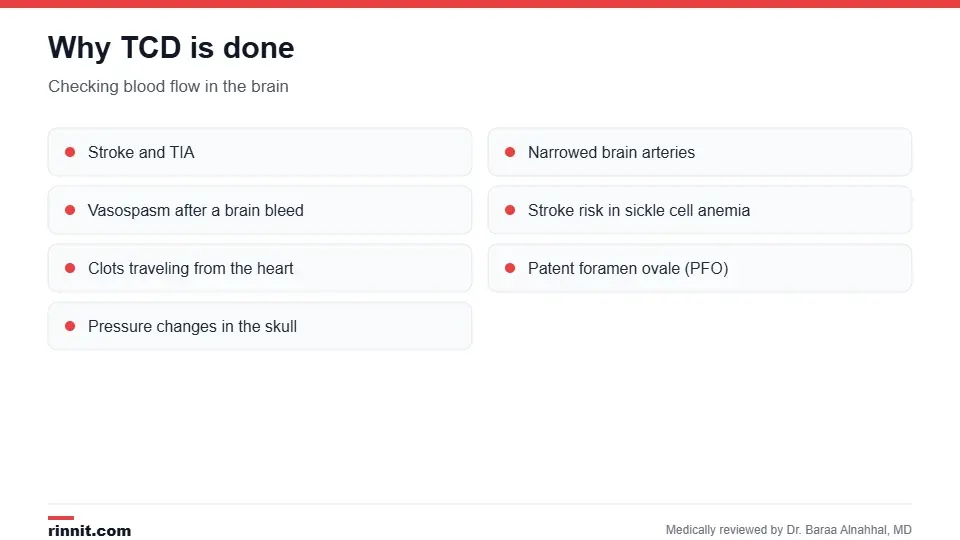
TCD checks blood flow inside the brain.
Stroke caused by clots and transient ischemic attack (TIA).
Narrowing of brain arteries from atherosclerosis.
Vasospasm after a subarachnoid hemorrhage.
Stroke risk in children with sickle cell anemia.
Emboli that start in the heart, and a patent foramen ovale (PFO).
Cerebral aneurysm, cerebral venous sinus thrombosis and changes in pressure inside the skull.
To help confirm brain death. Sources: [1]
How do I prepare?
No special preparation is needed. You may be asked to remove contact lenses. Head coverings can be adjusted or briefly removed, with privacy provided. Sources: [1]
What happens during the test?
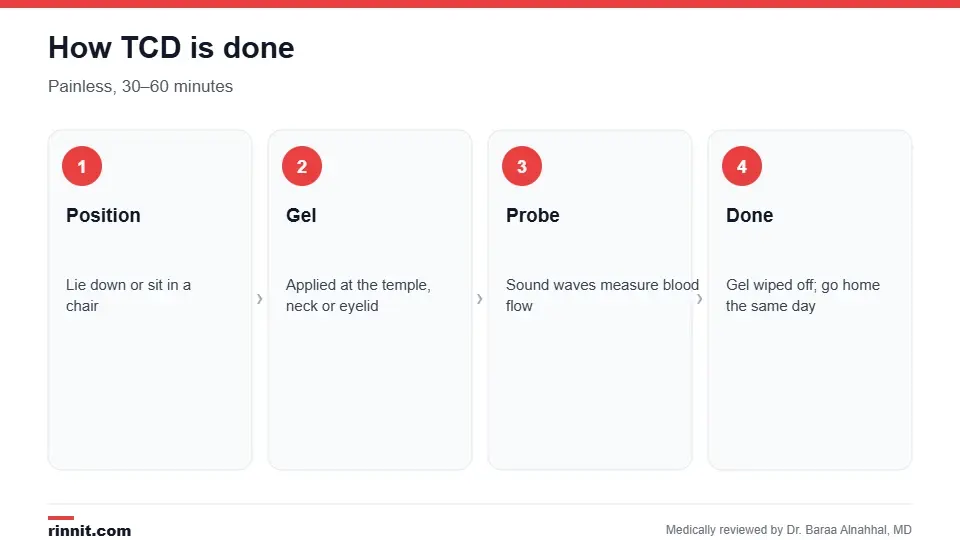
TCD is painless and takes 30 to 60 minutes.
You lie on a padded table or sit in a chair.
A technologist applies gel near your temple, above your cheekbone, in front of your ear, at your neck or over your closed eyelid.
A probe is moved over the gel while you keep your head still and avoid talking.
For some tests, salt water is injected into an arm vein to look for a hole in the heart; this is a bubble study.
The gel is wiped off when the test is done. Sources: [1]
The gel may feel cold, and you'll feel light pressure. The test takes 30–60 minutes, depending on how many parts are needed. Sources: [1]
Risks
TCD is considered safe, with no harmful side effects reported. Unlike X-ray tests, it uses no radiation. You can drive and return to normal activities right away. Sources: [1]
Understanding your results

A radiologist or neurologist reads the results.
Normal: blood flows to and within the brain as expected.
Abnormal: blood isn't moving as expected, which may mean a blockage, narrowed vessels, vasospasm or a clot passing from the heart. Sources: [1, 2, 3]
A radiologist or neurologist interprets the images, and results are often available the same day. Some people need follow-up tests to monitor a condition or check treatment. Sources: [1]
Conclusion
A transcranial Doppler is a quick, safe way to see how blood flows in the brain. It's especially valuable for stroke evaluation, watching for vasospasm after a brain bleed and protecting children with sickle cell anemia from stroke.
Keep learning: read about stroke and Doppler ultrasound.
Frequently asked questions
What is a transcranial Doppler?
An ultrasound that measures blood flow in the brain's arteries.
Does it hurt?
No. You may feel cool gel and light pressure.
How long does it take?
About 30–60 minutes.
Do I need to prepare?
No special preparation is needed.
Does it use radiation?
No.
Why is it done in sickle cell anemia?
To find children at high risk of stroke who may need treatment.
Can it detect vasospasm?
Yes, especially after a brain bleed.
Can it find a hole in the heart?
Yes, when combined with a saline bubble injection.
Can I drive afterward?
Yes.
When will I get results?
Often the same day.
Related Reading
Doppler Ultrasound: How It Works, Types, Uses and Results how Doppler ultrasound measures blood flow.
Stroke: Symptoms, Causes, Diagnosis, and Treatment — A Complete Guide a key reason for TCD testing.
Vasospasm: Symptoms, Causes, and Management artery narrowing TCD can monitor.
Sickle Cell Anemia: Symptoms, Causes, Treatment & Complete Guide where TCD helps prevent stroke.
Patent Foramen Ovale (PFO): Symptoms, Causes, and Treatment a heart hole TCD can help detect.
References
Cleveland Clinic. Transcranial Doppler (TCD) Ultrasound: Purpose & Procedure. Cleveland Clinic. Last updated September 25, 2024. https://my.clevelandclinic.org/health/diagnostics/4998-transcranial-doppler-ultrasound-ultrasonography-test
Adams RJ, McKie VC, Hsu L, et al. Prevention of a first stroke by transfusions in children with sickle cell anemia and abnormal results on transcranial Doppler ultrasonography. N Engl J Med. 1998;339(1):5-11. PMID 9647873. https://doi.org/10.1056/NEJM199807023390102
Lysakowski C, Walder B, Costanza MC, et al. Transcranial Doppler versus angiography in patients with vasospasm due to a ruptured cerebral aneurysm: a systematic review. Stroke. 2001;32(10):2292-2298. PMID 11588316. https://doi.org/10.1161/hs1001.097108
Medical disclaimer
This article is for general education only and does not replace advice from a qualified healthcare professional. Talk to your doctor about your own diagnosis and treatment, and seek emergency care right away for severe or sudden symptoms.



Comments