Subarachnoid Hemorrhage: Symptoms, Causes, Diagnosis, and Treatment Explained

Updated: 2 days ago
Medically reviewed by Dr. Baraa Alnahhal, MD · Last reviewed: October 2026
Quick Answer: What is a subarachnoid hemorrhage?
A subarachnoid hemorrhage is a type of stroke caused by bleeding between the brain and its covering tissues, most commonly from a burst aneurysm. Its key symptom is a sudden, very bad headache, often with vomiting, stiff neck or brief unconsciousness. It is a medical emergency; call 911 immediately. Imaging diagnoses it, and treatment repairs the aneurysm and prevents complications.
What the research says
An early CT scan is extremely reliable. In a prospective study of 3,132 emergency patients with a sudden severe headache (240 had a subarachnoid hemorrhage), CT found every case when it was done within six hours of headache onset (121 of 121; sensitivity 100%), compared with 92.9% overall (Perry et al., BMJ, 2011) [3].
Coiling gave better odds of independent survival than clipping in aneurysms suitable for either treatment. In a randomized trial of 2,143 patients, 23.7% of those allocated to coiling were dependent or dead at 1 year, versus 30.6% of those allocated to clipping (absolute risk reduction 6.9%, 95% CI 2.5–11.3). Rebleeding after the first year was uncommon with both approaches (Molyneux et al., J Stroke Cerebrovasc Dis, 2002) [4].
Nimodipine lowers the risk of a poor outcome. A meta-analysis of 13 randomized trials (1,727 patients) found less poor outcome (risk ratio 0.69, 95% CI 0.60–0.78) and lower mortality (risk ratio 0.50, 95% CI 0.32–0.78) with nimodipine (Hao et al., Front Neurol, 2022) [5].
A normal CT within six hours is very reassuring. A meta-analysis of five studies (about 8,907 patients) found that modern CT scans done within 6 hours of headache onset had a sensitivity of 98.7% (95% CI 97.1–99.4%) and a specificity of 99.9%; only 13 subarachnoid hemorrhages were missed (1.46 per 1,000) (Dubosh et al., Stroke, 2016) [6].
Smoking, high blood pressure, and heavy drinking are the main modifiable risks. A systematic review of 14 longitudinal and 23 case-control studies (3,936 patients) found higher risk with current smoking (relative risk 2.2, 95% CI 1.3–3.6), hypertension (relative risk 2.5, 95% CI 2.0–3.1), and excessive alcohol intake (relative risk 2.1, 95% CI 1.5–2.8) (Feigin et al., Stroke, 2005) [7].
What Is a Subarachnoid Hemorrhage?
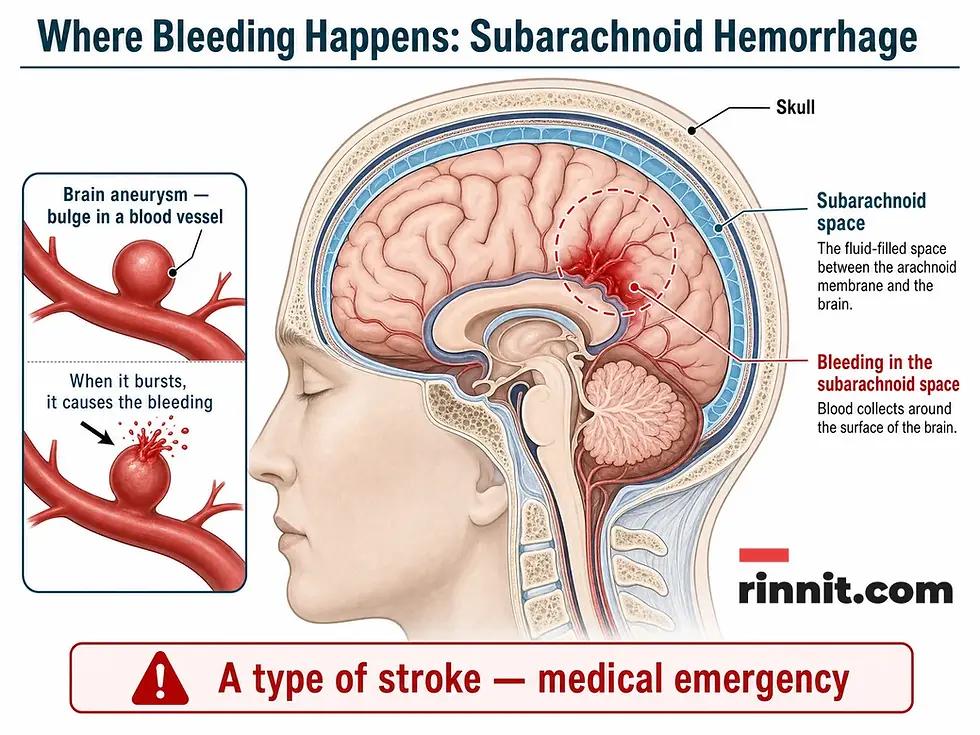
A subarachnoid hemorrhage is bleeding in the space between the brain and the tissues that cover the brain. The space is known as the subarachnoid space. [1]
The brain is protected by three membrane layers known as meninges: the outer dura mater, the middle arachnoid, and the inner pia mater. A subarachnoid hemorrhage occurs specifically when blood leaks into the space below the arachnoid layer. [8]
A subarachnoid hemorrhage is a type of stroke. It is a medical emergency that needs treatment right away. [1]
If a subarachnoid hemorrhage isn't treated, it can lead to permanent brain damage or death, so it's important to get treatment right away. [1]
In the United States, approximately 10 to 14 out of every 100,000 people experience a subarachnoid hemorrhage annually. [8]
What Are the Symptoms of a Subarachnoid Hemorrhage?
The most common symptom of a subarachnoid hemorrhage is a very sudden, very bad headache. The headache starts in a split second and becomes very painful right away. Some people describe it as the worst headache they have ever had. [1]
This is known as a thunderclap headache: an extremely intense and painful headache that reaches its peak intensity within seconds. [8]
Along with a sudden headache, symptoms may include:
Nausea
Vomiting
Stiff neck or neck pain
Changes in vision
Brief loss of consciousness [1]
Other symptoms can include decreased consciousness, confusion, irritability, sudden weakness or numbness, dizziness, double vision, blind spots, sensitivity to bright light (photophobia), seizures, and temporary vision loss in one eye. [8]
When should you call 911?
A subarachnoid hemorrhage is a medical emergency.
Get immediate medical attention if you experience a very sudden, very bad headache or if you have other symptoms of a subarachnoid hemorrhage. This is especially important if you have been diagnosed with a brain aneurysm or if you have experienced a head injury. [1]
If you're with someone who complains of a very bad headache that came on suddenly or who loses consciousness, call 911 or your local emergency number. [1]
What Causes a Subarachnoid Hemorrhage?
Bleeding usually happens when an irregular bulge in a blood vessel, known as an aneurysm, bursts in the brain. Bleeding also can happen because of a head injury. Sometimes a tangle of blood vessels in the brain, known as an arteriovenous malformation, causes the bleeding. And other health conditions, including conditions that affect the blood vessels, can cause bleeding. [1]
Cause | How it leads to bleeding | How common |
|---|---|---|
Burst brain aneurysm | A bulge in a blood vessel in the brain bursts and causes bleeding in the subarachnoid space | Most common cause [1] |
Head injury | An injury from an auto accident, fall, or violence leads to bleeding | Another common cause |
Arteriovenous malformation (AVM) | An irregular tangle of blood vessels ruptures and causes bleeding | Less common |
Vasculitis | Swelling of the blood vessels thickens and narrows vessel walls; can lead to a blood clot or an aneurysm [1] | Less common |
In non-traumatic cases, approximately 85% are due to a ruptured brain aneurysm. Less common causes also include bleeding disorders and the use of certain medications or substances. [8]
Who Is at Risk of a Subarachnoid Hemorrhage?
A subarachnoid hemorrhage has some risk factors that are out of your control and others that can be avoided.
Unchangeable risk factor | Details |
|---|---|
Older age | Most aneurysm-related subarachnoid hemorrhages occur in people between ages 55 and 60. Women in their 50s and 60s, in particular, have a higher risk [1] |
Family history | Having a first-degree relative (a parent, child, or sibling related by blood) with a brain aneurysm |
Certain health conditions | Ehlers-Danlos syndrome, Marfan syndrome, neurofibromatosis type 1, and polycystic kidney disease increase the risk [1] |
People who have two or more first-degree relatives with brain aneurysms or who have had a subarachnoid hemorrhage can get screened. [1]
Other risk factors include fibromuscular dysplasia and the use of blood thinners such as warfarin. [8]
Other risk factors can be avoided:
Avoidable risk factor | Action |
|---|---|
High blood pressure | Manage blood pressure with your healthcare team |
Smoking | Quitting smoking lowers risk |
Misusing alcohol | Reducing or stopping alcohol misuse lowers risk |
Using drugs such as cocaine and methamphetamine | Avoiding these drugs lowers risk |
How Is a Subarachnoid Hemorrhage Diagnosed?
To diagnose a subarachnoid hemorrhage, you may need the following tests:
Test | How it works | When it's used |
|---|---|---|
CT scan | An imaging test very effective at detecting bleeding in the brain; may not detect bleeding if you have a low red blood cell count or a small amount of bleeding; a contrast dye injection to view blood vessels in greater detail is known as a CT angiogram [2] | Usually the first test |
MRI | An imaging test that also can detect bleeding; may show signs of a subarachnoid hemorrhage in rare cases when it's not detected by a CT scan; with dye injected to view arteries and veins in greater detail it's known as an MR angiogram [2] | When CT misses small bleeding |
Cerebral angiography | A long, thin tube (catheter) is inserted into an artery and threaded to the brain; dye is injected into brain blood vessels to make them visible under X-ray imaging; if it does not show an aneurysm, a second angiogram may be done if a provider thinks an aneurysm is likely [2] | For more-detailed images, or when the cause isn't clear on other imaging |
Lumbar puncture | A needle is inserted into the lower back; a small amount of the fluid that surrounds the brain and spinal cord (cerebrospinal fluid) is removed and studied for blood, which may mean a subarachnoid hemorrhage [2] | When bleeding doesn't appear on initial imaging |
During a lumbar puncture, the fluid is also checked for a yellowish appearance (xanthochromia). An MRI can also detect "subacute" bleeding that may have occurred in the recent past. [8]

How Is a Subarachnoid Hemorrhage Treated?
Treatment of a subarachnoid hemorrhage focuses on stabilizing the condition. Your healthcare team checks your breathing, blood pressure, and blood flow. If you have a burst aneurysm, you're treated for it and your healthcare team works to prevent complications. [2]
To treat a ruptured brain aneurysm, your healthcare professional might recommend:
Treatment | How it works |
|---|---|
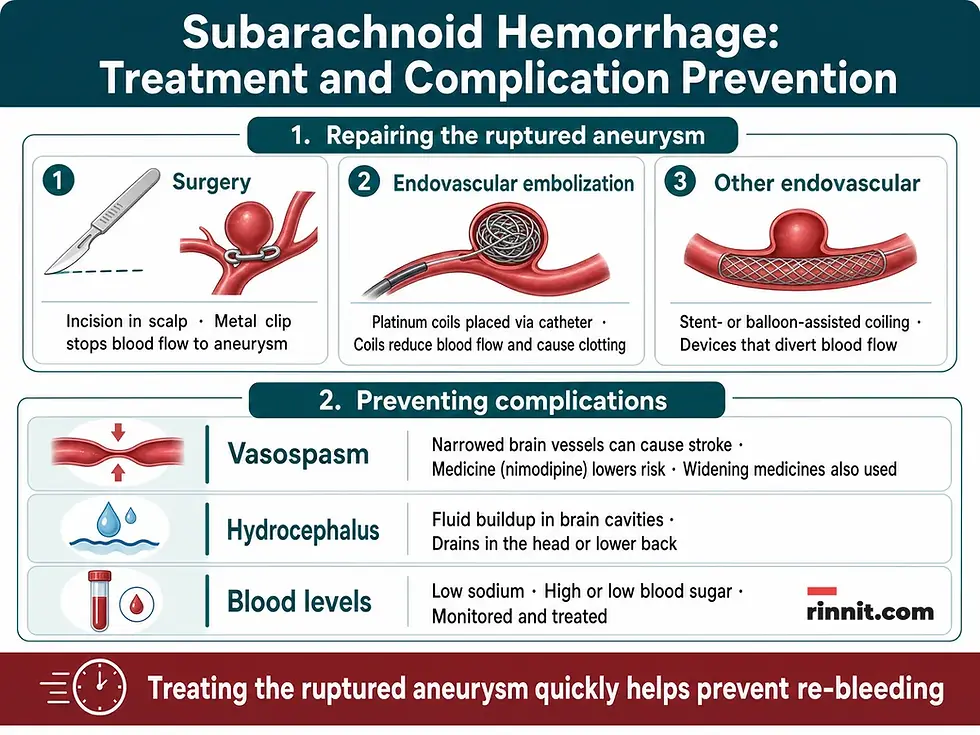
Surgery | The surgeon makes an incision in the scalp and locates the brain aneurysm. A metal clip is placed on the aneurysm to stop the blood flow to it [2] |
Endovascular embolization | A catheter is inserted into an artery and threaded to your brain. Detachable platinum coils are guided through the catheter and placed in the aneurysm. The coils reduce blood flow into the aneurysm and cause the blood to clot [2]; different types of coils have been developed |
Other endovascular treatments | Newer techniques include stent-assisted or balloon-assisted coiling or devices that divert blood flow [2] |
Treating the ruptured aneurysm quickly can help prevent bleeding from happening again. [2]
Surgery may also involve removing collections of blood to relieve pressure. Most hospital stays last between 10 and 20 days, depending on the severity of the hemorrhage and the patient's recovery progress. [8]
What Complications Can Occur, and How Are They Prevented?
It's also important to prevent other complications. A subarachnoid hemorrhage may lead to low salts such as sodium in the blood. It also may cause high or low blood sugar. Your healthcare team monitors these levels and treats them if needed. [2]
There also may be poor blood flow to the brain. A common complication of a subarachnoid hemorrhage due to a burst aneurysm is a constriction and narrowing of the blood vessels in the brain, known as vasospasm. [2] This can cause a stroke if blood flow decreases to a certain level. A stroke may be avoided by raising blood pressure or by widening blood vessels in the brain with medicines. The medicine nimodipine (Nymalize) also can lower the risk of vasospasm. [2] [5]
Another common complication is a buildup of fluid in cavities within the brain, known as hydrocephalus. This can be treated with drains inserted in the head or lower back. [2]
Sometimes, procedures need to be repeated. After your initial treatment, follow-up appointments with your healthcare team are important to watch for any changes. You also may need physical, occupational, and speech therapies. [2]
What Should You Expect at the Hospital?
A subarachnoid hemorrhage is a medical emergency, so it is likely to be treated in the emergency department. Doctors who specialize in the brain and nervous system may be involved in your care. These specialists may include neurologists, neurosurgeons, and neuroradiologists. [2]
To make the most of your time with your healthcare team, make a list of:
Your symptoms, including any that seem unrelated to the reason for seeking medical care
Key personal information, including major stresses, recent life changes, and family medical history
All medicines, vitamins, or other supplements you take, including the doses
Questions to ask your healthcare team
For subarachnoid hemorrhage, some basic questions to ask your healthcare professional include:
What's likely causing my symptoms?
Other than the most likely cause, what are other possible causes for my symptoms?
What tests do I need?
Is my condition likely short-term or long-lasting?
What's the best course of action?
What are the alternatives to the primary approach you're suggesting?
I have these other health conditions. How can I best manage them together?
Are there restrictions I need to follow?
Should I see a specialist?
Are there brochures or other printed material I can have? What websites do you recommend?
Your healthcare professional is likely to ask you several questions, such as:
When did your symptoms begin?
Have your symptoms been constant, or do they come and go?
How serious are your symptoms?
What, if anything, seems to improve your symptoms?
What, if anything, appears to worsen your symptoms?
Conclusion
A subarachnoid hemorrhage is one of the most time-critical emergencies in medicine. The warning sign is unmistakable when you know to look for it: a very sudden, very bad headache — the kind people describe as the worst headache they have ever felt — arriving in a split second, often with nausea, vomiting, a stiff neck, vision changes, or brief loss of consciousness. The cause is usually a burst brain aneurysm, though head injury, arteriovenous malformation, and vasculitis can also be responsible. Because untreated bleeding can lead to permanent brain damage or death, every minute counts.
The good news is that modern hospitals have a clear playbook. Rapid imaging — CT scan first, then MRI, cerebral angiography, and lumbar puncture when needed — pinpoints the bleeding. Teams then stabilize breathing and blood pressure, repair the aneurysm through surgery or endovascular techniques such as coil embolization, and actively guard against the complications that follow: vasospasm (with medicines like nimodipine), hydrocephalus (with drains), and electrolyte and blood sugar imbalances. Recovery often continues with physical, occupational, and speech therapies, and follow-up appointments matter because sometimes procedures need to be repeated.
What are the next steps after a subarachnoid hemorrhage?
Do not wait out a sudden, severe headache. If you or someone near you develops a very bad headache that comes on suddenly, or loses consciousness, call 911 or your local emergency number right away — especially if there is a known brain aneurysm or a recent head injury. If you have a family history of brain aneurysms (two or more first-degree relatives) or you've had a subarachnoid hemorrhage yourself, ask your doctor about screening. And for long-term protection, work with your healthcare team to control the avoidable risks: high blood pressure, smoking, alcohol misuse, and cocaine or methamphetamine use.
Trusted resources: MedlinePlus: Subarachnoid hemorrhage · NICE guideline NG228: Subarachnoid haemorrhage caused by a ruptured aneurysm
Related reading on Rinnit: Stroke: Symptoms, Causes, Diagnosis, and Treatment — A Complete Guide · Thunderclap Headaches: The 60-Second Emergency Headache Explained · Hydrocephalus: Symptoms, Causes & Treatment — What You Need to Know · Central Nervous System Vascular Malformations: Symptoms, Causes, Diagnosis and Treatment — What You Need to Know · Polycystic Kidney Disease (PKD): Symptoms, Types, and Treatment Options Explained
Frequently Asked Questions
What is a subarachnoid hemorrhage?
A subarachnoid hemorrhage is bleeding in the space between the brain and the tissues that cover the brain. The space is known as the subarachnoid space. It is a type of stroke and a medical emergency that needs treatment right away.
Is a subarachnoid hemorrhage a type of stroke?
Yes. A subarachnoid hemorrhage is a type of stroke.
What does a subarachnoid hemorrhage headache feel like?
The most common symptom is a very sudden, very bad headache. The headache starts in a split second and becomes very painful right away. Some people describe it as the worst headache they have ever had.
What are the symptoms of a subarachnoid hemorrhage?
Along with the sudden headache, symptoms may include nausea, vomiting, stiff neck or neck pain, changes in vision, and brief loss of consciousness.
Is a subarachnoid hemorrhage a medical emergency?
Yes — it is a medical emergency that needs treatment right away. Get immediate medical attention if you experience a very sudden, very bad headache or other symptoms, especially if you have been diagnosed with a brain aneurysm or have experienced a head injury.
When should I call 911 for a headache?
If you're with someone who complains of a very bad headache that came on suddenly or who loses consciousness, call 911 or your local emergency number.
What causes a subarachnoid hemorrhage?
Bleeding usually happens when an irregular bulge in a blood vessel, known as an aneurysm, bursts in the brain. Bleeding also can happen because of a head injury. Sometimes a tangle of blood vessels in the brain, known as an arteriovenous malformation, causes the bleeding. And other health conditions, including conditions that affect the blood vessels, can cause bleeding.
What is the most common cause of a subarachnoid hemorrhage?
A brain aneurysm that bursts. A brain aneurysm is a bulge in a blood vessel in the brain; it can burst and cause bleeding in the subarachnoid space.
Can a head injury cause a subarachnoid hemorrhage?
Yes. A head injury is another common cause. A head injury from an auto accident, fall, or violence can lead to a subarachnoid hemorrhage.
What is an arteriovenous malformation, and can it cause this?
An arteriovenous malformation is an irregular tangle of blood vessels in the brain. It can rupture and cause bleeding in the brain.
What is vasculitis, and how does it relate?
Vasculitis is swelling of the blood vessels. It can cause the walls of the blood vessels to thicken and narrow, and it can lead to a blood clot or an aneurysm.
Who is at risk of a subarachnoid hemorrhage?
Risk is higher at older age (most aneurysm-related cases occur in people between ages 55 and 60, with women in their 50s and 60s at particular risk), with a first-degree relative with a brain aneurysm, with conditions such as Ehlers-Danlos syndrome, Marfan syndrome, neurofibromatosis type 1, or polycystic kidney disease, and with avoidable factors such as high blood pressure, smoking, alcohol misuse, and cocaine or methamphetamine use.
Can a subarachnoid hemorrhage run in families?
Having a first-degree relative (parent, child, or sibling related by blood) with a brain aneurysm increases risk. People who have two or more first-degree relatives with brain aneurysms or who have had a subarachnoid hemorrhage can get screened.
What are the avoidable risk factors?
Having high blood pressure, smoking, misusing alcohol, and using drugs such as cocaine and methamphetamine are avoidable risk factors.
How is a subarachnoid hemorrhage diagnosed?
Diagnosis may involve a CT scan (very effective at detecting bleeding, with CT angiogram for more detail), an MRI (including MR angiogram), cerebral angiography (a catheter threaded to the brain with dye under X-ray), and, when bleeding doesn't appear on initial imaging, a lumbar puncture that examines cerebrospinal fluid for blood.
Can a CT scan miss a subarachnoid hemorrhage?
Yes. A CT scan may not detect bleeding if you have a low red blood cell count or if there is a small amount of bleeding. For some people, the bleeding may not appear on initial imaging and a lumbar puncture may be needed.
What is a lumbar puncture used for here?
During a lumbar puncture, a needle is inserted into the lower back and a small amount of the fluid that surrounds the brain and spinal cord (cerebrospinal fluid) is removed. The fluid is studied to look for blood, which may mean a subarachnoid hemorrhage.
What happens in cerebral angiography?
A long, thin tube known as a catheter is inserted into an artery and threaded to your brain. Dye is injected into the blood vessels of your brain to make them visible under X-ray imaging. Sometimes it does not show an aneurysm, and a second angiogram may be done if an aneurysm is considered likely.
How is a subarachnoid hemorrhage treated?
Treatment focuses on stabilizing the condition — checking breathing, blood pressure, and blood flow — then treating any burst aneurysm and working to prevent complications.
What is surgical treatment for a ruptured aneurysm?
The surgeon makes an incision in the scalp and locates the brain aneurysm. A metal clip is placed on the aneurysm to stop the blood flow to it.
What is endovascular embolization?
The surgeon inserts a catheter into an artery and threads it to your brain. Detachable platinum coils are guided through the catheter and placed in the aneurysm. The coils reduce blood flow into the aneurysm and cause the blood to clot.
Why is fast treatment important?
Treating the ruptured aneurysm quickly can help prevent bleeding from happening again. If a subarachnoid hemorrhage isn't treated, it can lead to permanent brain damage or death.
What is vasospasm?
A common complication of a subarachnoid hemorrhage due to a burst aneurysm is a constriction and narrowing of the blood vessels in the brain, known as vasospasm. It can cause a stroke if blood flow decreases to a certain level. A stroke may be avoided by raising blood pressure or by widening blood vessels in the brain with medicines; nimodipine (Nymalize) also can lower the risk.
What is hydrocephalus after a subarachnoid hemorrhage?
Another common complication is a buildup of fluid in cavities within the brain, known as hydrocephalus. It can be treated with drains inserted in the head or lower back.
What other complications can occur?
A subarachnoid hemorrhage may lead to low salts such as sodium in the blood, and it also may cause high or low blood sugar. Your healthcare team monitors these levels and treats them if needed.
What kind of doctors treat a subarachnoid hemorrhage?
It is likely treated in the emergency department. Specialists in the brain and nervous system may be involved, including neurologists, neurosurgeons, and neuroradiologists.
What happens after initial treatment?
Sometimes procedures need to be repeated. Follow-up appointments with your healthcare team are important to watch for any changes. You also may need physical, occupational, and speech therapies.
What questions should I ask my healthcare team?
Questions to ask include what's likely causing your symptoms, other possible causes, what tests you need, whether your condition is likely short-term or long-lasting, the best course of action, alternatives to the primary approach, how to manage other health conditions together, any restrictions, whether you should see a specialist, and what brochures or websites are recommended.
Related Reading
Lumbar Puncture (Spinal Tap): Purpose, Procedure, Recovery and Results explains how spinal fluid is collected and tested.
References
Mayo Clinic Staff. Subarachnoid hemorrhage - Symptoms and causes. Mayo Clinic. October 26, 2024. https://www.mayoclinic.org/diseases-conditions/subarachnoid-hemorrhage/symptoms-causes/syc-20361009
Mayo Clinic Staff. Subarachnoid hemorrhage - Diagnosis and treatment. Mayo Clinic. October 26, 2024. https://www.mayoclinic.org/diseases-conditions/subarachnoid-hemorrhage/diagnosis-treatment/drc-20361014
Perry JJ, Stiell IG, Sivilotti MLA, et al. Sensitivity of computed tomography performed within six hours of onset of headache for diagnosis of subarachnoid haemorrhage: prospective cohort study. BMJ. 2011;343:d4277. PMID 21768192. https://doi.org/10.1136/bmj.d4277
Molyneux A, Kerr R, Stratton I, et al. International Subarachnoid Aneurysm Trial (ISAT) of neurosurgical clipping versus endovascular coiling in 2143 patients with ruptured intracranial aneurysms: a randomized trial. J Stroke Cerebrovasc Dis. 2002;11(6):304-314. PMID 17903891. https://doi.org/10.1053/jscd.2002.130390
Hao G, Chu G, Pan P, et al. Clinical effectiveness of nimodipine for the prevention of poor outcome after aneurysmal subarachnoid hemorrhage: a systematic review and meta-analysis. Front Neurol. 2022;13:982498. PMID 36212656. https://doi.org/10.3389/fneur.2022.982498
Dubosh NM, Bellolio MF, Rabinstein AA, et al. Sensitivity of early brain computed tomography to exclude aneurysmal subarachnoid hemorrhage: a systematic review and meta-analysis. Stroke. 2016;47(3):750-755. PMID 26797666. https://doi.org/10.1161/STROKEAHA.115.011386
Feigin VL, Rinkel GJE, Lawes CMM, et al. Risk factors for subarachnoid hemorrhage: an updated systematic review of epidemiological studies. Stroke. 2005;36(12):2773-2780. PMID 16282541. https://doi.org/10.1161/01.STR.0000190838.02954.e8
Cleveland Clinic. Subarachnoid Hemorrhage (SAH). Cleveland Clinic. October 12, 2022. https://my.clevelandclinic.org/health/diseases/17871-subarachnoid-hemorrhage-sah
Medical Disclaimer
This article is for informational purposes only and does not constitute medical advice. A subarachnoid hemorrhage is a medical emergency — always call emergency services immediately and consult a qualified healthcare professional.



Comments