Central Nervous System Vascular Malformations: Symptoms, Causes, Diagnosis and Treatment — What You Need to Know

Updated: 2 days ago
Medically reviewed by Dr. Baraa Alnahhal, MD · Last reviewed: September 2026
Quick Answer
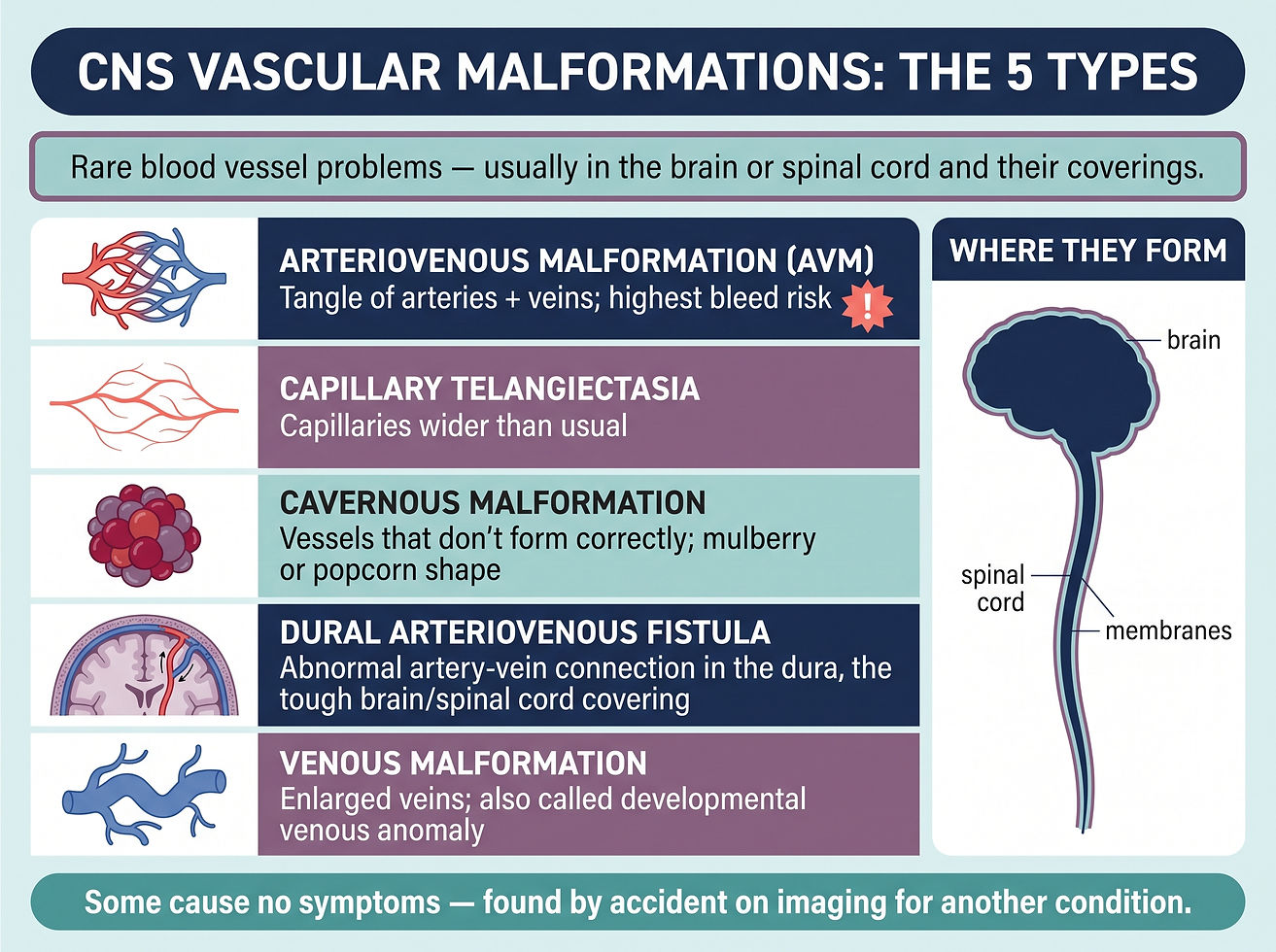
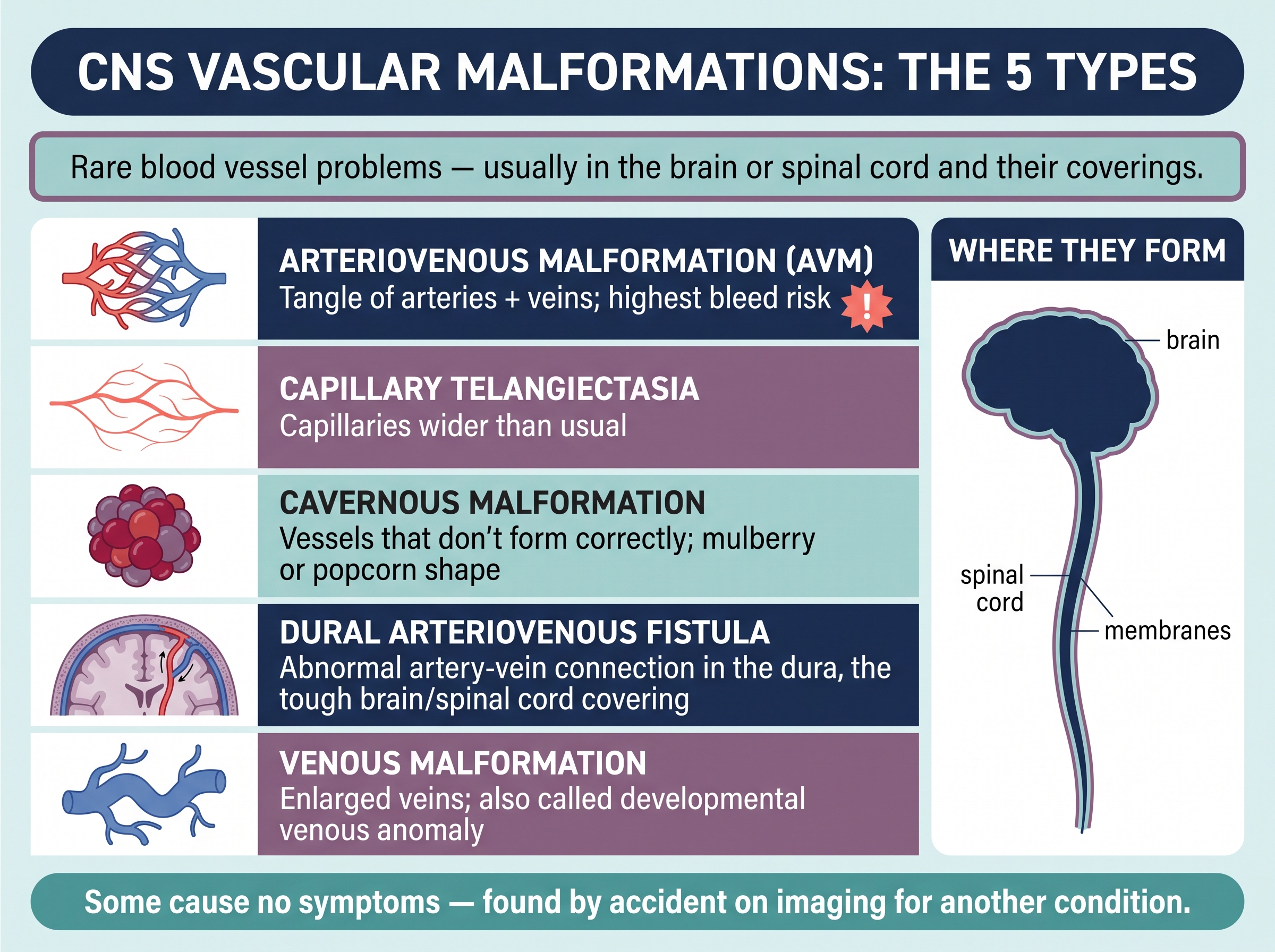
Central nervous system (CNS) vascular malformations are rare problems in blood vessels that usually form in the brain or spinal cord and their coverings. There are five main types, including arteriovenous malformations (AVMs), which carry the highest risk of bleeding.
Some cause no symptoms at all and are found by accident on imaging for another condition. When symptoms do occur, they can include bleeding, seizures, headaches, and neurological problems that worsen over time.
Treatment depends on the type, location, symptoms and bleeding risk — for some people, watchful monitoring is all that's needed; others may need surgery, radiation-based treatment, or a procedure that blocks blood flow to the malformation. If you've been diagnosed, close follow-up with a neurology team is essential.
TL;DR
CNS vascular malformations are rare structural issues in blood vessels, usually in the brain or spinal cord. The five types are arteriovenous malformations (AVMs — unusual artery-vein tangles with the highest bleed risk), capillary telangiectasias (unusually wide capillaries), cavernous malformations (mulberry- or popcorn-shaped vessels), dural arteriovenous fistulas (abnormal artery-vein connections in the dura), and venous malformations (enlarged veins, also called developmental venous anomalies).
Some people never have symptoms. When symptoms occur, they may include bleeding, seizures, headache, and neurological deficits — problems with speech, vision, balance or memory — that worsen over time.
The cause is often unclear: some are present at birth, some develop later, some may be genetic, and CNS injury can also play a role. Diagnosis involves imaging such as magnetic resonance angiography or CT angiography, and sometimes the doctor can hear a whooshing “bruit” from fast blood flow. Treatment ranges from monitoring to surgery, stereotactic radiosurgery, or endovascular embolization.
Limitation statement: This article is based exclusively on two expert-reviewed clinical overviews dated July 26, 2025. The sources contain no prevalence or outcome-rate statistics, and no statistics are presented or invented here. This is a general educational overview; only a healthcare professional can diagnose and manage a vascular malformation for you.
When Should You Seek Care?
Vascular malformations can damage the brain or spinal cord, and the complications list includes stroke, brain damage from a burst blood vessel, and death. A diagnosis — or new neurological symptoms — deserves prompt, serious attention.
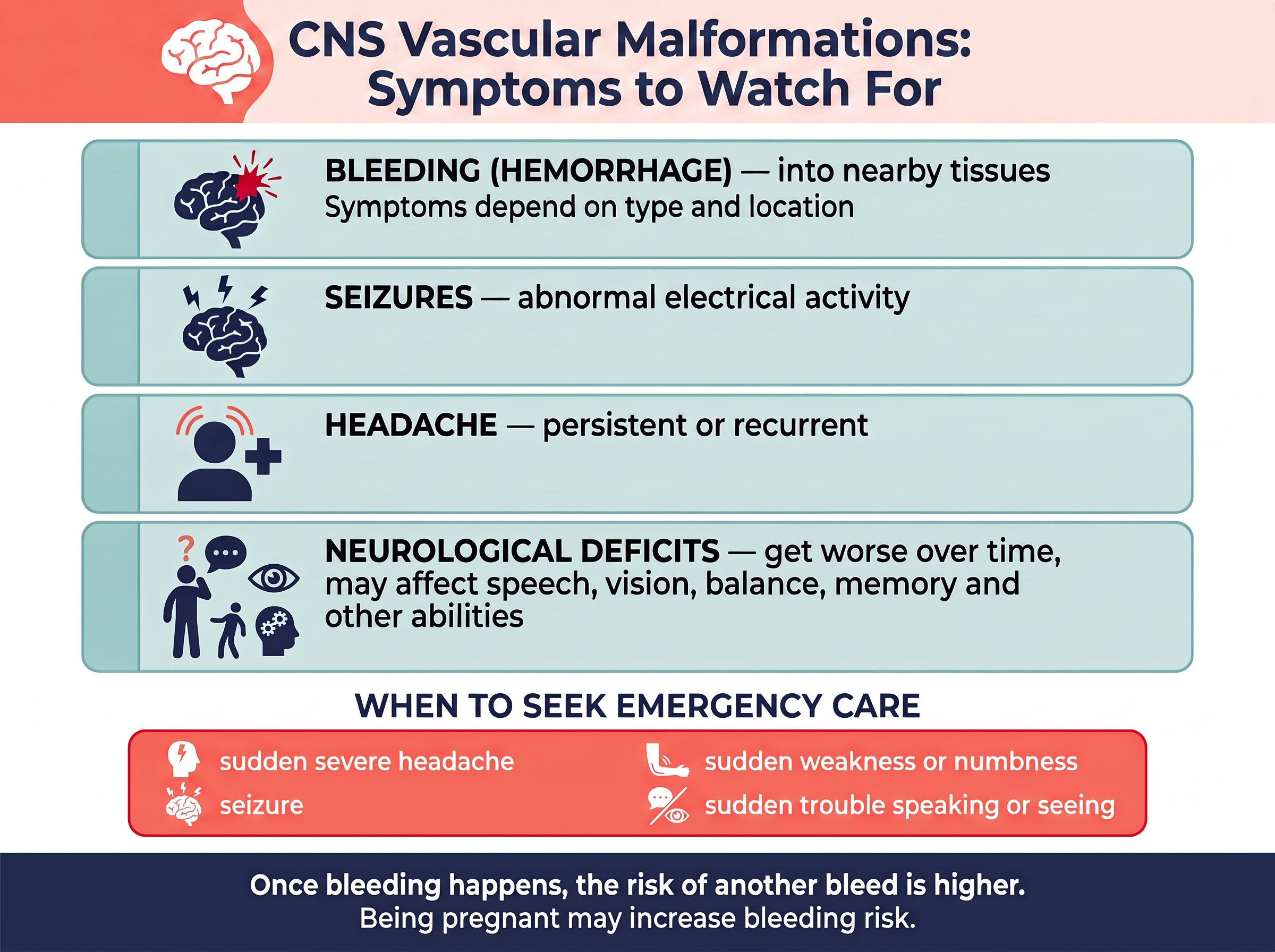
Seek emergency care right away if you or someone else experiences signs of bleeding in or around the brain or spinal cord, such as a sudden severe headache, seizure, sudden weakness or numbness, sudden trouble speaking or seeing, or any abrupt neurological change.
See a healthcare professional promptly if you have: new or worsening seizures, new or persistent headaches, or neurological symptoms (speech, vision, balance, memory) that develop or gradually worsen over time.
What Exactly Is a Central Nervous System Vascular Malformation?
Central nervous system vascular malformations are rare issues in blood vessels. They usually form in the brain or spinal cord and their coverings, called membranes.
Some malformations cause no symptoms at all. They may be found on imaging done to look for another condition.
There are five main types:
Type | What it is | Key detail from the sources |
|---|---|---|
Arteriovenous malformation (AVM) | An unusual tangle of blood vessels that connect arteries and veins | Can occur anywhere in the body, but most happen in or near the brain or spine; this type poses the highest risk of brain bleeds and other complications |
Capillary telangiectasia | Small blood vessels (capillaries) that are wider than usual | A vascular finding; the sources don't describe specific symptoms for this type |
Cavernous malformation | Blood vessels in the brain or spinal cord that don't form correctly | They look like mulberries or popcorn |
Dural arteriovenous fistula | Unusual connections between arteries and veins in the dura | The dura is the tough covering over the brain or spinal cord; these connections can lead to bleeding in the brain or other symptoms |
Venous malformation | Enlarged veins in the brain or spinal cord | Also called developmental venous anomalies |
What Are the Symptoms?
Symptoms depend on the type of vascular malformation and where it's found. As noted above, some cause no symptoms and are discovered by chance on imaging for something else.
For the ones that do cause symptoms, possibilities include:
Symptom | What it means |
|---|---|
Bleeding | Hemorrhage from the malformation |
Seizures | Abnormal electrical activity in the brain |
Headache | Persistent or recurrent head pain |
Neurological deficits | Brain and nervous system problems that get worse over time — may affect speech, vision, balance, memory and other abilities |
What Causes Central Nervous System Vascular Malformations?
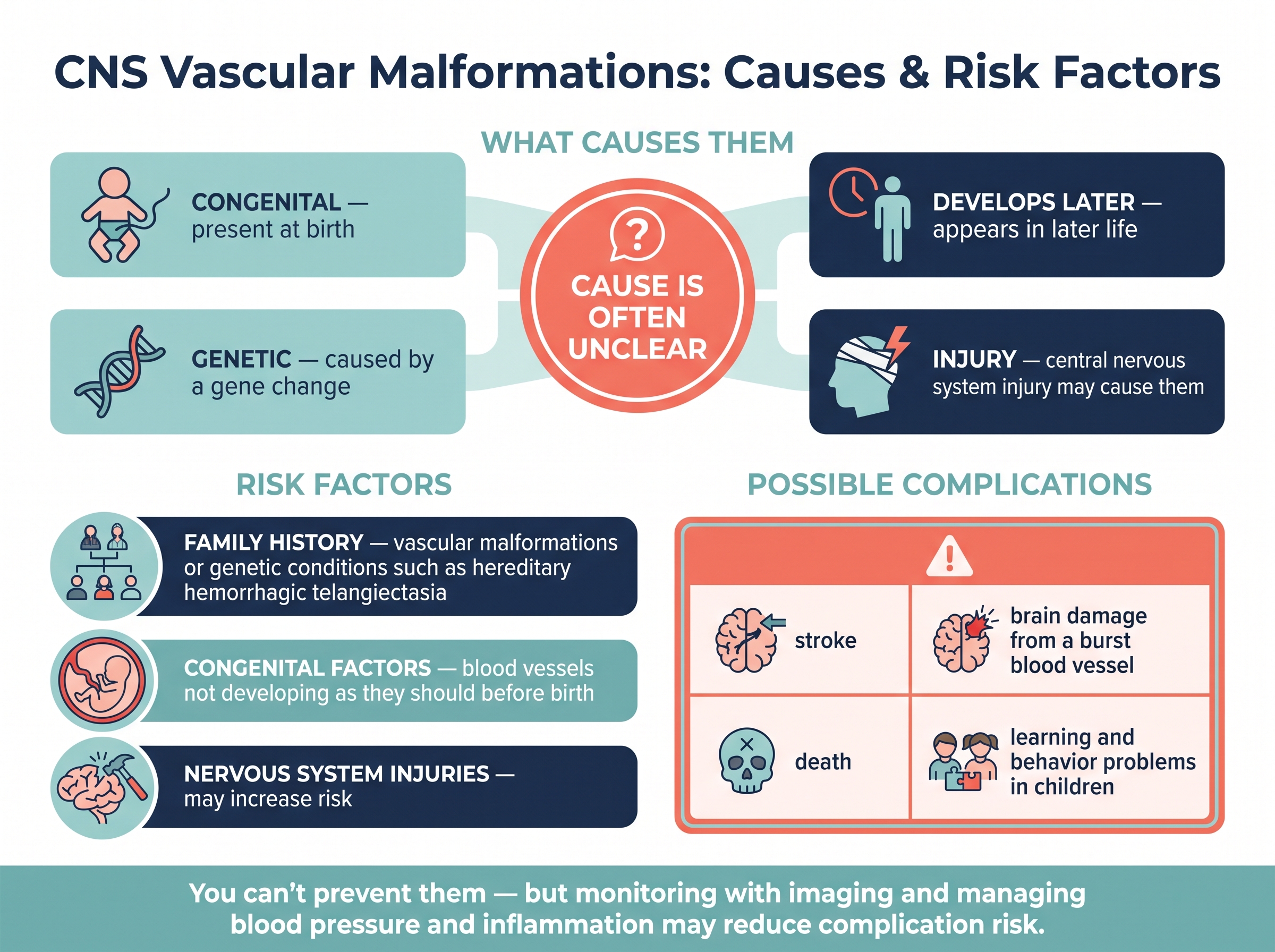
The cause of CNS vascular malformations is unclear.
What the sources do say: some are present at birth — these are called congenital. Others may happen later in life. Some may be caused by a change to a gene (genetic). Injury to the central nervous system also may cause these malformations.
Who Is at Higher Risk?
A family history of vascular malformations or of genetic conditions — such as hereditary hemorrhagic telangiectasia — may increase the risk of vascular malformations.
Rare congenital factors, such as blood vessels not developing as they should before birth, increase risk for the condition. Nervous system injuries also may increase risk.
Why Can These Malformations Be Serious?
Vascular malformations can damage the brain or spinal cord. Damage may come from bleeding — called hemorrhage — into nearby tissues. Once bleeding happens, there's a greater risk of having another bleed.
Vascular malformations also may block oxygen flow to tissues and put pressure on parts of the brain or spinal cord. Notably, being pregnant may increase the risk of bleeding for someone who has a vascular malformation.
Other possible complications include:
Complication | Note from the sources |
|---|---|
Stroke | Caused by disruption of blood flow |
Brain damage from a burst blood vessel | Related to hemorrhage |
Death | The most severe possible complication |
Learning and behavior problems in children | A long-term developmental complication |
To learn more about one of these complications, see our complete guide to stroke and our overview of transient ischemic attack (TIA).
Can You Prevent a Vascular Malformation?
You can't prevent vascular malformations. But if you have known risk factors, a few steps can help with early detection and management.
Monitoring helps find early signs of malformations using imaging. This is especially important if there is a family history of malformations or related genetic or congenital conditions. Your care team can discuss the best imaging tests for you and how often you need them.
Managing other conditions such as inflammation and high blood pressure may help too. While this doesn't prevent malformations, it may lessen the chances of complications such as hemorrhage.
How Are CNS Vascular Malformations Diagnosed?
To diagnose a CNS vascular malformation, a healthcare professional looks for a family history of stroke, epilepsy or related conditions.
You may have a physical exam. The professional may listen to the sound of blood flow in one of your arteries with a stethoscope. Some vascular malformations make a whooshing sound called a bruit — fast blood flow through a malformation causes it.
What Imaging Tests Are Used?
Imaging tests can detect a central nervous system vascular malformation. A magnetic resonance angiogram or a computerized tomography angiogram might be used to diagnose the malformation and plan treatment.
An angiogram shows blood flow through arteries or veins. A contrast material is put into the blood through an IV; the contrast lights up blood vessels on the angiogram image.
Some vascular malformations, such as cavernous malformations, are found using regular MRI or CT scans.
How Are They Treated?
Treatment depends on four things: the type of malformation, where it's found, the symptoms it causes, and the risk of the malformation bleeding.
Sometimes, watching for changes in the malformation might be all that's needed.
Medicines
Medicines to treat the symptoms of venous malformations include antiseizure medicines to treat seizures and pain relievers for headaches.
Surgery or Other Procedures
Some CNS vascular malformations that are very likely to bleed may be removed with a procedure. The choice depends on the malformation:
Procedure | How it works | What the sources say about risks and limits |
|---|---|---|
Surgery | Cutting into the brain or spinal cord to remove the malformation | Often used for an AVM that is small and in a place that's easy to reach. As with any surgery there are risks, such as infection and blood loss; there's also a risk of damaging nearby healthy tissue |
Stereotactic radiosurgery | Radiation beams aimed at the malformation damage the walls of its blood vessels, causing it to go away over time | Because it doesn't involve cutting, risks are lower than with standard surgery; however, there's a risk of radiation damage to healthy tissue |
Endovascular embolization | A long, thin catheter is placed into an artery in the leg or groin that feeds the malformation, then threaded to the brain using X-ray guidance; coils or a gluelike substance block the artery and lower blood flow | Often used with other surgical procedures; might not completely remove the malformation, or results might not last long |
What Should You Ask at the Appointment?
If you have symptoms, you might start by seeing your primary care provider — or you might learn you have a malformation after imaging tests for another condition. You might then be referred to a neurologist, a doctor who specializes in conditions of the nervous system.
When you make the appointment, ask if you need to do anything in advance, such as fasting before a specific test. Bring a list of your symptoms (including any that seem unrelated, and when they began), key medical information including personal and family medical history, and all medicines, vitamins or supplements you take with doses.
Helpful questions to ask include: What's likely causing my symptoms? What tests do I need? Is my condition likely temporary or chronic? What is the best course of action? What is my risk of complications? I have other health conditions — how can I best manage them together? Are there brochures or recommended websites?
If possible, bring a family member or friend to your appointment to help you remember the information you're given.
Your healthcare professional is likely to ask: How often do your symptoms happen? How painful are they? What seems to make them better? What seems to make them worse?
Conclusion
Central nervous system vascular malformations are rare, often silent, and sometimes serious. Many people never know they have one — it surfaces by accident on a scan for something else. Others find out through seizures, headaches, or neurological symptoms that gradually worsen.
The core message from the clinical sources is straightforward: the type, location, symptoms and bleeding risk all shape the plan. For some, careful monitoring is the whole treatment. For others — particularly those with malformations very likely to bleed — options include surgery, stereotactic radiosurgery, or endovascular embolization, each with its own trade-offs.
Because these malformations can damage the brain or spinal cord through bleeding, pressure, or blocked oxygen flow — and because one bleed raises the risk of another — a diagnosis deserves close, ongoing follow-up with a specialist team. Managing blood pressure and inflammation, and imaging follow-up especially with a family history, are the practical steps within your control.
If you've been told you have a vascular malformation, or you're having seizures, new headaches, or neurological symptoms that worsen — get evaluated by a healthcare professional. And if signs of bleeding ever appear suddenly, treat it as a medical emergency.
Frequently Asked Questions
What is a central nervous system vascular malformation?
It's a rare problem in blood vessels that usually forms in the brain or spinal cord and their coverings (membranes).
How many types are there?
There are five main types: arteriovenous malformations (AVMs), capillary telangiectasias, cavernous malformations, dural arteriovenous fistulas, and venous malformations.
Which type is the most dangerous?
Arteriovenous malformations (AVMs) pose the highest risk of brain bleeds and other complications.
Do vascular malformations always cause symptoms?
No. Some have no symptoms and are found on imaging done to look for another condition.
What symptoms can a brain or spinal vascular malformation cause?
Symptoms depend on the type and location, and may include bleeding, seizures, headache, and neurological deficits — problems with speech, vision, balance, memory and other abilities — that get worse over time.
Are vascular malformations and brain tumors the same thing?
No. A vascular malformation is a problem in blood vessels; it is not a tumor. You can read more in our guide to brain tumors.
Are they present at birth?
Some are present at birth (congenital); others may happen later. The cause of CNS vascular malformations is unclear.
Can they be genetic?
Some may be caused by a change to a gene. A family history of vascular malformations or of genetic conditions such as hereditary hemorrhagic telangiectasia may increase risk.
Can an injury cause one?
Injury to the central nervous system also may cause these malformations, and nervous system injuries may increase risk.
What is an AVM?
An arteriovenous malformation is an unusual tangle of blood vessels that connect arteries and veins. AVMs can occur anywhere in the body but most happen in or near the brain or spine.
What is a cavernous malformation?
These are blood vessels in the brain or spinal cord that don't form correctly. They look like mulberries or popcorn. For more detail, see our dedicated guide to cavernous malformations.
What is a dural arteriovenous fistula?
An unusual connection between arteries and veins that happens in the dura — the tough covering over the brain or spinal cord. It can lead to bleeding in the brain or other symptoms.
What are venous malformations?
Enlarged veins in the brain or spinal cord, also called developmental venous anomalies.
What are capillary telangiectasias?
Small blood vessels (capillaries) that are wider than usual.
How is it diagnosed?
A healthcare professional looks for a family history of stroke, epilepsy or related conditions, does a physical exam, and may listen with a stethoscope for a whooshing sound called a bruit, which fast blood flow through a malformation can cause. Imaging — such as magnetic resonance angiography or CT angiography — detects the malformation and helps plan treatment.
What is a bruit?
A whooshing sound made by some vascular malformations, caused by fast blood flow through the malformation. It can sometimes be heard with a stethoscope.
What does an angiogram show?
An angiogram shows blood flow through arteries or veins. A contrast material is injected through an IV, and it lights up blood vessels on the image.
Are they curable?
Some malformations very likely to bleed may be removed or treated so they go away over time, depending on the procedure. Sometimes watching for changes is all that's needed. Treatment decisions depend on the type, location, symptoms, and bleeding risk.
Is surgery the only treatment?
No. Options include surgery, stereotactic radiosurgery (targeted radiation that causes the malformation to go away over time), endovascular embolization (blocking the artery that feeds it), medicines for symptoms, and sometimes monitoring alone.
What is stereotactic radiosurgery?
Radiation beams aimed at the vascular malformation that damage the walls of its blood vessels, causing the malformation to go away over time. Because it doesn't involve cutting, risks are lower than with standard surgery, though there's a risk of radiation damage to healthy tissue.
What is endovascular embolization?
A procedure where a long, thin catheter is placed into an artery in the leg or groin that feeds the malformation, then threaded to the brain using X-ray guidance. Coils or a gluelike substance are sent through the tube to block the artery and lower blood flow. It's often used with other surgical procedures, might not completely remove the malformation, and results might not last long.
Can medicines treat the symptoms?
Yes — antiseizure medicines treat seizures and pain relievers treat headaches, for example in venous malformations.
Can a malformation get worse?
Vascular malformations can damage the brain or spinal cord, and complications can include stroke, brain damage, and death. Once bleeding happens, there's a greater risk of another bleed.
Is pregnancy riskier with a vascular malformation?
Being pregnant may increase the risk of bleeding for someone who has a vascular malformation. Discuss this with your care team.
Can children have learning or behavior problems from them?
Learning and behavior problems in children are listed among possible complications.
Can you prevent vascular malformations?
No — you can't prevent vascular malformations. But monitoring with imaging and managing conditions such as inflammation and high blood pressure may help with early detection and lessen the chance of complications like hemorrhage.
What should I ask at my appointment?
Ask what's likely causing your symptoms, what tests you need, whether the condition is likely temporary or chronic, the best course of action, your complication risk, how to manage other health conditions together, and whether there are recommended brochures or websites. Bring a family member or friend to help remember the information.
Related Reading
Sources
Central Nervous System Vascular Malformations — Symptoms & Causes — reviewed by medical experts; dated July 26, 2025.
Central Nervous System Vascular Malformations — Diagnosis & Treatment — reviewed by medical experts; dated July 26, 2025.
External References
Medical Disclaimer
This article is for general informational purposes only and does not constitute medical advice, diagnosis, or treatment. Always seek the advice of your physician or another qualified health provider with any questions you may have regarding a medical condition. Never disregard professional medical advice or delay seeking care because of something you have read here. Central nervous system vascular malformations can damage the brain or spinal cord, and complications may include stroke, brain damage, and death — seek emergency care for sudden severe headache, seizures, sudden weakness, or any abrupt neurological change. Only a healthcare professional can diagnose a vascular malformation and determine the right treatment plan for you, including whether monitoring, medication, or a procedure is appropriate.
Comments