Bubble Study (Bubble Echo): Finding PFO, ASD and Lung Shunts

Updated: 3 days ago
Written and medically reviewed by Dr. Baraa Alnahhal, MD · Last reviewed: November 2026 · How we review
Quick Answer
A bubble study is an ultrasound test that uses bubbles in shaken salt water to show how blood moves through the heart and lungs. It looks for abnormal openings (shunts), most often a patent foramen ovale (PFO). It's often done after an unexplained stroke. If bubbles appear on the left side of the heart, a shunt is likely.
What the research says
Bubble testing with TCD is highly accurate: a meta-analysis of 27 studies with 1,968 people found a transcranial Doppler bubble study had 97% sensitivity and 93% specificity for detecting a right-to-left shunt compared with a TEE bubble study (Mojadidi MK et al., JACC Cardiovasc Imaging, 2014) [2]
Finding a PFO can change treatment: in a randomized trial of people aged 16–60 with a stroke linked to a high-risk PFO, no strokes occurred over about 5 years in 238 people who had PFO closure, compared with 14 of 235 who took antiplatelet medicine alone (Mas JL et al., N Engl J Med, 2017) [3]
Key takeaways
Uses tiny saline bubbles during ultrasound to find shunts.
Most often finds a PFO, ASD or pulmonary AVM.
Often done after an unexplained stroke.
Can be paired with TTE, TEE or transcranial Doppler.
Very safe; TEE requires fasting and sedation.
What does a bubble study look for?
Normally, blood returning to the right side of the heart passes through the lungs before reaching the left side. Microbubbles are filtered out by the lungs, so they shouldn't appear on the left side. If they do, blood is taking a shortcut called a shunt. Sources: [1]
Patent foramen ovale (PFO): a flap-like opening between the upper chambers.
Atrial septal defect (ASD): a hole between the upper chambers; some types only show up on a bubble study.
Pulmonary AVM: abnormal vessels in the lungs that let blood skip the lung's filter. Sources: [1]
Why is it done?
A bubble study may be ordered if you've had a stroke with no clear cause, or if you have signs of a shunt such as low blood oxygen or shortness of breath. Some shunts let clots travel to the brain and cause an embolic stroke. Sources: [1, 3]
Types of bubble studies
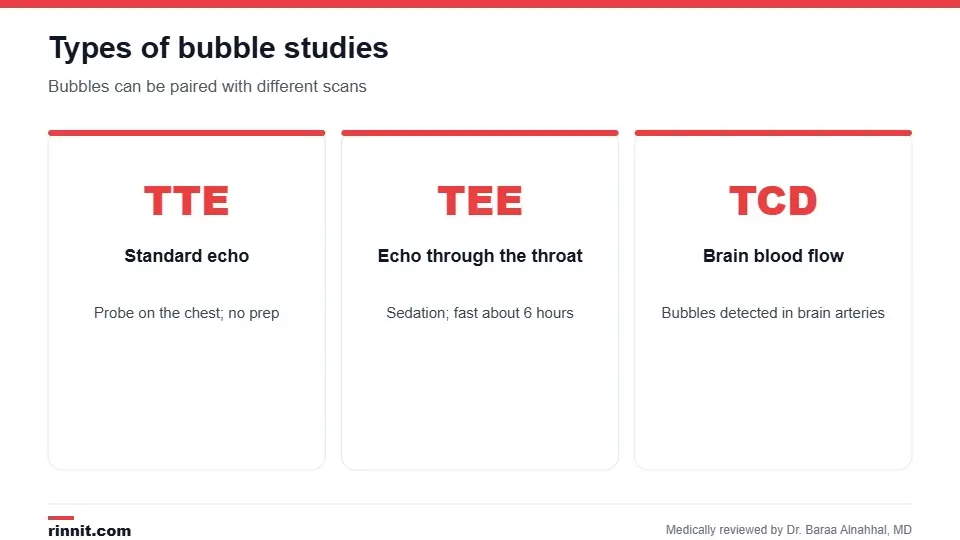
A bubble study can be paired with different scans.
Paired with | How it works | Preparation |
Probe on the outside of the chest | None | |
Small probe passed down the throat under sedation | Fast about 6 hours; need a driver | |
Detects bubbles in the brain's arteries | None |
Sources: [1]
What happens during the test?
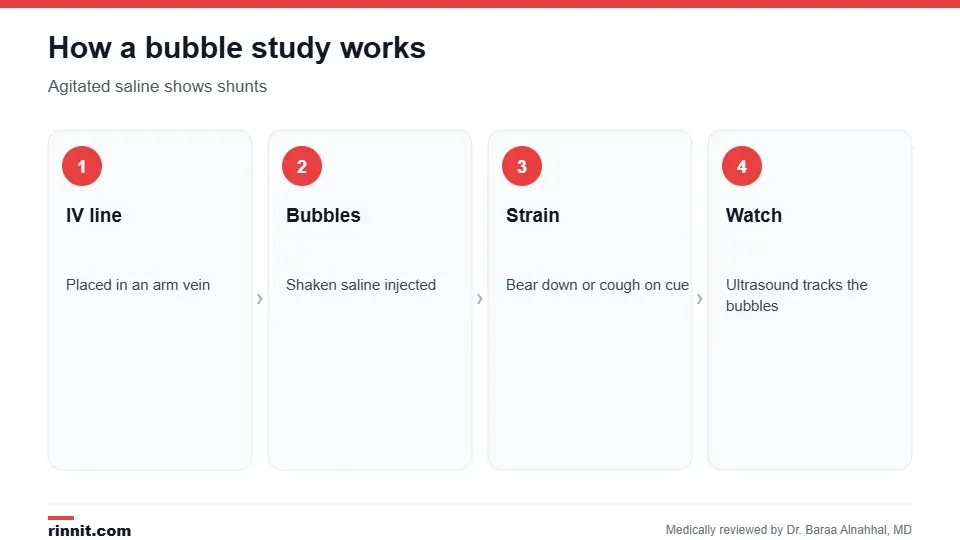
Bubbles show whether blood crosses a shunt.
You lie on your left side if you can, and gel is applied to your chest.
An IV is placed in your inner elbow or forearm.
Salt water is shaken with a little air, sometimes with a small amount of your blood, to make microbubbles.
The bubbles are injected while the ultrasound watches the heart.
You may be asked to bear down (Valsalva maneuver) or cough hard to briefly raise pressure on the right side and push bubbles across any opening. Sources: [1]
Risks
A bubble study is safe and low risk. A stroke is a very rare complication and is usually mild and treatable. After a TEE, you'll be watched as the sedation wears off and can't drive for 24 hours. Sources: [1]
Understanding your results

Timing of bubble crossing helps identify the shunt.
Negative: no bubbles appear on the left side, suggesting no shunt.
Positive: bubbles appear on the left side, suggesting a shunt.
Fast crossing: points to a heart opening such as a PFO or ASD.
Delayed crossing: points to a lung shunt such as a pulmonary AVM.
More bubbles: usually means a larger shunt. Sources: [1, 2]
False negatives can happen, especially when pressure on the right side of the heart is high. Treatment, if needed, may include blood thinners or a procedure such as PFO closure. Sources: [1, 3]
Conclusion
A bubble study is a simple add-on to an ultrasound that can uncover hidden heart and lung shunts. It's a key test after an unexplained stroke, because finding a PFO or other shunt can change treatment.
Keep learning: read about patent foramen ovale and the echocardiogram.
Frequently asked questions
What is a bubble study?
An ultrasound test using tiny saline bubbles to find shunts.
What does it diagnose?
Mostly PFO, ASD and pulmonary AVM.
Why would I need one after a stroke?
To look for a heart opening that could let clots reach the brain.
Does it hurt?
Only the IV placement; the bubbles aren't felt.
Do I need to fast?
Only if it's done with a TEE.
What does a positive result mean?
Bubbles crossed to the left side, suggesting a shunt.
Can it miss a shunt?
Yes. False negatives are possible.
Is it safe?
Yes. Serious problems are very rare.
Can I drive afterward?
Yes after TTE or TCD; not for 24 hours after TEE.
What happens if a PFO is found?
Treatment may include blood thinners or PFO closure.
Related Reading
Patent Foramen Ovale (PFO): Symptoms, Causes, and Treatment the most common shunt a bubble study finds.
Atrial Septal Defect (ASD): Symptoms, Types, Causes, Diagnosis & Treatment — Complete Guide another heart hole found with bubbles.
Echocardiogram: Types, What to Expect, Results and Risks the ultrasound a bubble study is added to.
Transesophageal Echocardiogram (TEE): Why It's Done, What to Expect and Risks a closer echo view through the throat.
PFO Closure: Procedure, Benefits, and Recovery a treatment after a PFO is found.
References
Cleveland Clinic. Understanding a Bubble Study (Bubble Echocardiogram). Cleveland Clinic. Last updated September 30, 2026. https://my.clevelandclinic.org/health/diagnostics/bubble-study
Mojadidi MK, Roberts SC, Winoker JS, et al. Accuracy of transcranial Doppler for the diagnosis of intracardiac right-to-left shunt: a bivariate meta-analysis of prospective studies. JACC Cardiovasc Imaging. 2014;7(3):236-250. PMID 24560213. https://doi.org/10.1016/j.jcmg.2013.12.011
Mas JL, Derumeaux G, Guillon B, et al. Patent foramen ovale closure or anticoagulation vs. antiplatelets after stroke. N Engl J Med. 2017;377(11):1011-1021. PMID 28902593. https://doi.org/10.1056/NEJMoa1705915
Medical disclaimer
This article is for general education only and does not replace advice from a qualified healthcare professional. Talk to your doctor about your own diagnosis and treatment, and seek emergency care right away for severe or sudden symptoms.



Comments