Vasospasm: Symptoms, Causes, and Management

Updated: 3 days ago
Medically reviewed by Dr. Baraa Alnahhal, MD · Last reviewed: October 2026
Editorial note: This article is provided for educational purposes only. It is not medical advice. Always consult a qualified healthcare professional about your individual health situation.
Quick Answer: What is a vasospasm?
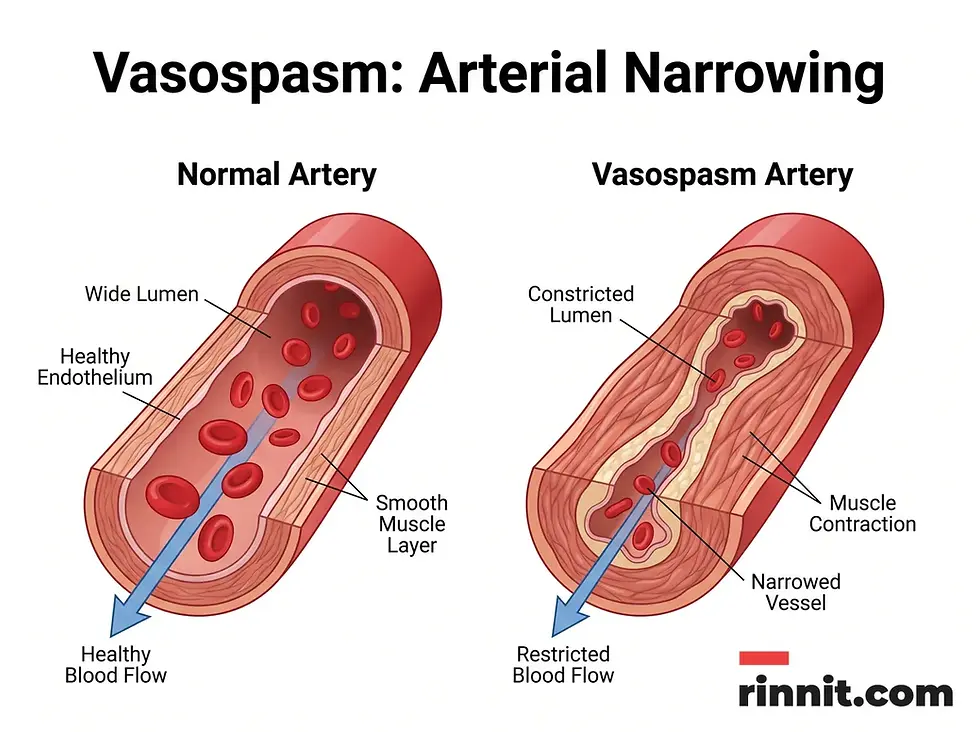
A vasospasm is a condition in which an artery narrows or tightens for an extended period, longer than a normal muscle constriction, reducing oxygen-rich blood flow to nearby organs and tissues. [1] It can occur anywhere in the body, but it is most dangerous in the heart or brain, where it can cause permanent tissue damage or life-threatening events.
What the research says
Cerebral vasospasm after a ruptured aneurysm is common, but estimates vary widely. Pooling 120 studies with 19,171 participants, about 42% (95% CI 39–46%) of patients were diagnosed with cerebral vasospasm after aneurysmal subarachnoid hemorrhage. Reported rates ranged from 9% to 93%, partly because more than 40 different diagnostic criteria were used; routine imaging found more cases (47%) than imaging done only when indicated (30%). (Donaldson et al., Neuroradiology, 2022 [2])
Calcium channel blockers are first-line for coronary artery spasm. A review of coronary artery spasm reports that provocative testing is the cornerstone of diagnosis, that long-acting non-dihydropyridine calcium channel blockers are recommended as first-line therapy, and that combination therapy is proposed for refractory cases. The review also notes that the prevalence of spasm tends to fall as calcium channel blockers, ACE inhibitors and statins are used more widely. (Matta et al., J Interv Cardiol, 2020 [3])
When to Call Your Care Team
Emergency notice: Seek immediate medical attention if you experience sudden, severe chest pain, or symptoms of a stroke such as those below. These may be signs of a critical vasospasm in the heart or brain.
A sudden “thunderclap” headache
Drowsiness
The inability to move one side of your body
Understanding Vasospasm
Arteries are not rigid pipes; they have muscular walls that naturally expand and contract to regulate blood pressure. [1] A vasospasm occurs when these smooth muscles overreact to signals and stay constricted for an abnormally long time. [1] This extended “clenching” can damage the layers of the artery walls and is more likely to occur in vessels that already have abnormal areas, a condition known as endothelial dysfunction. [1]
Types of Vasospasm and Their Impact
The severity and symptoms of a vasospasm depend entirely on which artery is affected. The body can experience these contractions in several distinct regions:
Coronary vasospasm: Also known as Prinzmetal angina, this affects the heart’s arteries. It can limit blood flow enough to cause a heart attack or sudden cardiac death. [1]
Cerebral vasospasm: Occurring in the brain, this can lead to a cerebral infarct, which is essentially a “heart attack in the brain.” It is extremely common following a brain aneurysm rupture, affecting roughly 4 in 10 such patients in pooled studies, though reported rates range from 9% to 93%. [1]
Peripheral vasospasm: These occur in the fingers or toes, often as part of Raynaud’s phenomenon, leading to numbness and skin color changes. [1]
Nipple vasospasm: Affecting an estimated 20% of breastfeeding women, this can cause significant pain and make breastfeeding difficult. [1]
Symptoms by Location
Because vasospasms affect different organs, the signs can vary significantly.
Location | Common Symptoms |
Heart | Chest pain at rest (often at night or early morning), fainting, cardiac arrest. [1] |
Brain | Sudden, severe headache; drowsiness; weakness on one side of the body. [1] |
Fingers/toes | Coldness, numbness, skin turning white/blue/red, tingling or throbbing. |
Nipples | Intense pain during or after breastfeeding, nipples changing color (white to purple). |
Causes and Triggers
The underlying causes of vasospasm are diverse and specific to the affected area. While some causes are genetic or related to underlying diseases, others are linked to external substances.
Heart triggers: Inflammation, migraines, chemotherapy, and the use of substances like cocaine, amphetamines, or cannabis. [1]
Brain triggers: Most commonly a ruptured brain aneurysm or other forms of bleeding around the brain (subarachnoid hemorrhage). [1]
Extremity triggers: Raynaud’s phenomenon, autoimmune diseases like scleroderma, or blood clots. [1]
Breastfeeding triggers: Exposure to cold, poor infant latch, tobacco use, or certain nipple creams and medications. [1]

Diagnosis and Treatment
Healthcare providers use a combination of physical exams and advanced imaging to diagnose vasospasms. [1] Common tests include Electrocardiograms (EKG) for the heart, and CT or MRI scans for the brain.
Management Strategies
Treatment focuses on relaxing the smooth muscles of the arteries and removing known triggers.
Medications: Calcium channel blockers (like amlodipine or nifedipine) and nitrates are the primary treatments used to prevent and stop spasms. [1] [3]
Lifestyle changes: Stopping tobacco and recreational drug use, losing weight, and limiting alcohol are critical for long-term management. [1]
Specialized care: For cerebral vasospasm after a brain bleed, hospital teams give the medicine nimodipine to lower the risk of brain injury, keep fluid levels normal and may raise blood pressure under close monitoring. [1] Nipple vasospasms are managed with warmth [1] and improved breastfeeding techniques.
Surgical options: In severe cases, botulinum toxin injections or the implantation of a cardioverter defibrillator (ICD) may be required. [1]

Conclusion
While vasospasms in the extremities are often just painful or bothersome, those affecting the heart and brain are serious medical conditions requiring expert care. By managing cardiovascular health—including blood pressure, cholesterol, and tobacco use—you can significantly reduce your risk of dangerous arterial tightening.
Are you experiencing unusual numbness in your extremities or chest discomfort at rest? Consult a healthcare provider for a thorough cardiovascular evaluation to rule out vasospasm.
Frequently Asked Questions
1. Is a vasospasm a heart attack?
Not necessarily, but a coronary vasospasm can cause a heart attack if it lasts long enough to destroy heart tissue.
2. What does a brain vasospasm feel like?
A brain vasospasm often presents as a sudden, severe “thunderclap” headache, which may be accompanied by weakness or drowsiness.
3. Can stress cause vasospasms?
Yes, researchers have linked coronary vasospasms to anxiety and depression, and emotional stress can be a trigger.
4. Why do my fingers turn white in the cold?
Fingers turning white in the cold is likely a peripheral vasospasm, often associated with Raynaud’s phenomenon, where cold triggers the arteries in the fingers to tighten.
5. How long does a vasospasm last?
By definition, it lasts longer than a normal muscle constriction, but the exact duration varies based on the cause and treatment.
6. Is vasospasm hereditary?
Some cases, particularly coronary vasospasms, have been linked to genetic mutations.
7. Can breastfeeding cause vasospasms?
Yes, nipple vasospasms are common in breastfeeding women, often triggered by cold or a poor latch.
8. What is the main treatment for vasospasm?
Calcium channel blockers are the most common medications used to relax the arterial muscles.
9. Can drugs cause vasospasms?
Yes, cocaine, amphetamines, and cannabis are known triggers for coronary vasospasms.
10. Are vasospasms life-threatening?
Vasospasms in the fingers, toes, or nipples are not, but cerebral and coronary vasospasms can be fatal.
11. How do doctors diagnose a heart vasospasm?
Doctors may use an EKG or perform an angiogram where they intentionally trigger a spasm with medicine to observe the reaction.
12. Can I prevent vasospasms?
You can reduce your risk by avoiding tobacco, managing blood pressure and cholesterol, and avoiding recreational drugs.
13. What is the “Shock Position”?
For non-head-injured patients in shock, it involves elevating the feet 12 inches to help blood flow to the vital organs.
14. Does alcohol affect vasospasms?
Limiting alcohol is recommended, as it can impact overall cardiovascular health and blood vessel function.
15. What should I do if I suspect a vasospasm?
If it’s in the heart or brain, call 911. For other areas, schedule an appointment with your healthcare provider.
Related Reading
Transcranial Doppler (TCD): Ultrasound of Blood Flow in the Brain explains the ultrasound test that measures blood flow in the brain.
References
Cleveland Clinic. Vasospasm. Cleveland Clinic. March 10, 2023. https://my.clevelandclinic.org/health/diseases/24825-vasospasm
Donaldson L, Edington A, Vlok R, et al. The incidence of cerebral arterial vasospasm following aneurysmal subarachnoid haemorrhage: a systematic review and meta-analysis. Neuroradiology. 2022;64(12):2381-2389. PMID 35794390. https://doi.org/10.1007/s00234-022-03004-w
Matta A, Bouisset F, Lhermusier T, et al. Coronary artery spasm: new insights. J Interv Cardiol. 2020;2020:5894586. PMID 32508542. https://doi.org/10.1155/2020/5894586
Medical disclaimer
The information provided in this article is for educational purposes only and should not be used as a substitute for professional medical advice, diagnosis, or treatment. Always seek the advice of your physician or other qualified health provider with any questions you may have regarding a medical condition.



Comments