Endovenous Thermal Ablation: Procedure, Recovery, and Risks

Updated: 6 days ago
Written and medically reviewed by Dr. Baraa Alnahhal, MD · Last reviewed: October 2026 · How we review
Quick Answer: What is endovenous thermal ablation?
Endovenous thermal ablation is a minimally invasive procedure that seals off medium to large varicose veins in the legs using laser or radiofrequency heat delivered through a thin catheter. It is done under local anesthesia, usually takes about one hour, and lets you go home the same day. Most people return to work within a few days. [1]
What the research says
Laser and radiofrequency work about equally well. A meta-analysis of 29 studies (16 randomized trials) found the treated vein stayed closed in about 98% of patients at 1 month with either method, and in 93.1% (radiofrequency) vs 94.2% (laser) at 1 year. Blood clot events stayed below 1% in both groups (0.78% vs 0.87%). (Jiang et al., J Vasc Surg Venous Lymphat Disord, 2024) [2]
Long-term results match traditional surgery. A review of 9 randomized trials covering 2,185 legs found no significant difference in 5-year varicose vein recurrence between laser ablation and surgery (36.6% vs 33.3%), although the authors noted that numbers were too small for definitive conclusions. (Kheirelseid et al., J Vasc Surg Venous Lymphat Disord, 2018) [3]
Better quality of life at 5 years than foam injections. In a randomized trial of 798 people, those treated with laser ablation or surgery reported better vein-related quality of life 5 years later than those treated with foam sclerotherapy, and 77.2% of cost-effectiveness models favored laser ablation. (Brittenden et al., N Engl J Med, 2019) [4]
Key takeaways
Endovenous thermal ablation closes a faulty vein from the inside with heat. The vein stays in place, and blood reroutes to healthy veins.
It is an outpatient procedure with a small incision and usually no stitches.
Compared with vein surgery, it typically means less pain, fewer complications, minimal scarring, and a faster return to normal life.
Side effects such as bruising, tingling, and soreness usually fade within a few weeks. Blood clots are rare but need emergency care.

How does endovenous thermal ablation work?
Endovenous thermal ablation works by heating the inside of a varicose vein until it permanently seals shut. Once the vein is closed, blood flows through nearby healthy veins instead, which restores normal circulation in the leg. [1]
The procedure is also called endovenous laser therapy or radiofrequency therapy, depending on the energy source used. [1]
The vein is not removed. Over time it shrinks, and after successful treatment you should no longer see or feel it. [1]
Laser vs radiofrequency at a glance
Feature | Endovenous laser ablation | Radiofrequency ablation |
Energy source | Laser light that generates heat | High-frequency radio waves that generate heat |
How it reaches the vein | Thin tool passed through a catheter | Thin tool passed through a catheter |
Effect on the vein | Permanently seals it | Permanently seals it |
Vein closure at 1 year (research) | 94.2% | 93.1% |
Blood clot events at 1 month (research) | 0.87% | 0.78% |
Research figures from a 2024 meta-analysis of 29 studies. [2]
Why is endovenous thermal ablation done?
Endovenous thermal ablation is done to treat medium to large varicose veins in the legs. These are swollen, twisted veins that bulge just under the skin and often look blue, purple, or skin-colored. They usually appear on the legs, feet, and ankles. [1]
Varicose veins form when the one-way valves inside your veins become weak or damaged. Normally, these valves keep blood moving toward your heart. When they fail, blood pools in the vein and causes a visible, sometimes painful bulge. [1]
Common symptoms that lead people to seek treatment include:
Aching legs
A heavy feeling in the legs and feet
Itching
Leg cramps, especially at night
Swelling
Some people choose treatment for cosmetic reasons. Others need it because varicose veins can lead to complications such as deep vein thrombosis (DVT), skin sores, or bleeding. [1]
If your vein problems are more advanced, you may also want to read about chronic venous insufficiency and venous ulcers.
Is endovenous thermal ablation considered surgery?
Endovenous thermal ablation is not considered surgery. It is a nonsurgical, minimally invasive procedure that needs only one small incision. [1]
Traditional varicose vein surgery, known as vein ligation and stripping, removes the affected veins through several incisions and needs several weeks of recovery. With thermal ablation, the vein stays in place, complications are fewer, and recovery is usually much shorter. [1]
Endovenous ablation vs vein surgery at a glance
Endovenous thermal ablation | Varicose vein surgery | |
Incisions | One small incision | Several incisions |
What happens to the vein | Sealed and left in place | Removed |
Typical setting | Office-based, same-day discharge | Surgical procedure |
Recovery | Usually back to work in a few days | Several weeks |
Scarring | Minimal | More incisions to heal |
Complications | Fewer | More |
The procedure is usually performed by a vascular surgeon or vascular specialist in an office-based setting. [1]
How do you prepare for endovenous thermal ablation?
Preparing for endovenous thermal ablation starts with telling your provider about every medication, vitamin, and supplement you take. You may need to stop some medications before the procedure, and your provider will give you exact instructions. [1]
Your provider will also review your symptoms and any other health conditions you have. Plan ahead for someone to drive you home afterward. [1]
What happens during endovenous thermal ablation?
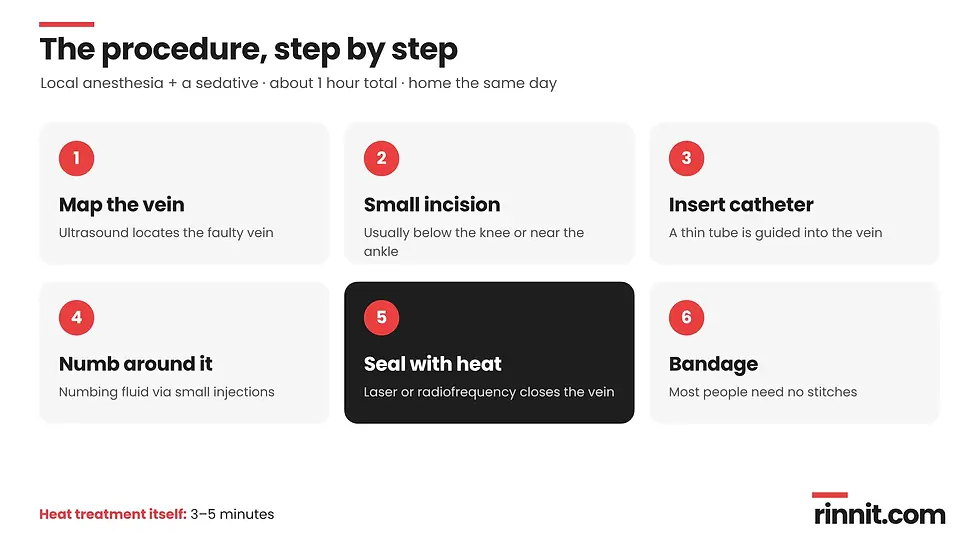
During endovenous thermal ablation, your provider uses ultrasound to guide a thin heat-producing tool into the faulty vein and seal it shut. Before starting, you receive two types of anesthesia: local anesthesia to numb the area around the vein and a sedative to help you relax. [1]
The procedure follows these steps: [1]
Map the vein. Your provider finds the vein using ultrasound.
Make a small incision. It is usually placed below the knee or near the ankle.
Insert the catheter. A thin tube is passed through the incision and guided into the vein.
Numb around the vein. Numbing fluid is placed around the vein through a series of small injections.
Seal the vein. A thin tool inside the catheter uses laser or radiofrequency energy to generate heat and permanently close the vein.
Cover the incision. A bandage goes over the incision. Most people do not need stitches.
How long does endovenous thermal ablation take?
Endovenous thermal ablation usually takes about one hour from start to finish. The heat treatment itself takes only three to five minutes. Because it is an outpatient procedure, you go home the same day. [1]
Is endovenous thermal ablation painful?
Endovenous thermal ablation is not painful during the procedure because anesthesia blocks the pain. [1]
Afterward, you may notice soreness, tingling, or bruising near the treated vein. Over-the-counter pain relievers usually control this, but ask your provider which ones are safe for you. [1]
What happens after endovenous thermal ablation?
After endovenous thermal ablation, you care for the small incision at home and wear compression socks while it heals. Your provider will usually ask you to: [1]
Keep the incision clean and dry
Wear compression socks
Raise the treated leg when you can
Avoid swimming and hot tubs
About one week later, your provider performs an ultrasound to confirm that the vein is fully sealed. [1]

What is the recovery time for endovenous thermal ablation?
Recovery from endovenous thermal ablation is usually quick, and most people return to work within a few days. If your job is physically demanding or keeps you on your feet all day, you may need more time off. Ask your provider when it is safe to go back. [1]
Endovenous ablation recovery timeline
When | What to expect or do |
Procedure day | Go home the same day; someone else must drive you |
First days | Walk and move often; sleep well; manage soreness as advised |
Within a few days | Most people return to work |
About 1 week | Follow-up ultrasound confirms the vein is sealed |
First 2 weeks | Do not fly |
A few weeks | Bruising, tingling, or soreness should have improved |
Until cleared | Avoid strenuous exercise until your provider says it is safe |
To support healing, move and walk around frequently during the day, get enough sleep, and hold off on strenuous exercise until your provider approves it. [1]
What are the benefits of endovenous thermal ablation?
The main benefit of endovenous thermal ablation is that it treats varicose veins with a faster recovery and lower complication risk than surgery, because the vein is sealed rather than removed. [1]
Compared with varicose vein surgery, the benefits include: [1]
Less pain
Fewer complications
Minimal scarring
Cosmetic results that are usually equal to or better than surgery
A shorter recovery and a quicker return to your routine
Long-term studies support these advantages. Five-year recurrence rates appear similar to surgery [3], and quality of life five years later is better than with foam injections. [4] For smaller veins, sclerotherapy is another option worth discussing with your provider. You can compare all the options in our guide to venous disease treatments.
What are the risks of endovenous thermal ablation?
Endovenous thermal ablation is generally safe when a licensed and experienced provider performs it. Possible side effects include: [1]
Bruising
Numbness or tingling
Pain
Blood clots in the legs (rare)
Most side effects improve within a few weeks. [1] In research, blood clot events after the procedure occurred in fewer than 1 in 100 patients. [2]
When should you go to the emergency room after endovenous thermal ablation?
You should go to the emergency room right away after endovenous thermal ablation if you notice any sign of a blood clot. These signs include: [1]
Chest pain
Coughing up blood
Fast heart rate
A pulling feeling in your calf
Lightheadedness or fainting
Pain or tenderness that gets worse instead of better
Discolored skin
Swelling
Trouble breathing
Chest pain, coughing up blood, and trouble breathing can signal that a clot has reached the lungs, a condition called pulmonary embolism. It needs emergency care.
Conclusion
Endovenous thermal ablation is a proven way to get rid of medium to large varicose veins without traditional surgery. A thin catheter delivers laser or radiofrequency heat that seals the faulty vein in about an hour, and most people are back at work within days. Recovery is simple: walk often, wear compression socks, skip flights for two weeks, and attend your one-week ultrasound. Side effects are usually mild and short-lived, but signs of a blood clot always need emergency care.
Living with aching, swollen, or bulging leg veins? Talk to a vascular specialist about whether endovenous thermal ablation fits your situation, and keep learning with our guides to venous disease and how your veins work. Explore more trusted, research-backed health guides on Rinnit.com.
FAQ
What is endovenous thermal ablation?
Endovenous thermal ablation is a minimally invasive procedure that uses laser or radiofrequency heat to seal off varicose veins in the legs. Blood then reroutes to healthy veins, and the sealed vein shrinks over time.
Is endovenous thermal ablation the same as laser vein treatment?
Endovenous thermal ablation includes laser treatment but is a broader term. It can use either laser energy (endovenous laser therapy) or radiofrequency energy (radiofrequency therapy), and both seal the vein with heat.
How long does endovenous thermal ablation take?
Endovenous thermal ablation usually takes about one hour. The actual heat treatment lasts only three to five minutes, and you go home the same day.
Does endovenous thermal ablation hurt?
Endovenous thermal ablation does not hurt during the procedure because you receive local anesthesia and a sedative. Afterward, mild soreness, tingling, or bruising is common and usually eases with over-the-counter pain relief your provider approves.
How soon can I return to work after endovenous thermal ablation?
Most people can return to work a few days after endovenous thermal ablation. If your job is physically demanding or keeps you standing all day, you may need more time off.
Can I fly after endovenous thermal ablation?
You should not fly for two weeks after endovenous thermal ablation. Ask your provider before booking any travel during your recovery.
What are the side effects of endovenous thermal ablation?
The most common side effects of endovenous thermal ablation are bruising, numbness or tingling, and pain near the treated vein. These usually improve within a few weeks. Blood clots in the legs are rare.
When should I seek emergency care after endovenous thermal ablation?
Seek emergency care after endovenous thermal ablation if you have chest pain, trouble breathing, coughing up blood, a fast heart rate, fainting, or calf pain and swelling that get worse. These can be signs of a blood clot.
Will I need to wear compression stockings after endovenous thermal ablation?
Most people wear compression stockings for a period after the procedure to reduce swelling and bruising. Your provider will tell you how long to wear them.
Is endovenous thermal ablation done with anesthesia?
Usually it is done with local numbing medicine injected around the vein, so you stay awake. Some people also get a mild sedative to help them relax.
Related Reading
What Are Varicose Veins? A Plain-Language Guide to the Bulging, Twisted Veins That Most Often Show Up on the Legs explains what causes varicose veins and how they are treated.
Chronic Venous Insufficiency (CVI): What It Is, Why It Happens, and How It Gets Treated covers leg veins that struggle to return blood to the heart.
Sclerotherapy: A Minimally Invasive Treatment for Varicose and Spider Veins describes how vein injections close spider and varicose veins.
Vein Ligation and Stripping for Varicose Veins explains the surgical option for removing varicose veins.
References
Cleveland Clinic. Endovenous Ablation: Procedure Details and Recovery. Cleveland Clinic. Last updated October 20, 2022. https://my.clevelandclinic.org/health/treatments/16965-endovenous-thermal-ablation
Jiang W, Liang Y, Long Z, et al. Endovenous radiofrequency ablation vs laser ablation in patients with lower extremity varicose veins: a meta-analysis. J Vasc Surg Venous Lymphat Disord. 2024;12(5):101842. PMID 38316290. https://doi.org/10.1016/j.jvsv.2024.101842
Kheirelseid EAH, Crowe G, Sehgal R, et al. Systematic review and meta-analysis of randomized controlled trials evaluating long-term outcomes of endovenous management of lower extremity varicose veins. J Vasc Surg Venous Lymphat Disord. 2018;6(2):256-270. PMID 29292115. https://doi.org/10.1016/j.jvsv.2017.10.012
Brittenden J, Cooper D, Dimitrova M, et al. Five-year outcomes of a randomized trial of treatments for varicose veins. N Engl J Med. 2019;381(10):912-922. PMID 31483962. https://doi.org/10.1056/NEJMoa1805186
Further reading (external):
National Heart, Lung, and Blood Institute. Varicose Veins. NHLBI Health Topics. Last updated September 26, 2023. https://www.nhlbi.nih.gov/health/varicose-veins
RadiologyInfo.org (RSNA and ACR). Varicose Vein Treatment (Endovenous Ablation of Varicose Veins). RadiologyInfo.org. Last reviewed August 16, 2024. https://www.radiologyinfo.org/en/info/varicoseabl
Medical disclaimer
This article is for general educational purposes only and does not replace professional medical advice, diagnosis, or treatment. Always talk to a qualified healthcare provider about your symptoms and treatment options. If you think you have a medical emergency, call your local emergency number or go to the nearest emergency room right away.



Comments