Venous Disease: Symptoms, Types, and Management Options

Updated: 3 days ago
Medically reviewed by Dr. Baraa Alnahhal, MD · Last reviewed: October 2026
Editorial note: This article is provided for educational purposes only. It is not medical advice. Always consult a qualified healthcare professional about your individual health situation.
Quick Answer: What Is Venous Disease?
Venous disease is any condition affecting the veins, which carry oxygen-poor blood back to the heart. When vein valves fail or walls weaken, blood can pool or clot. Common forms include deep vein thrombosis (DVT), varicose veins and venous ulcers. Symptoms include leg swelling and pain, and treatment ranges from compression stockings to medications and surgery. [1]
What the research says
Vein problems are very common, and the risk is not the same for everyone. A systematic review of 32 articles across 6 continents estimated that about 19% of adults have varicose veins (CEAP stage C2) and 0.42% have an active venous ulcer (stage C6). Commonly reported risk factors were female sex (OR 2.26; 95% CI 2.16 to 2.36), increasing age, obesity, prolonged standing, a family history of vein disease and having had children, although the studies varied widely (Salim et al., Ann Surg, 2021 [2]).
Compression helps venous leg ulcers heal. A Cochrane review of 14 trials with 1,391 participants found that people using compression bandages or stockings were more likely to have a venous leg ulcer completely healed within 12 months than those with no compression (risk ratio 1.77; 95% CI 1.41 to 2.21), and healed sooner (hazard ratio 2.17; 95% CI 1.52 to 3.10). The certainty of the evidence was moderate (Shi et al., Cochrane Database Syst Rev, 2021 [3]).
Emergency medical warning: Seek immediate emergency medical care if you experience sudden shortness of breath, chest pain that worsens with deep breaths, or coughing up blood. These may be signs of a pulmonary embolism, a life-threatening complication of venous disease where a blood clot travels to the lungs.
Understanding Venous Disease
Venous disease is a broad term for any condition that impacts the function of the veins. Unlike arteries, which carry oxygenated blood away from the heart, veins return oxygen-poor blood to the heart to be replenished. To accomplish this, veins contain one-way valves that open to allow blood flow and close to prevent it from leaking backward. [1] When these valves are damaged or the vein walls become weak, the circulatory process is disrupted, leading to various health issues.
Common Types of Venous Disease
Venous conditions vary in severity and location. Some affect the superficial veins near the skin's surface, while others involve the deep veins located within the muscles.
Blood Clots: These can form in various parts of the body, including the legs, arms, brain, or internal organs. [1]
Deep Vein Thrombosis (DVT): A clot in a deep vein, usually in the leg or arm. While not immediately fatal, it can break loose and travel to the lungs. [1]
Pulmonary Embolism (PE): A life-threatening condition occurring when a blood clot lodges in the lung's blood vessels. [1]
Chronic Venous Insufficiency (CVI): Long-term pooling of blood in the legs, leading to swelling, skin discoloration, and ulcers. [1]
Varicose and Spider Veins: Dilated, bulging veins caused by weakened vessel walls. [1]
Venous Stasis Ulcers: Open sores or wounds, typically occurring above the ankle, that are difficult to heal. [1]
Superficial Thrombophlebitis: A clot in a vein close to the skin's surface, often causing localized pain. [1]
Symptoms and Warning Signs
The symptoms of venous disease often manifest in the limbs, particularly the legs, due to the effects of gravity on blood return.
Symptom | Description |
Pain & Cramping | Persistent discomfort or aching in the affected limb. |
Heaviness | A feeling of weight or fatigue in the legs or arms. |
Swelling | Noticeable fluid buildup, often worsening throughout the day. |
Skin Changes | Redness, warmth, itching, or burning sensations. [1] |
Visible Veins | Bulging, twisted, or discolored veins visible under the skin. |
Causes and Risk Factors
Venous disease affects millions of people, and its prevalence is expected to rise as populations age. [1] Several factors can contribute to the weakening of vein walls and valves.
Primary Causes
Congenital Issues: Abnormalities in vein formation present from birth. [1]
Physical Injury: Trauma to the veins that damages valves or walls.
High Blood Pressure: Increased pressure within the circulatory system.
Secondary Conditions: Complications from other underlying venous diseases. [1]
Tumors or Cysts: Physical obstructions that put pressure on the veins.
Who Is at Risk?
Certain individuals are more likely to develop venous conditions. Risk factors include a family history of vein issues, pregnancy, and having a body mass index (BMI) over 30. Lifestyle factors, such as sitting or standing for extended periods, using tobacco products, and taking hormonal medications like birth control or hormone replacement therapy, also increase susceptibility. [1]

Potential Complications
Leaving venous disease untreated can lead to a cycle of worsening conditions. For example, varicose veins can progress to superficial thrombophlebitis or venous ulcers. [1] Deep vein thrombosis carries the highest risk, as it can lead to chronic venous insufficiency or a fatal pulmonary embolism. In severe cases, venous ulcers can become infected, potentially leading to gangrene. [1]
Diagnosis and Testing
Healthcare providers use a combination of medical history, physical examinations, and specialized imaging to diagnose venous disease. [1]
Ultrasound: The most common tool, including standard and intravascular (IVUS) options, to visualize blood flow.
Ankle-Brachial Index (ABI): A test comparing blood pressure in the ankle and the arm, often used to check arterial blood flow before compression therapy.
Advanced Imaging: CT scans, MRI, and angiograms provide detailed views of the venous structure and potential obstructions.

Management and Treatment Options
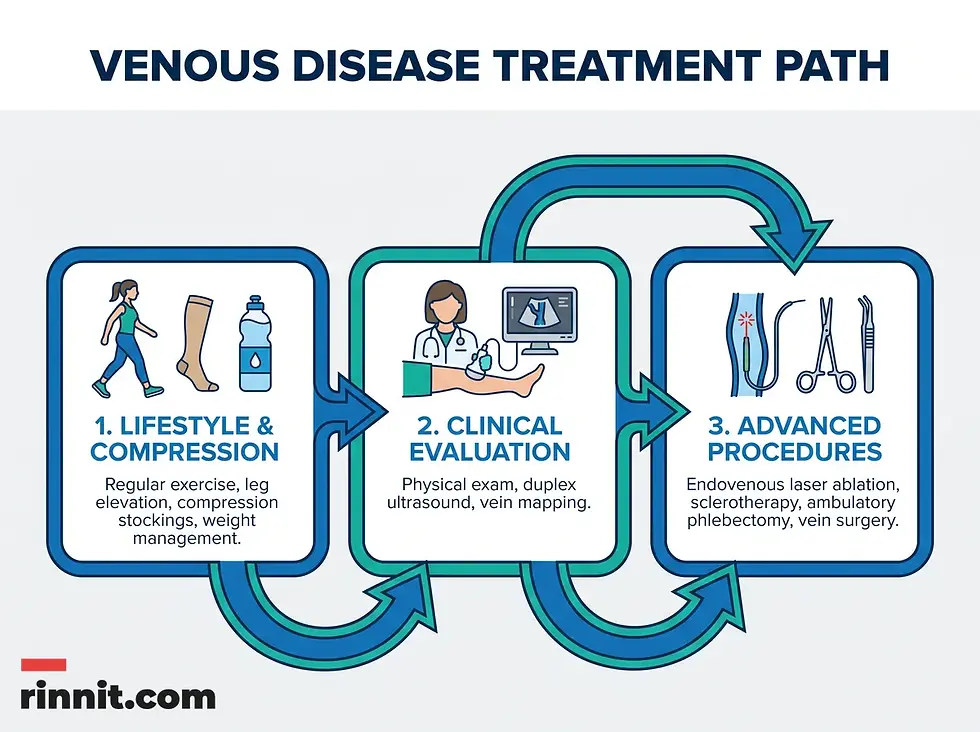
The primary goals of treatment are to alleviate symptoms and prevent dangerous complications. [1] Management plans are tailored to the specific type of venous disease identified.
Conservative Management
Surgical and Procedural Interventions
Procedure | Purpose |
Endovenous Ablation | Using lasers or radiofrequency to close diseased varicose veins. [1] |
Thrombectomy | The surgical removal of a blood clot from a vein. [1] |
Vena Cava Filter | A device placed in the large vein to catch clots before they reach the lungs. [1] |
Vein Surgery | Traditional ligation and stripping to remove damaged veins. [1] |
Conclusion
Venous disease is a common but manageable condition that requires proactive care to prevent serious health outcomes. By recognizing the early signs—such as leg heaviness, swelling, and visible vein changes—individuals can seek timely intervention. While some conditions are chronic, a combination of lifestyle adjustments, compression therapy, and modern medical procedures can restore circulation and protect long-term vascular health.
Are you experiencing persistent leg swelling or visible bulging veins? Consult a healthcare provider or a vascular specialist to discuss a personalized evaluation and management plan.
Related reading: Vena Cava Filters: Preventing Pulmonary Embolism | Stasis Ulcer: Symptoms, Causes, and Management of Venous Wounds | Thrombophlebitis: Symptoms, Causes & Treatment
Sources: Cleveland Clinic — Venous Disease | Salim et al., 2021 | Shi et al., 2021
Frequently Asked Questions
1. What is the main function of veins?
Veins carry oxygen-poor blood from the body's tissues back to the heart.
2. Can venous disease be cured?
While some conditions like superficial clots resolve, others are chronic and require long-term management to prevent worsening.
3. Are varicose veins just a cosmetic issue?
No, they can lead to pain, superficial clots, and skin ulcers if left untreated.
4. What is a pulmonary embolism?
A pulmonary embolism is a life-threatening condition where a blood clot travels to and lodges in the lungs.
5. How does pregnancy affect venous health?
Pregnancy increases blood volume and puts pressure on pelvic veins, which can weaken vessel walls.
6. Is walking good for venous disease?
Yes, exercise helps the leg muscles pump blood back toward the heart.
7. What are venous stasis ulcers?
Venous stasis ulcers are open sores, usually near the ankle, caused by chronic blood pooling and pressure.
8. Can I prevent venous disease?
You can reduce your risk by staying active, avoiding tobacco, and maintaining a healthy weight.
9. What is DVT?
Deep vein thrombosis is a blood clot in a deep vein, which has the potential to travel to the lungs.
10. Why do I need compression stockings?
Compression stockings apply pressure to the legs to help veins and valves work more efficiently.
11. Does aging increase the risk of vein problems?
Yes, vein walls and valves naturally weaken over time.
12. What is an angiogram?
An angiogram is an imaging test that uses a special dye to see how blood flows through your veins.
13. Can birth control pills cause venous disease?
Hormonal medications can increase the risk of developing blood clots.
14. What is endovenous ablation?
A procedure that uses heat (laser or radiofrequency) to close off diseased veins.
15. When should I see a doctor about my veins?
See a provider if you have persistent leg pain, swelling, or skin changes that don't go away.
References
Cleveland Clinic. Venous Disease. Cleveland Clinic. February 3, 2023. https://my.clevelandclinic.org/health/diseases/16754-venous-disease
Salim S, Machin M, Patterson BO, et al. Global Epidemiology of Chronic Venous Disease: A Systematic Review With Pooled Prevalence Analysis. Ann Surg. 2021;274(6):971-976. PMID 33214466. https://doi.org/10.1097/SLA.0000000000004631
Shi C, Dumville JC, Cullum N, et al. Compression bandages or stockings versus no compression for treating venous leg ulcers. Cochrane Database Syst Rev. 2021;7(7):CD013397. PMID 34308565. https://doi.org/10.1002/14651858.CD013397.pub2
Medical disclaimer
The information provided in this article is for educational purposes only and should not be used as a substitute for professional medical advice, diagnosis, or treatment. Always seek the advice of your physician or other qualified health provider with any questions you may have regarding a medical condition. Never disregard professional medical advice or delay in seeking it because of something you have read here.



Comments