Stasis Ulcer: Symptoms, Causes, and Management of Venous Wounds

Updated: 2 days ago
Medically reviewed by Dr. Baraa Alnahhal, MD · Last reviewed: October 2026
Quick Answer
A stasis ulcer, also called a venous ulcer, is a shallow skin wound, usually on the lower leg or ankle, caused by poor vein circulation that raises pressure and breaks down the skin. Treatment uses compression garments, specialized dressings and management of conditions like diabetes. Seek urgent care for fever, pus, darkening skin or severe worsening pain.

What the research says
Compression helps ulcers heal sooner. A Cochrane review of 14 trials (1,391 participants) found compression bandages or stockings probably shorten the time to complete healing compared with no compression (pooled hazard ratio 2.17, 95% CI 1.52–3.10) and make complete healing within 12 months more likely (risk ratio 1.77); the evidence was of moderate certainty (Shi et al., Cochrane Database Syst Rev, 2021) [2].
Multi-layer systems and elastic bandages perform best. An earlier Cochrane review of 48 trials (4,321 participants) concluded that compression increases healing rates, multi-component systems work better than single-component ones, and the four-layer bandage healed ulcers faster than the short-stretch bandage (hazard ratio 1.31, 95% CI 1.09–1.58) (O'Meara et al., Cochrane Database Syst Rev, 2012) [3].
Not every leg ulcer is venous. A clinical evidence overview reports that about 20% of people with leg ulcers have arterial disease, with or without a venous problem (Nelson & Adderley, BMJ Clin Evid, 2016) [4]. This is why circulation tests are done before compression is started.
What is a stasis ulcer?
Vascular ulcers are wounds that develop because of impaired blood circulation. The most common type is the venous, or stasis, ulcer, which occurs when blood flow leaving the feet and legs slows down. [1] A clinical evidence overview reports that between 1.5 and 3.0 in 1,000 people have an active leg ulcer, and prevalence rises to about 20 in 1,000 among people over 80 (Nelson & Adderley, BMJ Clin Evid, 2016) [4].
Because these wounds can take weeks or months to heal, specialized care is often needed to prevent complications. [1]
What are the symptoms and warning signs of a stasis ulcer?
Symptoms often progress in stages, starting with changes in the skin before a wound ever forms.
Early Warning Signs
Leg swelling and cramping: fluid pooling in the lower legs. [1]
Skin discoloration: the skin may turn dark red, purple, or brown. [1]
Texture changes: skin becoming thick, hard, shiny, or stretched thin.
Stasis dermatitis: tingling and itching in the affected area. [1]
Varicose veins: enlarged, twisted veins visible under the skin.
Active Ulcer Characteristics
What causes stasis ulcers, and who is at risk?
Stasis ulcers are caused primarily by venous insufficiency. This happens when the valves in the leg veins fail to work properly, letting gravity pull blood downward instead of toward the heart. The extra blood raises pressure in the veins, causing small vessels to leak and the skin to break down. [1]
Category | Contributing Factors |
|---|---|
Medical conditions | Diabetes, obesity, cardiovascular disease, high blood pressure [1] |
Lifestyle habits | Smoking and tobacco use, prolonged standing (for example, cashiers and bakers) [1] |
Physical factors | Advanced age, family history, leg injuries (fractures, burns), past blood clots |

How are stasis ulcers diagnosed?
A healthcare provider can often diagnose a stasis ulcer from a physical examination. Identifying the underlying cause is essential for choosing the right treatment.
Ankle-brachial index (ABI): compares blood pressure in the arm and the ankle to assess arterial circulation. [1]
Pulse checks: feeling for peripheral pulses in the lower legs and feet.
Blood tests: including an A1C test to check for diabetes. [1]
Imaging: ultrasound and other scans to view blood flow and vessel health.
What are the treatment options for stasis ulcers?
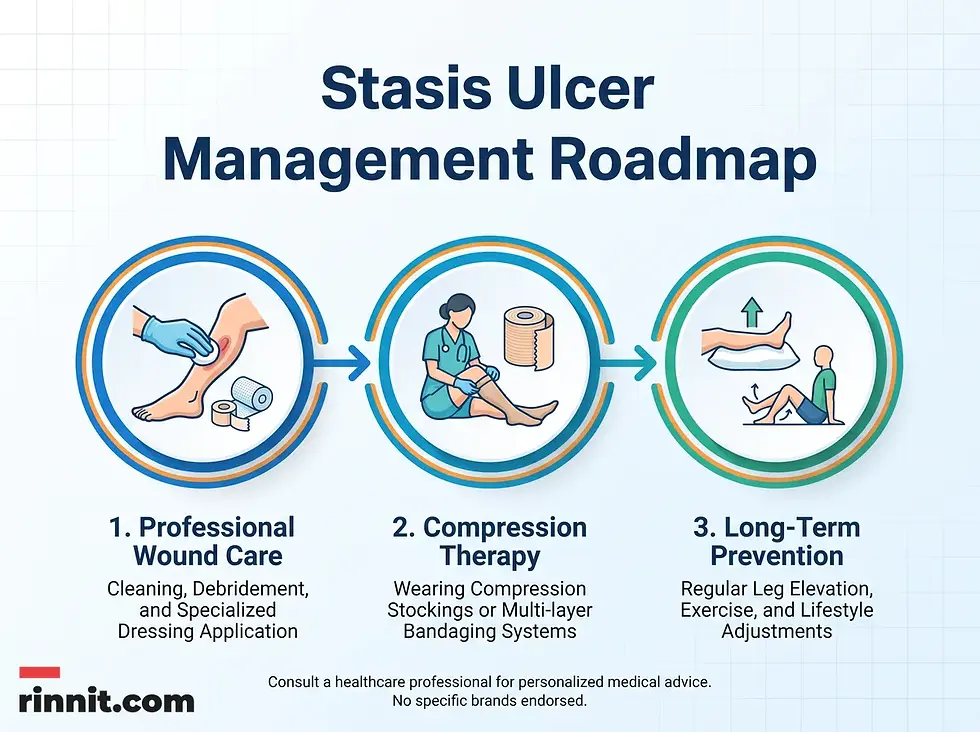
Healing a stasis ulcer takes a multi-part approach that addresses both the wound and the circulation problem behind it.
Primary Treatments
Compression therapy: specialized bandages or stockings that apply pressure and prevent blood from pooling. [1] [2]
Wound care: dressings, gels, or ointments chosen by your care team to promote healing and remove dead tissue.
Medications: antibiotics for infection, and drugs to manage blood pressure, cholesterol, or blood sugar. [1]
Advanced Interventions
Treatment | Description |
|---|---|
Debridement | Removal of dead or infected tissue to promote healing. [1] |
Revascularization | Procedures to restore blood flow when arterial disease is also present. |
Skin grafts | Surgical techniques to repair large or hard-to-heal wounds. |
Hyperbaric oxygen | Treatment in a high-pressure oxygen chamber to support recovery in selected cases. |
How can stasis ulcers be prevented and cared for long term?
Preventing a recurrence is just as important as healing the first wound.
Daily inspection: check your feet and ankles every day for new sores or color changes. [1]
Footwear: wear properly fitting shoes and socks to avoid pressure injuries.
Elevation: rest with your legs raised to reduce swelling and improve drainage. [1]
Activity: follow the walking or exercise plan your clinician recommends to boost circulation.
Condition management: keep blood pressure, weight, and blood sugar under control. [1]
Conclusion
Stasis ulcers are a serious sign of an underlying circulation problem and need active management. By recognizing early symptoms such as swelling and skin discoloration, you can seek treatment before a wound becomes severe. With consistent wound care, compression therapy, and lifestyle changes, many stasis ulcers heal and can be kept from coming back.
What are the next steps for a stasis ulcer?
If you are concerned about leg swelling or a sore that will not heal, contact your healthcare provider for a circulation check and a personalized wound care plan.
Frequently Asked Questions
1. What exactly is a stasis ulcer?
A stasis ulcer is a wound on the skin caused by poor blood circulation in the veins, usually appearing on the lower leg or ankle.
2. Are stasis ulcers the same as arterial ulcers?
No. Stasis ulcers are caused by vein problems and are usually shallow, while arterial ulcers are caused by artery blockages and tend to be deeper and more often found on the toes and feet.
3. Who is most at risk for developing these ulcers?
Older adults, people with obesity, diabetes, or high blood pressure, people who smoke, and those who have had leg injuries or blood clots are at higher risk.
4. Can prolonged standing cause stasis ulcers?
Prolonged standing can contribute. Standing for long periods without moving lets blood pool in the legs, which increases pressure on the veins.
5. What are the first signs of a stasis ulcer?
Early signs include leg swelling, cramping, and skin turning dark red, purple, or brown.
6. Is itching a symptom of an upcoming ulcer?
Yes. Tingling and itching in the affected area, known as stasis dermatitis, is a common warning sign.
7. Why do these ulcers form near the ankle?
Gravity pulls excess blood to the lowest part of the leg, so the ankle area is most exposed to the pressure and vessel leakage.
8. Are stasis ulcers painful?
Stasis ulcers are often painful and may feel warm to the touch, although some cause only mild burning or itching.
9. What happens if a stasis ulcer gets infected?
An infected ulcer may have a foul smell, ooze pus, and spread to the surrounding skin or bloodstream. Seek urgent medical care if you notice the warning signs listed above.
10. How do doctors diagnose the cause?
Doctors use a physical exam, blood pressure comparisons between the arm and ankle (the ABI test), blood work, and imaging such as ultrasound to find the root cause.
11. Can stasis ulcers be cured?
In many cases they heal, but success depends on early treatment and on managing the underlying circulation problem. They can come back, so prevention matters.
12. What is the most common treatment?
Compression therapy with specialized bandages or stockings is the standard first-line treatment for venous ulcers.
13. Is surgery ever required?
Sometimes. Surgery may be needed to clean the wound (debridement), perform skin grafts, or treat vein or artery problems.
14. Does walking help or hurt stasis ulcers?
Prescribed walking generally helps by improving circulation, but follow your clinician's specific activity guidance.
15. How can I prevent an ulcer from coming back?
Check your legs daily, wear well-fitting footwear, raise your legs when resting, wear compression as advised, and keep conditions like diabetes and high blood pressure under control.
Trusted External Resources
Related Reading
Chronic Venous Insufficiency (CVI): What It Is, Why It Happens, and How It Gets Treated explains the vein problem behind most stasis ulcers.
Compression Therapy: Types, Pressure Levels, Benefits, and Risks — What You Need to Know explains compression stockings and wraps that help venous ulcers heal.
Leg Ulcers: Causes, Symptoms, and Effective Treatment compares the main types of leg ulcers and their treatment.
Lipodermatosclerosis: Managing Chronic Skin and Fat Inflammation in the Legs describes hardened, discolored lower leg skin from long-term vein disease.
References
Cleveland Clinic. Stasis Ulcer. Cleveland Clinic. Last updated June 23, 2022. https://my.clevelandclinic.org/health/diseases/23357-stasis-ulcer
Shi C, Dumville JC, Cullum N, et al. Compression bandages or stockings versus no compression for treating venous leg ulcers. Cochrane Database Syst Rev. 2021;7(7):CD013397. PMID 34308565. https://doi.org/10.1002/14651858.CD013397.pub2
O'Meara S, Cullum N, Nelson EA, et al. Compression for venous leg ulcers. Cochrane Database Syst Rev. 2012;11:CD000265. PMID 23152202. https://doi.org/10.1002/14651858.CD000265.pub3
Nelson EA, Adderley U. Venous leg ulcers. BMJ Clin Evid. 2016;2016:1902. PMID 26771825. https://pubmed.ncbi.nlm.nih.gov/26771825/
Medical Disclaimer
This article is for informational purposes only and does not constitute medical advice. Always seek the advice of your physician or other qualified health provider with any questions you may have regarding a medical condition. Never disregard professional medical advice or delay in seeking it because of something you have read in this article.



Comments