Venous Ulcers: Symptoms, Causes, and Recovery

Updated: 2 days ago
Medically reviewed by Dr. Baraa Alnahhal, MD · Last reviewed: October 2026
Quick Answer: What is a venous ulcer?
A venous ulcer, also called a venous stasis ulcer, is a shallow, irregular wound on the lower leg near the ankle that develops when blood pools in the veins and damages the skin. It may ooze, itch or smell. [1] Venous ulcers do not heal on their own [1], so compression therapy and wound care are essential to avoid infection.

What the research says
Compression helps ulcers heal sooner and hurt less. A Cochrane review of 14 trials (1,391 participants) found that compression bandages or stockings probably shorten the time to complete healing compared with no compression (pooled hazard ratio 2.17, 95% CI 1.52 to 3.10) and probably lower pain scores (mean difference −1.39, 95% CI −1.79 to −0.98); the evidence was of moderate certainty (Shi et al., Cochrane Database Syst Rev, 2021 [2]).
Treating the underlying vein problem early speeds healing. In a UK trial of 450 people with venous leg ulcers, those who had endovenous ablation of superficial venous reflux within 2 weeks, plus compression, healed faster than those who had compression alone (hazard ratio 1.38, 95% CI 1.13 to 1.68). Median healing time was 56 days versus 82 days, and 85.6% versus 76.3% were healed at 24 weeks (Gohel et al., N Engl J Med, 2018 [3]).
Not every leg ulcer is venous. A clinical evidence overview reports that about 20% of people with leg ulcers have arterial disease, with or without a venous problem, and that active leg ulcers affect roughly 1.5 to 3.0 in 1,000 people, rising to about 20 in 1,000 over age 80 (Nelson & Adderley, BMJ Clin Evid, 2016 [4]). This is why circulation is checked before treatment is chosen.
Understanding Venous Ulcers
Venous ulcers are a circulatory problem in which wounds on the lower legs fail to heal within a normal timeframe. They arise when the venous system cannot efficiently return blood to the heart, a condition known as blood pooling or venous stasis. As blood collects, the pressure inside the veins damages the surrounding skin until it breaks down into an open sore. [1] These ulcers are most often found on the leg just above the ankle.
Healing is often slow. Venous ulcers can take several months to heal, and in severe cases they may never heal without advanced care. [1]
Symptoms and Warning Signs
Venous ulcers have a distinctive look and feel. Recognizing the signs early makes it easier to get the right wound care.
Symptom | Description |
|---|---|
Sore appearance | Shallow, irregularly shaped wounds, often with hard or discolored skin around them. [1] |
Fluid discharge | Pus or other fluid may ooze from the sore, sometimes with a foul odor. [1] |
Physical discomfort | A persistent dull ache, itching, or swelling (edema) in the affected area. [1] |
Skin changes | The skin around the ulcer may feel unusually firm or look dark and inflamed. |
Unlike a minor cut, a venous ulcer does not improve without medical care. If it is left untreated, the damage can spread and lead to serious complications such as gangrene or, in severe cases, amputation of the limb. [1]
Causes and Risk Factors
The main driver of venous ulcers is valve dysfunction in the leg veins. Tiny valves keep blood moving against gravity. When they weaken or fail, blood flows backward or becomes obstructed, and pressure builds in the veins. [1]
Primary Causes
Chronic venous insufficiency (CVI): the most common cause, in which the vein valves are damaged or too weak to do their job.
Venous reflux: blood flowing backward through weak or damaged valves. [1]
Venous obstruction: a blockage, sometimes caused by a blood clot, that disrupts normal circulation. [1]
High blood pressure (hypertension): over time it can damage blood vessel walls. [1]
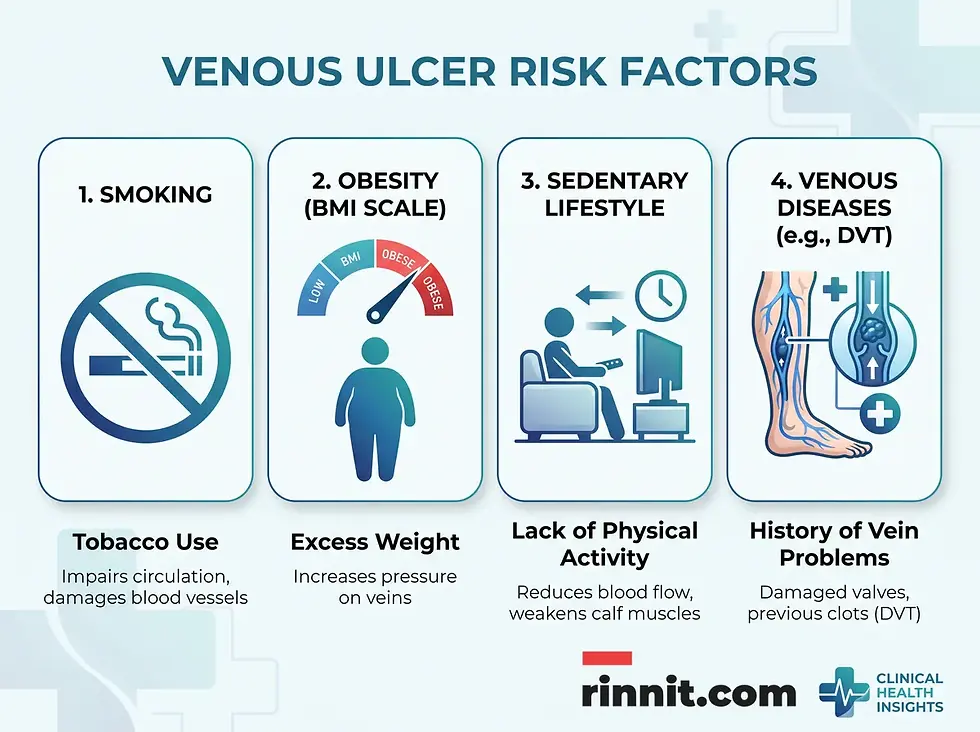
Risk Factors
Several factors raise the chance of developing a venous ulcer:
Diagnosis and Testing
A physical exam and a review of your health history are usually enough to diagnose a venous ulcer. [1] Tests help show how severe the ulcer is and whether treatment is working:
Management and Treatment Strategies
Healing often takes several months and works best when it is managed by an experienced wound care provider, with frequent follow-up visits to make sure treatment is working. [1]
Standard Care
Compression therapy: specialized bandages or stockings that support circulation [1] [2] and reduce swelling.
Wound care: daily cleaning to flush out bacteria, special dressings to keep the ulcer covered, and debridement to remove dead tissue. [1]
Medications: antibiotics for infection, protective ointments, and pain relievers for discomfort. [1]
Care for related conditions: referrals to specialists to manage conditions such as diabetes. [1]
Advanced Interventions
Severe ulcers, or those that do not respond to standard care, may need additional treatment:
Skin graft: healthy skin from another part of the body replaces diseased skin. [1]
Growth factor therapy: injectable substances that attract healthy cells to the ulcer. [1]
Hyperbaric oxygen therapy: breathing pure oxygen in a pressurized chamber to promote healing. [1]
Stem cell therapy: injections of bone marrow to help generate healthy tissue. [1]
Lymphedema therapy: massage, skin care, and bandaging techniques that clear fluid buildup. [1]
Venous disease treatment: procedures that correct the blood pooling problem and improve circulation. [1] [3]

Prevention and Living With a Venous Ulcer
Once you have had a venous ulcer, you are more likely to get another, often in the same area. [1] Ongoing preventive care helps lower that risk.
While you are being treated, you can also support healing by eating a healthy diet, keeping the ulcer and nearby skin clean, raising your legs periodically when seated, and staying active with gentle exercise such as walking. [1]
Conclusion
Venous ulcers are serious, slow-healing wounds, but full recovery is possible with timely, specialized care. The key to long-term success is managing the underlying circulation problem and following every wound care instruction closely. Because these ulcers often come back, ongoing prevention, such as keeping a healthy weight, staying active, and wearing prescribed compression garments, is essential for protecting your vein health.
Next Steps
Do you have a leg sore that is slow to heal? Contact a healthcare provider or wound care specialist promptly to help prevent serious complications.
Frequently Asked Questions
1. How long does it take for a venous ulcer to heal?
Healing can take several weeks or months, and in some severe cases a venous ulcer may not heal without advanced intervention.
2. Can venous ulcers heal on their own?
No. They need specialized medical treatment to heal and to prevent infection.
3. Why do these ulcers often come back?
Once you have had an ulcer, the underlying vein problem makes it more likely to return, often in the same area.
4. What is the most common location for a venous ulcer?
Venous ulcers most often occur on the lower leg, typically near the ankle.
5. Is walking helpful during recovery?
Yes. Staying active with gentle exercise such as walking can help improve circulation. Follow your care team's guidance on how much activity is right for you.
6. What happens if a venous ulcer is left untreated?
An untreated venous ulcer can lead to permanent tissue damage, serious infections such as gangrene, and in severe cases the loss of a limb.
7. What is debridement?
Debridement is a medical procedure that removes debris and dead tissue from the wound to promote healing.
8. How does compression therapy work?
Compression bandages or stockings apply pressure to the leg, which helps move blood through the veins and reduces the pooling that damages the skin.
9. Can smoking affect ulcer healing?
Yes. Smoking is a recognized risk factor, and quitting is part of preventing venous ulcers and supporting healing.
10. What is a skin graft?
A skin graft is a procedure in which healthy skin from another part of the body replaces diseased skin at the ulcer site.
11. Why do venous ulcers sometimes have a foul odor?
Bacteria and fluid or pus draining from an infected or slow-healing wound can cause an unpleasant smell. Let your care team know if you notice it.
12. Is a family history of vein disease a risk factor?
Yes. A family history of venous disease raises your risk of developing a venous ulcer.
13. What is hyperbaric oxygen therapy?
Hyperbaric oxygen therapy is a treatment in which you breathe pure oxygen inside a pressurized chamber. It may be used for severe ulcers that do not respond to standard care.
14. How can I prevent future ulcers?
Maintain a healthy weight, quit smoking, keep conditions such as high blood pressure under control, wear prescribed compression garments, and take blood thinners if they are prescribed.
15. What is the difference between a venous ulcer and a regular cut?
A venous ulcer is caused by internal vein pressure and poor circulation, so it heals far more slowly than a cut and is prone to complications.
Trusted External Resources
References
Cleveland Clinic. Venous Ulcer. Cleveland Clinic. Last updated May 26, 2022. https://my.clevelandclinic.org/health/diseases/23165-venous-ulcer
Shi C, Dumville JC, Cullum N, et al. Compression bandages or stockings versus no compression for treating venous leg ulcers. Cochrane Database Syst Rev. 2021;7(7):CD013397. PMID 34308565. https://doi.org/10.1002/14651858.CD013397.pub2
Gohel MS, Heatley F, Liu X, et al. A randomized trial of early endovenous ablation in venous ulceration. N Engl J Med. 2018;378(22):2105-2114. PMID 29688123. https://doi.org/10.1056/NEJMoa1801214
Nelson EA, Adderley U. Venous leg ulcers. BMJ Clin Evid. 2016;2016:1902. PMID 26771825. https://pubmed.ncbi.nlm.nih.gov/26771825/
Medical Disclaimer
This article is for informational purposes only and does not constitute medical advice. Always seek the advice of your physician or other qualified health provider with any questions you may have regarding a medical condition. Never disregard professional medical advice or delay in seeking it because of something you have read in this article.



Comments