Diuretics (Water Pills): Types, Uses, Side Effects and How They Work

Updated: 6 days ago
Written and medically reviewed by Dr. Baraa Alnahhal, MD · Last reviewed: October 2026 · How we review
Quick Answer: What are diuretics?
Diuretics are medicines, often called water pills, that help the kidneys move extra salt and water out of the body through urine. They treat high blood pressure, heart failure and fluid buildup (edema). Common side effects include frequent urination and, with some types, low potassium, so providers check kidney function and potassium levels. [1]
What the research says
Thiazide-type diuretics remain a strong first choice for high blood pressure. In a trial of 33,357 adults aged 55 or older, a thiazide-type diuretic (chlorthalidone) prevented heart attacks and coronary deaths as well as two other drug classes, with a lower 6-year heart failure rate than amlodipine (7.7% vs 10.2%). (ALLHAT Officers, JAMA, 2002) [2]
Two common thiazides performed about the same. Among 13,523 adults aged 65 or older, switching to chlorthalidone did not lower major cardiovascular events compared with staying on hydrochlorothiazide (10.4% vs 10.0%), but low potassium was more common with chlorthalidone (6.0% vs 4.4%). (Ishani et al., N Engl J Med, 2022) [3]
For heart failure, the loop diuretic chosen did not change survival. In 2,859 people discharged after a heart failure hospital stay, death rates were similar with torsemide and furosemide (26.1% vs 26.2%). (Mentz et al., JAMA, 2023) [4]
Key takeaways
Diuretics help your kidneys put extra salt and water into your urine, which lowers blood pressure and reduces fluid buildup. [1]
The main types are thiazide, loop and potassium-sparing diuretics; some pills combine two types. [1]
Thiazide diuretics are the most common type used for high blood pressure. [1]
Most people take diuretics without serious problems, but your provider will check your kidneys and potassium. [1]
Take your dose on schedule, ideally in the morning, and never change it without talking to your provider. [1]
What are diuretics and how do they work?
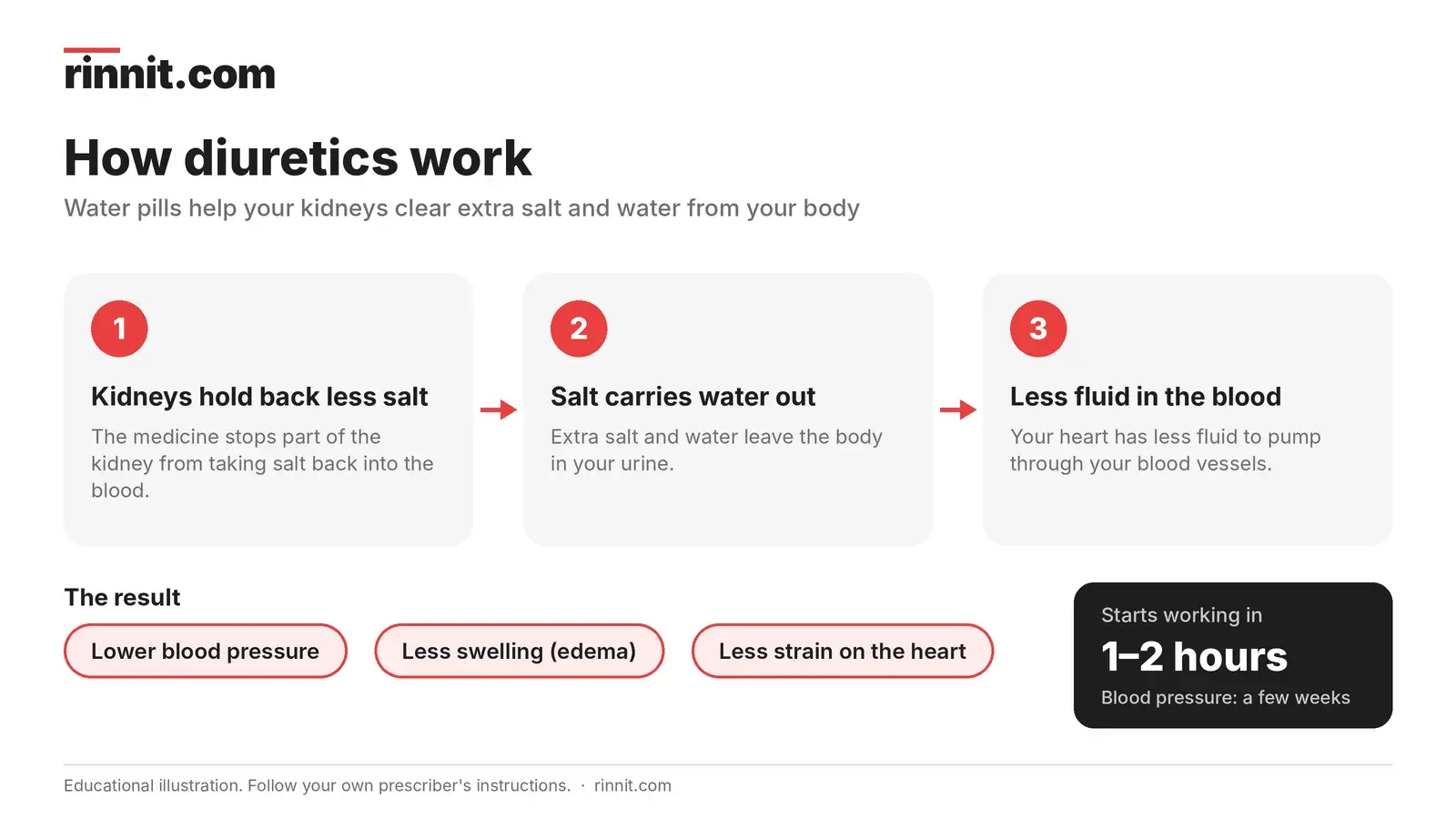
Diuretics are medicines that help your body get rid of extra fluid and salt by making your kidneys put more of both into your urine. [1] That is why they are often called water pills.
Each diuretic acts on a specific part of the kidney and stops it from taking salt back into the blood. [1] Water follows the salt out of the body.
With less fluid in your blood, your heart has less to pump. [1] This helps in three main ways:
Lower blood pressure: less fluid moving through your blood vessels means less pressure on their walls. [1]
Easier work for the heart: in heart failure, the heart cannot pump as well as it should, so having less fluid to move eases the demand on it. [1]
Wider blood vessels: water pills also help blood vessels widen, which lowers blood pressure further. [1]
Most people take diuretics as tablets. In the hospital, some of these medicines can also be given through an IV in the arm. [1]

What are the main types of diuretics?
The main types of diuretics are thiazide, loop and potassium-sparing diuretics, plus combination pills that contain two types. [1] Thiazide and potassium-sparing diuretics work in one part of the kidney, while loop diuretics work in another. [1]
Type | Examples | What sets it apart |
Thiazide | Hydrochlorothiazide, chlorthalidone | The most common type for high blood pressure; hydrochlorothiazide is the one prescribed most often |
Loop | Furosemide, bumetanide | Potent drugs that providers prefer for people with a low glomerular filtration rate (GFR), a measure of kidney function |
Potassium-sparing | Triamterene, amiloride | Keep you from losing too much potassium |
Combination pill | Triamterene + hydrochlorothiazide | Two types in one pill that help limit potassium loss |
Source for table: [1]
The type your provider chooses depends on your condition and how well your kidneys work. [1] If potassium loss is a concern, a potassium-sparing diuretic or a combination pill may be used. [1] People who already have high potassium can read more in our guide to hyperkalemia.

What conditions do diuretics treat?
Diuretics treat conditions where the body holds too much fluid or where blood pressure is too high. [1]
Condition | What it means |
Blood pushes too hard against artery walls | |
The heart cannot pump well, so fluid builds up | |
Cardiomyopathy | Disease of the heart muscle |
Fluid buildup in the lungs | |
Fluid buildup in the belly | |
Kidney failure | The kidneys can no longer filter blood well |
Too much protein leaks into the urine | |
High intraocular pressure | Fluid buildup raises pressure inside the eye (linked to glaucoma) |
Increased intracranial pressure | Fluid buildup raises pressure inside the skull |
Source for table: [1]
Diuretics also help reduce swelling, known as edema, and support people whose kidneys are not working well. [1]
How should you take a diuretic?
You should take a diuretic once or twice a day at the same time each day, ideally in the morning. [1] Because water pills make you pee more often, a morning dose keeps nighttime bathroom trips to a minimum. [1]
Swallow the tablet as prescribed. [1]
Keep taking the same dose on schedule unless your provider tells you otherwise. [1]
Expect to urinate more than usual at first — that is a sign the medicine is working. [1]
How quickly do diuretics start working?
Diuretics usually start working one to two hours after you take them. [1] Their effect fades as the day goes on, and some have almost no effect after six hours. [1]
Blood pressure takes longer to respond. It may take a couple of weeks before your blood pressure goes down. [1]
Effect | Typical timing |
More frequent urination | Starts within 1–2 hours |
Peak effect fades | Through the day; little effect after ~6 hours for some types |
Lower blood pressure | A couple of weeks |
Source for table: [1]
What are the side effects of diuretics?
The most common side effect of diuretics is peeing more often, and most people take them without serious problems. [1] Other possible side effects include:
Area | Possible side effects |
Digestion | Upset stomach, gas, diarrhea, loss of appetite |
General | Tiredness (fatigue), headache, hair loss |
Muscles and joints | Muscle cramps, gout |
Blood chemistry | Low potassium (with some types), unbalanced electrolytes |
Blood sugar | Higher blood sugar in people with diabetes |
Sexual health | Difficulty getting an erection (erectile dysfunction) |
Source for table: [1]
Taking too high a dose or not drinking enough fluids can lead to dehydration. [1] Low fluid intake while on a diuretic can also cause constipation. [1]
Who should talk to a doctor before taking diuretics?
People who are pregnant, breastfeeding, or living with kidney or liver problems should discuss the risks of diuretics with their provider first. [1] If you have chronic kidney disease or liver cirrhosis, your provider will choose the type and dose carefully.
Tell your provider if you plan to become pregnant or find out you are pregnant, so they can switch you to the safest blood pressure medicine. [1]
How can you stay safe while taking a diuretic?
You can stay safe on a diuretic by limiting salt, staying hydrated, getting your ordered lab tests and keeping follow-up visits. [1]
Limit salt. Eating less salt helps the medicine work better. [1]
Avoid dehydration. Drink enough fluids unless your provider has told you to limit them. [1]
Get your blood and urine tests. These check how well your kidneys work and whether your potassium is normal. [1]
Don't adjust the dose yourself. Always check with your provider first. [1]
Keep follow-up appointments. Your provider needs to see how you respond over time. [1]

Are natural diuretics like coffee or tea a substitute for water pills?
Natural diuretics such as coffee and tea are not a substitute for prescribed water pills, because the caffeine makes you pee more only for a short time. [1] Some herbal supplements may help, but prescription diuretics give more reliable results. [1] Do not replace a prescribed diuretic with a natural option without talking to your provider.
When should you call your healthcare provider about a diuretic?
You should call your healthcare provider if a diuretic causes side effects that bother you, especially: [1]
Signs of dehydration
If side effects continue, ask whether you can switch to a different medicine rather than stopping on your own. [1]
Conclusion
Diuretics are some of the most widely used and reliable medicines for high blood pressure, heart failure and fluid buildup. [1] They work by helping your kidneys clear extra salt and water, and most people tolerate them well. [1] Taking your dose on schedule, limiting salt, staying hydrated and keeping up with lab tests are the habits that keep water pills safe and effective. [1]
Next step: If you were just prescribed a water pill, read our guide to high blood pressure to understand your numbers, or explore our heart failure guide to learn how fluid control fits into treatment. Bring any questions about your dose or side effects to your next appointment.
FAQ
What is a diuretic?
A diuretic is a medicine, often called a water pill, that helps your kidneys move extra salt and water out of your body through urine. This lowers blood pressure and reduces fluid buildup.
What are the three main types of diuretics?
The three main types are thiazide, loop and potassium-sparing diuretics. Some pills combine a potassium-sparing diuretic with a thiazide to limit potassium loss.
What conditions are diuretics used to treat?
Diuretics treat high blood pressure, heart failure and fluid buildup such as edema, pulmonary edema and ascites. They are also used for kidney failure, nephrotic syndrome, and raised pressure in the eye or skull.
What is the best time of day to take a diuretic?
The best time to take a diuretic is usually in the morning, because it makes you urinate more often. Take it at the same time every day, once or twice daily as prescribed.
How long does it take for a diuretic to work?
Diuretics usually start working within one to two hours and wear off over the day. Lowering blood pressure can take a couple of weeks.
What are the most common side effects of diuretics?
The most common side effect is urinating more often. Others include upset stomach, headache, tiredness, muscle cramps, gout, low potassium with some types, and higher blood sugar in people with diabetes.
Can diuretics cause dehydration?
Yes, diuretics can cause dehydration if the dose is too high or you don't drink enough fluids. Call your provider if you feel dizzy or notice signs of dehydration.
When should I call my doctor about a diuretic?
Call your doctor if you have heart palpitations, dizziness, signs of dehydration, or side effects that bother you. Also tell them if you are pregnant or planning a pregnancy.
Do I need more potassium while taking a diuretic?
It depends on the type. Some diuretics lower potassium while potassium-sparing diuretics can raise it, so don't take potassium supplements or salt substitutes unless your provider tells you to.
Can diuretics help with weight loss?
No. Diuretics remove water, not fat, so any weight drop comes back once you drink fluids. Using them for weight loss can cause dehydration and dangerous changes in blood salts.
Related Reading
High Blood Pressure: Silent Symptoms, Serious Risks, and Proven Ways to Lower It explains high blood pressure, its risks and treatment options.
Heart Failure Medications: Types, Benefits, Side Effects, and How to Take Them Safely explains the main medicines used to treat heart failure.
Edema: Symptoms, Causes, and Treatment explains what causes fluid swelling in the body and how it is treated.
Hypokalemia: A Comprehensive Guide to Managing Low Potassium Levels explains the symptoms and treatment of low potassium levels.
References
Cleveland Clinic. Diuretics (Water Pills): Types, Uses & Side Effects. Cleveland Clinic. Last updated December 4, 2024. https://my.clevelandclinic.org/health/treatments/21826-diuretics
ALLHAT Officers and Coordinators for the ALLHAT Collaborative Research Group. Major outcomes in high-risk hypertensive patients randomized to angiotensin-converting enzyme inhibitor or calcium channel blocker vs diuretic: The Antihypertensive and Lipid-Lowering Treatment to Prevent Heart Attack Trial (ALLHAT). JAMA. 2002;288(23):2981-2997. PMID: 12479763. https://doi.org/10.1001/jama.288.23.2981
Ishani A, Cushman WC, Leatherman SM, et al. Chlorthalidone vs. Hydrochlorothiazide for Hypertension-Cardiovascular Events. N Engl J Med. 2022;387(26):2401-2410. PMID: 36516076. https://doi.org/10.1056/NEJMoa2212270
Mentz RJ, Anstrom KJ, Eisenstein EL, et al. Effect of Torsemide vs Furosemide After Discharge on All-Cause Mortality in Patients Hospitalized With Heart Failure: The TRANSFORM-HF Randomized Clinical Trial. JAMA. 2023;329(3):214-223. PMID: 36648467. https://doi.org/10.1001/jama.2022.23924
Medical disclaimer
This article is for general education only and does not replace advice from your doctor or pharmacist. Do not start, stop or change any medicine based on this information. If you have chest pain, severe shortness of breath or fainting, seek emergency care right away.



Comments