Pulmonary Edema: Symptoms, Causes, and Treatment

Updated: 3 days ago
Medically reviewed by Dr. Baraa Alnahhal, MD. Last reviewed October 13, 2026. This content is for educational purposes and is not medical advice.
Quick Answer
Pulmonary edema is too much fluid in the lungs' air sacs [1], preventing the body from taking in enough oxygen. It is most often caused by heart failure [1] [4] but can also result from pneumonia, drug reactions or high altitude [1]. Sudden pulmonary edema is life-threatening [1]: call 911. Treatment starts with oxygen, followed by diuretics and other medicines [2] [4].
What the research says
High-flow nasal oxygen worked as well as a breathing mask for cardiac pulmonary edema. In 178 emergency-room patients with acute cardiogenic pulmonary edema, the drop in breathing rate at 120 minutes was similar with high-flow nasal oxygen and non-invasive ventilation, and the authors noted the nasal option is generally better tolerated (Altunbas et al., Am J Emerg Med, 2025) [5].
At altitude, oxygen alone cleared fluid about as fast as added pressure. In 64 adults with high-altitude pulmonary edema, resolution took about 158 minutes with CPAP versus about 178 minutes with oxygen only (p = 0.297), and no one needed intubation (Bolotin et al., Acad Emerg Med, 2025) [6].
Midazolam caused fewer serious side effects than morphine. In 111 patients with acute cardiogenic pulmonary edema from the MIMO trial, the relative risk of serious adverse events with midazolam versus morphine was 0.44 (95% CI 0.22–0.91) in patients without COPD and 0.36 (95% CI 0.1–1.46) in those with COPD, and the reduced risk was similar in both groups (Domínguez-Rodríguez et al., Am J Emerg Med, 2023) [7].
Key Facts at a Glance
Fact | Detail |
Also known as | Fluid in the lungs |
What happens | Fluid collects in the air sacs (alveoli) of the lungs [1] |
Most common cause | |
Sudden (acute) form | A medical emergency that can cause death without prompt care [1] |
Other forms | Chronic (long-term) and high-altitude pulmonary edema (HAPE) [1] |
First treatment | Oxygen, then medicines that target the cause [2] |
Prevention focus | Heart-healthy habits and gradual ascent to high altitude [1] |
What Is Pulmonary Edema?
Pulmonary edema is a condition caused by too much fluid in the lungs. This fluid collects in the many air sacs in the lungs [1], making it difficult to breathe.
Lungs contain many small, elastic air sacs called alveoli. With each breath, these air sacs take in oxygen and release carbon dioxide. Sometimes, the alveoli fill with fluid instead of air. This keeps the bloodstream from taking in oxygen.

In most cases, heart problems cause pulmonary edema. [1] But fluid can collect in the lungs for other reasons. These include pneumonia, contact with certain toxins, medications, trauma to the chest wall, and traveling to or exercising at high elevations [1].
Pulmonary edema that develops suddenly is called acute pulmonary edema. It is a medical emergency that needs immediate care [1]. Pulmonary edema can sometimes cause death. [1] Prompt treatment might help.
What are the symptoms of pulmonary edema?
Pulmonary edema symptoms may appear suddenly or develop over time. Symptoms depend on the type of pulmonary edema.
Sudden (Acute) Pulmonary Edema Symptoms
Acute pulmonary edema is life-threatening. Know the signs below.
Long-Term (Chronic) Pulmonary Edema Signs and Symptoms
Sign | What to Watch For |
Night awakenings | Waking with a cough or breathless feeling that eases when sitting up [1] |
Breathing difficulty | With activity or when lying flat |
Fatigue [1] | Feeling unusually tired |
Shortness of breath | More than usual during physical activity [1] |
Cough | New or worsening [1], sometimes with wheezing |
Rapid weight gain [1] | Gaining weight quickly from fluid |
Swelling | In the legs and feet [1] |
High-Altitude Pulmonary Edema (HAPE)
HAPE can occur in adults and children who travel to or exercise at high altitudes, usually above 8,000 feet (about 2,400 meters) [1]. Symptoms resemble those of acute pulmonary edema and can include a headache, which may be the first symptom [1]. Shortness of breath starts with activity and progresses to rest, with reduced ability to exercise. A dry cough may appear at first, later turning into a cough that produces frothy sputum that may look pink or have blood in it [1]. Other signs include a very fast heartbeat, weakness, chest pain, and low fever [1]. Symptoms tend to get worse at night. [1]
When should you see a doctor about pulmonary edema?
Pulmonary edema that comes on suddenly is life-threatening. Call 911 or emergency medical help [1] if you have any of the following acute symptoms.
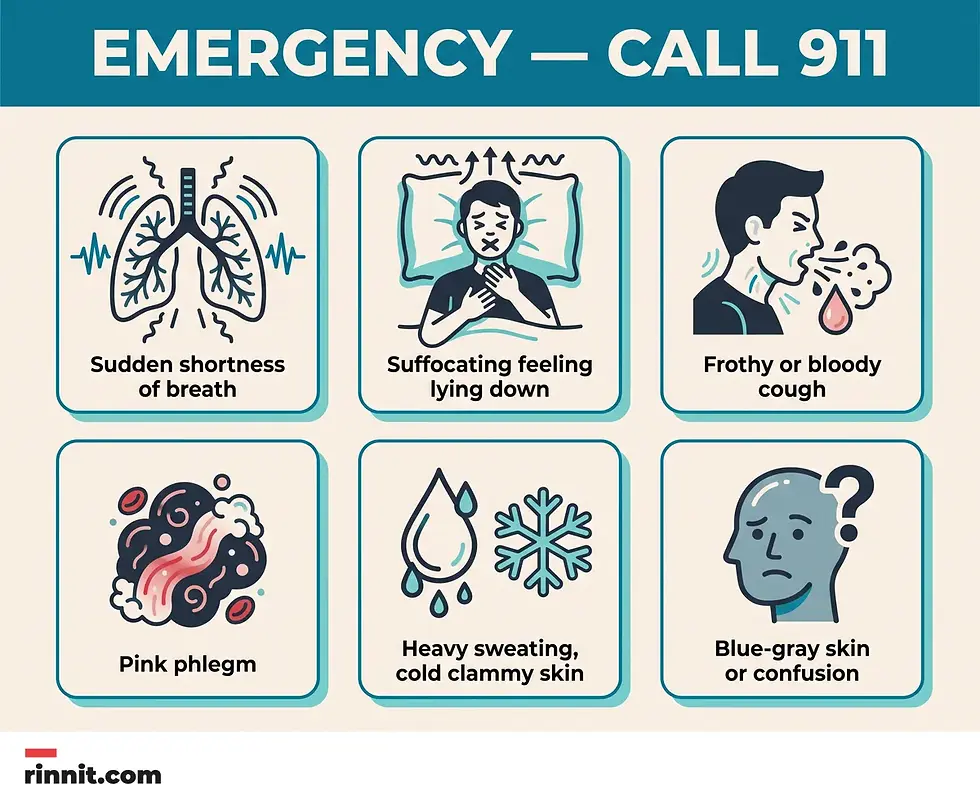
Shortness of breath, especially if it comes on suddenly [1]
Trouble breathing or a feeling of suffocating (dyspnea) [1]
A bubbly, wheezing or gasping sound when breathing [1]
Coughing up phlegm that looks pink or has blood in it [1]
Breathing difficulty with a lot of sweating
A blue or gray color to the skin [1]
Confusion [1]
A big drop in blood pressure that causes lightheadedness, dizziness, weakness or sweating [1]
A sudden worsening of any pulmonary edema symptoms [1]
Don't drive yourself to the hospital. [1] Call 911 or emergency medical care and wait for help.
What causes pulmonary edema?
The causes of pulmonary edema vary. Pulmonary edema falls into two categories, depending on where the problem starts.
If a heart problem causes the pulmonary edema, it is called cardiogenic pulmonary edema [1]. Most often, the fluid buildup in the lungs is due to a heart condition.
If pulmonary edema is not heart related, it is called noncardiogenic pulmonary edema [1].
Sometimes, pulmonary edema can be caused by both a heart problem and a nonheart problem [1].
Understanding the relationship between the lungs and the heart can help explain why pulmonary edema may occur.
The typical heart has two upper and two lower chambers. The upper chambers (the right and left atria) receive incoming blood [1] and pump it into the lower chambers (the right and left ventricles). The lower chambers pump blood out of the heart. The heart valves keep blood flowing in the right direction.
Normally, blood without oxygen enters the right atrium, then the right ventricle, and is pumped through the pulmonary arteries to the lungs. There, the blood releases carbon dioxide and picks up oxygen as it flows by the alveoli. The oxygen-rich blood returns to the left atrium through the pulmonary veins, flows through the mitral valve into the left ventricle, and leaves the heart through the aorta to the rest of the body.
Heart-Related (Cardiogenic) Pulmonary Edema
Cardiogenic pulmonary edema is caused by increased pressures in the heart [1]. It is usually a result of heart failure. [4] When a diseased or overworked left lower heart chamber (left ventricle) can't pump out enough of the blood it gets from the lungs, pressures in the heart go up. The increased pressure pushes fluid through the blood vessel walls into the air sacs [1].
Heart Condition | How It Leads to Pulmonary Edema |
Coronary artery disease [1] | Narrowed arteries from fatty deposits (plaques) weaken the left ventricle; a blood clot can trigger a heart attack, and damaged heart muscle cannot pump well |
Cardiomyopathy [1] | Heart muscle damage forces the heart to pump harder, raising pressures until it cannot keep up |
Heart valve problems [1] | Narrowed (stenosis) or leaky aortic or mitral valves affect blood flow; a sudden leak can cause sudden and severe pulmonary edema |
High blood pressure [1] | Untreated or uncontrolled pressure can enlarge the heart |
Other heart problems | Heart muscle inflammation (myocarditis), heart problems present at birth, and irregular heart rhythms (arrhythmias) [1] |
Kidney disease [1] | Narrowed kidney arteries or fluid buildup can cause pulmonary edema |
Chronic health conditions | Thyroid disease and a buildup of iron (hemochromatosis) or protein (amyloidosis) [1] may contribute to heart failure |
Non-Heart-Related (Noncardiogenic) Pulmonary Edema
Non-Heart Cause | What Happens |
Acute respiratory distress syndrome (ARDS) [1] | The lungs suddenly fill with fluid, often from trauma, widespread infection (sepsis), pneumonia, or severe bleeding |
Drug reaction or overdose | Many drugs, from aspirin to heroin and cocaine [1], can cause pulmonary edema |
Blood clot in the lungs (pulmonary embolism) [1] | A clot moving from the leg blood vessels to the lungs can cause fluid buildup |
Toxin exposure or aspiration [1] | Inhaling toxins or stomach contents while vomiting irritates the airways and air sacs |
High altitudes [1] | Seen in climbers, skiers, and hikers who do not take days or weeks to adjust to the elevation |
Near drowning [1] | Inhaling water causes fluid buildup in the lungs |
Negative pressure pulmonary edema | A blocked upper airway creates negative pressure; most people recover within about 24 hours with treatment [1] |
Nervous system conditions or surgeries | Neurogenic pulmonary edema can occur after a head injury, seizure, or brain surgery [1] |
Smoke inhalation [1] | Fire chemicals damage the membrane between the air sacs and the capillaries |
Transfusion-related lung injury [1] | Blood transfusions may overload the left ventricle with fluid |
Viral illnesses | Viruses such as hantavirus and dengue can cause pulmonary edema [1] |
At high altitudes, it is believed that blood vessels in the lungs squeeze together (constrict), increasing pressure [1]. This causes fluid to leak from the blood vessels into the lung tissues and eventually into the air sacs.
What are the risk factors for pulmonary edema?
Heart failure and other heart conditions that raise pressure in the heart increase the risk of pulmonary edema [1].
Risk Factor | Why It Matters |
Irregular heart rhythms (arrhythmias) [1] | Raise the risk of heart failure |
Alcohol use [1] | Damages the heart over time |
Congenital heart disease [1] | Heart problems present at birth raise risk |
Coronary artery disease [1] | A major driver of heart failure |
Diabetes [1] | Increases heart disease risk |
Heart valve disease [1] | Affects blood flow through the heart |
High blood pressure [1] | A leading cause of heart failure |
Sleep apnea [1] | Strains the heart during sleep |
Some nervous system conditions and lung damage due to near drowning, drug use, inhaling smoke, viral illnesses, and blood clots also raise the risk.
People who travel to high-altitude locations above 8,000 feet are more likely to develop high-altitude pulmonary edema. It usually affects those who don't take the time — a few days to a week or more [1] — to get used to the elevation. Children who already have pulmonary hypertension and structural heart defects may be more likely to get HAPE [1].
What complications can pulmonary edema cause?
Complications of pulmonary edema depend on the cause. [1] In general, if pulmonary edema continues, the pressure in the pulmonary artery can rise (pulmonary hypertension) [1]. Eventually, the heart becomes weak and begins to fail, and pressures in the heart and lungs go up.
Possible complications include breathing difficulty, swelling of the legs, feet, and belly area, a buildup of fluid in the membranes that surround the lungs (pleural effusion), and congestion and swelling of the liver [1]. Immediate treatment is necessary for acute pulmonary edema to prevent death.
How is pulmonary edema diagnosed?
Breathing problems require immediate diagnosis and treatment. A health care provider can base a diagnosis of pulmonary edema on the symptoms and the results of a physical exam and certain tests [2]. Once the condition is more stable, the provider can ask about medical history, especially a history of cardiovascular or lung disease [2].
Test | What It Shows |
Chest X-ray | |
Chest CT scan | Gives more detail about the lungs; can diagnose or rule out pulmonary edema [2] |
Pulse oximetry | A finger or ear sensor uses light to measure oxygen in the blood [2] |
Arterial blood gas test | Measures oxygen and carbon dioxide levels in the blood [2] |
BNP blood test | |
Other blood tests | Complete blood count, metabolic panel (kidney function), and thyroid function [2] |
Electrocardiogram (ECG/EKG) | Records the heart's electrical signals; shows heart wall thickening or a previous heart attack [2] |
Echocardiogram | Ultrasound pictures of the beating heart; identifies poor blood flow, valve issues [2], and muscle problems |
Cardiac catheterization and coronary angiogram | Finds blockages in the heart arteries [2]; used when other tests are unclear or chest pain is present |
Lung ultrasound |
How is pulmonary edema treated?
The first treatment for acute pulmonary edema is oxygen. [2] [4] Oxygen flows through a face mask or a nasal cannula [2] that delivers oxygen to each nostril. This should ease some symptoms. A health care provider monitors the oxygen level. Sometimes it may be necessary to assist breathing with a mechanical ventilator or positive airway pressure [2] [4].
Treatment | How It Helps |
Oxygen | First treatment [2]; eases symptoms immediately |
Diuretics | Furosemide (Lasix) decreases pressure from excess fluid in the heart and lungs [2] |
Blood pressure drugs | Manage high or low blood pressure; nitroglycerin and nitroprusside [2] lower pressure going into or out of the heart |
Inotropes | Given by IV in the hospital for severe heart failure [2]; improve heart pumping and maintain blood pressure |
Morphine |
It is important to diagnose and treat, if possible, any nervous system problems or causes of heart failure [2].
Treating High-Altitude Pulmonary Edema
Oxygen is usually the first treatment. [2] If oxygen isn't available, a portable hyperbaric chamber can imitate going down to a lower elevation [2] until moving down is possible.
Descend immediately. For mild symptoms, going down 1,000 to 3,000 feet (about 300 to 1,000 meters) as quickly as possible can help [2]. Someone with severe HAPE might need rescue assistance to get off the mountain [2].
Stop exercise and stay warm. Physical activity and cold can make pulmonary edema worse. [2]
Consider medication. Some climbers take acetazolamide or nifedipine (Procardia) [1] [2] to prevent or treat HAPE; nifedipine is the medicine used for HAPE, while acetazolamide mainly prevents acute mountain sickness. To prevent HAPE, they start taking the medication at least a day before going higher [2].
What self-care and prevention steps help with pulmonary edema?
You may be able to prevent pulmonary edema by managing existing heart or lung conditions and following a healthy lifestyle [1]. Controlling cholesterol and blood pressure can help lower the risk of heart disease.

Lifestyle steps support heart health and can help with some forms of pulmonary edema.
Keep blood pressure under control. Take medications as prescribed and check blood pressure regularly. A health care provider can help set a target blood pressure [2].
Manage other medical conditions. For example, controlling glucose levels if you have diabetes [2].
Avoid the cause of your condition. If pulmonary edema results from drug use or high altitudes, avoiding those triggers can prevent further lung damage [2].
Don't smoke. It is always a healthy idea to stop smoking. [2]
Eat less salt. Salt helps the body retain fluid. [2] In some people with damage in the left ventricle, too much salt might trigger congestive heart failure. In general, most people should consume less than 2,300 milligrams a day of sodium [2].
Choose a healthy diet. Eat plenty of fruits, vegetables, and whole grains [2]. Limit saturated fats, trans fats, added sugars, and sodium.
Manage weight. Losing even small amounts of weight can lower blood pressure and cholesterol [2] and reduce the risk of diabetes.
Get regular exercise. Healthy adults should get at least 150 minutes of moderate aerobic activity [2] or 75 minutes of vigorous aerobic activity a week, or a combination. Get your care provider's OK before starting an exercise program.
Preventing High-Altitude Pulmonary Edema
To prevent HAPE, gradually ascend to high elevations [1]. Most experts advise increasing elevation no more than 1,000 to 1,200 feet (about 300 to 360 meters) a day once you reach 8,200 feet (about 2,500 meters) [1]. Some climbers take prescription medications such as nifedipine to help prevent HAPE (acetazolamide mainly prevents acute mountain sickness), starting at least one day before ascent [1]. Ask your health care provider how long you need to take the medication after arriving at your high-altitude destination.
Conclusion and Next Steps
Pulmonary edema means fluid is building up in the air sacs of the lungs, and it usually points back to the heart. Most cases are cardiogenic, caused by heart failure and the conditions that lead to it, but infections, toxins, blood clots, injuries, and high altitude can also fill the lungs with fluid. The sudden form is a medical emergency. Knowing the warning signs — sudden shortness of breath, a suffocating feeling when lying down, a frothy or bloody cough, and blue-gray skin — and calling 911 right away can save a life.
Treatment begins with oxygen and moves to medicines such as diuretics and blood pressure drugs, always aimed at the underlying cause. Beyond the hospital, day-to-day choices matter: controlling blood pressure, eating less salt, not smoking, exercising regularly, managing weight, and handling stress all protect the heart that protects your lungs. For those who climb or trek at elevation, a slow, gradual ascent is the best defense against high-altitude pulmonary edema.
Frequently Asked Questions
What is pulmonary edema and what causes it?
Pulmonary edema is a condition caused by too much fluid in the lungs. The fluid collects in the many air sacs (alveoli), making it difficult to breathe. Most often, heart problems cause pulmonary edema — usually heart failure, where increased pressures push fluid through blood vessel walls into the air sacs. Other causes include pneumonia, toxins, medications, chest trauma, and high elevations.
Is pulmonary edema an emergency?
Acute pulmonary edema that develops suddenly is a medical emergency and is life-threatening. Call 911 or emergency medical help immediately for sudden shortness of breath, a suffocating feeling, a bubbly or gasping breathing sound, pink or bloody phlegm, heavy sweating with breathing difficulty, blue or gray skin, or confusion. Do not drive yourself to the hospital.
How is pulmonary edema treated?
The first treatment for acute pulmonary edema is oxygen, delivered through a face mask or nasal cannula. Depending on the severity and cause, treatment might also include diuretics such as furosemide, blood pressure drugs like nitroglycerin, IV inotropes for severe heart failure, and sometimes morphine. It is equally important to diagnose and treat the underlying cause of heart failure or the non-heart trigger.
Can high altitude really cause fluid in the lungs?
Yes. High-altitude pulmonary edema (HAPE) can occur in adults and children who travel to or exercise at elevations above about 8,000 feet, especially those who don't take days or weeks to acclimatize. Believed to result from blood vessels in the lungs constricting and raising pressure, HAPE starts with headache and shortness of breath that worsens at night. Immediate descent of 1,000 to 3,000 feet, rest, warmth, and oxygen are the key treatments.
How can I prevent pulmonary edema?
You may be able to prevent pulmonary edema by managing existing heart or lung conditions and following a healthy lifestyle. Controlling blood pressure and cholesterol, eating a healthy diet with less salt, not smoking, exercising regularly, managing weight, and managing stress all lower heart disease risk. To prevent HAPE, ascend gradually — no more than about 1,000 to 1,200 feet per day once above 8,200 feet.
Trusted External Resources
References
Mayo Clinic Staff. Pulmonary edema - Symptoms & causes. Mayo Clinic. May 27, 2022. https://www.mayoclinic.org/diseases-conditions/pulmonary-edema/symptoms-causes/syc-20377009
Mayo Clinic Staff. Pulmonary edema - Diagnosis & treatment. Mayo Clinic. May 27, 2022. https://www.mayoclinic.org/diseases-conditions/pulmonary-edema/diagnosis-treatment/drc-20377014
National Heart, Lung, and Blood Institute. Heart Failure - What Is Heart Failure? National Heart, Lung, and Blood Institute. Last updated March 24, 2022. https://www.nhlbi.nih.gov/health/heart-failure
Fine NM. Pulmonary Edema. Merck Manual Professional Edition. Last updated October 2025. https://www.merckmanuals.com/professional/cardiovascular-disorders/heart-failure/pulmonary-edema
Altunbas E, Bayram N, Unal E, et al. Is high-flow nasal oxygen as effective as non-invasive ventilation in acute cardiogenic pulmonary edema? Am J Emerg Med. 2025;98:93-99. PMID 40848477. https://doi.org/10.1016/j.ajem.2025.08.023
Bolotin T, Subedi S, Dahal S, et al. High altitude pulmonary edema response to continuous airway positive pressure: a randomized controlled trial: the HAPER CAPER trial. Acad Emerg Med. 2025;32(11):1215-1223. PMID 40938265. https://doi.org/10.1111/acem.70126
Domínguez-Rodríguez A, Hernandez-Vaquero D, Suero-Mendez C, et al. Effects of midazolam versus morphine in acute cardiogenic pulmonary edema and chronic obstructive pulmonary disease: an analysis of MIMO trial. Am J Emerg Med. 2023;73:176-181. PMID 37703629. https://doi.org/10.1016/j.ajem.2023.09.003



Comments