DHEAS Test (DHEA Sulfate): Why It's Done and What Results Mean

Updated: 3 days ago
Written and medically reviewed by Dr. Baraa Alnahhal, MD · Last reviewed: November 2026 · How we review
Quick Answer
A DHEAS test (DHEA sulfate test) is a blood test that measures dehydroepiandrosterone sulfate, a hormone made mostly by the adrenal glands. It helps check adrenal gland function and find causes of androgen excess. High DHEAS can point to PCOS, congenital adrenal hyperplasia or an adrenal tumor; low DHEAS can point to Addison's disease.
What the research says
Severe or rising levels can signal something other than PCOS: in 1,205 women who had DHEAS, androstenedione and testosterone measured together, PCOS was the most common cause of androgen excess, but in women after menopause every case of severe DHEAS excess was caused by adrenocortical carcinoma (Elhassan YS et al., J Clin Endocrinol Metab, 2018) [2]
High DHEAS is common in young women with PCOS: among 648 women in their twenties with PCOS and high androgens, about one in three (33%) had raised DHEAS, usually alongside higher testosterone and androstenedione (Carmina E, Longo RA, Cells, 2022) [3]
Key takeaways
Measures an adrenal hormone that's converted into testosterone and estrogen.
Checks adrenal function and causes of high androgen levels.
High levels: PCOS, congenital adrenal hyperplasia or adrenal tumors.
Low levels: Addison's disease or pituitary problems.
Levels peak around puberty and fall naturally with age.
What is DHEAS?
DHEAS is a steroid hormone made mostly by the adrenal cortex, with small amounts from the ovaries and testicles. The body converts it into androgens such as testosterone and androstenedione, and into estrogen. Levels peak around puberty and then decline with age, and they stay fairly stable through the day. Sources: [1]
Why is it done?
To check how well the adrenal glands work, including when an adrenal tumor is suspected.
In females with signs of high androgen levels: irregular or missed periods, hirsutism, hair loss, severe acne or infertility.
In children with early puberty, or infants with differences in sex development.
When low levels are suspected, with symptoms such as low sex drive, dizziness, salt cravings, nausea or unexplained weight loss. Sources: [1]
It's often ordered with other hormone tests, such as a testosterone test or cortisol test. Sources: [1]
How do I prepare?
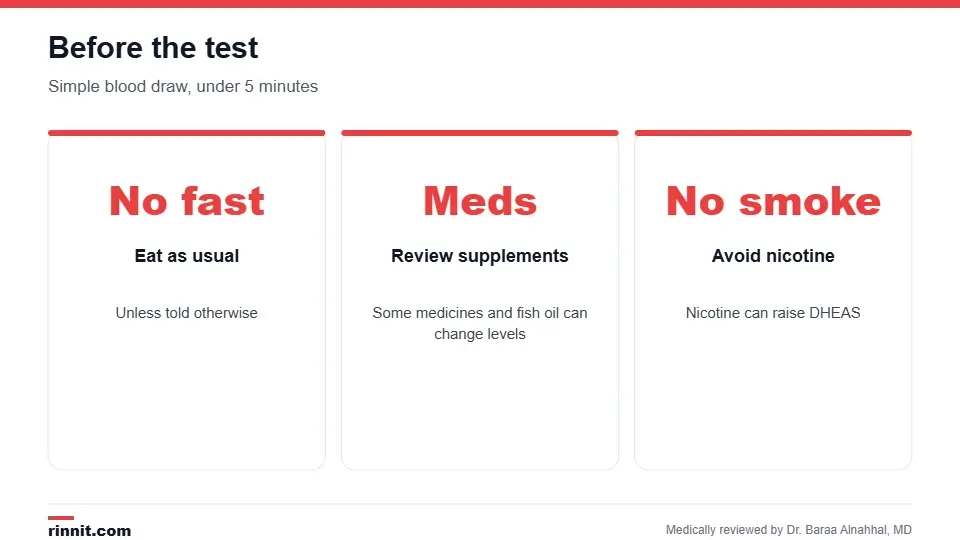
DHEAS levels are stable through the day.
Fasting usually isn't needed, and time of day doesn't matter much.
Ask whether to stop any medicines or supplements; some diabetes and blood pressure medicines can raise DHEAS, while fish oil and vitamin E can lower it.
Don't smoke before the test, since nicotine raises levels. Sources: [1]
What happens during the test?
A phlebotomist draws blood from a vein in your arm, which takes under five minutes. You may feel a brief pinch. Not every lab offers the test, so you may be sent to a specific lab, and results can take several days. Sources: [1]
What do high levels mean?

High DHEAS needs further testing.
Ovarian tumors. Sources: [1, 2, 3]
What do low levels mean?
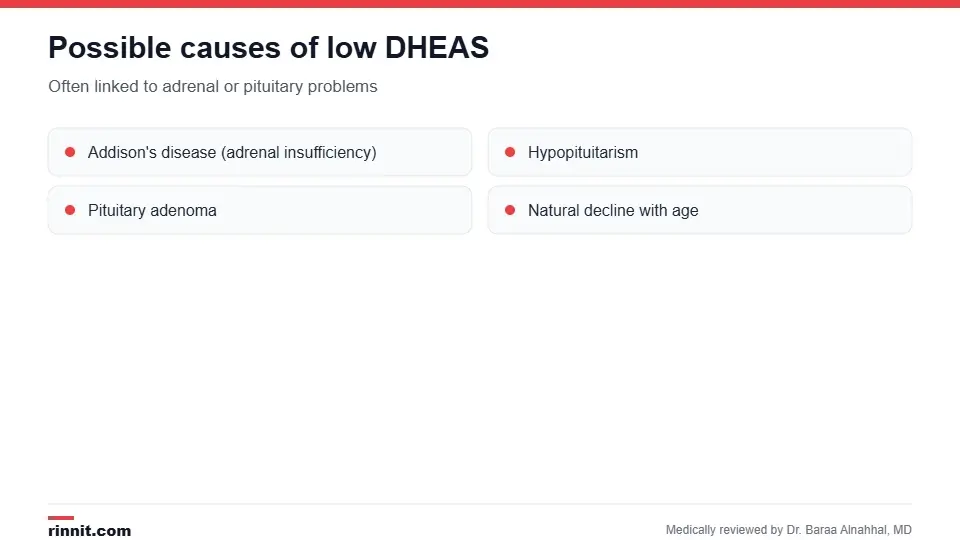
Low DHEAS can reflect adrenal or pituitary problems.
Addison's disease (adrenal insufficiency).
Hypopituitarism, including from pituitary adenomas.
A natural decline with age. Sources: [1]
Normal ranges depend on age, sex and the lab, so follow-up tests are best done at the same lab. Sources: [1]
A note on DHEA supplements
There's no good evidence that over-the-counter DHEA supplements slow aging or improve muscle or performance. They can cause side effects and interact with medicines, and they're banned in competitive sports. Talk to your provider before taking them. Sources: [1]
Conclusion
The DHEAS test is a useful window into adrenal hormone production. It helps explain symptoms of androgen excess, guides the search for PCOS, adrenal disorders and tumors, and is always read alongside other hormone tests and your symptoms.
Frequently asked questions
What does a DHEAS test measure?
A hormone made mainly by the adrenal glands.
Why would a woman have a DHEAS test?
For signs of high androgens, such as excess hair, acne or missed periods.
Do I need to fast?
Usually not, unless your provider says otherwise.
What causes high DHEAS?
PCOS, congenital adrenal hyperplasia or adrenal or ovarian tumors.
What causes low DHEAS?
Addison's disease, pituitary problems or normal aging.
Does time of day matter?
Not much; DHEAS levels are fairly stable through the day.
Can medicines affect results?
Yes. Some medicines and supplements raise or lower DHEAS.
Does smoking affect the test?
Yes. Nicotine can raise levels.
Is DHEAS the same as DHEA?
DHEAS is the sulfated, more stable form of DHEA.
Should I take DHEA supplements?
Talk to your provider first; benefits are unproven and side effects are possible.
Related Reading
Polycystic Ovary Syndrome (PCOS): Symptoms, Causes, Diagnosis, and Treatment the most common cause of high DHEAS in women.
What Is Congenital Adrenal Hyperplasia (CAH)? Symptoms, Causes, Diagnosis & Treatment Explained an inherited cause of high adrenal androgens.
Hirsutism: Causes, Symptoms, and the Treatment Options That Work excess hair growth that may prompt testing.
Adrenal Cancer: Complete Guide to Symptoms, Causes & Treatment a rare cause of very high DHEAS.
Addison's Disease: Complete Guide to Adrenal Insufficiency Symptoms, Causes & Treatment adrenal insufficiency that can lower DHEAS.
References
Cleveland Clinic. DHEAS Test: What It Is, Procedure, Results. Cleveland Clinic. Last updated November 24, 2021. https://my.clevelandclinic.org/health/diagnostics/22148-dheas-test-dhea-sulfate-test
Elhassan YS, Idkowiak J, Smith K, et al. Causes, patterns, and severity of androgen excess in 1205 consecutively recruited women. J Clin Endocrinol Metab. 2018;103(3):1214-1223. PMID 29342266. https://doi.org/10.1210/jc.2017-02426
Carmina E, Longo RA. Increased prevalence of elevated DHEAS in PCOS women with non-classic (B or C) phenotypes: a retrospective analysis in patients aged 20 to 29 years. Cells. 2022;11(20):3255. PMID 36291122. https://doi.org/10.3390/cells11203255
Medical disclaimer
This article is for general education only and does not replace advice from a qualified healthcare professional. Talk to your doctor about your own diagnosis and treatment, and seek emergency care right away for severe or sudden symptoms.



Comments