The Adrenal Cortex: Function, Layers, and Hormonal Health

Updated: 2 days ago
Medically reviewed by Dr. Baraa Alnahhal, MD · Last reviewed: October 2026
The adrenal cortex is the outer part of the adrenal gland and makes up about 85% of its tissue [1]. Its three layers make aldosterone, cortisol, and androgens, hormones that help regulate blood pressure, metabolism, stress responses, and sexual development [1]. Disorders of the cortex can cause too much or too little of these hormones, but they can usually be managed with hormone replacement, medication, surgery, or lifestyle changes [1].
Quick Answer: What is the adrenal cortex?
The adrenal cortex is the outer layer of the adrenal glands, which sit on top of the kidneys [1]. Its three layers make different hormones: aldosterone for salt and water balance, cortisol for metabolism and stress, and androgens for puberty and sexual function [1]. Damage usually happens slowly [1], so symptoms such as fatigue, weight changes and muscle weakness may appear gradually.
What the research says
Addison's disease can leave lasting fatigue even when hormones are replaced. A systematic review of 23 studies with 1,764 people with autoimmune primary adrenal insufficiency found that health-related quality of life was consistently reduced, most notably in vitality, energy, and physical functioning, even though patients receive lifelong hormone replacement (Silvestro et al., Frontiers in Endocrinology, 2026) [2].
Long-term oral glucocorticoid use is linked to higher death rates, and dose matters. A meta-analysis of 116 studies (128 cohorts, 51,380 patients) of chronic oral glucocorticoid exposure, the cause of exogenous Cushing's syndrome, found a pooled standardized mortality ratio of 1.87 (95% CI 1.32 to 2.61); an average daily dose above 5 mg and a cumulative dose of 5 g or more (prednisolone-equivalent) were each independently associated with higher mortality, though the authors caution that causation is uncertain because of confounding by indication (Limumpornpetch et al., The Journal of Clinical Endocrinology & Metabolism, 2026) [3].
Primary aldosteronism is linked to thyroid nodules. A meta-analysis of five case-control studies (1,368 patients with primary aldosteronism and 6,774 controls) found thyroid disease more common in primary aldosteronism (odds ratio 1.33; 95% CI 1.03 to 1.71), driven mainly by thyroid nodules (odds ratio 1.85; 95% CI 1.23 to 2.80), with no significant link to hyperthyroidism, hypothyroidism, thyroiditis, or thyroid cancer (Hu et al., Frontiers in Endocrinology, 2025) [4].
What is the adrenal cortex?
The adrenal cortex is a key part of the endocrine system. You have two adrenal glands, one on top of each kidney, and each is about the size and shape of a fortune cookie [1]. The cortex is the outer part of the gland and takes up about 85% of its tissue; the small inner section is the medulla [1].

The gland is highly vascular, with as many as 50 arterial branches supplying its blood [1]. It develops in the early weeks of gestation; at first it has a fetal zone and an adult definitive zone, and the fetal zone shrinks and disappears after birth [1].
What are the layers of the adrenal cortex, and which hormones do they make?
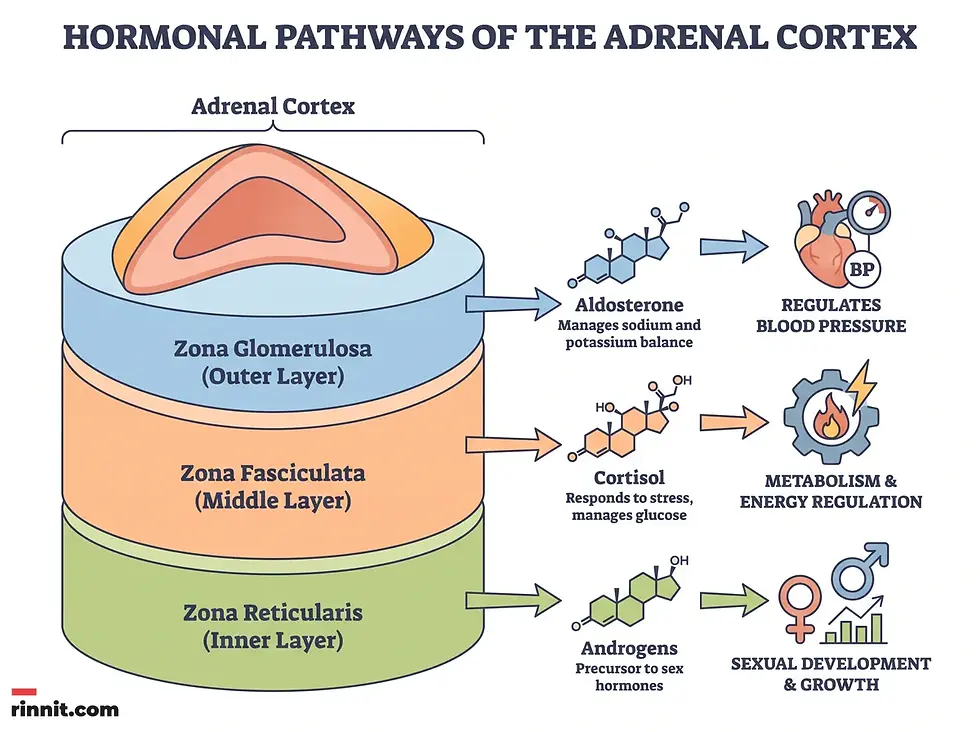
The cortex has three layers, and each makes different hormones that regulate vital organ functions and bodily processes [1].
Layer | Location | Main hormone | Key functions |
Zona glomerulosa | Outer layer | Aldosterone | Water and sodium retention; removes excess potassium in urine [1]. |
Zona fasciculata | Middle layer | Cortisol | Blood sugar, metabolism, blood pressure, inflammation, sleep-wake cycle, stress response [1]. |
Zona reticularis | Innermost layer | Androgens (mainly DHEA) | Bone density, puberty, red blood cell production, sexual function [1]. |
Aldosterone and mineral balance
Made in the zona glomerulosa, aldosterone helps maintain blood pressure and electrolyte balance. It causes the body to retain water and sodium and to get rid of excess potassium through urine [1].
Cortisol and the stress response
The zona fasciculata makes cortisol, often called the stress hormone. Cortisol controls blood sugar, supports the breakdown of carbohydrates, proteins, and fats, regulates blood pressure, suppresses inflammation, regulates the sleep-wake cycle, and raises glucose levels when the body is under stress [1].
Androgens and development
The zona reticularis makes androgens, which are sex hormones; the primary one is DHEA [1]. In males, androgens lengthen the vocal cords (leading to a deeper voice), stimulate facial and chest hair growth, and support sperm development [1]. In females, they help regulate menstruation, play a role in conception and pregnancy, and minimize bone loss [1].
What conditions affect the adrenal cortex?
Many conditions, some of them rare, can affect the cortex [1]. They can be functional, meaning they cause abnormally high hormone levels, or nonfunctional, meaning they do not make hormones [1].
Addison's disease (adrenal insufficiency): the cortex does not make enough hormones [1].
Cushing syndrome: hypercortisolism, or abnormally high levels of cortisol [1].
Conn's syndrome (primary aldosteronism) and hyperaldosteronism: overproduction of aldosterone [1].
Congenital adrenal hyperplasia: a group of genetic disorders that affect the glands' ability to make hormones.
Adrenal tumors and adrenocortical carcinoma: growths in the gland, including a rare cancer that starts in the cortex [1].
What are the symptoms of adrenal cortex disorders?
Adrenal cortex disorders cause symptoms that develop slowly and worsen until treated, affecting appetite, weight, blood pressure, blood sugar, mood, muscles and skin [1]. They gradually worsen until you receive appropriate therapy [1]. Symptoms can affect your:
Key point: because symptoms such as fatigue, weight change, and muscle weakness are common and non-specific, an endocrinologist can run the tests needed to tell whether they come from the adrenal glands.
How are adrenal cortex disorders managed and treated?
The most appropriate treatment depends on your diagnosis and symptom severity [1].

Hormone replacement therapy: bioidentical hormones restore hormone levels if you cannot make enough, for example hydrocortisone pills to replace cortisol; never stop these pills suddenly, and ask your provider how to raise the dose when you are sick, because severe weakness, vomiting, belly pain, confusion or fainting can signal an adrenal crisis that needs emergency care [1].
Medications: prescription drugs can help when hormone levels are too high; spironolactone blocks the effects of aldosterone, and ketoconazole slows cortisol production [1].
Tumor and cancer treatments: tumors may need surgical removal, especially larger ones or those that make excess hormones; radiation and chemotherapy may be needed for adrenocortical carcinoma [1].
Plastic and reconstructive surgery: repairs structures affected by abnormal hormone levels, for example in congenital adrenal hyperplasia [1].
Lifestyle changes: limit alcohol, eat a low-sodium diet if your provider recommends it (people with Addison's disease may instead need extra salt), quit smoking and tobacco use, and manage stress with meditation or yoga [1].
Taking Care of Your Adrenal Cortex
Conclusion: Small Glands, Big Influence
The adrenal cortex makes hormones that help regulate everything from blood pressure and metabolism to puberty and sexual function. Disorders are often rare, but they can affect many parts of the body.
Taking good care of your overall health supports adrenal function and lowers your risk of tumors and other disorders [1].
Next step: If you have persistent fatigue, unexplained weight changes, or muscle weakness, talk to a healthcare professional; an endocrinologist can evaluate your adrenal function and build a plan for you.
Frequently Asked Questions
What is the adrenal cortex?
The adrenal cortex is the outer part of the adrenal gland. It makes up about 85% of the gland's tissue and releases hormones that support vital organ functions.
Where is the adrenal cortex located?
The adrenal cortex is part of the adrenal glands, which sit one on top of each kidney. The glands are about the size and shape of a fortune cookie.
What are the three layers of the adrenal cortex?
From outside to inside: the zona glomerulosa, the zona fasciculata, and the zona reticularis.
What hormone does the zona glomerulosa make?
The zona glomerulosa makes aldosterone, which causes the body to retain water and sodium and to get rid of excess potassium through urine.
What is the function of cortisol?
Cortisol, made in the middle layer, controls blood sugar, supports metabolism, regulates blood pressure, suppresses inflammation, regulates the sleep-wake cycle, and raises glucose levels when the body is under stress.
What role do androgens play?
Androgens such as DHEA, made in the innermost layer, support bone density, puberty, red blood cell production, and sexual function in both males and females.
What is Addison's disease?
Addison's disease, also called adrenal insufficiency, is a condition in which the adrenal glands do not make enough hormones.
What are the symptoms of an adrenal cortex disorder?
Symptoms can affect appetite, weight, blood pressure, blood sugar, heart health, mood, muscle strength, and skin. They often start slowly and worsen over time without treatment.
How are adrenal cortex disorders treated?
Treatment depends on the diagnosis. Options include hormone replacement (such as hydrocortisone), medications like spironolactone or ketoconazole, surgery, radiation or chemotherapy for tumors, and lifestyle changes.
Can lifestyle changes support adrenal health?
Healthy habits can help your glands work well: regular physical activity, a nutrient-rich diet with plenty of water, stress management through meditation or yoga, and regular preventive care. Limiting alcohol and avoiding tobacco support overall health; ask your provider about salt, because people with Addison's disease may need more of it, not less.
Related Reading
Addison's Disease: Complete Guide to Adrenal Insufficiency Symptoms, Causes & Treatment explains adrenal insufficiency symptoms and lifelong hormone replacement.
Cushing Syndrome: What High Cortisol Does to Your Body and How It Is Treated covers the signs and treatment of too much cortisol.
Primary Aldosteronism (Conn’s Syndrome): Causes, Symptoms, and Management explains how excess aldosterone raises blood pressure and lowers potassium.
What Is Congenital Adrenal Hyperplasia (CAH)? Symptoms, Causes, Diagnosis & Treatment Explained describes the inherited adrenal hormone disorder and its treatment.
References
Cleveland Clinic. Adrenal Cortex. Cleveland Clinic. Last updated May 12, 2022. https://my.clevelandclinic.org/health/body/22983-adrenal-cortex
Silvestro O, Costa L, Ferraù F, et al. Health-related quality of life and patterns of psychological vulnerability in autoimmune Addison's disease: a systematic review. Frontiers in Endocrinology. 2026;17:1901783. PMID 42851403. https://doi.org/10.3389/fendo.2026.1901783
Limumpornpetch P, Stewart PM, Pujades-Rodriguez M, et al. Mortality risk and causes of death in exogenous Cushing's syndrome: a systematic review and meta-analysis. The Journal of Clinical Endocrinology & Metabolism. 2026;111(6):1765-1785. PMID 41873700. https://doi.org/10.1210/clinem/dgag123
Hu W, Wu Y, Li P, et al. Prevalence and risk of thyroid disease among adult primary aldosteronism patients: a systematic review, meta-analysis, and trial sequential analysis. Frontiers in Endocrinology. 2025;16:1614789. PMID 41180194. https://doi.org/10.3389/fendo.2025.1614789
Medical disclaimer
The information provided in this article is for educational purposes only and should not be used as a substitute for professional medical advice, diagnosis, or treatment. Always seek the advice of your physician or other qualified health provider with any questions you may have regarding a medical condition.



Comments