Chemoembolization (TACE): How It Works, Who It's For, Risks and Recovery

Updated: 6 days ago
Written and medically reviewed by Dr. Baraa Alnahhal, MD · Last reviewed: October 2026 · How we review
Quick Answer: What is chemoembolization?
Chemoembolization (transarterial chemoembolization, or TACE) is a minimally invasive liver cancer treatment that delivers chemotherapy straight into the artery feeding a tumor, then blocks that artery with an embolic agent. It treats hepatocellular carcinoma and cancers that have spread to the liver, stops tumor growth in about 70% of patients, and usually needs a one- to two-day hospital stay. [1]
What the research says
Chemoembolization improves survival in liver cancer that cannot be removed by surgery. A meta-analysis of 7 randomized trials (545 patients) found arterial embolization improved 2-year survival compared with control (odds ratio 0.53), with the clearest benefit when chemotherapy drugs were added (odds ratio 0.42); 35% of patients had a measurable tumor response. (Llovet et al., Hepatology, 2003) [2]
Long-term results across more than 10,000 patients are consistent. A systematic review of 101 studies (10,108 patients treated with oil-based TACE) reported a 52.5% tumor response rate, survival of 70.3% at 1 year, 51.8% at 2 years and 32.4% at 5 years, a median survival of 19.4 months, and a treatment-related death rate of 0.6%. (Lencioni et al., Hepatology, 2016) [3]
Drug-eluting beads may be easier on the liver. In a randomized trial of 212 patients, TACE with doxorubicin-loaded beads produced an objective response in 52% vs. 44% with conventional TACE (not a statistically significant difference overall), with significantly less serious liver toxicity and fewer doxorubicin-related side effects. (Lammer et al., Cardiovascular and Interventional Radiology, 2010) [4]
Key takeaways
Chemoembolization treats liver tumors from the inside, through the artery that feeds them.
It combines two actions: concentrated chemotherapy and an agent that cuts off the tumor's blood supply.
The healthy liver keeps working because it gets most of its blood from a different vessel.
Most people stay in the hospital 1 to 2 days and feel better within a few weeks.
Results are not permanent, so repeat treatment and regular scans are often needed.
What is chemoembolization (TACE)?
Chemoembolization is a cancer treatment that blocks a tumor's blood supply while delivering cancer-fighting drugs directly into it. Its full name is transarterial chemoembolization, shortened to TACE. [1]
The treatment places two substances into the blood vessel that feeds the tumor: [1]
Component | What it is | What it does |
Chemotherapy drugs | Cancer-fighting medicines | Halt abnormal cell growth inside the tumor |
Embolic agent | An oil or tiny plastic particles | Traps the chemotherapy in place and blocks the tumor's blood flow |
Think of it as starving the tumor and poisoning it at the same time, without flooding the whole body with medicine.
How does chemoembolization work without harming the liver?
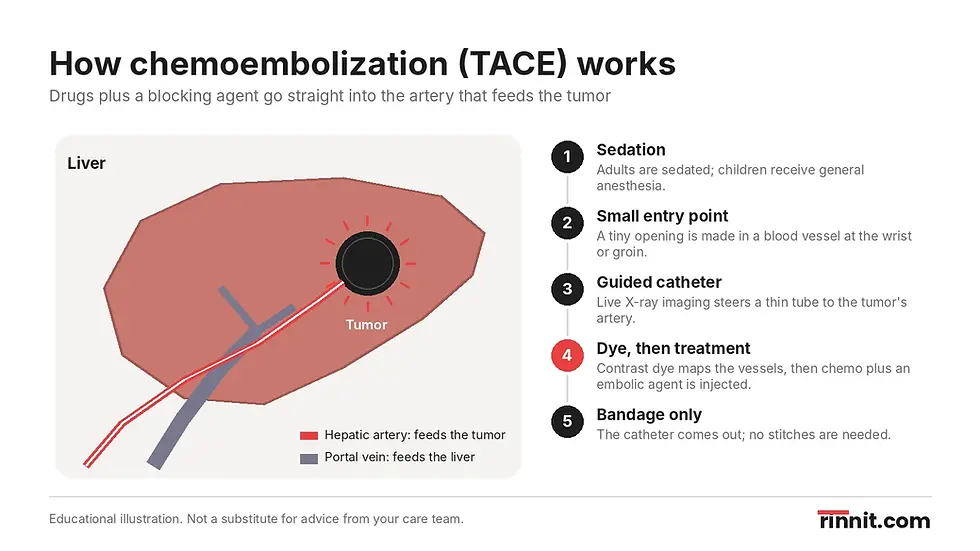
Chemoembolization protects the liver because liver tumors and healthy liver tissue get their blood from different vessels. The liver has two blood supplies: [1]
Blood vessel | Share of liver blood supply | Role in TACE |
Hepatic artery | Smaller portion | Liver tumors get nearly all their blood from this vessel, so this is the one TACE blocks |
Most of the supply | Stays open and keeps feeding healthy liver tissue after treatment |
Because the blocked artery carries only a small share of the liver's blood, liver function is not significantly affected. The portal vein supplies all the blood the healthy liver needs afterward. [1]
Is chemoembolization the same as chemotherapy?
Chemoembolization and chemotherapy both use cancer-fighting drugs, but chemoembolization sends a higher dose straight into the tumor instead of through the whole body. [1]
Feature | Chemoembolization (TACE) | Systemic chemotherapy |
Where the drugs go | Directly into the tumor's artery | Throughout the body via the bloodstream |
Dose at the tumor | Higher | Lower, spread across the body |
Tumor blood supply | Blocked by an embolic agent | Left open |
Chance of severe side effects | Lower | Higher |
Because the drugs stay concentrated in the tumor, severe side effects are less likely than with standard chemotherapy. [1] For a full overview of how standard treatment works, see our guide to chemotherapy and its side effects.

Who is chemoembolization for?
Chemoembolization is for adults and children with primary liver cancer (hepatocellular carcinoma), and it is often the first treatment when tumors are too large to remove with surgery. [1]
It is also used for cancers that have spread to the liver from elsewhere, including: [1]
Colon cancer
Sarcoma
New to the condition itself? Start with our complete guide to liver cancer.
Who should not have chemoembolization?
Chemoembolization is not safe for people with certain health conditions, so your care team screens for them before treatment. These include: [1]
Condition | Why it matters |
Bile duct blockage | Raises the risk of complications in the liver |
Blood clotting disorders | Affects safety of the blood vessel procedure |
Kidney disease | The kidneys must clear contrast dye and byproducts of dying tumor cells |
Metastatic cancer affecting many organs | Treating the liver alone may not help |
Other liver diseases, such as hepatic encephalopathy or portal vein thrombosis | The liver may not tolerate treatment |
Severe allergy to contrast dye | Dye is used to map the blood vessels during the procedure |
Who performs chemoembolization?
An interventional radiologist performs chemoembolization. This specialist uses thin tubes called catheters and live imaging to treat disease from inside the blood vessels. [1]
How do you prepare for chemoembolization?
Preparation for chemoembolization includes imaging and blood tests that help your care team plan the procedure. [1]
Tests before treatment:
CT scan
MRI
Blood tests to check kidney function and look for clotting problems
Medicines you may receive:
Antibiotics to lower the risk of infection
Medicine to reduce nausea
Medicine to protect your kidneys from substances released by dying tumor cells
What happens during the chemoembolization procedure?
The chemoembolization procedure uses a catheter guided through a blood vessel to deliver treatment directly to the tumor. Here is what happens, step by step: [1]
Sedation or anesthesia. Adults receive sedation that makes them relaxed and sleepy. Children receive general anesthesia, which puts them to sleep.
Small incision. The interventional radiologist makes a tiny opening in a blood vessel near the wrist or groin.
Catheter placement. A catheter is inserted through the opening.
Guidance to the tumor. Live X-ray imaging (fluoroscopy) helps steer the catheter to the tumor.
Contrast dye. A special dye is injected to show the fine details of the tumor and nearby blood vessels.
Treatment. A mix of chemotherapy drugs and an embolic agent is injected into the tumor.
Finishing up. The catheter is removed and a bandage covers the opening. No stitches or closure devices are needed.
Will you need other cancer treatments after chemoembolization?
Chemoembolization is the only treatment some people need, while others receive it as one part of a wider plan. [1] Your interventional radiologist helps decide which therapies fit your situation. Other options may include: [1]
Surgery to remove the tumor if it comes back
Systemic chemotherapy
Radiation therapy, such as stereotactic body radiation therapy (SBRT)
What are the benefits of chemoembolization?
The main benefits of chemoembolization are effective tumor control, preserved liver function and a shorter recovery than many cancer treatments. [1]
Benefit | What it means for you |
High success rate | Tumor growth stops in about 70% of patients |
Preserved liver function | The treatment rarely affects how well your liver works |
Shorter recovery | Most people feel better within a few weeks |
What are the risks of chemoembolization?
Chemoembolization carries risks that range from mild chemotherapy reactions to liver or kidney damage. Possible risks include: [1]
Infection
Kidney damage, especially in people with diabetes
Liver damage, which can happen if the drugs and embolic agent lodge in the wrong place
Mild chemotherapy reactions, such as nausea, hair loss and anemia
Blood clots, a higher risk in children
Repeat procedures, because results are not permanent
What are the side effects of chemoembolization?
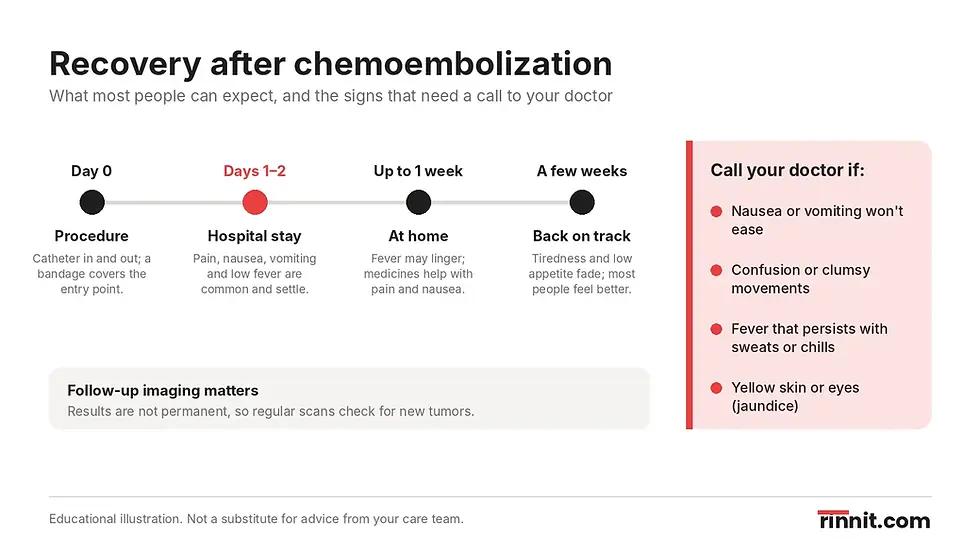
The most common side effect of chemoembolization is post-embolization syndrome: pain, nausea, vomiting and a low-grade fever after the procedure. [1] Most people stay in the hospital for a day or two until these symptoms settle. [1]
Time after TACE | What to expect |
First 1 to 2 days | Hospital stay while pain, nausea, vomiting and fever ease |
Up to 1 week | Fever may continue; medicines help with lingering pain and nausea |
A few weeks | Tiredness and loss of appetite gradually fade |
How long does recovery from chemoembolization take?
Recovery from chemoembolization usually takes a few weeks, and most people feel better within that time. [1] Once you are home, take it easy and let your body rest. [1]
Most people recover well from the procedure itself, but TACE rarely cures liver cancer; in a review of over 10,000 patients, median survival was about 19 months. You will need ongoing scans to check for new tumors. [1]
When should you call your doctor after chemoembolization?
Call your doctor after chemoembolization if you notice any of these warning signs: [1]
Nausea and vomiting that do not get better
Becoming easily confused or having clumsy, uncoordinated movements
A fever that will not go away, along with sweats and chills
Yellowing of the skin or eyes (jaundice), a possible sign of liver failure
Conclusion
Chemoembolization gives many people with liver cancer a targeted, minimally invasive option when surgery is not possible. By sending concentrated chemotherapy into the tumor and cutting off its blood supply, TACE controls tumor growth in about 7 in 10 patients while leaving the healthy liver working. [1] Recovery is usually measured in weeks, not months. The best results come from an experienced interventional radiologist and a follow-up plan with regular scans. [1]
Facing a liver cancer diagnosis or weighing your treatment options? Explore our liver cancer guide and hepatocellular carcinoma explainer, then bring your questions to your care team so you can decide together whether chemoembolization is right for you.
FAQ
What is chemoembolization used for?
Chemoembolization is used to treat primary liver cancer (hepatocellular carcinoma) and cancers that have spread to the liver, such as breast cancer, colon cancer, neuroendocrine tumors and ocular melanoma. Chemoembolization is often the first treatment when a liver tumor is too large to remove with surgery.
Is chemoembolization painful?
Chemoembolization is done with sedation for adults, which makes them relaxed and sleepy, and general anesthesia for children, which puts them to sleep and blocks sensation. Afterward, many people have pain, nausea and a low-grade fever, known as post-embolization syndrome, which is treated with medicines in the hospital.
How long is the hospital stay after chemoembolization?
The hospital stay after chemoembolization is usually one to two days. Patients stay until post-embolization symptoms such as pain, nausea, vomiting and fever settle.
How successful is chemoembolization?
Chemoembolization stops tumor growth in about 70% of patients. A large systematic review of more than 10,000 patients found about 70% were alive one year after oil-based TACE, with a median survival of 19.4 months.
Does chemoembolization damage the liver?
Chemoembolization rarely affects liver function because it blocks only the hepatic artery, which supplies a small share of the liver's blood. The portal vein keeps feeding healthy liver tissue, although liver damage can occur if the treatment lodges in the wrong place.
Can chemoembolization be repeated?
Chemoembolization can be repeated, and many people need more than one session because the results are not permanent. Regular follow-up scans help your care team decide when another treatment is needed.
How long does it take to recover from chemoembolization?
Recovery from chemoembolization usually takes a few weeks. Fever may last up to a week, and tiredness and low appetite can last a few weeks before fading.
When should I seek urgent help after chemoembolization?
Urgent medical help is needed after chemoembolization if you develop yellow skin or eyes, confusion or clumsy movements, a fever with sweats and chills that will not go away, or vomiting that does not stop. These signs can point to liver problems or infection.
What is post-embolization syndrome?
Post-embolization syndrome is a common reaction after chemoembolization that can cause fever, belly pain, nausea and tiredness. It usually eases on its own within several days, and your care team can give medicine to help. Call your doctor if your fever is high or the pain keeps getting worse.
Can chemoembolization cure liver cancer?
Chemoembolization is usually not a cure on its own. It is mainly used to slow tumor growth and control the cancer, and sometimes to shrink a tumor enough for surgery, ablation or a liver transplant.
Further reading (external)
RadiologyInfo.org. TACE Cancerous Tumor Therapy. RadiologyInfo.org. Last updated September 16, 2024. https://www.radiologyinfo.org/en/info/chemoembol
American Cancer Society. Embolization Therapy for Liver Cancer. American Cancer Society. Last updated February 11, 2025. https://www.cancer.org/cancer/liver-cancer/treating/embolization-therapy.html
Young M, John S. Hepatic Chemoembolization. In: StatPearls. Treasure Island (FL): StatPearls Publishing. Last updated June 2, 2025. PMID 29939599. https://www.ncbi.nlm.nih.gov/books/NBK507822/
Related Reading
Hepatocellular Carcinoma: What It Is, the 10 Risk Factors, and How Treatment Protects Your Liver explains the main liver cancer that chemoembolization treats and its risk factors.
Y-90 Treatment (Radioembolization) describes how radioactive beads are used to treat liver tumors.
Understanding Metastatic Liver Cancer: Causes, Symptoms, and Treatment covers cancer that has spread to the liver and its treatment options.
Hepatectomy (Liver Resection): Why It's Done, Types, Risks, and Recovery explains surgery to remove part of the liver and what recovery involves.
References
Cleveland Clinic. Transarterial Chemoembolization (TACE): Definition & Procedure. Cleveland Clinic. Last updated June 29, 2022. https://my.clevelandclinic.org/health/treatments/23403-chemoembolization
Llovet JM, Bruix J. Systematic review of randomized trials for unresectable hepatocellular carcinoma: Chemoembolization improves survival. Hepatology. 2003;37(2):429-442. PMID 12540794. https://doi.org/10.1053/jhep.2003.50047
Lencioni R, de Baere T, Soulen MC, et al. Lipiodol transarterial chemoembolization for hepatocellular carcinoma: A systematic review of efficacy and safety data. Hepatology. 2016;64(1):106-116. PMID 26765068. https://doi.org/10.1002/hep.28453
Lammer J, Malagari K, Vogl T, et al. Prospective randomized study of doxorubicin-eluting-bead embolization in the treatment of hepatocellular carcinoma: results of the PRECISION V study. Cardiovasc Intervent Radiol. 2010;33(1):41-52. PMID 19908093. https://doi.org/10.1007/s00270-009-9711-7
Medical disclaimer
This article is for educational purposes only and does not replace professional medical advice, diagnosis or treatment. Always talk with your doctor or another qualified healthcare provider about any questions you have regarding a medical condition or treatment, and seek emergency care right away for urgent symptoms.



Comments