Neuroendocrine Tumors: Symptoms, Causes, Diagnosis and Treatment — What You Need to Know

Updated: 2 days ago
Medically reviewed by Dr. Baraa Alnahhal, MD · Last reviewed: September 2026
Editorial note: This article is provided for educational purposes only. It is not medical advice. Always consult a qualified healthcare professional for diagnosis and treatment of any condition.
TL;DR
Neuroendocrine tumors (NETs) are rare cancers that start in neuroendocrine cells. Most occur in the lungs, appendix, small intestine, rectum and pancreas. They may be functional (producing excess hormones, causing flushing, diarrhea, dizziness, shakiness, thirst or rash) or nonfunctional (no hormone symptoms). General symptoms include pain from a growing tumor, a growing lump under the skin, fatigue and unintended weight loss. The exact cause is unknown, but inherited syndromes (MEN 1, MEN 2, von Hippel-Lindau disease, tuberous sclerosis, neurofibromatosis) raise risk. Diagnosis uses an exam, hormone tests, imaging and biopsy, with differentiation and grade (1–3) assessed. Treatment is tailored to tumor type, location, hormones, aggressiveness and spread.
Quick Answer
Neuroendocrine tumors are rare cancers that start in neuroendocrine cells — cells with traits of both nerve cells and hormone-making endocrine cells. They can form anywhere in the body, but most develop in the lungs, appendix, small intestine, rectum and pancreas.
Some tumors grow slowly; others grow quickly. Functional tumors release excess hormones and can cause symptoms like skin flushing, diarrhea and dizziness; nonfunctional tumors don't release enough hormones to cause symptoms and are often found late. Diagnosis combines hormone blood/urine tests, imaging (including dotatate PET scans), and biopsy with grading (1–3). Treatment includes surgery, chemotherapy, targeted therapy, immunotherapy, hormone-control medicines and specialized radiation.
When Should You See a Doctor?
Neuroendocrine tumors don't always cause symptoms at first, and they are rare enough that early warning signs are easy to overlook. Make an appointment with a doctor or other healthcare professional if you have any symptoms that worry you — especially any of the following:
What you notice | What it may suggest |
Pain from a growing tumor | A tumor pressing on surrounding tissue |
A growing lump you can feel under the skin | A mass forming in or near the skin |
Feeling very tired | General effect of a growing cancer |
Losing weight without trying | Unintended weight loss can signal cancer |
Skin flushing, diarrhea, dizziness, shakiness | Excess hormones from a functional tumor |
Increased thirst or skin rash | Hormone-related symptoms of a functional tumor |
Because functional tumors release excess hormones, their symptom pattern — flushing, diarrhea, thirst, dizziness, shakiness, rash — often stands apart from typical illness. Lasting or unusual symptoms deserve evaluation rather than waiting them out.
"Neuroendocrine tumors are cancers that start in neuroendocrine cells. Neuroendocrine cells have traits similar to nerve cells, which send and receive signals from the brain, and endocrine cells, which make hormones that regulate various body functions." — Mayo Clinic
What Exactly Are Neuroendocrine Tumors?
Neuroendocrine tumors are cancers that start in neuroendocrine cells. These hybrid-like cells resemble nerve cells, which send and receive signals from the brain, and endocrine cells, which make hormones that regulate various body functions. They are rare and can happen anywhere in the body, but most occur in the lungs, appendix, small intestine, rectum and pancreas.
There are many types. Some grow slowly and some grow very quickly. The key distinction is whether the tumor releases hormones:
Tumor type | What it means |
Functional neuroendocrine tumors | Make excess hormones, causing hormone-driven symptoms |
Nonfunctional neuroendocrine tumors | Don't release hormones, or don't release enough to cause symptoms |
Diagnosis and treatment depend on the type of tumor, its location, whether it produces excess hormones, how aggressive it is, and whether it has spread to other parts of the body.
Some people wonder if neuroendocrine tumors are related to adenocarcinoma, which is cancer that starts in gland cells. Both can happen just about anywhere in the body, but they are different cancers that behave differently. For example, pancreatic neuroendocrine tumors tend to grow more slowly than pancreatic adenocarcinomas and have a better prognosis.
Known types of neuroendocrine tumors include:
Type | Description |
Adrenal cancer | Cancer of the adrenal glands |
Carcinoid tumors | A type of NET, often well-differentiated and slow-growing |
Merkel cell carcinoma | An aggressive skin-based NET |
Pancreatic neuroendocrine tumors | NETs starting in the pancreas |
Paraganglioma | NET starting outside the adrenal glands |
Pheochromocytoma | NET of the adrenal glands |

What Are the Symptoms of Neuroendocrine Tumors?
Neuroendocrine tumors don't always cause signs and symptoms at first. Symptoms depend on the location of the tumor and whether it produces excess hormones. In general, symptoms might include:
General symptom | Description |
Pain | Pain from a growing tumor |
A growing lump | A lump you can feel under the skin |
Fatigue | Feeling very tired |
Weight loss | Losing weight without trying |
Some neuroendocrine tumors make excess hormones. These are called functioning neuroendocrine tumors. Their hormone-driven symptoms can include:
Hormone-related symptom | Description |
Skin flushing | Sudden reddening of the skin |
Diarrhea | Frequent loose stools |
Increased thirst | Unusual thirst |
Dizziness | Feeling lightheaded |
Shakiness | Trembling or shakiness |
Skin rash | Rash on the skin |

What Causes Neuroendocrine Tumors?
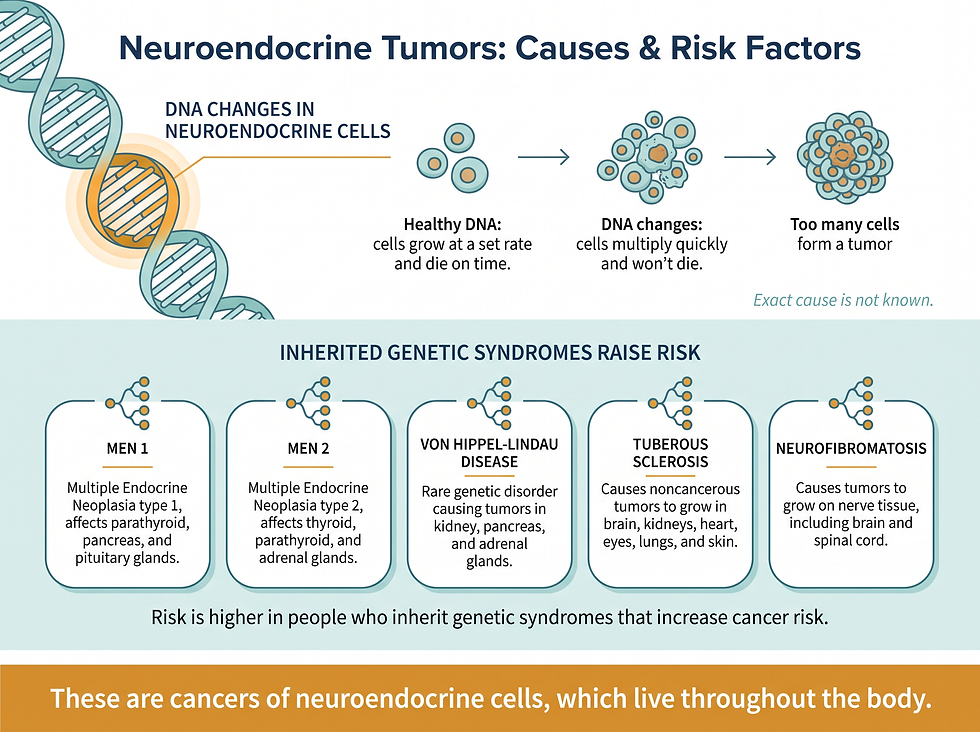
The exact cause of neuroendocrine tumors isn't known. What is understood is the mechanism at the cell level. These cancers begin in neuroendocrine cells, which are found throughout the body, when those cells get changes in their DNA. A cell's DNA holds the instructions that tell the cell what to do.
In healthy cells, DNA tells cells to grow and multiply at a set rate and to die at a set time. In cancer cells, the DNA changes give other instructions: grow and multiply quickly, and keep living when healthy cells would die. This causes too many cells.
The cancer cells might form a mass called a tumor, which can grow to invade and destroy healthy body tissue. In time, cancer cells can break away and spread to other parts of the body. When cancer spreads, it's called metastatic cancer.
Who Is at Higher Risk?
The risk of neuroendocrine tumors is higher in people who inherit genetic syndromes that increase the risk of cancer. Examples include:
Inherited syndrome | Detail |
Multiple endocrine neoplasia, type 1 (MEN 1) | Inherited syndrome increasing cancer risk |
Multiple endocrine neoplasia, type 2 (MEN 2) | Inherited syndrome increasing cancer risk |
Von Hippel-Lindau disease | Inherited syndrome increasing cancer risk |
Tuberous sclerosis | Inherited syndrome increasing cancer risk |
Neurofibromatosis | Inherited syndrome increasing cancer risk |
Because neuroendocrine tumors can happen anywhere in the body and may be silent for long periods, anyone with one of these inherited syndromes should discuss monitoring with their healthcare team.
How Are Neuroendocrine Tumors Diagnosed?
Diagnosis often starts with an exam, in which a healthcare professional checks your body for signs of cancer. Other tests and procedures might include blood and urine tests, imaging tests, and a biopsy.
Step | What happens |
Physical exam | The professional may feel for swollen lymph nodes, look for signs of excess hormones, and ask about symptoms |
Hormone tests | Blood or urine tests may look for signs of extra hormones, since tumors sometimes make them |
Imaging tests | Pictures of the inside of the body show the cancer's location and size, and look for spread |
Biopsy | A tissue sample is removed and tested in a lab to confirm whether cancer cells are present |
The Imaging Tests
Imaging might include ultrasound, CT scan, MRI scan and PET scan. The PET scan used for NETs is specialized: it uses a tracer that attaches to cells with receptors for a chemical called somatostatin, which neuroendocrine tumor cells often have. It is sometimes called a somatostatin receptor (SSTR) PET scan, or a dotatate PET scan because the tracer contains a medicine called dotatate.
How the Biopsy Is Done
How a biopsy is done depends on where the cancer is in the body. A long, thin tube with a light and camera can go down the throat to collect tissue from a lung tumor (bronchoscopy), or through the anus to get tissue from a tumor in the colon or rectum (colonoscopy). Sometimes, collecting a tissue sample requires surgery.
How the Cancer Cells Are Classified
In the lab, healthcare professionals look at the tumor cells under a microscope and classify them in two ways. Differentiation describes how much the cancer cells look like healthy cells:
Classification | What it means |
Well-differentiated | Cells look similar to healthy cells; usually grows more slowly and is less aggressive; can still grow large and spread, but less likely to; sometimes called carcinoid tumors |
Poorly differentiated | Cells look different from healthy cells; usually grows quickly and is more aggressive; called neuroendocrine carcinomas (NECs) |
Grade measures how fast the cancer cells are growing and dividing. Lab professionals count how many cells are dividing (the mitotic rate) and measure how many cells are actively growing (the Ki-67 score). Grades go from 1 to 3:
Grade | Classification | Behavior |
Grade 1 | Low grade | Tends to grow slowly |
Grade 2 | Intermediate grade | Usually grows and spreads faster than grade 1 but slower than grade 3 |
Grade 3 | High grade | Tends to grow quickly |
Differentiation and grade tell the healthcare team how the cancer is likely to act, helping them understand the prognosis and choose a treatment.
How Are Neuroendocrine Tumors Treated?
Treatments include surgery, radiation therapy and medicines such as chemotherapy, targeted therapy and immunotherapy. If the cancer is making excess hormones, medicines can help control the symptoms the hormones cause. The healthcare team considers the type of tumor, its location, and whether you have symptoms when creating a plan.
Treatment | How it works | When it's used |
Surgery | Removes the tumor; when possible, all of the cancer plus some surrounding healthy tissue (the margin). If it can't be removed completely, removing as much as possible might help | Primary treatment when removal is possible |
Chemotherapy | Strong medicines, most given through a vein and some in pill form; sometimes used before surgery to shrink the tumor or after to kill remaining cells | When surgery isn't possible; spread; before or after surgery |
Targeted therapy | Medicines that attack specific chemicals in cancer cells, causing them to die; example: everolimus | Cancers that can't be removed with surgery; cancers that spread |
Hormone-control medicines | Somatostatin analog medicines control excess hormones and help with symptoms; examples: octreotide and lanreotide | Functional tumors releasing excess hormones |
Immunotherapy | Medicine that helps the immune system find and kill cancer cells that hide from it; example: pembrolizumab | Option for advanced cancers |
External beam radiation | Energy beams from X-rays, protons or other sources directed to precise points on the body; some NET types may respond | If surgery isn't an option |
Peptide receptor radionuclide therapy (PRRT) | A radiopharmaceutical combines a cancer-targeting medicine with a small radioactive substance, delivering radiation directly to cancer cells; example: lutetium Lu 177 dotatate | Advanced neuroendocrine tumors |
How Do You Cope with a Neuroendocrine Tumor Diagnosis?
Coping can be challenging. Some people feel shocked or worried when they find out they have a neuroendocrine tumor, and a cancer diagnosis can bring up many emotions. With time, you'll find ways to cope. Four approaches can help:
Learn enough about neuroendocrine tumors to make treatment decisions. Make a list of questions for your next appointment, bring a trusted person to help take notes, and ask your healthcare team about reliable sources of information.
Connect with others with neuroendocrine tumors. A support group, in your community or online, can be a source of useful information, practical tips and encouragement. Ask your healthcare team or the American Cancer Society.
Take time for yourself. Set aside time each day to take your mind off your cancer and do what makes you happy. Even a short break between tests and scans may help.
Find a good listener. A friend or family member, or a counselor, medical social worker or clergy member, can offer guidance and care.
What Should You Prepare for Your Appointment?
Start by making an appointment with a doctor or other healthcare professional if you have any symptoms that worry you. If a neuroendocrine tumor is suspected, you'll likely be referred to a specialist — the kind depends on the body part affected; you might see an oncologist. Because appointments can be brief, preparation helps:
Preparation step | What to do |
Ask about restrictions | When you make the appointment, ask if there's anything to do in advance, such as changing your diet |
Write down symptoms | Include any that may seem unrelated to the reason for the appointment |
Note key personal info | Any major stresses or recent life changes |
List all medicines | Medicines, vitamins or supplements with doses |
Bring someone | A family member or friend may remember something you missed |
Write down questions | Prioritized from most to least important |
Questions worth asking include:
What may be causing my symptoms or condition?
What kinds of tests do I need?
What do you recommend for next steps in determining my diagnosis and treatment?
What are the alternatives to the approach you're suggesting?
Do I need to start treatment right away, and what are the possible side effects?
I have other health conditions — how can I best treat them together?
Are there any restrictions I need to follow, and should I see a specialist?
Expect questions too: when did your symptoms begin, how have they changed, how severe are they, and what seems to improve or worsen them?
Conclusion
Neuroendocrine tumors are rare cancers that begin in neuroendocrine cells and can form anywhere in the body, most often in the lungs, appendix, small intestine, rectum and pancreas. Their behavior varies widely — some grow slowly, some quickly, and whether they release excess hormones dramatically changes the symptom picture.
Because nonfunctional tumors produce no hormone symptoms, and because fatigue, pain, lumps and unintended weight loss can mimic many other conditions, neuroendocrine tumors are frequently recognized late. Diagnosis hinges on hormone tests, specialized imaging including the dotatate PET scan, and biopsy with careful grading. Treatment is tailored to each tumor's type, location, hormones and spread.
Take action today: If you notice symptoms that worry you — especially the unusual combination of flushing, diarrhea and dizziness, or any lasting lump, pain or unintended weight loss — make an appointment with a healthcare professional. If your family carries an inherited syndrome such as MEN 1, MEN 2, von Hippel-Lindau disease, tuberous sclerosis or neurofibromatosis, discuss monitoring with your care team.
Related reading: Gastrointestinal Neuroendocrine Tumors (GI NETs) | Lung Carcinoid Tumors | Pancreatic Cancer
Sources: Mayo Clinic — Neuroendocrine Tumors: Symptoms & Causes | Mayo Clinic — Neuroendocrine Tumors: Diagnosis & Treatment
Frequently Asked Questions
1. What are neuroendocrine tumors in simple terms?
Neuroendocrine tumors are cancers that start in neuroendocrine cells. These cells have traits similar to nerve cells (which send and receive signals from the brain) and endocrine cells (which make hormones that regulate various body functions).
2. Where do neuroendocrine tumors form in the body?
They can happen anywhere in the body, but most occur in the lungs, appendix, small intestine, rectum and pancreas.
3. Are neuroendocrine tumors rare?
Yes. Neuroendocrine tumors are rare.
4. What is the difference between functional and nonfunctional neuroendocrine tumors?
Functional tumors make excess hormones, causing hormone-driven symptoms. Nonfunctional tumors don't release hormones, or don't release enough to cause symptoms.
5. What are the symptoms of a functional neuroendocrine tumor?
Symptoms can include skin flushing, diarrhea, increased thirst, dizziness, shakiness and skin rash.
6. What are the general symptoms of neuroendocrine tumors?
General symptoms might include pain from a growing tumor, a growing lump you can feel under the skin, feeling very tired, and losing weight without trying.
7. Do neuroendocrine tumors always cause symptoms?
No. They don't always cause signs and symptoms at first. Symptoms depend on the tumor's location and whether it produces excess hormones.
8. What causes neuroendocrine tumors?
The exact cause isn't known. They happen when neuroendocrine cells develop changes in their DNA that tell the cells to grow and multiply quickly and to keep living when healthy cells would die, which can form a tumor.
9. What genetic conditions raise the risk of neuroendocrine tumors?
The risk is higher in people who inherit syndromes that increase cancer risk, including MEN 1, MEN 2, von Hippel-Lindau disease, tuberous sclerosis and neurofibromatosis.
10. What is the difference between neuroendocrine tumors and adenocarcinoma?
Adenocarcinoma is cancer that starts in gland cells. Both can occur almost anywhere, but they are different cancers that behave differently. For example, pancreatic neuroendocrine tumors tend to grow more slowly than pancreatic adenocarcinomas and have a better prognosis.
11. How is a neuroendocrine tumor diagnosed?
Diagnosis often starts with a physical exam, then blood and urine tests for excess hormones, imaging tests, and a biopsy. Imaging can include ultrasound, CT, MRI and a specialized dotatate PET scan.
12. What is a dotatate PET scan?
It is a PET scan that uses a tracer attaching to cells with receptors for somatostatin, which neuroendocrine tumor cells often have. It is also called a somatostatin receptor (SSTR) PET scan because the tracer contains a medicine called dotatate.
13. What does well-differentiated vs poorly differentiated mean?
Well-differentiated tumors have cells that look similar to healthy cells and usually grow more slowly and less aggressively; they are sometimes called carcinoid tumors. Poorly differentiated tumors look different from healthy cells, usually grow quickly, and are called neuroendocrine carcinomas (NECs).
14. How are neuroendocrine tumors graded?
Grades run from 1 to 3 based on how fast cells grow and divide, measured by the mitotic rate and the Ki-67 score. Grade 1 is low grade and slow-growing; Grade 2 is intermediate; Grade 3 is high grade and tends to grow quickly.
15. How are neuroendocrine tumors treated?
Options include surgery, chemotherapy, targeted therapy (such as everolimus), somatostatin analog medicines (octreotide, lanreotide) for excess hormones, immunotherapy (such as pembrolizumab), external beam radiation, and PRRT (such as lutetium Lu 177 dotatate). The plan depends on tumor type, location, hormones and spread.
16. Can neuroendocrine tumors spread?
Yes. In time, cancer cells can break away and spread to other parts of the body. When cancer spreads, it's called metastatic cancer.
17. Should I see a specialist for a neuroendocrine tumor?
If your healthcare professional suspects one, you'll likely be referred to a specialist. The kind depends on the body part affected; you might see an oncologist, a doctor who specializes in treating cancer.
Medical Disclaimer: The information provided in this article is for educational purposes only and should not be used as a substitute for professional medical advice, diagnosis, or treatment. Always seek the advice of a qualified healthcare provider with any questions you may have regarding a medical condition.
Comments