Hepatocellular Carcinoma: What It Is, the 10 Risk Factors, and How Treatment Protects Your Liver

Updated: 2 days ago
Medically reviewed by Dr. Baraa Alnahhal, MD · Last reviewed: September 2026
Clinical content reviewed and current through December 30, 2025. For general education only — not a substitute for professional medical care.
TL;DR
Hepatocellular carcinoma (HCC) is the most common type of liver cancer. It begins in hepatocytes, the liver's main cells, most often in people with long-standing liver conditions such as cirrhosis or hepatitis B or C infection. It may not cause symptoms right away, which is why screening matters for high-risk people. Diagnosis combines imaging, blood tests, and sometimes a biopsy. Treatment options range from surgery and liver transplant to ablation, embolization, radiation, immunotherapy, and targeted therapy, chosen based on how advanced the cancer is and how well the liver is working.
Quick Answer
What is hepatocellular carcinoma? The most common type of liver cancer, starting in hepatocyte cells that make up most of the liver.
Who gets it most often? People with cirrhosis or hepatitis B/C infection, though it can occur without a known liver condition.
Are there early symptoms? Usually none. Early warning signs are typically found on screening: an elevated AFP blood test or nodules on an ultrasound.
What are the later symptoms? Unexplained weight loss, loss of appetite, upper abdominal pain, a lump in the abdomen, and jaundice (yellowing of skin and eyes).
How is it diagnosed? Physical exam, health history, imaging (ultrasound, CT, MRI, PET), liver function blood tests, AFP tumor marker, and sometimes a biopsy.
What are the main treatments? Surgery (partial hepatectomy), liver transplant, radiofrequency or cryoablation, chemoembolization, radioembolization, radiation, immunotherapy, and targeted therapy.
What decides the treatment? Two things together: how advanced the cancer is AND how well the liver is working.
What Is Hepatocellular Carcinoma?
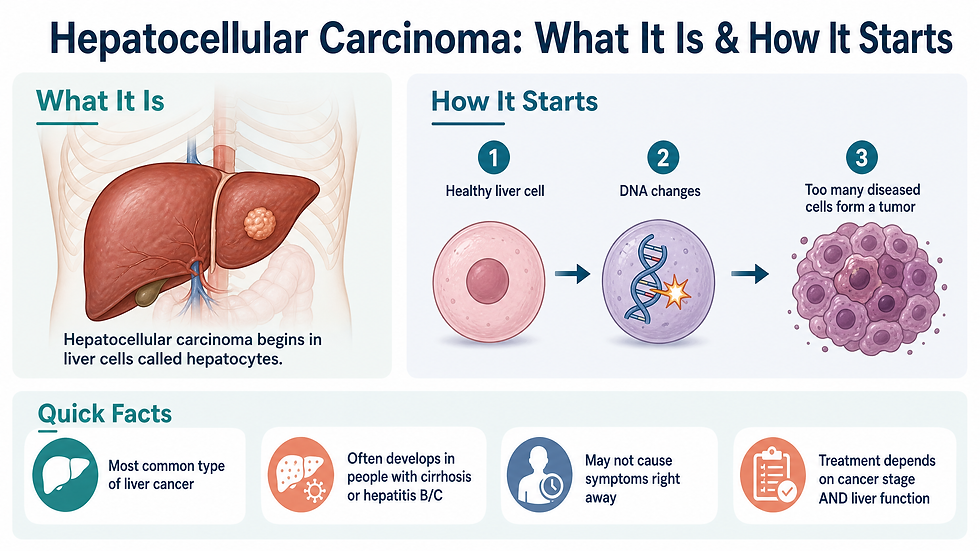
Your liver sits just under the rib cage on the right side of your belly. It digests food, removes waste from the blood, and performs hundreds of other jobs. The liver's main cells are called hepatocytes, and hepatocellular carcinoma (HCC) is a cancer that begins in these cells. It is the most common type of liver cancer.
The disease starts with DNA changes inside a hepatocyte. Healthy cell DNA instructs cells to grow and multiply at a set rate and to die at a set time. Cancer DNA gives the cell different instructions: grow and multiply quickly, and keep living when healthy cells would die. The result is far too many cells, which form a tumor mass that can invade healthy tissue and grow into nearby blood vessels.
Cancer cells can break away and spread to other parts of the body. This is called metastasis, and a spread HCC is called metastatic hepatocellular carcinoma. When HCC spreads, it most often reaches the lungs, abdominal lymph nodes, bones, adrenal glands, or brain.
HCC is one of the most serious cancers. Two reasons make it especially challenging: it may not cause symptoms right away, so it can grow undetected, and it often develops in people who already have serious liver disease, which makes treatment harder.
A related note: HCC is different from intrahepatic cholangiocarcinoma, a liver cancer that starts in the bile ducts. It has different risk factors and treatments. Hepatoblastoma is a third type that mostly affects young children. All three fall under the umbrella term "malignant neoplasms of the liver."
HCC itself has no true subtypes. One related condition, fibrolamellar carcinoma, is sometimes called a variant. It starts in hepatocytes like HCC but behaves differently, happens most often in young adults without liver disease, is usually treated with surgery, and often does not cause high AFP tumor-marker levels. Experts still disagree on whether it is truly related to HCC.
Symptoms: Why Early Detection Relies on Screening
HCC might not cause noticeable symptoms at first. In people with cirrhosis from hepatitis B or C, cancer symptoms may even mirror the cirrhosis symptoms, making the cancer easy to miss.
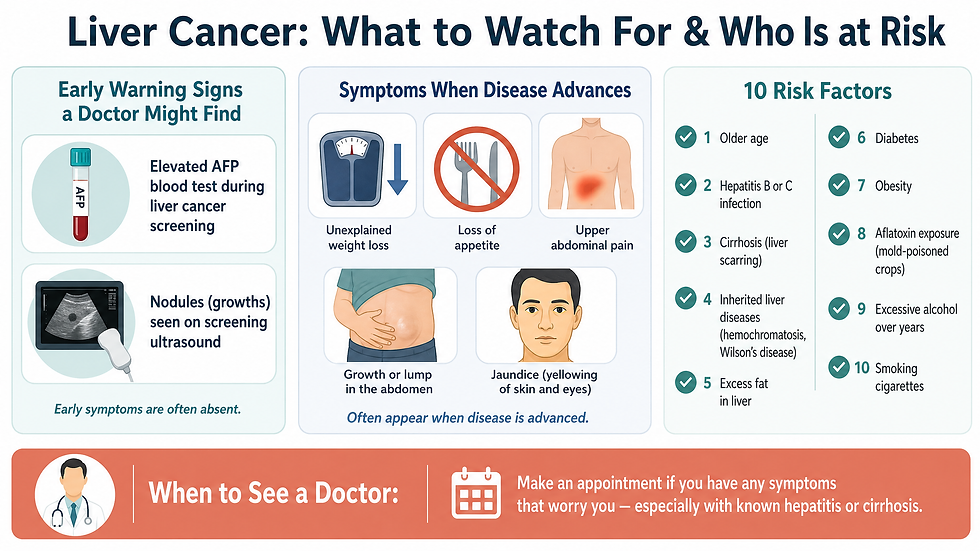
The earliest warning signs are usually not felt at all — they are found by a professional during liver cancer screening. There are two: an elevated alpha-fetoprotein (AFP) level on a blood test in a high-risk person, and nodules (growths) seen on the liver during an ultrasound screening.
AFP is a protein the liver makes as a baby grows in the womb. Levels drop sharply after birth. Injured liver cells may produce AFP again while repairing themselves, and most people with HCC have very high AFP. But a high AFP alone does not mean cancer — pregnancy, acute liver injury, and liver fibrosis can also raise levels. Care teams use AFP together with imaging, and may track it over time to see whether treatment is working.
If symptoms do develop, the disease is usually advanced by then. The classic picture includes:
Symptom | What You Would Notice |
Unexplained weight loss | Dropping pounds without trying, no change in diet or activity |
Loss of appetite | Food seems unappealing; eating less than usual |
Upper abdominal pain | Aching under the right rib cage where the liver sits |
Growth or lump in the abdomen | A noticeable mass in the belly area |
Jaundice | Yellowing of the skin and whites of the eyes, caused by bilirubin buildup in the blood |
When to see a doctor: Make an appointment if you have any symptoms that worry you. For people with hepatitis B or C or cirrhosis, regular six-month screening is where early detection actually happens.
Causes: How Normal Liver Cells Turn Cancerous
The main drivers of HCC are cirrhosis and hepatitis B or C virus infection. Cirrhosis is progressive, irreversible scarring of the liver. However, not everyone with HCC starts with a serious liver condition. In those without liver disease, the cause is often unclear.
The mechanism is the same one behind most cancers. Healthy DNA in a hepatocyte controls a set growth rate and a set death time. Cancer-causing DNA changes override both controls. The altered cells multiply rapidly, refuse to die on schedule, crowd out healthy cells, and form a tumor that invades surrounding tissue. From there, cells can break away and travel through the blood to become metastatic cancer.
Risk Factors: Who Is Most Likely to Develop Liver Cancer
Ten factors raise the odds of developing HCC. Most of them connect back to one theme: long-term liver injury.
Risk Factor | What It Means |
Older age | More common in older adults |
Hepatitis B or C infection | Ongoing or previous infection increases risk |
Cirrhosis | Progressive, irreversible scarring of the liver |
Certain inherited liver diseases | Hemochromatosis (iron overload) and Wilson's disease |
Excess fat in the liver | Metabolic dysfunction-associated steatotic liver disease (MASLD, formerly NAFLD) |
Diabetes | Carries a greater risk than not having it |
Obesity | Raises cirrhosis and fatty-liver odds, which raises HCC odds |
Exposure to aflatoxins | Poisons from molds on poorly stored grains and nuts that end up in foods |
Excessive alcohol over years | More than moderate daily drinking over many years causes irreversible liver damage |
Smoking cigarettes | Independently increases risk |
Diagnosis: The Tests Behind a Liver Cancer Diagnosis
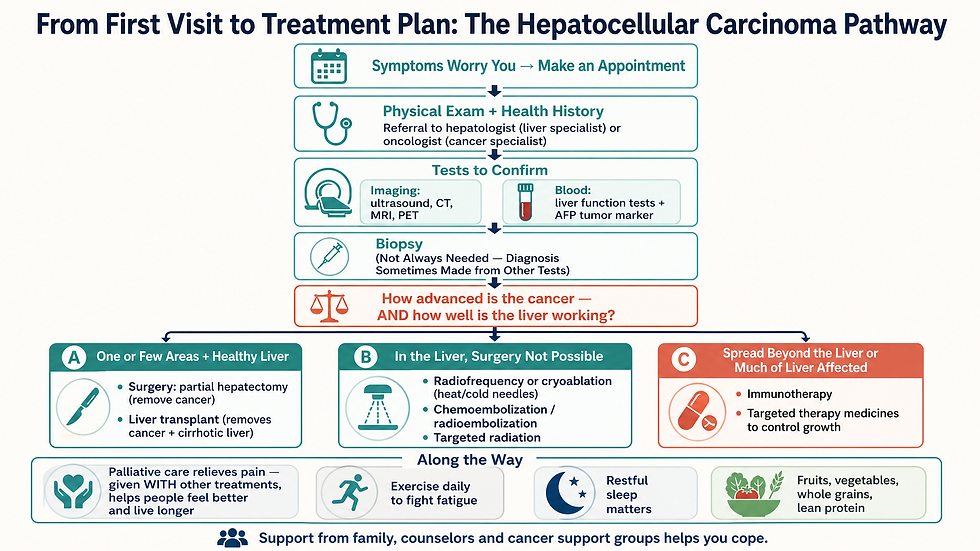
A diagnosis begins with a physical exam and health-history questions. From there, care teams typically order several kinds of tests.
Imaging is the backbone: ultrasound, CT scan, MRI scan, and PET scan, each mapping the liver to find tumors and check blood vessels.
Blood work includes liver function tests — ALT, AST, ALP, albumin, bilirubin, and prothrombin time (PT) — plus the AFP tumor-marker test described above.
A biopsy is not always needed. A needle passes through the skin into the cancer to draw out cells for lab testing, and special tests on those cells help shape the treatment plan. Sometimes, however, the diagnosis is made from imaging and blood results alone.
After diagnosis, referrals usually follow: a hepatologist (liver specialist) and, if cancer is confirmed, an oncologist (cancer specialist).
Test | What Happens | What It Shows |
Ultrasound | Sound waves map the liver | Nodules or tumors |
CT scan | X-ray imaging from many angles | Tumor size, location, blood-vessel involvement |
MRI scan | Magnetic imaging with detail | Soft-tissue detail of tumors |
PET scan | Tracer highlights active cells | Where cancer is active, including spread |
Liver function tests | Blood draw (ALT, AST, ALP, albumin, bilirubin, PT) | How well the liver is working |
AFP blood test | Blood draw | Tumor-marker level; tracked over time |
Biopsy | Needle through skin into the mass | Cell-level confirmation; not always required |
Treatment: Options Depend on Two Things
Treatment choices for HCC depend on two factors together: how advanced the cancer is and how well the liver is working. A healthy liver opens doors that cirrhosis closes.
The overall logic is straightforward. Cancer in one or a few areas can sometimes be removed with surgery. If surgery is not possible but the cancer is confined to the liver, ablation, embolization, and radiation can attack it directly. If many parts of the liver are involved or the cancer has spread beyond the liver, medicines are used to control and slow growth. When cancer and cirrhosis coexist, a liver transplant may cure both at once — if the person is healthy enough for surgery.
Surgery Options
Procedure | How It Works | When It Is Used |
Partial hepatectomy | Removes the cancer plus some healthy tissue around it | Cancer in one part of the liver; depends on location, liver function, and overall health |
Liver transplant | Removes the cancer and the entire liver; a donor liver is placed | Otherwise healthy people whose cancer has not spread beyond the liver; may cure both cancer and cirrhosis |
Surgery carries bleeding and infection risks. After a transplant, lifelong medicine prevents the body from rejecting the new organ, with side effects that include a weakened immune system. Other treatments may be used to control the cancer while waiting for a donor liver.
Other Liver Procedures
Procedure | How It Works |
Radiofrequency ablation | Small needles carry electric current and heat into the cancer to damage cancer cells |
Cryoablation | Small needles deliver extreme cold to damage cancer cells |
Chemoembolization | Chemotherapy is delivered directly to the cancer while a medicine blocks its blood flow, shrinking or slowing it |
Radioembolization | Tiny beads holding radiation are placed into a blood vessel leading to the liver, targeting the cancer directly |
Radiation therapy | Powerful energy beams (X-rays, protons, or other sources) are aimed at the cancer in the liver |
Side effects depend on the procedure and how much of the liver is treated.
Medicines for Liver Cancer
Immunotherapy helps the immune system find and kill cancer cells, which otherwise survive by hiding from it. It is used after surgery to kill remaining cells, or for advanced HCC that cannot be removed. Side effects vary by medicine and include high blood pressure, nausea, cough, and fatigue.
Targeted therapy medicines attack specific chemicals in cancer cells; blocking those chemicals causes the cancer cells to die. It is used after surgery or for advanced, non-removable HCC. Side effects include high blood pressure, fatigue, diarrhea, and joint pain.
Palliative Care: An Extra Layer of Support
Palliative care is specialized healthcare that relieves pain and other symptoms during serious illness. A team of doctors, nurses, and trained professionals works to improve quality of life for the patient and family. Importantly, palliative care is not a replacement for treatment — it is an extra layer given alongside surgery, chemotherapy, immunotherapy, targeted therapy, or radiation. Research shows that combining palliative care with other treatments helps people feel better and live longer.
Prevention: Lowering Your Liver Cancer Risk
You can reduce your risk by protecting your liver from long-term damage. Drink alcohol in moderation — up to one drink a day for women and two for men, if at all. Maintain a healthy weight by eating fewer calories and slowly increasing exercise.
Get the hepatitis B vaccine, which is available for infants, children, adults, and older adults. Prevent hepatitis C by knowing your partner's health status and using condoms, avoiding IV drugs or using a sterile, never-shared needle through needle-exchange programs, and choosing safe, clean piercing and tattoo shops that can explain their sterilization practices.
If you already have hepatitis B or C, seek treatment. Research shows that treating the infection reduces the risk of HCC.
What about screening? Routine screening is not generally recommended for most people because it has not been proved to reduce dying of liver cancer. But people with hepatitis B, hepatitis C, or cirrhosis might consider it. Screening typically involves a blood test plus an abdominal ultrasound every six months.
Lifestyle and Coping: Living Well During Treatment
If you have been diagnosed, the goal is to help your body feel as good as possible during treatment.
Stay active. Physical activity is often the best treatment for cancer-related fatigue. Daily exercise prevents muscle loss. Walk around the block, use an exercise bike, try strengthening work with weights or resistance bands, and explore low-impact options like yoga, tai chi, and Pilates. A regular program matters more than intensity or duration, and pacing yourself protects your energy.
Get the rest you need. Symptoms can disrupt sleep, and lack of sleep makes you more irritable and less able to cope with pain and stress. Talk to your care team about sleep problems.
Eat a healthy diet. Fruits, vegetables, whole grains, and lean protein keep your energy up for exercise, help manage symptoms, and improve overall well-being.
Coping emotionally starts with learning enough about your cancer — test results, treatment options, and prognosis if you want it — to make confident decisions. Keep friends and family close for practical and emotional support. Find someone to talk with: a friend, family member, counselor, medical social worker, clergy member, or cancer support group. The American Cancer Society and online communities can also help you connect.
Preparing for Your Appointment
Your time with the healthcare team is limited, so preparation helps. Ask about any pre-appointment restrictions (such as diet limits). Write down all symptoms, including ones that seem unrelated. Note major stresses or recent life changes. List every medicine, vitamin, and supplement with doses. Bring a family member or friend to remember information you might miss. And write down your questions, ranked most to least important.
Questions to Ask Your Healthcare Team
Do I have hepatocellular carcinoma?
What is the stage of my cancer? Has it spread beyond my liver?
Will I need more tests? What are my treatment options?
How much does each treatment increase my cure chance or prolong life?
What are the potential side effects of each treatment, and how will it affect my daily life?
Is there one treatment option you consider the best? What would you recommend to a friend or family member in my situation?
Should I see a specialist? What determines whether I need a follow-up visit?
Questions Your Doctor Will Likely Ask You
When did your symptoms begin, and have they been continuous or occasional?
How severe are your symptoms?
What seems to improve or worsen your symptoms?
Conclusion: Knowledge Is Part of Your Treatment
Hepatocellular carcinoma is serious, but it is not a single story. Where you start on the pathway — a healthy liver versus a cirrhotic one — changes the options dramatically. A transplant can cure both cancer and cirrhosis at once. Ablation and embolization can attack tumors without open surgery. Immunotherapy and targeted therapy can control disease that surgery cannot reach. And palliative care improves both comfort and survival when added to any plan.
If you have hepatitis B, hepatitis C, or cirrhosis, six-month screening with a blood test and ultrasound is your strongest defense against late-stage discovery. If you carry any of the ten risk factors, reducing what you can control — alcohol, weight, smoking, vaccination status — genuinely lowers your odds.
Next steps: If you have hepatitis B or C, or cirrhosis, talk to your doctor about a six-month liver cancer screening plan. If you have unexplained weight loss, abdominal pain, or jaundice, book an appointment this week rather than waiting. And if you or a loved one has already received a diagnosis, bring a prepared question list, a support person, and consider asking about clinical trials and palliative care at your first visit.
Related Reading on Rinnit
Fatty Liver Disease (MASLD): The Silent Liver Condition Linked to Weight, Diabetes, and Metabolic Health — how fat buildup in the liver raises liver cancer risk
References
FAQ
Is hepatocellular carcinoma curable?
It can be, in the right situation. If the cancer is confined to the liver and you are healthy enough for surgery, partial hepatectomy can remove it. If cirrhosis is also present, a liver transplant may cure both the cancer and the cirrhosis. When the cancer has spread or involves much of the liver, treatment shifts to controlling and slowing growth.
What does an elevated AFP blood test mean?
AFP is a protein made by the liver as a baby grows in the womb. Levels normally drop after birth, but injured liver cells — including cancer cells — may produce AFP again. Most people with HCC have very high AFP. However, pregnancy, acute liver injury, and liver fibrosis can also raise levels, so AFP is always interpreted alongside imaging, never alone.
Can you have liver cancer without cirrhosis?
Yes. Most HCC develops in people with cirrhosis or hepatitis B or C, but it can occur in people without a known serious liver condition. In those cases the cause is often unclear. Fibrolamellar carcinoma, a related form, typically affects young adults without liver disease.
How often should people at high risk be screened?
People with hepatitis B, hepatitis C, or cirrhosis might consider screening that typically includes a blood test and an abdominal ultrasound every six months. Routine screening is not generally recommended for the wider population because it has not been proved to reduce dying of liver cancer.
What happens if liver cancer spreads beyond the liver?
HCC most often spreads to the lungs, abdominal lymph nodes, bones, adrenal glands, or brain. At that stage it is called metastatic hepatocellular carcinoma, and the main treatments are immunotherapy and targeted therapy medicines that control and slow growth.
What is the difference between ablation and embolization?
Ablation destroys the tumor directly using heat (radiofrequency) or cold (cryoablation) delivered through small needles. Embolization attacks the tumor through its blood supply: chemoembolization delivers chemotherapy to the cancer while blocking its blood flow, and radioembolization delivers radiation via tiny beads placed in a liver blood vessel.
What is palliative care, and is it the same as hospice?
No. Palliative care is specialized symptom relief — pain, fatigue, nausea — given alongside curative or life-prolonging treatment. Research shows that adding palliative care to other treatments helps people with serious illness feel better and live longer.
Rinnit.com provides general health information for educational purposes. This content is not a substitute for professional medical advice, diagnosis, or treatment. Always seek the guidance of a qualified healthcare provider with any questions about your health.
Comments