Hepatectomy (Liver Resection): Why It's Done, Types, Risks, and Recovery

Updated: 6 days ago
Written and medically reviewed by Dr. Baraa Alnahhal, MD · Last reviewed: October 2026 · How we review
Quick Answer: What is a hepatectomy?
A hepatectomy (liver resection) is surgery to remove part of the liver, commonly to treat primary liver cancer, colorectal cancer that has spread to the liver, benign tumors, cysts or bile duct stones. Surgeons can usually remove up to two-thirds of a healthy liver, and the remaining liver regrows over weeks to months. [1]
What the research says
Keyhole surgery cut complications in a randomized trial. In 280 patients having liver resection for colorectal cancer that had spread to the liver, complications occurred in 19% after laparoscopic surgery vs. 31% after open surgery, and the hospital stay was shorter (53 vs. 96 hours). (Fretland et al., Annals of Surgery, 2018) [2]
Robotic surgery showed fewer complications than open surgery for liver cancer. A network meta-analysis of 23 studies (9,666 patients) found robotic hepatectomy had about half the odds of overall complications compared with open surgery (OR 0.52) and a hospital stay about 3 days shorter. All included studies were observational. (Abdelsamad et al., Journal of Robotic Surgery, 2026) [3]
Robotic vs. laparoscopic: similar safety, fewer switches to open surgery. An umbrella review of 12 meta-analyses (more than 15,000 patients) found robotic surgery lowered the odds of converting to open surgery (OR 0.70) but took about 30 minutes longer; complications, blood loss and hospital stay were comparable. (Song et al., Surgery in Practice and Science, 2026) [4]
Key takeaways
A hepatectomy removes part of the liver. Removing the whole liver happens only during a liver transplant. [1]
The liver can grow back, so a large portion can be removed safely in the right patient. [1]
Surgery can be open, laparoscopic (keyhole) or robotic, and usually takes 2 to 6 hours. [1]
Home recovery takes about 4 to 8 weeks after open surgery and 2 to 4 weeks after keyhole or robotic surgery. [1]
When surgery removes all of a liver cancer, it offers the best survival among cancer treatment options. [1]
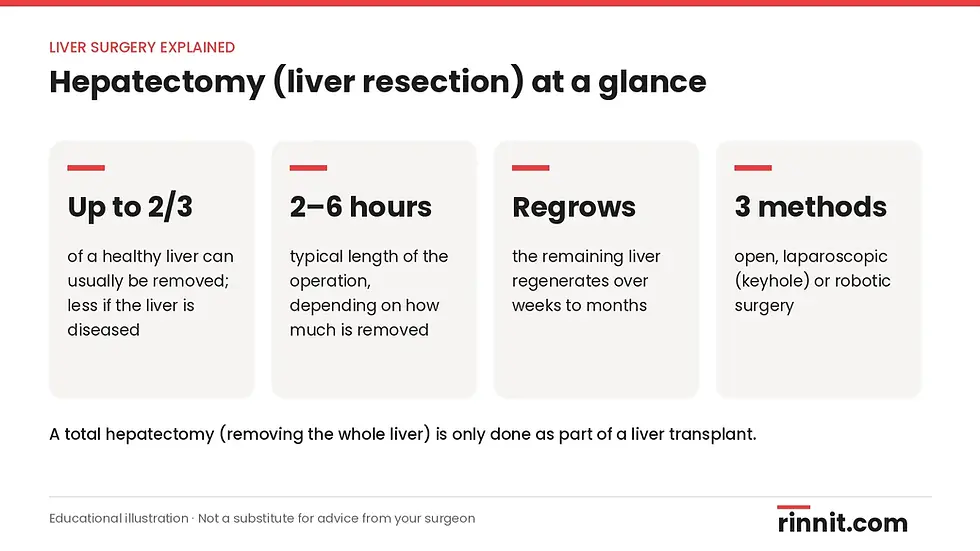
What is a hepatectomy?
A hepatectomy is an operation that removes diseased or damaged tissue from the liver. Doctors also call it a liver resection or partial hepatectomy. [1]
The liver is divided into eight functional segments (I to VIII). Surgeons plan the operation around these segments, along with the blood vessels and bile ducts that serve each one. [1][5]
A total hepatectomy means removing the entire liver. This is only done when a new liver is placed at the same time, during a transplant. [1]
Liver surgery is technically demanding. The liver has a very rich blood supply, so bleeding is the main challenge surgeons work to control. [1]
Why would someone need a hepatectomy?
A hepatectomy is most often done to remove a tumor from the liver, but it treats several other conditions too. [1]
Reason | What it means |
Primary liver cancer | Cancer that starts in the liver, such as hepatocellular carcinoma or cholangiocarcinoma (bile duct cancer) |
Cancer that has spread to the liver | Most commonly from colorectal cancer — see metastatic liver cancer |
Benign (non-cancerous) tumors | Growths such as a hepatic adenoma that cause problems or may become harmful |
Liver cysts | Fluid-filled sacs that grow large or cause symptoms — see liver cysts |
Stones in the bile ducts inside the liver | Gallstones lodged in the liver's bile ducts — see choledocholithiasis |
Living liver donation | A healthy person donates part of their liver to someone who needs a transplant |
Not sure what a spot on your scan means? Our guide to benign and malignant liver lesions explains the main types.
How much of the liver can be removed in a hepatectomy?
Surgeons can usually remove up to two-thirds of a healthy liver. [1]
The remaining liver regenerates — it grows back toward its original size and function. This regrowth takes weeks to months. [1]
A liver that is already damaged cannot spare as much tissue. With conditions like cirrhosis or fatty liver disease (MASLD), surgeons remove less, and regrowth can be slower. Recent chemotherapy can also slow regrowth. [1]
What are the types of hepatectomy?
Hepatectomy types are grouped by how much liver is removed and how many operations are needed. [1]

Type | What is removed |
Major resection | More than three segments, such as a whole half of the liver (right or left hemiliver) |
Minor resection | One segment (segmentectomy) or a small wedge of tissue (wedge resection) |
Multiple resections | Several separate areas in one operation |
Two-stage resection | Part of the disease is removed first; after the liver regrows, a second operation removes the rest |
A two-stage approach is used when removing all the disease at once would leave too little healthy liver. [1]
Is a hepatectomy done as open, laparoscopic or robotic surgery?
A hepatectomy can be done through one large incision (open surgery) or several small incisions (laparoscopic or robotic surgery). [1]
Feature | Open surgery | Laparoscopic (keyhole) | Robotic |
Incision | One larger cut in the upper abdomen | Several small cuts; a camera guides the surgeon | Several small cuts; the surgeon controls robotic arms |
Typical use | Often used for larger resections | Mostly smaller resections | Mostly smaller resections |
Home recovery | About 4–8 weeks | About 2–4 weeks | About 2–4 weeks |
Full return to normal activity | Up to 12 weeks | About 6–8 weeks | About 6–8 weeks |
Minimally invasive methods are generally used for smaller resections. [1] In research, keyhole surgery lowered complications compared with open surgery in a randomized trial, and robotic surgery reduced the need to convert to an open operation. [2][4]
Your surgeon chooses the method based on the size and location of the disease, the health of your liver and their own experience.
How do you prepare for a hepatectomy?
Preparation for a hepatectomy focuses on three questions: are you healthy enough for surgery, can the disease be removed, and has any cancer spread beyond the liver? [1]
Common tests before surgery:
CT or MRI scan — maps the tumor, blood vessels and bile ducts. [1]
Liver function blood tests — show how well your liver is working. [1]
Liver biopsy — sometimes needed to confirm what a lesion is. [1]
Some people receive treatment first, such as chemotherapy, radiation or interventional radiology procedures, to shrink a tumor or prepare the liver. [1]
What happens during hepatectomy surgery?
A hepatectomy typically lasts 2 to 6 hours, depending on how much liver is removed and the method used. [1]
Access — the surgeon makes one larger incision (open) or several small ones (laparoscopic or robotic). [1]
Bleeding control — because the liver has many blood vessels, controlling blood loss is a central part of the operation. [1]
Resection — the planned part of the liver is removed: one or more segments, a whole half, or a small wedge. [1]
Afterward — you are moved to a recovery unit for close monitoring. [1]
What is recovery like after a hepatectomy?
Recovery after a hepatectomy starts with close monitoring and usually ends with a return to normal life within about 2 to 3 months. [1]

Stage | What to expect |
Right after surgery | Recovery in a post-anesthesia unit; complex cases may need 1–2 days in intensive care |
Hospital stay | Up to about one week |
Home recovery | About 4–8 weeks (open) or 2–4 weeks (laparoscopic or robotic) |
Full return to normal activity | Up to 12 weeks (open) or 6–8 weeks (minimally invasive) |
Liver regrowth | Weeks to months; slower with prior chemotherapy, fatty liver or cirrhosis |
Source for table: [1]
What are the risks of a hepatectomy?
A hepatectomy is major surgery, and its main risks come from bleeding, infection and the liver's ability to recover. [1]
Complication | What it means |
Bleeding | The liver's rich blood supply makes bleeding a key risk |
Infection | At the wound or inside the abdomen |
Bile leak | Bile escapes from a cut surface or duct |
Fluid buildup | Fluid collects in the chest or abdomen |
Blood clots | Clots can form in the legs or lungs |
Kidney failure | The kidneys can be affected after major surgery |
The remaining liver cannot keep up with the body's needs |
About 2% of patients die from complications of liver resection. [1] This is why the tests before surgery focus on whether your body and liver can handle the operation. [1]
What is the outlook after a hepatectomy?
The outlook after a hepatectomy depends on why it was done and whether all the disease was removed. [1]
For liver cancer, surgery that removes all of the cancer offers the best survival rate of any treatment option. [1] Many people return to normal activities once healing is complete, and the remaining liver continues to regrow over the following months. [1]
To understand how the liver works and why it can regrow, read our guide to the human liver.
When should you call a doctor after a hepatectomy?
Call your doctor after a hepatectomy if you notice any of these signs: [1]
Bleeding or discharge from the wound
A fever that does not go away
Vomiting or diarrhea
Constipation lasting more than three days
A swollen or bloated abdomen
Yellowing of the skin or eyes (jaundice)
Conclusion
A hepatectomy removes part of the liver to treat cancer, benign growths, cysts or bile duct stones, and the liver's ability to regrow is what makes it possible. Keyhole and robotic methods can shorten recovery for smaller resections, while open surgery remains the route for many larger operations. If a hepatectomy has been suggested for you or a loved one, bring this guide to your appointment and ask your surgeon which type, which method, and what recovery timeline fits your case.
Keep learning with Rinnit: explore our liver health guides, and follow us on Instagram and YouTube for clear, doctor-reviewed health explainers. Questions? Email support@rinnit.com.
FAQ
What is a hepatectomy?
A hepatectomy is surgery to remove part of the liver, also called a liver resection. It is commonly done to remove liver cancer, cancer that has spread to the liver, benign tumors, cysts or bile duct stones.
Can the liver grow back after a hepatectomy?
Yes. The remaining liver regenerates over weeks to months after surgery. Regrowth can be slower after chemotherapy or in people with fatty liver disease or cirrhosis.
How much of the liver can be removed?
Surgeons can usually remove up to two-thirds of a healthy liver. Less can be removed if the liver is already damaged.
How long does a hepatectomy take?
A hepatectomy typically takes 2 to 6 hours. The length depends on how much liver is removed and the surgical method used.
How long is recovery after liver resection?
Home recovery takes about 4 to 8 weeks after open surgery and 2 to 4 weeks after laparoscopic or robotic surgery. A full return to normal activity can take up to 12 weeks after open surgery.
Is a hepatectomy a high-risk surgery?
A hepatectomy is major surgery with risks including bleeding, infection, bile leak and liver failure. About 2% of patients die from complications.
Is laparoscopic liver resection better than open surgery?
For suitable, usually smaller resections, laparoscopic surgery can mean fewer complications and a shorter hospital stay. In one randomized trial, complications were 19% after laparoscopic surgery vs. 31% after open surgery.
When should I call my doctor after a hepatectomy?
Call your doctor for wound bleeding or discharge, a lasting fever, vomiting or diarrhea, constipation over three days, a swollen abdomen, or yellowing of the skin or eyes.
What tests are done before a hepatectomy?
Tests usually include a CT or MRI scan to map the tumor, blood vessels and bile ducts, plus liver function blood tests. These help your surgeon plan how much liver can be removed safely.
What is portal vein embolization?
Portal vein embolization is a procedure done before some liver surgeries to block blood flow to the part of the liver that will be removed. This helps the remaining liver grow larger so surgery is safer.
Related Reading
Liver Cancer: A Comprehensive Guide to Symptoms, Causes, and Treatment explains liver cancer symptoms, causes and treatment options.
Hepatocellular Carcinoma: What It Is, the 10 Risk Factors, and How Treatment Protects Your Liver covers hepatocellular carcinoma risk factors and treatment.
Liver Function Tests (LFTs): What They Measure, Normal Ranges and Results explains the blood tests that show how well your liver works.
Liver Transplant: Who Qualifies, Surgery, Recovery and Survival explains when a liver transplant is needed and what to expect.
References
Cleveland Clinic. Hepatectomy (Liver Resection) Surgery: Procedure & Recovery. Cleveland Clinic. Last updated April 29, 2022. https://my.clevelandclinic.org/health/treatments/22930-hepatectomy-liver-resection
Fretland ÅA, Dagenborg VJ, Bjørnelv GMW, et al. Laparoscopic Versus Open Resection for Colorectal Liver Metastases: The OSLO-COMET Randomized Controlled Trial. Ann Surg. 2018;267(2):199-207. PMID 28657937. https://doi.org/10.1097/SLA.0000000000002353
Abdelsamad A, Alsharif MMA, Khalil I, et al. Robotic versus laparoscopic versus open hepatectomy for hepatocellular carcinoma: a systematic review and network meta-analysis. J Robot Surg. 2026;20(1):380. PMID 41910840. https://doi.org/10.1007/s11701-026-03344-2
Song G, Xu D, Chen Z, et al. Robotic versus laparoscopic hepatectomy: an umbrella review of systematic reviews and meta-analyses. Surg Pract Sci. 2026;25:100338. PMID 41939129. https://doi.org/10.1016/j.sipas.2026.100338
Jones J, Knipe H. Couinaud classification of hepatic segments. Radiopaedia.org. Last updated July 21, 2025. https://radiopaedia.org/articles/couinaud-classification-of-hepatic-segments
American Cancer Society. Surgery for Liver Cancer. American Cancer Society (cancer.org). Last updated February 11, 2025. https://www.cancer.org/cancer/types/liver-cancer/treating/surgery.html
Medical disclaimer
This article is for general education and does not replace advice from your doctor or surgeon. Decisions about liver surgery depend on your full medical history, imaging and test results. Always talk with your healthcare team about your own situation.



Comments