Hepatic Adenoma: Causes, Symptoms, and Treatment Options

Updated: 3 days ago
Medically reviewed by Dr. Baraa Alnahhal, MD · Last reviewed: October 2026
Quick Answer
A hepatic adenoma is a rare, benign liver tumor most often found in females, with higher risk at ages 20 to 40. Its growth is strongly influenced by estrogen from birth control pills and hormone therapy. Most people have no symptoms. The main risks are rupture with internal bleeding and, rarely, cancer. Treatment ranges from monitoring to surgery. [1]
What the research says
Subtype matters: cancer risk ranges from under 1% to about 50%. A 2024 review reports at least 8 molecular subtypes of hepatic adenoma, with malignant transformation risk ranging from under 1% to about 50% depending on subtype. Up to 42% present with spontaneous bleeding, yet only 15% to 20% of patients need surgery. Adenomas larger than 5 cm are more likely to bleed or become cancerous regardless of subtype and should generally be removed, and MRI is the best imaging method for diagnosis. (Aziz et al., J Gastrointest Surg, 2024)
Stopping hormones and watching small tumors works for most women. A review reports hemorrhage in 25% and malignant transformation in 5% of patients with hepatocellular adenoma. In women with tumors smaller than 5 cm, stopping hormone therapy and radiologic surveillance showed that the vast majority remain stable or regress. Resection is recommended for all men because of their higher rate of malignant transformation, and transarterial embolization is the initial treatment for an adenoma complicated by bleeding. (Agrawal et al., Clin Gastroenterol Hepatol, 2015)
Pregnancy needs close surveillance, but serious bleeding is rare. A systematic review of 33 studies (90 patients, 99 pregnancies) found that among 73 pregnancies without prior treatment of the adenoma, 39 (53.4%) stayed stable, 11 (15.1%) regressed and 23 (31.5%) progressed. Fifteen adenoma-related hemorrhages occurred, all in adenomas measuring 6.5 to 17.0 cm. The authors say bleeding is rare but can be fatal, and that pregnancy with an adenoma of any size warrants close surveillance. (Haring et al., HPB, 2021)
What Is Hepatic Adenoma?
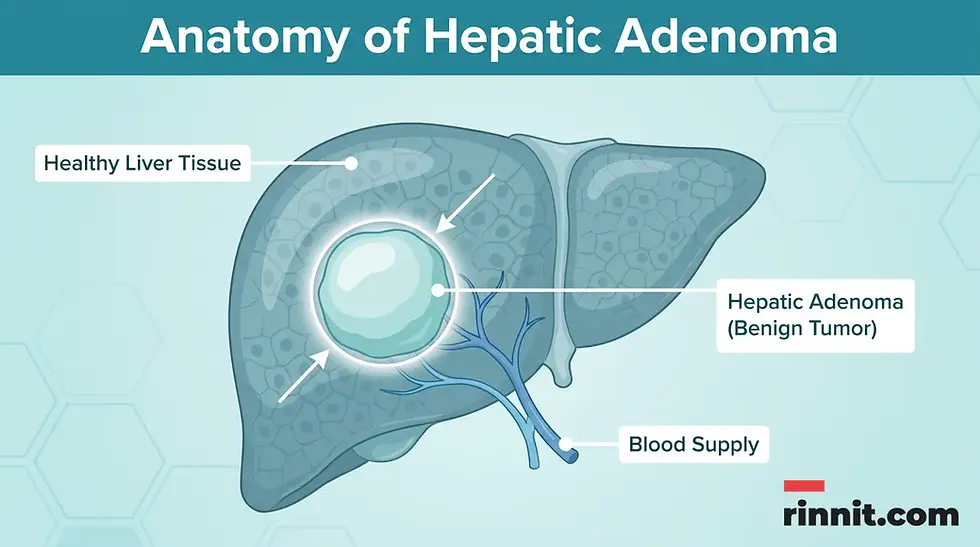
Hepatic adenoma, also called liver adenoma or hepatocellular adenoma, is a rare benign (noncancerous) liver tumor. It is often linked to the use of oral contraceptives (birth control pills) and is most often found in females. [1]
Most hepatic adenomas do not cause symptoms, and they are often found during imaging tests done for other reasons. But they carry a risk of rupture, which can cause severe pain and internal bleeding. Rarely, they can become malignant (cancerous), which is called hepatocellular carcinoma. Because adenomas can grow in the setting of estrogen, they may grow during pregnancy and need more frequent monitoring. [1]
Because of these risks, a proper diagnosis matters. Providers monitor or treat hepatic adenomas based on their size, type and who they affect. [1]
Types of Hepatic Adenoma
Providers group hepatic adenomas into types based on gene variations and how the tumor behaves. They may do a biopsy to find the type, but not every adenoma needs one. Knowing the type helps guide monitoring and treatment. [1]
Type | Key characteristics | Risk profile |
Inflammatory | The most common type. Often linked to estrogen exposure, obesity and excessive alcohol use. Mainly affects females. | More likely to cause symptoms and can bleed. |
HNF-1 alpha-mutated | The second most common type. Mainly affects females who use estrogen-containing birth control. | Usually a lower risk of bleeding or cancer when small. |
Beta-catenin-mutated (exon 3) | More common in males and in people who use anabolic steroids. | Highest risk of turning into cancer, so it is usually treated with surgery. |
Mixed inflammatory and beta-catenin-mutated (exon 3) | Shows features of both types. More common in females. | Higher cancer risk because of the beta-catenin variation. |
Beta-catenin-mutated (exon 7 or 8) | Found only in females. Linked to genetic conditions such as glycogen storage disease. | Much lower cancer risk than exon 3, but a higher risk of bleeding. |
Mixed inflammatory and beta-catenin-mutated (exon 7 or 8) | Mostly inflammatory with beta-catenin variations. Linked to obesity and alcohol use. | Higher risk of bleeding. |
Sonic hedgehog | Rare. Linked to long-term use of estrogen-containing birth control and fatty liver changes. | Highest risk of bleeding. |
Unclassified | About 5% to 10% of adenomas do not fit a specific type. | Managed based on size, symptoms and risk factors. |
What Causes Hepatic Adenoma?

Researchers do not know the exact cause. A hepatic adenoma develops when liver cells begin to grow in an abnormal but noncancerous way. This growth is strongly influenced by hormones, especially estrogen but also testosterone. Changes in how the body handles sugar and fat can also lead to it. [1]
In most cases the adenoma forms in a healthy liver. People with MASH (metabolic dysfunction-associated steatohepatitis) are also more likely to develop adenomas. [1]
Risk Factors
Hepatic adenoma is most common in females. Estrogen exposure, especially from oral contraceptives and hormone replacement therapy, increases the risk. It also affects people who: [1]
Are ages 20 to 40
Are pregnant
Use anabolic steroids
Have certain genetic conditions, such as glycogen storage disease
Have metabolic syndrome, obesity or MASH
Drink alcohol
How to Lower Your Risk
Avoid or stop estrogen-containing medicines if your provider advises it.
Maintain a healthy weight for you.
Manage conditions linked to metabolic syndrome, such as diabetes.
Limit the amount of alcohol you drink.
Always talk with your provider before stopping or changing any medicine. [1]
Symptoms and Emergency Warning Signs
Most people with hepatic adenoma do not have symptoms, and providers usually find it on abdominal imaging done for another reason. If the tumor is large, you may have: [1]
Upper right abdominal pain or discomfort
Nausea
A feeling of fullness or pressure in the abdomen
When a Tumor Ruptures
If the tumor ruptures, it can cause serious internal bleeding, which is a medical emergency. Seek immediate medical care if you develop: [1]
Sudden, severe abdominal pain
Symptoms of shock, such as dizziness, a fast pulse or shallow breathing
Symptoms of low blood pressure, such as lightheadedness, nausea or blurred vision
Possible Complications
Bleeding: Larger tumors are more likely to bleed. In rare cases, a tumor can rupture and cause life-threatening internal bleeding.
Cancer risk: Some adenomas, especially certain subtypes and those in males, have a higher chance of becoming cancerous.
Contact your provider if you have ongoing or worsening abdominal pain, notice new symptoms, or are diagnosed with a hepatic adenoma and become pregnant. [1]
How Is Hepatic Adenoma Diagnosed?
Your provider will use detailed imaging tests to look for signs of hepatic adenoma, and may make the diagnosis if the imaging shows a solid liver lesion. [1]
Contrast-enhanced ultrasound (CEUS): Often the first test to detect a liver problem.
MRI with contrast: The most useful test for diagnosing hepatic adenoma and identifying its subtype.
CT scan: Helps show the size and structure of the tumor.
Your provider may order a liver biopsy if the imaging results are not clear or the subtype cannot be determined. [1]
How Is Hepatic Adenoma Treated?

Treatment depends on the tumor size, the subtype, your symptoms and your sex. [1]
Monitoring: A small, low-risk tumor may be watched with regular imaging tests to check for changes.
Stopping hormones: Stopping oral contraceptives or hormone therapy can sometimes cause tumors to shrink or stop growing.
Your provider may recommend treatment for larger tumors, tumors with a high risk of rupture (in males), and tumors that look cancerous. Options include: [1]
Surgical resection: Surgical removal of the tumor.
Transarterial embolization (TAE): A procedure that blocks blood flow to the tumor.
Radiofrequency ablation: A procedure that uses heat to destroy the tumor.
Recovery Time
Recovery after surgery or a procedure such as embolization varies, but it may take several weeks. Your provider will guide you based on your situation. [1]
Outlook
Most people with hepatic adenoma do very well, especially when higher-risk tumors are treated. Many tumors stay stable or shrink after hormone changes or weight loss. The long-term outlook is generally good with proper treatment and follow-up. [1]
Conclusion
Hepatic adenoma is an uncommon liver tumor that shows how strongly hormones can influence liver health. The word "tumor" can be frightening, but these growths are benign and manageable. By working with your healthcare team to monitor the tumor and address risk factors, most people can stay healthy and active.
Looking for clear answers on tough health questions? Browse plain-language health guides at Rinnit.com.
Frequently Asked Questions
Can a hepatic adenoma go away on its own?
Hepatic adenoma always requires medical care. Your provider may recommend monitoring to see whether the tumor shrinks or stops growing, and many tumors stay stable or shrink after hormone changes or weight loss. If it does not shrink, you will need regular follow-up imaging. [1]
Is it safe to get pregnant with a liver adenoma?
Many people with small tumors can safely become pregnant, but your provider will want to monitor you closely throughout pregnancy. Contact your provider if you are diagnosed with a hepatic adenoma and become pregnant. [1]
Are these tumors cancerous?
No, they are benign. Rarely, a hepatic adenoma can become cancerous (hepatocellular carcinoma). The beta-catenin-mutated type (exon 3) has the highest risk of turning into cancer. [1]
How common are hepatic adenomas?
Hepatic adenomas are uncommon, and they are most often found in females. [1]
What is the main risk of a large adenoma?
Larger tumors are more likely to bleed. In rare cases, a tumor can rupture and cause life-threatening internal bleeding. [1]
Do men get hepatic adenomas?
Yes, although they are most common in females. The beta-catenin-mutated type is more common in males and in people who use anabolic steroids, and tumors in males have a higher chance of becoming cancerous. [1]
What imaging test is best for diagnosis?
An MRI with contrast is the most useful test for diagnosing a hepatic adenoma and identifying its subtype. [1]
Can alcohol affect these tumors?
Drinking alcohol is listed as a risk factor, and the inflammatory type is often linked to excessive alcohol use. Limiting alcohol may help lower your risk. [1]
Will I need a biopsy?
Not always. Your provider may order a liver biopsy if imaging results are not clear or the subtype cannot be determined. [1]
What is MASH?
MASH stands for metabolic dysfunction-associated steatohepatitis, a type of fatty liver disease. People with MASH are more likely to develop hepatic adenomas. [1]
What is transarterial embolization?
Transarterial embolization is a procedure that blocks blood flow to the tumor. It is one of the treatment options for hepatic adenoma. [1]
What should I do if I have sudden abdominal pain?
Seek emergency care if you have sudden, severe abdominal pain, dizziness or signs of low blood pressure, because it could mean the tumor has ruptured. [1]
Related Reading
References
Cleveland Clinic. Hepatic Adenoma. Cleveland Clinic. Last updated July 8, 2026. https://my.clevelandclinic.org/health/diseases/hepatic-adenoma
Aziz H, et al. Hepatic adenoma: evolution of a more individualized treatment approach. J Gastrointest Surg. 2024;28(6):975-982. PMID 38521190. https://doi.org/10.1016/j.gassur.2024.03.010
Agrawal S, et al. Management of Hepatocellular Adenoma: Recent Advances. Clin Gastroenterol Hepatol. 2015;13(7):1221-1230. PMID 24909909. https://doi.org/10.1016/j.cgh.2014.05.023
Haring MPD, et al. Behavior and complications of hepatocellular adenoma during pregnancy and puerperium: a retrospective study and systematic review. HPB (Oxford). 2021;23(8):1152-1163. PMID 33985906. https://doi.org/10.1016/j.hpb.2021.04.019
Medical disclaimer
This article is for general educational purposes only and is not a substitute for professional medical advice, diagnosis, or treatment. Always seek the advice of your physician or other qualified healthcare provider with any questions you may have about a medical condition. Never disregard professional medical advice or delay seeking care because of something you have read here. If you think you may have a medical emergency, call your doctor or emergency services immediately.



Comments