What Is a Choledochal Cyst? Symptoms, Types, Treatment and Outlook

Updated: 2 days ago
Medically reviewed by Dr. Baraa Alnahhal, MD · Last reviewed: October 17, 2026
Quick Answer: What is a choledochal cyst?
A choledochal cyst is a rare swelling of the bile ducts present from birth and diagnosed most often in children. [1] [5] It may cause no symptoms or cause abdominal pain, jaundice, nausea and fever. [1] It usually requires surgical removal and bile flow reconstruction. [1] [5] With early, complete removal, most people recover well, while untreated cysts raise infection, liver damage and cancer risk. [1] [5]
Key takeaways
A choledochal cyst (biliary cyst) is a rare swelling where one or more bile ducts widen or enlarge. [1] [5]
It affects the tubes that carry bile from the liver to the gallbladder and small intestine. [1]
It is congenital (present at birth) and diagnosed most often in children, though adults can have it too. [1] [5]
The "classic triad" of symptoms is upper-right abdominal pain, jaundice, and a feelable abdominal mass — but most people have only one or two. [1] [6] [5]
Without treatment, it can cause infections, blockages, liver damage, and an increased risk of bile duct or gallbladder cancer. [1]
Treatment depends on the cyst type; most are surgically removed, often with laparoscopic or robotic methods. [1] [3] [5]
Six types exist, classified by location and number — Type I is the most common; Type V is Caroli disease. [1] [6]
After surgery, regular follow-up matters, because problems like narrowing, stones, or rarely cancer can still develop. [1] [5]
Get medical attention right away for sudden severe pain, unstoppable vomiting, high fever, or worsening jaundice. [1]
With treatment, most people do very well and have a good long-term outcome. [1] [5]
What the research says
Surgery is recommended because of complication and cancer risks, and outcomes after excision are good. A review of the published literature reports malignant transformation in about 3–7.5% of choledochal cysts, states that complete excision is necessary for cysts with high malignant potential such as types I and IV, and gives a 5-year overall survival of 95.5% after cyst excision. It concludes that most choledochal cysts should undergo surgery to reduce complications such as cholangitis and malignant transformation (Brown et al., HPB (Oxford), 2023). [2]
In children, laparoscopic removal looks at least as safe as open surgery, based on retrospective data. A meta-analysis of 14 retrospective cohorts (1,767 children) found no significant difference in short-term postoperative complications between laparoscopic and open cyst excision with Roux-en-Y hepaticojejunostomy, and the laparoscopic group did better on long-term and total complications, blood loss and transfusion, time to first feeding, and length of hospital stay. All of the included studies were retrospective, so selection bias is possible (Sun et al., PLoS One, 2020). [7]
Narrowing at the surgical repair is uncommon, which is why follow-up matters. In a systematic review and meta-analysis of 70 studies of children (206 patients with postoperative anastomotic stricture), the incidence was 2.1%, and it was higher with Todani type IV-A cysts (10.1%) than type I (2.0%), with no significant difference between laparoscopic and open surgery. The authors recommend careful follow-up, especially for type IV-A, and note that none of the studies were prospective (Tanaka et al., Pediatr Surg Int, 2023). [8]
What Is a Choledochal Cyst?
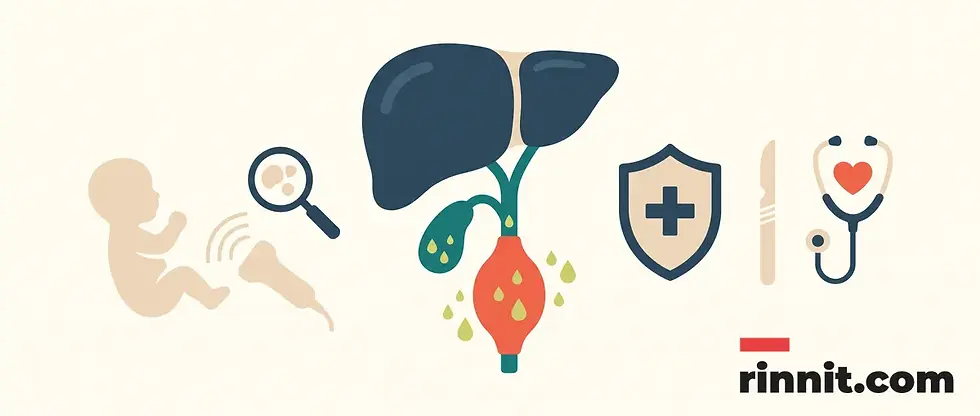
A choledochal cyst, or biliary cyst, is a rare condition that affects your biliary tree. It causes one or more of your bile ducts to widen or enlarge (dilate). [1] [5] Your bile ducts are tubes that carry bile from your liver to your gallbladder and small intestine. [1] Choledochal cysts usually affect the ducts outside your liver (extrahepatic ducts), like your common bile duct. But they can also affect the ducts inside your liver (intrahepatic ducts). [5] Healthcare providers diagnose children with bile duct cysts most often, but they can also affect adults. [1] [5]
How Serious Is a Choledochal Cyst?
A choledochal cyst can be serious because it can lead to severe complications without treatment. It may cause bile to back up, leading to infections and other health issues. [1] [5] Over time, the cyst can increase the risk of cancer in your bile ducts or gallbladder [1] [2]. Because they're considered potentially dangerous, healthcare providers generally recommend immediate treatment [1].
Choledochal Cyst Types
Healthcare providers classify choledochal cysts by type. These types are based on their location and number:
Type | Alternate Name | What Happens | How Common |
Type I | — | The common bile duct widens in a spindle shape; it may look like a balloon or a fat cigar, depending on its subtype | The most common type |
Type II | — | A small pouch (diverticulum) forms anywhere along your outer bile ducts | Rare |
Type III | Choledochocele | The lower part of your common bile duct swells inside the first part of your small intestine (duodenum) | Rare |
Type IV | — | Multiple cysts form; subtypes affect the inner and outer ducts, or just the outer ducts | Second most common |
Type V | Caroli disease | Multiple cysts of the inner bile ducts only; can lead to infections that keep coming back; may require a liver transplant | Less common |
Type VI | — | A cyst forms on your cystic duct, where the neck of your gallbladder connects to your common hepatic (liver) duct | Very rare |
Symptoms and Causes
What Is the Classic Triad of a Choledochal Cyst?
The classic triad describes the three main symptoms that a choledochal cyst may cause. These three symptoms are abdominal pain (usually affecting your upper right abdomen), jaundice (yellowing of your skin and the whites of your eyes due to bile buildup), and a mass you can feel (a lump in your abdomen, often in the upper right quadrant). But most people don't have all three symptoms. Many only have one or two. [1] [6] [5] Other possible symptoms include nausea, vomiting, fever, itching, and unexplained weight loss. [1]

Symptom | What It Looks or Feels Like |
Abdominal pain | Pain that usually affects your upper right abdomen |
Jaundice | Yellowing of your skin and the whites of your eyes due to bile buildup |
Mass you can feel | A lump in your abdomen, often in the upper right quadrant |
Nausea | A queasy stomach feeling |
Vomiting | Throwing up |
Fever | Elevated body temperature |
Itching | Persistent skin itch from bile buildup |
Unexplained weight loss | Losing weight without a clear reason |
What Causes a Choledochal Cyst?
Choledochal cysts are congenital — that means they're present at birth. [5] Scientists aren't exactly sure why these form. [1] [5] They may form due to a problem with the way your bile duct and pancreatic duct connect [1] [2] [5]. Or they may occur because your bile ducts didn't form properly during fetal development [1] [5].
Factor | What the Source Says |
Present at birth | Congenital — the cyst is there from fetal development |
Exact cause | Scientists aren't exactly sure why these cysts form |
One theory | A problem with how the bile duct and pancreatic duct connect |
Another theory | The bile ducts didn't form properly during fetal development |
What Are the Complications of a Choledochal Cyst?
Without treatment, choledochal cysts can cause both immediate problems and long-term risks. [1] [5] Complications can include:
Complication | Plain-Language Description |
Bile duct infection (cholangitis) | An infection of the bile ducts |
Pancreas inflammation (pancreatitis) | Swelling and inflammation of the pancreas |
Gallstones or bile duct stones | Hard deposits forming in the gallbladder or ducts |
Liver damage | Injury to the liver from backed-up bile |
Cyst rupture | The cyst breaking open |
Cancer (bile duct cancer) | An increased long-term risk of cancer in the bile ducts |
Diagnosis and Tests
How Doctors Diagnose a Choledochal Cyst
Your healthcare provider may first see a choledochal cyst on a prenatal ultrasound [1] [4] [5]. Sometimes, they find them by accident [1] if you're having an imaging test for an unrelated condition. They'll use imaging tests to confirm a diagnosis. These tests include:
Test | What It Is |
Abdominal ultrasound | Sound waves create pictures of the organs in your abdomen |
CT scan | X-ray technology creates cross-sectional images of your abdomen |
MRI scan | Magnets and radio waves create detailed internal images |
MRCP (magnetic resonance cholangiopancreatography) | A special MRI focused on the bile ducts and pancreatic ducts |
EUS (endoscopic ultrasound) | An ultrasound probe on the end of a flexible tube views the ducts from inside |
ERCP (endoscopic retrograde cholangiopancreatography) | An endoscope combined with contrast dye images the ducts and can treat blockages |
HIDA scan (hepatobiliary scintigraphy) | A tracer shows how bile flows through the liver, gallbladder and ducts |
Management and Treatment
How Do You Treat a Choledochal Cyst?
Choledochal cyst treatment depends on the type. Healthcare providers surgically remove most cysts [1] to prevent complications. [5] They often use minimally invasive methods like laparoscopic or robotic surgery [1] [3].
Type | How It's Treated |
Types I and IV | Providers completely remove these cysts, along with most of the bile ducts outside your liver and your gallbladder, then reconstruct where your bile flows |
Type II | Often treated with a simple surgical removal |
Type III (choledochocele) | Only treated if it causes symptoms |
Type V (Caroli disease) | Focus on managing symptoms and preventing infections; you may eventually need a liver transplant |
Type VI | So rare that providers don't have a standard procedure, but they'll likely remove the cyst completely |
If you have an infection or a blockage, you may need antibiotics, digestive rest and monitoring. Your provider may also place temporary stents or tubes to help with drainage. [1]

When Should I See My Healthcare Provider?
After treatment, you'll have follow-up appointments with your provider. These are important because even after removal, you can develop problems in your remaining bile ducts — including narrowing (biliary stricture), stones, or, rarely, cancer. [1] [5] You should get medical attention right away if you have:
These signs may mean you have a complication like an infection or a blockage.
Outlook / Prognosis
What Is the Outlook (Prognosis) for Someone With a Choledochal Cyst?
The prognosis depends on several factors, including the type of cyst, whether it's treated, and if you have any complications [1] [5].
Scenario | What to Expect |
With treatment | Most people do very well; surgery lowers the risk of developing a serious health issue; early diagnosis and complete surgical removal usually lead to a good long-term outcome |
Without treatment | A higher risk of complications — repeated infections, bile duct blockage, and an increased risk of cancer over time |
Learning about a rare condition like a choledochal cyst can feel overwhelming. It's OK to take things one step at a time. Ask questions, stay involved in your care, and lean on your healthcare team. They're prepared to help you understand each decision and what comes next.
Conclusion
A choledochal cyst — also called a biliary cyst — is a rare swelling of the bile ducts, the tubes that carry bile from your liver to your gallbladder and small intestine. Present at birth and diagnosed most often in children, it may cause no symptoms at all or produce the classic triad of upper-right abdominal pain, jaundice, and a feelable abdominal lump, along with nausea, vomiting, fever, itching, or unexplained weight loss. Left untreated, the cyst raises the risk of infections, blockages, liver damage, and cancer over time, which is why providers generally recommend prompt treatment — usually surgical removal of the cyst (often with part of the bile ducts and the gallbladder) through minimally invasive laparoscopic or robotic methods, followed by reconstruction of the bile flow. With early diagnosis and complete removal, most people do very well and enjoy a good long-term outcome, though regular follow-up appointments remain important to watch for narrowing, stones, or, rarely, cancer. Because this information covers a wide range of anatomy, symptoms, and treatment steps, visual guides can make it far easier to understand — which is why Rinnit's infographic templates can help you turn complex medical topics like this into clear, shareable visuals for families, classrooms, or patient education.
Frequently Asked Questions
What is a choledochal cyst?
A choledochal cyst (also called a biliary cyst) is a rare condition where one or more bile ducts widen or enlarge.
What are bile ducts?
Bile ducts are tubes that carry bile from your liver to your gallbladder and small intestine.
What is another name for a choledochal cyst?
It's also called a biliary cyst.
Is a choledochal cyst common?
No — it's a rare condition.
Who gets choledochal cysts?
Healthcare providers diagnose them most often in children, but they can also affect adults.
Is a choledochal cyst present at birth?
Yes — choledochal cysts are congenital, meaning present at birth.
Do choledochal cysts only affect ducts outside the liver?
Usually they affect the ducts outside your liver (extrahepatic ducts), like the common bile duct, but they can also affect ducts inside your liver (intrahepatic ducts).
Is a choledochal cyst serious?
It can be — without treatment it can lead to severe complications, including infections and an increased risk of cancer.
What is the classic triad of a choledochal cyst?
The three main symptoms: abdominal pain (usually upper right), jaundice, and a mass you can feel in your abdomen.
Do most people have all three classic symptoms?
No — most people don't have all three; many only have one or two.
What does choledochal cyst pain feel like?
Pain that usually affects your upper right abdomen.
What is jaundice in this context?
Yellowing of your skin and the whites of your eyes due to bile buildup.
Can you feel a choledochal cyst?
Sometimes — it can present as a lump in your abdomen, often in the upper right quadrant.
Can a choledochal cyst cause nausea?
Yes — nausea is one of the possible symptoms.
Can it cause vomiting?
Yes — vomiting is a possible symptom.
Can it cause fever?
Yes — fever is a possible symptom.
Can it cause itching?
Yes — itching is a possible symptom.
Can it cause weight loss?
Yes — unexplained weight loss is a possible symptom.
Why do choledochal cysts form?
Scientists aren't exactly sure; they may form from a problem with how the bile duct and pancreatic duct connect, or because the bile ducts didn't form properly during fetal development.
What is the most common type of choledochal cyst?
Type I — the common bile duct widens in a spindle shape, looking like a balloon or a fat cigar depending on its subtype.
What is a Type II choledochal cyst?
A rare type where a small pouch (diverticulum) forms anywhere along your outer bile ducts.
What is a choledochocele?
A Type III choledochal cyst, where the lower part of your common bile duct swells inside the first part of your small intestine (duodenum).
What is a Type IV choledochal cyst?
The second most common type — multiple cysts form, with subtypes affecting the inner and outer ducts, or just the outer ducts.
What is Type V choledochal cyst?
Caroli disease — multiple cysts of the inner bile ducts only, which can cause recurrent infections and may require a liver transplant.
What is a Type VI choledochal cyst?
A very rare type where a cyst forms on your cystic duct, where the neck of your gallbladder connects to your common hepatic (liver) duct.
How are choledochal cyst types classified?
By their location and number.
Can choledochal cysts be seen before birth?
Yes — a provider may first see a choledochal cyst on a prenatal ultrasound.
Can they be found by accident?
Yes — sometimes they're discovered accidentally during imaging for an unrelated condition.
What tests diagnose a choledochal cyst?
Imaging tests, including abdominal ultrasound, CT scan, MRI scan, MRCP, endoscopic ultrasound (EUS), ERCP, and a HIDA scan.
What is MRCP?
Magnetic resonance cholangiopancreatography — a special MRI focused on the bile and pancreatic ducts.
What is ERCP?
Endoscopic retrograde cholangiopancreatography — an endoscope with contrast dye that images the ducts and can treat blockages.
What is a HIDA scan?
Hepatobiliary scintigraphy — a test using a tracer to show how bile flows through the liver, gallbladder, and ducts.
How is a choledochal cyst treated?
Treatment depends on the type, but most cysts are surgically removed, often with laparoscopic or robotic (minimally invasive) methods.
How are Type I and Type IV cysts treated?
Providers completely remove the cysts, most of the bile ducts outside your liver, and your gallbladder, then reconstruct where your bile flows.
How is a Type II cyst treated?
Usually with a simple surgical removal.
How is a Type III cyst (choledochocele) treated?
Only if it causes symptoms.
How is Caroli disease (Type V) treated?
Providers focus on managing symptoms and preventing infections; you may eventually need a liver transplant.
How is a Type VI cyst treated?
There's no standard procedure because it's so rare, but providers will likely remove the cyst completely.
What happens if there's an infection or blockage?
You may need antibiotics, digestive rest, monitoring, and possibly temporary stents or tubes for drainage.
Why is a choledochal cyst treated right away?
Because it's potentially dangerous — untreated it causes bile to back up and raises the risk of infections and cancer.
What complications can an untreated choledochal cyst cause?
Bile duct infection (cholangitis), pancreatitis, gallstones or bile duct stones, liver damage, cyst rupture, and cancer.
What is cholangitis?
A bile duct infection.
Can a choledochal cyst cause pancreatitis?
Yes — pancreas inflammation is a possible complication.
Can it cause cancer?
Yes — over time it can increase the risk of cancer in your bile ducts or gallbladder.
Do I need follow-up after surgery?
Yes — follow-up appointments are important because even after removal, problems like narrowing (biliary stricture), stones, or rarely cancer can develop in your remaining bile ducts.
When should I get medical attention right away?
For sudden severe pain, vomiting that won't stop, high fever, or worsening jaundice — these may signal an infection or blockage.
What is the prognosis with treatment?
Most people do very well; surgery lowers the risk of serious health issues, and early diagnosis with complete surgical removal usually leads to a good long-term outcome.
What happens without treatment?
A higher risk of complications, including repeated infections, bile duct blockage, and an increased risk of cancer over time.
Is Caroli disease curable?
Treatment focuses on managing symptoms and preventing infections, and you may eventually need a liver transplant.
Can a choledochal cyst come back after surgery?
The cyst itself is removed, but you can still develop problems in your remaining bile ducts — narrowing, stones, or rarely cancer — which is why follow-up matters.
What is a biliary stricture?
Narrowing of the bile ducts that can develop even after cyst removal.
Can adults have choledochal cysts?
Yes — though they're diagnosed most often in children, they can affect adults too.
Related Reading
Understanding the Biliary Tract: Anatomy, Function, and Health
Bile Duct: The Essential Transport System of the Biliary Tree
Cholangitis: What It Is, Why It Happens, and When It's an Emergency
Cholangiocarcinoma (Bile Duct Cancer): Symptoms, Causes, and Treatment
What Is Caroli Disease? Symptoms, Causes, Diagnosis, and Treatment
Robotic Surgery: A Comprehensive Guide to Minimally Invasive Procedures
References
Cleveland Clinic. Choledochal Cyst. Cleveland Clinic. Medically reviewed; last updated April 23, 2026. https://my.clevelandclinic.org/health/diseases/choledochal-cyst
Brown ZJ, Baghdadi A, Kamel I, et al. Diagnosis and management of choledochal cysts. HPB (Oxford). 2023;25(1):14-25. PMID: 36257874. https://doi.org/10.1016/j.hpb.2022.09.010
Cazares J, Koga H, Yamataka A. Choledochal cyst. Pediatr Surg Int. 2023;39(1):209. PMID: 37261604. https://doi.org/10.1007/s00383-023-05483-1
Children's Liver Disease Foundation. Choledochal Cyst. Children's Liver Disease Foundation. Accessed October 30, 2026. https://childliverdisease.org/liver-information/childhood-liver-conditions/choledochal-cyst/
Goosenberg E, John S. Choledochal Cyst. In: StatPearls [Internet]. Treasure Island (FL): StatPearls Publishing; 2026 Jan-. Updated March 6, 2026. PMID 32491694. https://www.ncbi.nlm.nih.gov/books/NBK557762/
Radiopaedia.org. Choledochal cyst. Radiopaedia. Last revised May 18, 2024. https://radiopaedia.org/articles/choledochal-cyst?lang=us
Sun R, Zhao N, Zhao K, et al. Comparison of efficacy and safety of laparoscopic excision and open operation in children with choledochal cysts: A systematic review and update meta-analysis. PLoS One. 2020;15(9):e0239857. PMID: 32986787. https://doi.org/10.1371/journal.pone.0239857
Tanaka R, Nakamura H, Yoshimoto S, et al. Postoperative anastomotic stricture following excision of choledochal cyst: a systematic review and meta-analysis. Pediatr Surg Int. 2023;39(1):30. PMID: 36454303. https://doi.org/10.1007/s00383-022-05293-x
Medical disclaimer
This article is for general informational purposes only and is not a substitute for professional medical advice, diagnosis, or treatment. Always consult a qualified healthcare provider with questions about a medical condition, and seek immediate emergency care for sudden severe pain, unstoppable vomiting, high fever, or worsening jaundice.



Comments