Biliary Stricture: The Narrowed Bile Duct That Cuts Off Your Body's Fat-Digesting Fluid — and How Doctors Open It Back Up

Updated: 3 days ago
Medically reviewed by Dr. Baraa Alnahhal, MD. Last reviewed October 13, 2026. This content is for educational purposes and is not medical advice.

Quick Answer
A biliary stricture is a narrowing or blockage of the bile ducts, which carry bile from the liver to the small intestine [1]. Cancer causes about 7 in 10 cases, and conditions such as pancreatitis and gallstones cause the rest [1]. Symptoms include abdominal pain, jaundice and pale stools [1]. It is most often treated with a balloon and stent endoscopically.
What the research says
For benign strictures, covered metal stents and multiple plastic stents worked about equally well, but metal stents needed fewer procedures. In a meta-analysis of 8 randomized trials with 524 patients, stricture resolution (risk ratio 1.02, 95% CI 0.96 to 1.10), stricture recurrence (risk ratio 1.68, 95% CI 0.72 to 3.88), and adverse events (risk ratio 1.17, 95% CI 0.73 to 1.87) did not differ significantly between the two stent types. Metal stents needed significantly fewer ERCP procedures, but they moved out of place (migrated) more often (Kamal et al., Eur J Gastroenterol Hepatol, 2022) [6].
Covered metal stents resolved most benign strictures, and few came back. In a pooled analysis of 37 studies and 1,677 patients, the stricture resolved in 83% of cases, 11% (95% CI 8% to 14%) recurred at 4-year follow-up, and the pooled complication rate was 23% (95% CI 20% to 26%). The authors noted that more randomized studies are needed to confirm these results (Zheng et al., Dig Endosc, 2017) [7].
The ERCP procedure itself carries a risk of pancreatitis, which was higher with metal stents. In 6 randomized trials with 444 patients, post-ERCP pancreatitis was more likely with covered metal stents than with multiple plastic stents (odds ratio 3.34, 95% CI 1.44 to 7.77), while stricture resolution and recurrence were similar (Yang et al., Ann Med, 2022) [8].
What Is a Biliary Stricture?
A biliary stricture occurs when your bile ducts narrow due to disease, scarring, or blockage [1]. This narrowing restricts the flow of bile from your liver to your small intestine [1]. When bile builds up, your body has a harder time digesting food.
Another term for biliary stricture is bile duct stricture — the two mean the same thing.
What are bile ducts?
Your bile ducts are tubes that connect organs in your digestive system. Your liver makes bile, a fluid that aids digestion [2]. Your bile ducts carry this liquid to your small intestine, where bile salts help break down and absorb fats from food [2]. Your bile duct joins the pancreatic duct, which carries enzymes (proteins) your body uses for digestion [2].
Think of bile ducts as the plumbing between your liver and your intestine. A stricture is like a kink in a hose: the fluid is still being produced, but it can't get where it needs to go.
How common is biliary stricture?
Experts aren't sure how many people develop biliary strictures every year. But the condition seems to be on the rise [1]. This may be due to an increase in gallbladder removal surgery [1] — particularly laparoscopic cholecystectomy. These procedures may damage or scar the bile ducts, causing them to narrow. Biliary strictures rarely affect children.
What Causes a Biliary Stricture?
Rarely, a baby is born with narrowed bile ducts — a type of birth defect (congenital condition) [1]. More commonly, cancer causes about 7 in 10 biliary strictures [1]. Pancreatic cancer and bile duct cancer (cholangiocarcinoma) are the primary causes [1].
Other cancers that can cause bile duct narrowing include gallbladder cancer, hepatocellular carcinoma, liver cancer, lymphoma, metastasis (metastatic cancer), and small intestine cancer [1].
What other conditions cause a biliary stricture?
Noncancerous (benign) conditions — along with certain procedures — cause about 30% of biliary strictures [1].
Benign cause | What it involves |
Abdominal injuries or trauma | Damage to the bile ducts from physical injury |
Pancreatitis and autoimmune pancreatitis | Inflammation of the pancreas that can narrow nearby ducts |
Bile duct scarring from gallstones | Scar tissue that chokes the duct |
Mirizzi syndrome (impacted gallstones) | Gallstones pressed against and obstructing the duct |
Primary biliary cholangitis | A condition that damages bile ducts |
Primary sclerosing cholangitis | A condition that causes scarring of bile ducts |
Radiation therapy | Can injure the ducts during cancer treatment |
What is an anastomotic biliary stricture?
An anastomotic biliary stricture may occur after a Whipple procedure or liver transplantation [1]. During these operations, a surgeon reconnects passages in the gastrointestinal tract. This reconnection — called an anastomosis — can injure or scar the bile ducts, and that scarring is what causes the stricture.
What Are the Symptoms of a Biliary Stricture?
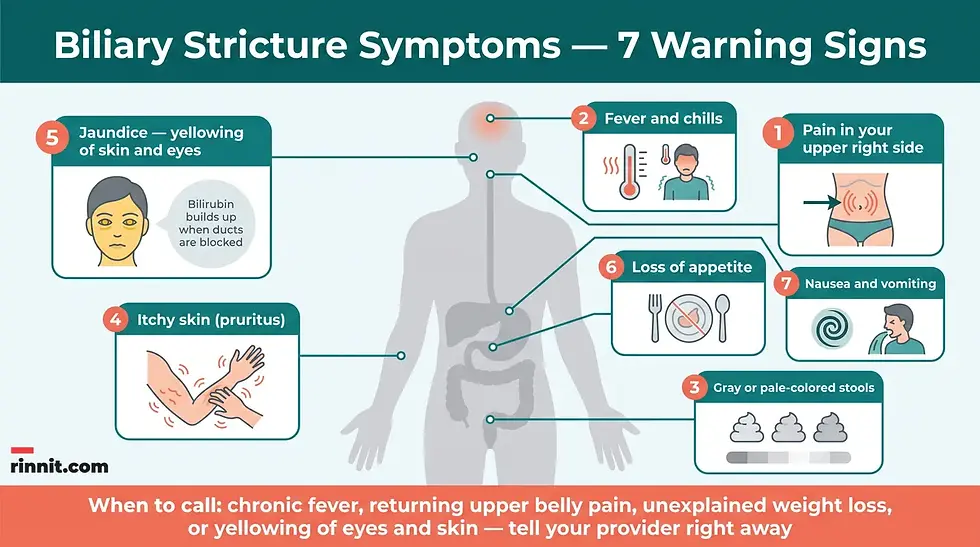
Signs of a biliary stricture include seven symptoms that tend to cluster together.
Symptom | What it looks or feels like |
Abdominal pain in your upper right side | Aching or pain high on the right side of your belly |
Fever and chills | Can signal a bile duct infection brewing |
Changes in stool color | Gray or pale-colored stools |
Itchy skin (pruritus) | Itching caused by backed-up bile in your bloodstream |
Jaundice | Yellowing of the skin and whites of your eyes |
Loss of appetite | Food loses its appeal |
Nausea and vomiting | Upset stomach that may not go away |
Pruritus is the medical term for itchy skin. Jaundice is the yellowing of the whites of your eyes or your skin — it happens because bilirubin, a waste product in bile, builds up when the ducts are blocked.
What are the complications of a biliary stricture?
If a bile duct remains narrowed or blocked for too long, bile can build up in your liver. You may develop an infection, liver disease, and liver scarring — cirrhosis of the liver [1].
How Do Healthcare Providers Diagnose a Biliary Stricture?
For diagnosis and treatment, you'll see a gastroenterologist — a doctor who diagnoses and treats gastrointestinal (GI) disorders like biliary strictures.
What blood tests detect a biliary stricture?
Your gastroenterologist may order two kinds of blood tests. A bilirubin test measures levels of bilirubin, the waste product in bile that builds up when bile ducts become narrow or blocked [1]. Liver function tests check for elevated liver enzymes, which signal that your liver is under stress [1].
What imaging tests detect biliary strictures?
Test | How it works |
Ultrasound | Produces images showing changes in biliary structures that indicate blockage or narrowing; may be endoscopic, abdominal, or liver ultrasound |
ERCP (endoscopic retrograde cholangiopancreatography) | Combines upper endoscopy and X-rays — the provider threads an endoscope (lighted, flexible tube) through your numbed esophagus to reach your abdominal organs and bile ducts; may also take tissue samples for a biopsy, which can detect cancer cells |
MRCP (magnetic resonance cholangiopancreatography) | An advanced MRI that produces detailed images of your bile ducts, liver, pancreas, and gallbladder |
PTC (percutaneous transhepatic cholangiography) | A special X-ray where the provider views an injectable contrast dye as it moves from your liver to your bile ducts and small intestine — the dye highlights blockages |
How Are Biliary Strictures Treated?
Your healthcare provider can treat certain causes of biliary strictures during the diagnosis with ERCP or PTC [1] — the same procedure that finds the blockage can often open it too.
Depending on the cause, your provider may break up and remove gallstones, use a balloon device to expand the narrowed bile duct and place a stent (a metal or plastic tube) to keep it open, or remove tumors [1] [3].

What are the surgical treatments?
A small number of people need surgery. Surgery may be an option if cancer causes the narrowing [1]. The two main surgical options are a bypass — a new route that goes around the narrowed bile duct so bile can flow directly into your small intestine — and resection, where the diseased bile duct is removed and the healthy ends are reconnected (anastomosis) [1].
Can a biliary stricture happen again?
Yes. It's possible for a bile duct to narrow again after treatment to open it [1]. If this happens, your provider may perform bile duct exploration surgery to remove the narrowed bile duct [1]. After removal, they reconnect your healthy bile ducts and small intestine.
What complications can occur after treatment?
Post-treatment complications vary depending on the treatment. Some people develop acute (sudden onset) pancreatitis — inflammation of the pancreas — after ERCP treatment [1] [3].
What is recovery like?
Your recovery — including how quickly you can return to work, school, and normal activities — depends on the type of treatment you have. Minimally invasive treatments like ERCP promote a faster recovery with less pain compared to open surgeries that take place through larger incisions [1]. Your provider's recommendations may include temporarily eating soft foods or changing your diet to include easier-to-digest foods [1].
Can You Prevent a Biliary Stricture?
You can take steps to lower your risk of certain conditions that cause biliary strictures.
Prevention step | What it protects |
Eat a healthy diet with fresh fruits and vegetables | General digestive health |
Lower your cholesterol numbers | Protects your gallbladder and helps prevent gallstones |
Maintain a weight that's healthy for you | Reduces strain on your digestive organs |
Seek help for alcohol use disorder | Helps prevent pancreatitis and liver damage |
When Should I Call My Healthcare Provider?
You should call your healthcare provider if you experience chronic fever; recurrent (returning) upper abdominal pain; signs of post-treatment infection, such as drainage or redness; unexplained weight loss, nausea, or vomiting; or yellowing of the whites of your eyes or skin (jaundice).
Symptoms like abdominal pain, fever, chills, and jaundice can be worrisome, especially if they come on suddenly. If you develop these symptoms, it's a good idea to tell your healthcare provider right away. If you have fever and chills together with jaundice or belly pain, get emergency care, because this can signal a serious bile duct infection (cholangitis). They can run tests to find out why and recommend appropriate treatment.
What should I ask my provider?
What caused the biliary stricture?
What's the best treatment for me?
Can I take steps to lower my risk of another biliary stricture?
What is the bottom line on biliary strictures?
A biliary stricture is a narrowing or blockage of the bile ducts — the tubes that carry bile from your liver to your small intestine — and it slows down your ability to digest food. Cancer is behind about 7 in 10 cases [1], which is why doctors take a stricture seriously and check for underlying causes, but noncancerous conditions like pancreatitis, gallstones, and surgical scarring account for about 30% [1]. The warning signs are hard to miss: upper right belly pain, fever and chills, pale stools, itchy skin, and jaundice. The good news is that treatments to open narrowed bile ducts are typically successful — most often with a balloon and stent placed during an endoscopic procedure — and minimally invasive treatment means a faster, less painful recovery. If you notice yellowing of your skin or eyes, persistent fever, or returning abdominal pain, tell your healthcare provider right away so they can find out what's causing it and get treatment started.
Want clearer, calmer answers about your health? Rinnit.com turns complicated medical information into plain language you can actually use. Explore more clear health guides at Rinnit.com.
Frequently Asked Questions
What is a biliary stricture?
A biliary stricture (also called a bile duct stricture) occurs when your bile ducts narrow due to disease, scarring, or blockage, restricting the flow of bile from your liver to your small intestine.
What do bile ducts do?
Your bile ducts are tubes that carry bile — a digestive fluid made by your liver — to your small intestine, where bile salts help break down and absorb fats from food.
How common are biliary strictures?
Experts aren't sure how many people develop them each year, but the condition seems to be on the rise, possibly due to more gallbladder removal surgeries. They rarely affect children.
What causes a biliary stricture?
Cancer causes about 7 in 10 cases — most often pancreatic cancer or bile duct cancer. Noncancerous conditions like pancreatitis, gallstone scarring, and abdominal injury cause about 30%. Rarely, a baby is born with narrowed bile ducts.
What is cholangiocarcinoma?
Cholangiocarcinoma is the medical name for bile duct cancer, one of the two primary causes of biliary strictures (alongside pancreatic cancer).
What is an anastomotic biliary stricture?
It's a stricture that forms after surgery like a Whipple procedure or liver transplantation, where the reconnection of gastrointestinal passages (anastomosis) injures or scars the bile ducts.
What are the symptoms of a biliary stricture?
Upper right abdominal pain, fever and chills, gray or pale stools, itchy skin (pruritus), jaundice, loss of appetite, and nausea and vomiting.
Why does my skin turn yellow?
That's jaundice. Bilirubin, a waste product in bile, builds up in your bloodstream when bile ducts become narrow or blocked, and it yellows your skin and the whites of your eyes.
Can a biliary stricture damage my liver?
Yes. If a bile duct stays narrowed or blocked too long, bile builds up in your liver and can lead to infection, liver disease, and cirrhosis (liver scarring).
Who treats biliary strictures?
A gastroenterologist — a doctor who diagnoses and treats gastrointestinal disorders.
How is a biliary stricture diagnosed?
With blood tests (bilirubin and liver function tests) and imaging — ultrasound, ERCP, MRCP, or PTC.
What is ERCP?
Endoscopic retrograde cholangiopancreatography — a procedure combining upper endoscopy and X-rays, where a provider threads a lighted, flexible tube through a numbed esophagus to reach the bile ducts and can also take biopsy samples to check for cancer cells.
How are biliary strictures treated?
Providers can often treat strictures during diagnosis with ERCP or PTC — breaking up and removing gallstones, widening the duct with a balloon device and placing a stent to keep it open, or removing tumors.
Do I need surgery?
A small number of people need surgery, especially if cancer causes the narrowing. Options include a bypass around the narrowed duct or resection of the diseased bile duct with reconnection (anastomosis).
Can a biliary stricture come back?
Yes — a bile duct can narrow again after treatment. If so, bile duct exploration surgery can remove the narrowed duct and reconnect the healthy ducts to the small intestine.
Related Reading
Primary Sclerosing Cholangitis (PSC): Complete Guide to Symptoms, Causes, Diagnosis, and Treatment: the condition that scars bile ducts from the inside and can lead to strictures.
ERCP (Endoscopic Retrograde Cholangiopancreatography): Why It's Done, What Happens and Risks explains the endoscopic procedure used to diagnose and treat bile duct problems.
References
Cleveland Clinic. Biliary Stricture. Cleveland Clinic. Updated October 16, 2023. https://my.clevelandclinic.org/health/diseases/15796-biliary-stricture
Cleveland Clinic. Bile Duct. Cleveland Clinic. Updated December 12, 2022. https://my.clevelandclinic.org/health/body/24523-bile-duct
Cleveland Clinic. ERCP (Endoscopic Retrograde Cholangiopancreatography). Cleveland Clinic. Updated November 1, 2023. https://my.clevelandclinic.org/health/diagnostics/4951-ercp-endoscopic-retrograde-cholangiopancreatography
Cleveland Clinic. Primary Sclerosing Cholangitis. Cleveland Clinic. Updated July 27, 2025. https://my.clevelandclinic.org/health/diseases/23569-primary-sclerosing-cholangitis
Cleveland Clinic. Cholecystectomy (Gallbladder Removal). Cleveland Clinic. Updated July 24, 2025. https://my.clevelandclinic.org/health/procedures/21614-gallbladder-removal
Kamal F, et al. Metal versus plastic stents in the management of benign biliary strictures: systematic review and meta-analysis of randomized controlled trials. Eur J Gastroenterol Hepatol. 2022;34(5):478-487. PMID 35170533. https://doi.org/10.1097/MEG.0000000000002352
Zheng X, et al. Clinical outcome of endoscopic covered metal stenting for resolution of benign biliary stricture: Systematic review and meta-analysis. Dig Endosc. 2017;29(2):198-210. PMID 27681297. https://doi.org/10.1111/den.12742
Yang H, et al. Post-ERCP pancreatitis occurs more frequently in self-expandable metallic stents than multiple plastic stents on benign biliary strictures: a meta-analysis. Ann Med. 2022;54(1):2439-2449. PMID 36799364. https://doi.org/10.1080/07853890.2022.2105395
Medical disclaimer
The information in this article is for general informational purposes only and is not intended as professional medical advice, diagnosis, or treatment. Always seek the advice of your physician or other qualified health provider with any questions you may have regarding a medical condition. Never disregard professional medical advice or delay in seeking it because of something you have read here.



Comments