Robotic Surgery: A Comprehensive Guide to Minimally Invasive Procedures

Updated: 2 days ago
Medically reviewed by Dr. Baraa Alnahhal, MD · Last reviewed: October 2026
Quick Answer
Robotic surgery is a surgical method in which a surgeon controls a robotic system to perform precise procedures, guiding robotic arms with tiny instruments and a high-definition camera from a console. It allows complex movements in tight spaces with minimal trauma to surrounding tissue. It does not replace the surgeon but provides advanced tools that can improve outcomes. [1]

What the research says
In liver surgery, robotic surgery lowers the chance of switching to open surgery but takes longer. An umbrella review of 12 meta-analyses (152 studies, more than 15,000 patients) found that robotic hepatectomy had a lower rate of conversion to open surgery than laparoscopic hepatectomy (odds ratio 0.70, 95% CI 0.56–0.88) and a longer operative time (about 30 minutes), while complications, blood loss, transfusion, and hospital stay were generally comparable (Song et al., Surg Pract Sci, 2026). [2]
In stomach cancer surgery, benefits are procedure-specific and the evidence is not yet strong. An umbrella review of 14 meta-analyses of robotic versus laparoscopic gastrectomy found less blood loss, a shorter hospital stay, and faster return of bowel function with robotic surgery but a longer operation, with no difference in total complications, mortality, or conversion to open surgery; the authors concluded that the safety and efficacy of the robotic approach are not clearly supported by strong evidence (Marano et al., Updates Surg, 2021). [3]
In groin hernia repair, robotic and laparoscopic surgery performed similarly. A meta-analysis of 7 randomized trials (691 patients) found no significant differences in complications, recurrence, or same-day discharge, although the certainty of the evidence was low to very low (Schena et al., Surg Endosc, 2026). [4]
What is robotic surgery, and how does its technology work?
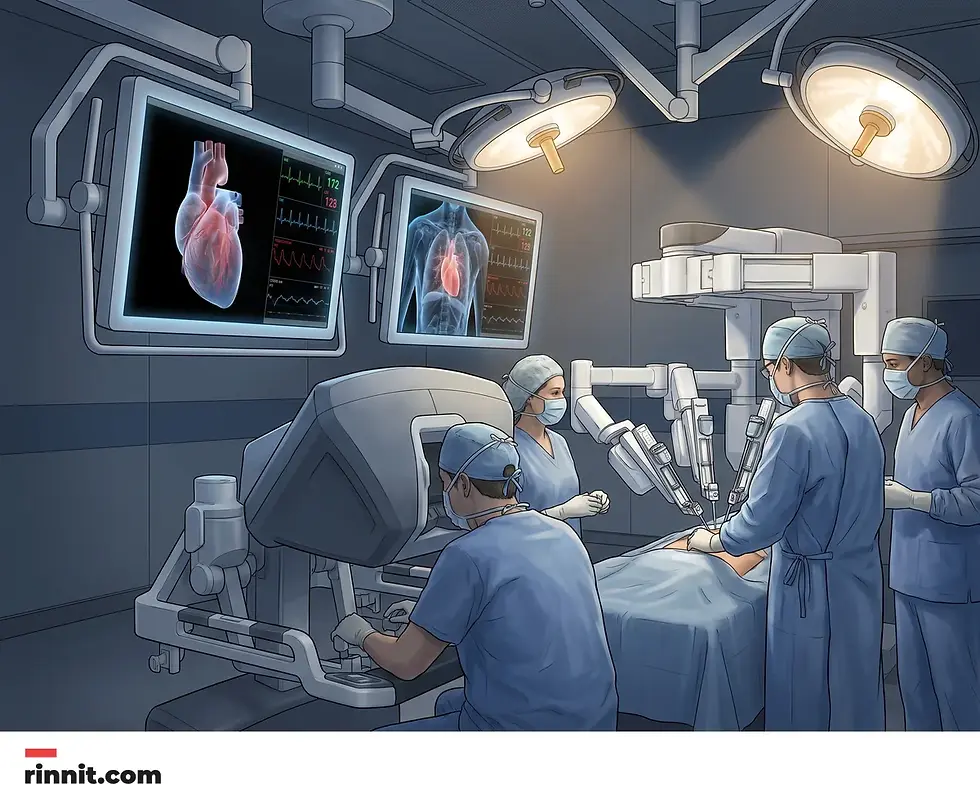
Robotic surgery is a significant advance in minimally invasive medical care. Unlike traditional open surgery, which requires a single large incision, this approach uses several small openings to reach the surgical site. The technology is built around three core components that work together under the direct control of a trained surgeon. [1]
Component | Function | Key Feature |
Robotic arms | Hold and manipulate surgical tools | Greater range of motion than human hands |
3D camera | Provides a view of the surgical site | Magnified, high-definition 3D views |
Surgical console | Control center for the surgeon | Joystick-like controllers for precision |
It is important to understand that the robot does not perform the surgery on its own. It serves as an extension of the surgeon’s hands, translating their movements into precise actions inside the body. Surgeons must complete additional, specialized training to use these systems, and some pursue formal robotic surgery fellowships. [1]
What are common uses of robotic-assisted surgery?
Many medical specialties now use robotic technology to treat a wide range of conditions. From routine procedures such as gallbladder removal to complex operations on the heart and spine, the range of robotic systems continues to grow. For detailed guides to two common examples, see our articles on robotic hernia surgery and robotic cystectomy. [1]
Specialty | Common Robotic Procedures |
General surgery | Appendectomy, hernia repair, gallbladder removal |
Gastrointestinal | Colectomy, gastric bypass, pancreatectomy |
Gynecology | Hysterectomy, myomectomy |
Urology | Prostatectomy, cystectomy |
Cardiothoracic | Mitral valve repair, lung resection |
What should you expect during robotic surgery?
The techniques used in robotic surgery are similar to those used in traditional surgery. The main difference is how the surgeon reaches the surgical area. The process typically follows a structured sequence to support safety and precision. [1]
Incisions and ports: The surgeon makes one or more small incisions and places thin tubes called ports, which act as temporary tunnels for the instruments. [1]
Device attachment: The robotic device is attached to the ports, and the specialized instruments are inserted. [1]
Visualization: A long, thin camera (endoscope) is placed through one port to give the surgeon high-definition 3D images at the console. [1]
Procedure execution: Sitting a few feet away, the surgeon uses the console to control every movement of the robotic arms during the operation. [1]
Closure: When the procedure is complete, the instruments and ports are removed and the small incisions are closed with sutures. [1]
What are the benefits of robotic surgery?
Compared with traditional open surgery, robotic-assisted procedures offer important advantages for patients and surgeons. These come from the minimally invasive approach and the capabilities of the robotic system (for more on how these techniques compare in general, see our guide to minimally invasive surgery). [1]
Reduced trauma: Small incisions mean less blood loss and a lower risk of infection. [1]
Faster recovery: Many people have shorter hospital stays and return to daily activities sooner. [1]
Enhanced precision: The robotic arms can rotate instruments in tight spaces in ways a human hand cannot. [1]
Magnified view: The 3D camera gives a detailed view that helps identify delicate structures. [1]
Less postoperative pain: Most people report less discomfort during healing than after open procedures. [1]
Robotic surgery is not automatically better than other approaches. Cleveland Clinic notes that it offers outcomes similar to laparoscopic surgery and that surgeons choose it case by case, based on the type of surgery, your overall health, their own expertise, and technological limits. [1]
What are the risks and disadvantages of robotic surgery?
Cleveland Clinic reports an overall success rate for robot-assisted surgery of 94% to 100%, depending on the procedure and the patient’s general health. It still has potential drawbacks, and you should discuss them with your surgical team. [1]
Training and availability: This technology is only available at centers with surgeons who have completed specialized robotic training. [1]
Surgical conversion: In some cases, such as when there is significant scar tissue from past surgery, the surgeon may need to switch to a traditional open procedure. [1]
Specific complications: Possible risks include nerve damage or compression and, in extremely rare cases, equipment malfunction. [1]
What is recovery like after robotic surgery, and what is the long-term outlook?
Recovery from robotic-assisted surgery is generally much shorter than recovery from traditional surgery. Depending on the procedure and your overall health, you may be able to get out of bed and eat within hours after the anesthesia wears off. [1]
General Recovery Guidelines
Immediate care: Many people go home the same day or the day after their procedure. [1]
Activity levels: Resume everyday activities gradually. Avoid heavy lifting until your surgeon clears you. [1]
Driving: You can start driving once you are no longer taking prescription pain medication and feel comfortable behind the wheel. [1]
Monitoring: Watch for signs of infection, such as fever, yellowish discharge, or pain that does not improve with medication. [1]

Conclusion
Robotic surgery offers a sophisticated, minimally invasive alternative for people who need surgery. By combining human expertise with advanced technology, this approach aims to deliver effective treatment while supporting patient safety and recovery. It is one of several options, and the best choice depends on your condition, your health, and your surgeon’s experience.
What are the next steps if you are considering robotic surgery?
Considering robotic surgery starts with a specialist consultation, comparing robotic, laparoscopic and open options, following pre-operative instructions, arranging support and keeping follow-ups.
Consult a specialist: Discuss your condition with a surgeon trained in robotic-assisted procedures to see whether you are a candidate.
Review your options: Compare the benefits and risks of robotic, laparoscopic, and open approaches for your specific needs.
Prepare for surgery: Follow all pre-operative instructions, including fasting and medication changes.
Arrange support: Make sure someone can help you at home during the first days of recovery.
Follow up: Keep all post-operative appointments so your team can monitor your healing and long-term health.
Frequently Asked Questions
What is robotic surgery?
Robotic surgery is a minimally invasive surgical approach in which a surgeon uses a robotic device to perform procedures through small incisions. [1]
Does the robot perform the surgery alone?
No. The robot is a tool controlled entirely by the surgeon sitting at a console. [1]
Is robotic surgery better than traditional surgery?
Not necessarily. It is one of several approaches, chosen case by case based on your health, the type of surgery, and your surgeon’s expertise. [1]
How successful is this type of surgery?
Cleveland Clinic reports an overall success rate of 94% to 100%, depending on the procedure and your general health. [1]
Will I have large scars?
No. Robotic surgery uses small incisions, so scars are much smaller and less noticeable than after open surgery. [1]
How long is the hospital stay?
Many people go home the same day or the next day, depending on the procedure. [1]
Is it painful?
The procedure is done under general anesthesia, so you will not feel it. Pain afterward is typically less than after traditional surgery. [1]
What are the main parts of the robotic system?
The robotic system consists of robotic arms, a high-definition 3D camera, and a surgical console. [1]
Can any surgeon perform robotic surgery?
No. Surgeons must complete additional, specialized training, and some pursue formal fellowships, to use this technology. [1]
What are the risks?
Possible risks include infection, bleeding, nerve damage or compression, and, rarely, equipment malfunction. [1]
How long has this technology existed?
Robotic surgical technology has been in use since the 1980s. [1]
What if there are complications during surgery?
The surgeon is prepared to switch to a traditional open procedure if necessary. [1]
Can I eat after surgery?
Most people can eat within a few hours after the anesthesia wears off. [1]
When can I return to work?
It depends on the type of surgery, but recovery is generally faster than with traditional methods. Your surgeon will advise you.
Which specialties use this technology?
Robotic surgery is used in general surgery, urology, gynecology, cardiothoracic surgery, and colorectal surgery, among others. [1]
Related Reading
Single-Port Surgery: Uses, Benefits and Recovery explains single-port surgery.
Trendelenburg Position: Uses, Variations, Angles and Risks explains the head-down surgical position, its variations and angles, and its risks.
References
Cleveland Clinic. Robotic Surgery. Cleveland Clinic. April 30, 2024. https://my.clevelandclinic.org/health/treatments/22178-robotic-surgery
Song G, Xu D, Chen Z, et al. Robotic versus laparoscopic hepatectomy: an umbrella review of systematic reviews and meta-analyses. Surg Pract Sci. 2026;25:100338. PMID: 41939129. https://doi.org/10.1016/j.sipas.2026.100338
Marano L, Fusario D, Savelli V, et al. Robotic versus laparoscopic gastrectomy for gastric cancer: an umbrella review of systematic reviews and meta-analyses. Updates Surg. 2021;73(5):1673-1689. PMID: 34031848. https://doi.org/10.1007/s13304-021-01059-7
Schena CA, Laterza V, Rosa F. Robotic versus laparoscopic inguinal hernia repair: a systematic review and meta-analysis of randomized controlled trials. Surg Endosc. 2026;40(9):7411-7425. PMID: 42625069. https://doi.org/10.1007/s00464-026-13253-y
Medical Disclaimer
This article is for informational purposes only and does not constitute medical advice. Always seek the advice of your physician or other qualified health provider with any questions you may have regarding a medical condition. Never disregard professional medical advice or delay in seeking it because of something you have read in this article.



Comments