Trendelenburg Position: Uses, Variations, Angles and Risks

Updated: 3 days ago
Written and medically reviewed by Dr. Baraa Alnahhal, MD · Last reviewed: November 2026 · How we review
Quick Answer: What is the Trendelenburg position?
The Trendelenburg position is a head-down tilt in which you lie on your back on an operating table or hospital bed with your head angled at least 15° lower than your feet. This gives surgeons more room for lower abdominal and pelvic surgery and makes it easier to place a central line in the neck or upper chest.
What the research says
Tailored ventilator pressure protects the lungs during head-down keyhole surgery. In a meta-analysis of 14 studies with 1,121 patients having surgery with the belly inflated by gas and a Trendelenburg tilt, individualized positive end-expiratory pressure (PEEP) raised blood oxygen levels (PaO2/FiO2) by about 56.5 mmHg and reduced lung complications after surgery compared with a fixed setting. (Gao et al., International Journal of Surgery, 2025) [2]
Higher pressure inside the skull during the tilt is linked to problems after surgery. In a scoping review of 12 studies, 10 linked raised intracranial pressure, estimated without needles, during head-down surgery with gas inflation to postoperative complications, especially nausea and vomiting. (von Knorring et al., Journal of Anesthesia, Analgesia and Critical Care, 2025) [3]
Steep tilts raise eye pressure. A review of steep Trendelenburg positions of 25° to 45° found that eye pressure rises during the tilt and that pressures above 21 mmHg are a risk, although studies have not shown lasting optic nerve damage after surgery. (Ripa et al., Journal of Clinical Medicine, 2022) [4]
Key takeaways
In the Trendelenburg position, you lie on your back with your head tilted at least 15° below your feet. [1]
It is mainly used for lower abdominal and pelvic surgery and for placing central lines in the neck or upper chest. [1]
Variations include steep (30° to 40°), reverse (head up 15°), modified (legs raised) and hip flexion. [1]
Risks include sliding, nerve injury, raised eye and brain pressure, and breathing problems, and they grow with longer procedures and steeper angles. [1]
Using it to treat shock is no longer routinely recommended. [1]
What is the Trendelenburg position?
The Trendelenburg position is a head-down tilt used on an operating table or hospital bed. You lie on your back (supine), and the table tilts so your head is at least 15° lower than your feet. It is named after Friedrich Trendelenburg, a 19th-century surgeon who made it popular. [1]

The main Trendelenburg variations and their tilt angles.
Trendelenburg position variations
Variation | Position | Main purpose |
Standard | Head tilted down at least 15° | Access to lower abdominal and pelvic organs |
Steep | Head tilted down 30° to 40° | Better access for robotic pelvic surgery |
Reverse | Head raised 15° above the feet | Better access to upper abdominal organs |
Modified | Legs raised, head and back level | Encourages blood flow to the heart and brain |
With hip flexion | Knees bent toward the chest | Flattens the curve at the base of the spine |
Sources: [1]
Why is the Trendelenburg position used?
Care teams use the position when gravity can help them do a procedure more safely or easily. [1]

Where the Trendelenburg position is most often used.
Lower abdominal and pelvic surgery: organs slide toward the chest and give the surgeon more room, including in laparoscopy and robotic surgery. [1]
Central line placement: blood fills the veins of the neck and upper chest, making a central venous catheter easier to place. [1]
Spinal anesthesia: the tilt helps numbing medicine spread higher when it does not reach far enough. [1]
Dynamic CT myelography: a contrast CT scan used to look for a cerebrospinal fluid leak. [1]
The position was once used to treat hypovolemic shock and anaphylactic shock, but this is no longer routinely recommended because it carries risks for some people. [1]
How is the Trendelenburg position done?
You lie on your back on an adjustable table, and the care team tilts the whole table so your feet are higher than your head. Because the tilt can make you slide, you are secured to the table. Modern shoulder supports use foam or microbead pads and gel overlays to protect your nerves. [1]
The team chooses the angle and how long to keep you tilted based on the procedure and your health. They may use the position only briefly, schedule breaks or choose the modified or reverse variation instead. [1]
What are the risks of the Trendelenburg position?
Most people tolerate the position well, but risks rise with longer procedures, steeper angles and higher body mass. [1]
Risk | What happens |
Slipping | Sliding on the table can cause skin or head injury, or misplacement during robotic surgery |
Brachial plexus injury | Pressure from shoulder braces can damage the nerves to the arm |
Eye injury | Raised eye pressure can reduce blood supply to the optic nerve |
Breathing problems | Abdominal organs press on the diaphragm |
Raised intracranial pressure | Blood and spinal fluid can pool in the head |
Pulseless electrical activity | In very rare, severe cases, organ weight compresses the heart |
Sources: [1]
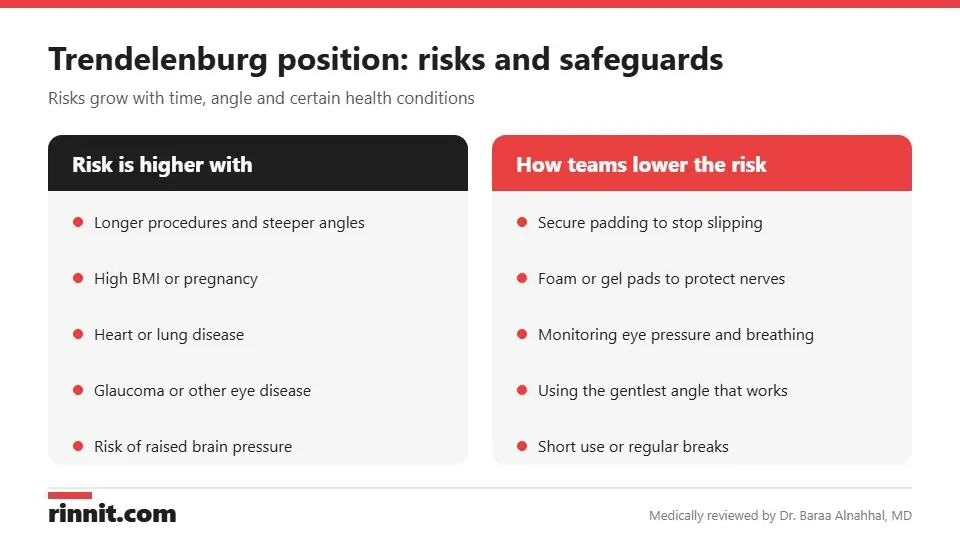
Risk factors and the safeguards care teams use.
Who faces a higher risk?
Long procedures and steep tilt angles [1]
A high body mass index (BMI) or pregnancy [1]
Heart disease or lung risk factors [1]
Eye disease such as glaucoma or hypertensive retinopathy [1]
Conditions that raise pressure in the skull, such as brain swelling or bleeding [1]
Studies show that the care team can lower some of these risks. Tailoring ventilator pressure improves oxygen levels and reduces lung complications, [2] and monitoring eye pressure matters during steep tilts. [4]
What happens after time in the Trendelenburg position?
After a short time in the position, you usually need no recovery. [1]
After longer procedures, your face or throat may be swollen with fluid, and feeling normal can take minutes to hours. [1]
If you had a breathing tube, staff watch you closely and confirm you breathe normally before removing it. [1]
You may feel lightheaded or dizzy, especially as anesthesia wears off, so take it easy for the rest of the day. [1]
When should you talk to your care team?
Before surgery, tell your care team if you have glaucoma or another eye disease, heart or lung disease, a recent head injury or bleeding in the brain, or if you are pregnant, because these raise the risk of complications in this position. [1] After surgery, tell staff right away about vision changes, a severe headache or trouble breathing.
Conclusion
The Trendelenburg position tilts you head-down so gravity can move your organs and blood in a helpful direction. It is a routine part of many pelvic and abdominal operations and central line procedures, and its variations let care teams match the tilt to each procedure. [1]
Risks such as nerve injury, raised eye and brain pressure and breathing problems are uncommon and grow with longer, steeper tilts. Share your medical history with your care team so they can plan the safest position for you. [1]
Keep learning: Read our laparoscopy guide to see how keyhole surgery uses this position.
Frequently asked questions
What is the Trendelenburg position?
It is a position in which you lie on your back with your head tilted at least 15° lower than your feet.
What angle is the Trendelenburg position?
The standard tilt is at least 15° head-down. The steep version uses 30° to 40°.
What is the reverse Trendelenburg position?
Your head is raised about 15° above your feet, which gives surgeons better access to upper abdominal organs.
What is the modified Trendelenburg position?
Your legs are raised while your head and back stay level, which encourages blood flow to the heart and brain.
Why is the Trendelenburg position used in surgery?
Gravity moves abdominal organs toward the chest, giving surgeons more room for lower abdominal and pelvic surgery.
Why is it used for central line placement?
The tilt fills the veins of the neck and upper chest with blood, making them easier to find and use.
Is the Trendelenburg position used for shock?
It was used in the past, but it is no longer routinely recommended because it carries risks for some people.
What are the risks of the Trendelenburg position?
Risks include sliding, nerve injury, raised eye and brain pressure, breathing problems and, very rarely, heart compression.
Who should be careful with the Trendelenburg position?
People with glaucoma, heart or lung disease, a high BMI, pregnancy or raised pressure in the skull face higher risk.
How long does it take to recover?
After a short tilt, no recovery is needed. After long surgery, swelling and dizziness can take minutes to hours to ease.
Related Reading
Laparoscopy: What It Is, Uses, Procedure and Recovery explains keyhole surgery, which often uses the Trendelenburg position.
Robotic Surgery: A Comprehensive Guide to Minimally Invasive Procedures covers robotic surgery, where steep head-down tilts are common.
Central Venous Catheter (Central Line): Types, Procedure, Risks and Care describes central line placement and its risks.
Glaucoma: The Silent Threat to Vision, and How Early Treatment Can Protect Your Sight explains the eye disease that raises risk during steep tilts.
Understanding Hypovolemic Shock: Causes, Symptoms, and Emergency Treatment reviews how shock is treated today.
References
Cleveland Clinic. Trendelenburg Position: What It Is, Why It's Done & Variations. Cleveland Clinic. Last updated July 7, 2025. https://my.clevelandclinic.org/health/procedures/trendelenburg-position
Gao L, Zhang B, Qi J, et al. Effects of individualized positive end-expiratory pressure on intraoperative oxygenation and postoperative pulmonary complications in patients requiring pneumoperitoneum with Trendelenburg position: a systematic review and meta-analysis. Int J Surg. 2025;111(1):1386-1396. PMID 39172728. https://doi.org/10.1097/JS9.0000000000002041
von Knorring C, Gjordeni M, Thomsson T, et al. Intracranial pressure estimated non-invasively and postoperative outcomes in surgery in the Trendelenburg position with pneumoperitoneum. J Anesth Analg Crit Care. 2025;5(1):8. PMID 39962515. https://doi.org/10.1186/s44158-025-00229-y
Ripa M, Schipa C, Kopsacheilis N, et al. The Impact of Steep Trendelenburg Position on Intraocular Pressure. J Clin Med. 2022;11(10):2844. PMID 35628970. https://doi.org/10.3390/jcm11102844
Medical disclaimer
This article is for general education only and does not replace advice from a qualified healthcare professional. Talk to your doctor about your own diagnosis and treatment, and seek emergency care right away for severe or sudden symptoms.



Comments