Laparoscopy: What It Is, Uses, Procedure and Recovery

Updated: 3 days ago
Written and medically reviewed by Dr. Baraa Alnahhal, MD · Last reviewed: November 2026 · How we review
Quick Answer: What is a laparoscopy?
A laparoscopy is a minimally invasive procedure in which a surgeon passes a thin camera, called a laparoscope, through a cut of about 1 cm to see inside the abdomen or pelvis. It can find the cause of symptoms, take biopsies or treat problems such as endometriosis, cysts, hernias and gallstones. Many people return to work in three days. [1]
What the research says
Keyhole appendix surgery means fewer wound infections and a faster return to normal life. Across 85 randomized trials with 9,765 people, adults who had laparoscopic appendix removal had about 58% lower odds of wound infection (OR 0.42), left hospital about 1 day sooner and returned to normal activity about 5 days earlier than with open surgery, though abscesses inside the belly were somewhat more common (OR 1.65). (Jaschinski et al., Cochrane Database of Systematic Reviews, 2018) [2]
Laparoscopic gallbladder surgery shortens recovery. In 38 randomized trials with 2,338 patients, laparoscopic gallbladder removal cut the hospital stay by about 3 days and recovery by about 22 days compared with open surgery, with no difference in deaths. (Keus et al., Cochrane Database of Systematic Reviews, 2006) [3]
Key takeaways
Laparoscopy lets a surgeon see inside the belly or pelvis on a monitor through a small cut, without a large incision. [1]
It can be diagnostic (finding the cause of a problem and taking biopsies) or operative (treating the problem). [1]
Compared with open surgery, it usually means less pain, less blood loss, smaller scars, lower infection risk and faster recovery. [1]
Shoulder pain and bloating from the gas are common for a day or two afterward. [1]
If an operation cannot be finished safely this way, the surgeon may switch to open surgery. [1]
How does laparoscopy work?
Laparoscopy works by filling the abdomen with gas so the organs separate and are easier to see, then passing a lighted camera through a small cut. The camera sends live images to a monitor, and the surgeon uses thin tools through up to three other small cuts to examine or operate. [1]

The gas is released at the end of the procedure and the small cuts are closed.
What is laparoscopy used for?
Laparoscopy is used both to diagnose problems that other tests cannot explain and to treat a wide range of conditions. Diagnostic laparoscopy can also collect tissue samples (biopsies). [1]
Area | Examples of laparoscopic procedures |
Gynecology | Endometriosis surgery, ovarian cyst or fibroid removal, ectopic pregnancy removal, tubal ligation or its reversal |
Digestive system | Gallbladder removal for gallstones, appendix removal, fundoplication for reflux, gastric bypass, rectopexy |
Hernias | Hernia repair |
Urology and reconstruction | Orchiopexy, urethral and vaginal reconstruction, stone removal |
Diagnosis | Biopsies and removal of polyps or small tumors |
Sources: [1]
Laparoscopic surgery is still surgery, and some laparoscopic operations are major procedures. [1]
How does laparoscopy compare with open surgery?
Laparoscopy is generally safer and easier to recover from than traditional open surgery because it disturbs less tissue. Surgeons increasingly prefer it for common operations. [1] [2] [3]
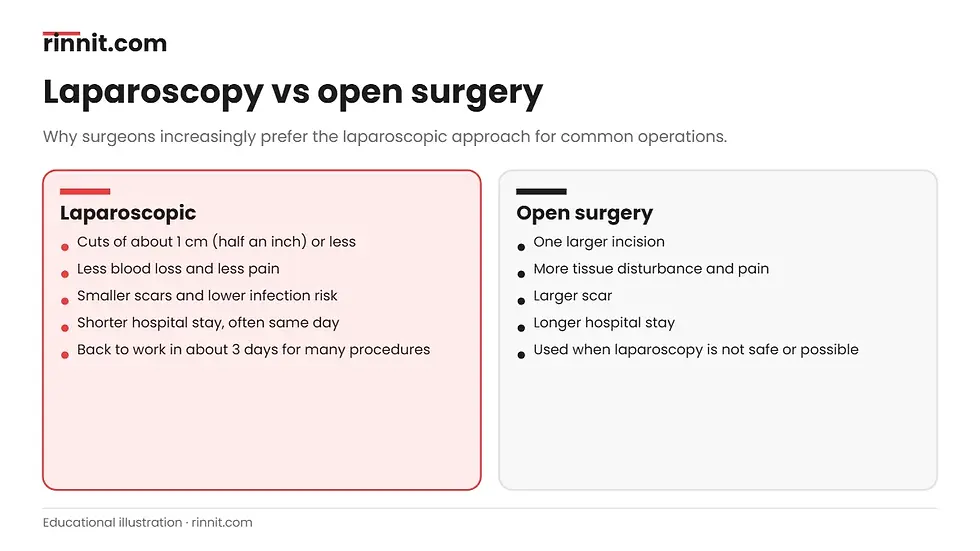
Smaller cuts usually mean less pain and a quicker return to normal activity.
Feature | Laparoscopy | Open surgery |
Incision | About 1 cm (half an inch) or less, plus up to 3 more small cuts | One larger incision |
Blood loss and pain | Less | More |
Scars | Smaller | Larger |
Infection risk | Lower | Higher |
Hospital stay and recovery | Shorter and faster | Longer |
Sources: [1]
How do you prepare for a laparoscopy?
To prepare for a laparoscopy, follow your team's instructions about food, drink and medicines. Typical steps include: [1]
Do not eat, drink or smoke after midnight the night before.
Wear loose clothing and low-heeled shoes.
Leave jewelry at home (a wedding ring is fine) and remove nail polish.
Arrange for someone to drive you home.
What happens during a laparoscopy?
During a laparoscopy you are asleep under general anesthesia, lying on a table tilted so your head is slightly lower than your feet. [1]
The surgeon makes a cut of about 1 cm (half an inch) or less, often near the belly button.
A tube fills the abdomen with gas so the organs are easier to see.
The laparoscope is inserted and sends live video to a monitor.
Up to three more small cuts may be made for other instruments.
The surgeon examines the organs, takes biopsies or performs the planned surgery.
The gas is released and the cuts are closed.
Sources: [1]
Laparoscopy at a glance
Item | Typical detail |
Anesthesia | General (you are asleep) |
Diagnostic laparoscopy | 30 minutes to 1 hour |
Laparoscopic surgery | 1 to 3 hours |
Recovery room | About 1 hour |
Back to work | Often about 3 days, depending on the procedure |
Exercise | Often about 1 week |
Sources: [1]
What is recovery like after a laparoscopy?
Recovery after a laparoscopy is usually quick. You spend about an hour in the recovery room while your vital signs are checked, receive pain medicine and book a follow-up visit before you leave. [1]

Exact timing depends on what was done during your laparoscopy.
Take it easy for at least a day or two, and avoid alcohol for 24 hours.
Remove the outer bandage the next morning and the skin tapes (Steri-Strips) after two to three days.
Bowel movements may take a few days to return to normal.
Urine may look green for a short time if a blue dye was used.
Ask your provider when sex is safe, since this depends on the procedure.
Sources: [1]
Common side effects
Pain from leftover gas, often felt in the shoulder
Pain at the cuts or inside the belly
Tenderness, bloating and cramping
Sources: [1]
What are the risks of laparoscopy?
Laparoscopy is generally safe, but like any surgery it has risks: [1]
Risk | What it means |
Bleeding | Usually at an incision site |
Organ or blood vessel injury | Damage to nearby structures from the instruments |
Infection | At the cuts or inside the abdomen |
Anesthesia problems | Reactions to general anesthesia |
Abdominal swelling | From gas or fluid |
Blood clots | Clots that travel to the heart or brain are very rare |
Sources: [1]
When should you call a doctor after a laparoscopy?
Contact your healthcare provider if you notice any of these after a laparoscopy: [1]
Fever or chills
Redness or swelling at the cuts
Unusual discharge or bleeding
Vomiting
Trouble urinating
Conclusion
Laparoscopy is a versatile, minimally invasive way to find and treat problems inside the abdomen and pelvis. Small cuts usually mean less pain, smaller scars and a faster recovery than open surgery. Expect some gas-related shoulder pain for a day or two, and call your provider if you develop fever, redness or vomiting.
If your doctor suggests a laparoscopy, ask whether it will be diagnostic, operative or both, so you know what recovery to expect.
Keep learning: Read our guides to endometriosis surgery, ovarian cystectomy and gallbladder removal (cholecystectomy), three common laparoscopic operations. For more background, see this laparoscopy overview from MedlinePlus.
FAQ
What is a laparoscopy?
A laparoscopy is a minimally invasive procedure that uses a thin camera, called a laparoscope, passed through a small cut to see inside the abdomen or pelvis.
What is the difference between diagnostic laparoscopy and laparoscopic surgery?
Diagnostic laparoscopy looks for the cause of a problem and can take biopsies. Laparoscopic surgery uses the same tools to treat or remove organs or tissue.
What conditions can laparoscopy diagnose or treat?
It can treat endometriosis, ovarian cysts, fibroids, ectopic pregnancy, hernias, gallstones and appendicitis, and it can remove small tumors or take biopsies.
Is laparoscopy done under general anesthesia?
Yes. Laparoscopy is done under general anesthesia, so you are asleep and feel no pain during the procedure.
How long does a laparoscopy take?
A diagnostic laparoscopy usually takes 30 minutes to an hour. Laparoscopic surgery usually takes one to three hours.
How big are the cuts for laparoscopy?
The cut for the camera is usually about 1 cm (half an inch) or less, and up to three more small cuts may be made for instruments.
Why does my shoulder hurt after laparoscopy?
Shoulder pain is common after laparoscopy. It comes from the gas used to inflate the belly and fades as the body absorbs it.
How long is recovery after laparoscopy?
Many people return to work in about three days and to exercise in about a week, though it depends on the procedure done.
What are the risks of laparoscopy?
Risks include bleeding, infection, injury to nearby organs or blood vessels, anesthesia problems, abdominal swelling and, rarely, blood clots.
How do I prepare for a laparoscopy?
Don't eat, drink (including water) or smoke after midnight the day before, and arrange for someone to drive you home. [1] Wear loose-fitting clothing and low-heeled shoes, remove nail polish, and leave jewelry at home except a wedding ring. [1]
When should I call a doctor after laparoscopy?
Call for fever or chills, redness or swelling at the cuts, unusual discharge or bleeding, vomiting or trouble urinating.
Related Reading
Single-Port Surgery: Uses, Benefits and Recovery explains single-port surgery.
Endometriosis: Symptoms, Causes, and Treatment explains why laparoscopy is the main way endometriosis is confirmed and treated.
Ovarian Cysts: Symptoms, Causes, and Treatment Options Explained covers when an ovarian cyst needs laparoscopic removal and when it can be watched.
Ectopic Pregnancy: Symptoms, Causes, and Treatment describes the warning signs of an ectopic pregnancy and how laparoscopic surgery is used to treat it.
Trendelenburg Position: Uses, Variations, Angles and Risks explains the head-down surgical position, its variations and angles, and its risks.
Appendectomy: Laparoscopic vs Open Surgery, Recovery and Risks explains laparoscopic and open surgery to remove the appendix, recovery time and risks.
Endometriosis Ultrasound: What It Can Find, What It Misses, Preparation and Results explains the specialized transvaginal scan that maps endometriomas and deep nodules.
References
Cleveland Clinic. Laparoscopy: What It Is, What To Expect & Recovery. Cleveland Clinic. Last updated March 1, 2024. https://my.clevelandclinic.org/health/procedures/4819-laparoscopy
Jaschinski T, Mosch CG, Eikermann M, et al. Laparoscopic versus open surgery for suspected appendicitis. Cochrane Database Syst Rev. 2018;11(11):CD001546. PMID 30484855. https://doi.org/10.1002/14651858.CD001546.pub4
Keus F, de Jong JAF, Gooszen HG, et al. Laparoscopic versus open cholecystectomy for patients with symptomatic cholecystolithiasis. Cochrane Database Syst Rev. 2006;(4):CD006231. PMID 17054285. https://doi.org/10.1002/14651858.CD006231
Medical disclaimer
This article is for general education only and does not replace advice from a qualified healthcare professional. Talk to your doctor about your own diagnosis and treatment, and seek emergency care right away for severe or sudden symptoms.



Comments