Ovarian Cystectomy: Why It's Done, How It Works, Recovery and Risks

Updated: 6 days ago
Written and medically reviewed by Dr. Baraa Alnahhal, MD · Last reviewed: October 2026 · How we review
Quick Answer: What is an ovarian cystectomy?
An ovarian cystectomy is surgery that removes a cyst — a fluid-filled sac — from the ovary. It is advised when a cyst is large, painful, possibly cancerous, or keeps coming back. Most surgeons use keyhole (laparoscopic) surgery, with about two to three weeks of recovery; open surgery takes four to six weeks. [1]
What the research says
Keyhole surgery is gentler than open surgery for benign ovarian tumors. A review of 9 randomized trials (482 women) found laparoscopy cut the odds of surgical complications by about 70% (OR 0.3), lowered pain scores, and shortened the hospital stay by almost 3 days compared with open surgery (Medeiros et al., Cochrane Database Syst Rev, 2009). [2]
Removing an endometrioma can lower egg-reserve markers. Across 30 studies, anti-Müllerian hormone (AMH) — a blood marker of ovarian reserve — fell by 1.39 ng/mL within 6 weeks of laparoscopic cystectomy for endometriomas, and by 2.12 ng/mL at 6–18 months (Murdock et al., Gynecol Obstet Invest, 2025). [3]
How the ovary is closed may matter. In 21 randomized trials (1,519 participants), stitching the ovary after endometrioma cystectomy left AMH 0.69 ng/mL higher at 3–6 months than cystectomy alone (Nirgianakis et al., Hum Reprod Open, 2026). [4]
Key takeaways
An ovarian cystectomy removes the cyst and aims to keep the ovary. [1]
Many ovarian cysts go away on their own; surgery is for cysts that are large, cause symptoms, may be cancerous, or keep returning. [1]
Laparoscopic (keyhole) surgery is the most common approach and usually allows going home within two to three hours. [1]
The cyst surgery itself does not lower your chance of pregnancy, but the condition that caused the cyst might. [1]
Fever, severe pelvic pain, severe vaginal bleeding, or a swollen, aching leg after surgery need a call to your surgeon. [1]
Why is an ovarian cystectomy done?
An ovarian cystectomy is done to remove an ovarian cyst that is unlikely to go away on its own or could cause harm. An ovarian cyst is a fluid-filled sac that forms on or inside an ovary. [1]
Many cysts disappear without treatment. Your doctor may recommend surgery when a cyst: [1]
Is large — typically more than 2.5 to 3 inches (about 6 to 7.5 cm) wide
Causes pain or other symptoms
Might be cancerous
Does not go away, or keeps coming back
Removing a troublesome cyst also lowers the risk of two emergencies: a cyst bursting (ruptured ovarian cyst), which can cause severe pain, and ovarian torsion, where the ovary twists and loses its blood supply. [1]
To learn how cysts form in the first place, read our guide to ovarian cysts.
What are the types of ovarian cystectomy?
The two types of ovarian cystectomy are laparoscopic (keyhole) surgery and open surgery, also called a laparotomy. [1]

Feature | Laparoscopic cystectomy | Open cystectomy (laparotomy) |
Cuts (incisions) | Several small cuts in the abdomen | One larger cut in the abdomen |
How the surgeon sees | A thin camera (laparoscope) | Directly through the open cut |
Usual use | Most cysts; preferred by most surgeons | Very large cysts or suspected cancer |
Going home | Often within 2–3 hours | Usually after one night in hospital |
Recovery | About 2–3 weeks | 4–6 weeks; full recovery up to 12 weeks |
Your surgeon chooses the approach based on the cyst's size, your symptoms, your plans for pregnancy, your medical history, and your cancer risk. [1]
Learn more about minimally invasive surgery and laparotomy.
How should you prepare for an ovarian cystectomy?
Preparing for an ovarian cystectomy means following your surgeon's instructions on fasting, medicines, and arrival time. [1]
Before surgery, your care team will tell you:
When to stop eating and drinking
Which medicines to pause or change
What time to arrive at the hospital or surgery center
Write down your questions in advance. Asking about pain relief options before surgery helps you plan your first days at home. [1]
What happens during an ovarian cystectomy?
During an ovarian cystectomy, you are under general anesthesia, so you sleep through the surgery and feel no pain. [1]

Laparoscopic cystectomy, step by step: [1]
You receive general anesthesia, and an IV line is placed in your arm.
The surgeon makes a small cut near your belly button and passes in the laparoscope. Carbon dioxide gas gently inflates your abdomen so the organs are easier to see.
Two or three more small cuts are made in the lower abdomen for the surgical tools.
The surgeon removes the cyst through one of the cuts. The cyst may be sent to a lab for testing.
The gas is let out, and the cuts are closed with dissolvable stitches and covered with bandages.
Open cystectomy: the surgeon makes one larger cut in the abdomen, removes the cyst, and closes the skin with stitches and a bandage. [1]
What happens right after an ovarian cystectomy?
Right after an ovarian cystectomy, you rest in a recovery room while staff monitor you as the anesthesia wears off. [1]
Some discomfort after surgery is common. Your surgeon will give you clear instructions on: [1]
Showering and caring for your cuts
Activity limits
How much vaginal bleeding to expect
Pain medicine
When you can have sex or insert anything into the vagina
Follow-up visits and returning to work
What are the benefits and risks of an ovarian cystectomy?
The main benefit of an ovarian cystectomy is removing a cyst that is painful or could cause harm. Without treatment, a cyst can burst or twist the ovary, and some cysts can be cancerous — especially after menopause. [1]
Like any surgery, it carries risks. Possible complications include: [1]
Possible complication | What it means |
Infection | Germs entering a cut or the abdomen |
Incision irritation | Soreness or redness around a cut |
Injury to the ovary or fallopian tube | Damage to nearby reproductive organs |
Bleeding | Blood loss during or after surgery |
Reaction to anesthesia | An allergic response to the anesthetic |
Blood clots | Clots that can form in the legs — see deep vein thrombosis |
Cyst recurrence | A new cyst forming later |
Removal of one or both ovaries | Needed in some cases during surgery |
Your personal health can raise or lower these risks, so ask your surgeon what applies to you. [1]
How long is ovarian cystectomy recovery?
Ovarian cystectomy recovery takes about two to three weeks after laparoscopic surgery and four to six weeks after open surgery. Full recovery from open surgery can take up to 12 weeks. [1]
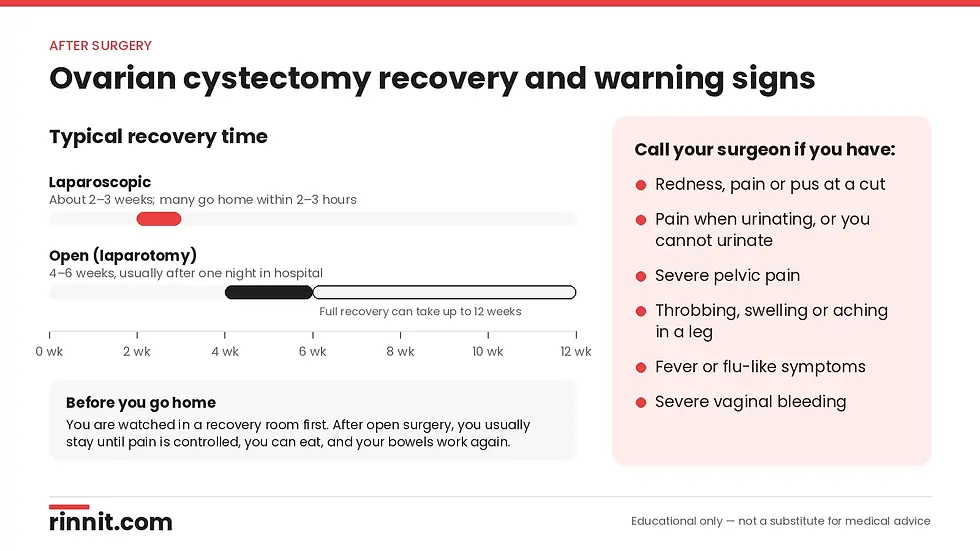
Recovery milestone | Laparoscopic | Open |
Going home | Often within 2–3 hours | Usually after one night |
Typical recovery | About 2–3 weeks | 4–6 weeks |
Full recovery | — | Up to 12 weeks |
Your return to work, exercise and sex depends on your surgeon's advice for your case. [1]
Does an ovarian cystectomy affect fertility or weight?
An ovarian cystectomy does not, by itself, lower your chance of getting pregnant. However, the condition that caused the cyst — such as endometriosis — might. [1] Damage to the ovary or fallopian tube during surgery is rare, but it could affect fertility. [1]
For endometriomas (cysts caused by endometriosis), research shows that ovarian reserve markers can drop after cystectomy, and the surgical technique may influence how much. [3][4] If you are planning a pregnancy, ask your surgeon how they protect healthy ovarian tissue, and read about diminished ovarian reserve and endometriosis surgery.
Weight: removing a large cyst may cause some weight loss and less bloating. Removing a small cyst is unlikely to change your weight. [1]
When should you call your doctor after an ovarian cystectomy?
Call your surgeon after an ovarian cystectomy if you notice signs of infection, bleeding, or a blood clot. [1] Contact your care team if you have:
Redness, pain or pus at a cut
Pain when urinating, or you cannot urinate
Severe pelvic pain
Throbbing, swelling or aching in a leg
Fever or flu-like symptoms
Severe vaginal bleeding
Conclusion
An ovarian cystectomy removes a problem cyst while aiming to keep the ovary. Most people have keyhole surgery, often go home within two to three hours, and recover in two to three weeks; open surgery needs a longer stay and recovery. Talk openly with your surgeon about the approach, your risks, and — if pregnancy is in your plans — how your ovaries will be protected.
Keep learning with Rinnit: explore our guides to ovarian cysts, ovarian dermoid cysts, PCOS and how the ovaries work. For trusted, plain-language health updates, follow us on Instagram and YouTube. For a broader overview, see this plain-language ovarian cysts overview.
FAQ
What is an ovarian cystectomy?
An ovarian cystectomy is surgery to remove a cyst from the ovary while keeping the ovary in place. It is usually done when a cyst is large, painful, possibly cancerous, or keeps coming back. [1]
Is an ovarian cystectomy a major surgery?
An ovarian cystectomy is usually done as keyhole (laparoscopic) surgery through a few small cuts, and many people go home within two to three hours. Open surgery uses one larger cut and usually needs an overnight hospital stay. [1]
How big does an ovarian cyst have to be for surgery?
An ovarian cyst is generally considered large enough for surgery when it is more than 2.5 to 3 inches (about 6 to 7.5 cm) wide. Smaller cysts may also be removed if they cause symptoms, look suspicious, or keep returning. [1]
How long does it take to recover from an ovarian cystectomy?
Recovery from a laparoscopic ovarian cystectomy takes about two to three weeks. Recovery from open surgery takes four to six weeks, and full recovery can take up to 12 weeks. [1]
Can you get pregnant after an ovarian cystectomy?
An ovarian cystectomy does not, by itself, reduce the chance of pregnancy. The condition that caused the cyst may affect fertility, and rare damage to the ovary or fallopian tube during surgery could too. [1]
Can an ovarian cyst come back after cystectomy?
An ovarian cyst can come back after cystectomy, and recurrence is one of the listed risks of the surgery. Ask your surgeon what follow-up visits you need. [1]
Will removing an ovarian cyst help me lose weight?
Removing a large ovarian cyst may lead to some weight loss and less bloating. Removing a small cyst is unlikely to change your weight. [1]
When should I seek urgent care after an ovarian cystectomy?
Seek urgent care after an ovarian cystectomy if you have severe pelvic pain, severe vaginal bleeding, fever, pus at a cut, trouble urinating, or a swollen, aching leg. These can signal infection, bleeding, or a blood clot. [1]
Will I lose my ovary during an ovarian cystectomy?
The goal is to remove only the cyst and keep the ovary. Sometimes the ovary must be removed if it is badly damaged or cancer is found.
How painful is recovery after an ovarian cystectomy?
Mild to moderate belly pain is common for a few days. After keyhole surgery, some people also feel shoulder pain from the gas used, which fades within a few days.
Related Reading
Ovarian Cysts: Symptoms, Causes, and Treatment Options Explained explains the types of ovarian cysts and when they need treatment.
Ovarian Dermoid Cyst: Symptoms, Causes, Diagnosis, and Treatment describes dermoid cysts, a common reason for cyst removal surgery.
Ovarian Torsion: Symptoms, Causes, Diagnosis, and Emergency Treatment explains the emergency signs of a twisted ovary.
Endometriosis Surgery: Types, Recovery, Risks, and Results covers surgery for endometriosis, including endometrioma removal.
References
Cleveland Clinic. Ovarian Cystectomy: Purpose, Procedure, Risks & Recovery. Cleveland Clinic. Last updated July 24, 2026. https://my.clevelandclinic.org/health/treatments/24427-ovarian-cystectomy
Medeiros LR, Rosa DD, Bozzetti MC, et al. Laparoscopy versus laparotomy for benign ovarian tumour. Cochrane Database Syst Rev. 2009;2009(2):CD004751. PMID 19370607. https://doi.org/10.1002/14651858.CD004751.pub3
Murdock C, Sanchez-Ramos L, McKinney JA, et al. The Impact of Laparoscopic Cystectomy for Ovarian Endometrioma on Anti-Müllerian Hormone Levels: A Systematic Review and Meta-Analysis. Gynecol Obstet Invest. 2025;90(6):657-671. PMID 40179834. https://doi.org/10.1159/000545230
Nirgianakis K, Kalaitzopoulos DR, Fadinger N, et al. Comparative effect of different surgical treatments for ovarian endometrioma on anti-Müllerian hormone levels: a systematic review and network meta-analysis. Hum Reprod Open. 2026;2026(3):hoag019. PMID 42164538. https://doi.org/10.1093/hropen/hoag019
Medical disclaimer
This article is for general education and does not replace advice from your doctor. Always talk with a qualified healthcare provider about your symptoms, test results, and treatment options. If you have severe pain, heavy bleeding, or signs of a blood clot, seek emergency care.



Comments