Diminished Ovarian Reserve (Low Egg Count): What It Means for Your Fertility

Updated: 3 days ago
Medically reviewed by Dr. Baraa Alnahhal, MD · Last reviewed: October 2026
Quick Answer
Diminished ovarian reserve is when the ovaries hold fewer eggs than expected for age, making pregnancy harder but not impossible [1]. It is diagnosed with blood tests for AMH, FSH and estradiol plus an ultrasound antral follicle count [1]. Most people have no other symptoms [1]. No treatment reverses it, but egg freezing, IVF and donor eggs can help achieve pregnancy [1].
What the research says
Low AMH or high FSH does not mean you can't conceive naturally. In a prospective cohort of 750 women aged 30 to 44 with no history of infertility who had been trying to conceive for 3 months or less, women with low AMH (below 0.7 ng/mL) had a similar predicted chance of conceiving within 6 cycles as women with normal AMH (65% vs 62%) and within 12 cycles (84% vs 75%); high FSH also was not linked to reduced fertility (PubMed: Steiner et al., JAMA, 2017 [2]).
Few add-on treatments have solid evidence in diminished ovarian reserve. A systematic review and meta-analysis of 38 randomized trials in women with diminished ovarian reserve found that, among all the interventions evaluated, testosterone supplementation was the one associated with higher live birth rates (odds ratio 2.19, 95% CI 1.11–4.32; 4 studies, 368 patients), and the authors say this needs to be explored in further randomized trials (PubMed: Conforti et al., Fertil Steril, 2025 [3]).
DHEA has not been shown to raise live birth rates in randomized trials. A meta-analysis of 32 studies of DHEA in women with poor ovarian response or diminished ovarian reserve undergoing IVF/ICSI found no significant improvement in live birth rate when only randomized trials were analyzed, although DHEA was linked to a lower miscarriage rate (relative risk 0.46, 95% CI 0.29–0.73) (PubMed: Zhang et al., Front Endocrinol, 2023 [4]).
What Is Diminished Ovarian Reserve?
Diminished ovarian reserve is the medical term for having fewer eggs in your ovaries compared to other people your age [1]. It is also called low egg count or low ovarian reserve.
Your eggs, together with sperm, are the building blocks for pregnancy. Every person starts life with a fixed supply of eggs, and that supply drops over time. For most people the decline follows a fairly predictable curve. For some people, the drop happens sooner or faster than expected — and that is diminished ovarian reserve.
A lower egg count makes it harder to get pregnant. But it does not mean pregnancy is impossible [1]. It means you may find conception more difficult, or you may want to consider fertility treatment sooner rather than later. Healthcare providers diagnose the condition with ovarian reserve testing, a set of blood tests and an ultrasound that estimate how many eggs you have left [1].
Key insight: Many people with diminished ovarian reserve go on to conceive — naturally or with help. The condition changes the odds, not the destination.
How Many Eggs Should You Have?
People are born with all the eggs they will ever produce — no new eggs form after birth. Your age is the strongest predictor of your egg supply, and research shows the rate of egg loss speeds up once you turn 35 [1]. Average numbers vary from person to person, but these are the typical figures across a lifetime:
Life stage | Average number of eggs remaining |
Birth | 1 to 2 million |
Puberty | 300,000 to 400,000 |
Age 40 | About 25,000 |
Menopause | Less than 1,000 |
Only a healthcare provider can estimate how many eggs you personally have left, and they do this using ovarian reserve testing results rather than any single number.

Diminished Ovarian Reserve vs. POI: What Is the Difference?
It helps to understand where diminished ovarian reserve sits alongside related conditions. The table below summarizes the distinctions:
Condition | What it means | Typical symptoms |
Diminished ovarian reserve (DOR) | Fewer eggs than peers of the same age | Often none; mainly difficulty conceiving |
Primary ovarian insufficiency (POI) | Ovaries slow or stop functioning before age 40 | Perimenopause-like symptoms |
Menopause | Natural end of egg supply, usually around age 45–55 | Periods stop permanently; perimenopause symptoms |
Diminished ovarian reserve is about quantity — how many eggs remain — not about whether your ovaries still work. Most people with DOR continue ovulating and having periods.
Can You Get Pregnant With Diminished Ovarian Reserve?
Yes. You can still get pregnant with diminished ovarian reserve. Your odds of conceiving may be smaller when your ovarian reserve is low, but you only need one egg to get pregnant [1].
Egg count is not the only factor in conception. These elements also play a large part:
Factor | Why it matters |
Egg quality | Determines whether a fertilized egg develops normally |
Sperm quality | Affects fertilization success |
Uterus function | The embryo must implant and grow there |
Fallopian tube function | Sperm and egg meet, and the embryo travels through the tubes |
A diagnosis of diminished ovarian reserve is not a fertility verdict. It is a starting point for planning.
Symptoms of Diminished Ovarian Reserve
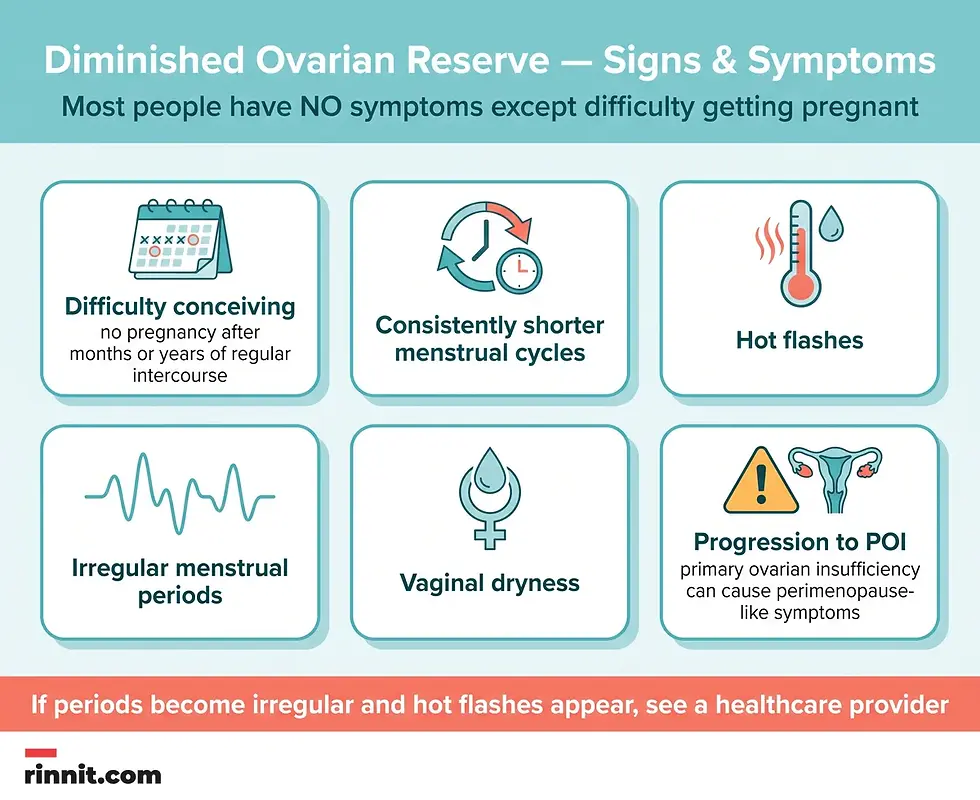
Most people have no symptoms of diminished ovarian reserve other than not getting pregnant after months or years of regular sexual intercourse [1].
Some people notice their menstrual cycle getting consistently shorter [1] — a subtle signal that the egg supply is shrinking.
If diminished ovarian reserve has progressed toward primary ovarian insufficiency (POI), perimenopause-like symptoms may appear:
Symptom | Description |
Hot flashes | Sudden waves of heat, often with sweating |
Irregular menstrual periods | Cycles become unpredictable |
Vaginal dryness | Lower estrogen affects vaginal tissue |
What Causes Diminished Ovarian Reserve?
Aging is one of the biggest causes of low ovarian reserve. Sometimes there is no identifiable cause at all. In other cases, genetics or medical treatments are responsible [1].
Cause | How it lowers egg count |
Aging | Natural, ongoing egg loss; accelerates after 35 |
Genetic disorders affecting the X chromosome | Disrupt normal egg development and survival |
Radiation therapy | Damages eggs and ovarian tissue |
Chemotherapy | Cancer drugs destroy eggs |
Ovarian surgery | Removes or damages egg-containing tissue |
Losing one or both ovaries | Reduces total egg supply directly |
Autoimmune conditions | The immune system attacks ovarian tissue |
Can Stress Cause Diminished Ovarian Reserve?
No. Stress cannot cause diminished ovarian reserve [1]. According to the American Society for Reproductive Medicine, smoking and tobacco use are the only lifestyle factors associated with decreased ovarian reserve [1].
How Is Diminished Ovarian Reserve Diagnosed?
Providers screen for diminished ovarian reserve using ovarian reserve testing — a way to estimate how many eggs you have left. It is important to understand what these tests can and cannot do:
They cannot tell you exactly how many years of fertility you have left or whether you will get pregnant [1].
They do identify whether you are less likely to respond well to the ovarian stimulation medications used in IVF, or whether you have a lower likelihood of achieving pregnancy without treatment.
A positive screen does not mean you cannot conceive naturally — the tests do not predict your ability to conceive on your own [1] [2].
The testing typically involves these components:
Test | What it measures | What it predicts |
AMH blood test | Anti-Müllerian hormone level | Likely response to ovarian stimulation |
FSH + estradiol blood test | Follicle-stimulating hormone and estradiol levels | Ovarian signaling and function |
Antral follicle count (AFC) | A vaginal ultrasound counts visible follicles and measures ovarian volume | Remaining egg supply |
Clomiphene citrate challenge | Take oral fertility medication and monitor the body's response | Ovarian responsiveness (uncommon test) |
People with diminished ovarian reserve show a consistent pattern compared to people of the same age: higher FSH levels, lower AMH levels, and a lower AFC [1]. These tests measure your likely response to fertility medication — they do not measure your ability to get pregnant without it.

How Is Diminished Ovarian Reserve Treated?
There is no way to reverse diminished ovarian reserve or produce more eggs [1]. Once a provider suspects a low ovarian reserve, they work with you on a treatment plan built around your pregnancy goals. Your plan depends on:
Factor | Why it matters |
How soon you want to get pregnant | Determines urgency of treatment |
How many children you want | Shapes the number of cycles or frozen eggs needed |
Finances | Treatments like IVF carry significant costs |
Desire for a genetically related child | Influences the choice between own eggs, donor eggs, or adoption |
Treatment options fall into three broad paths: freezing your eggs for later use, attempting to conceive naturally, or undergoing IVF with your own eggs or donor eggs.
Using Your Own Eggs
Egg freezing is one way to preserve your fertility. If your provider says you are at high risk for a low ovarian reserve, they may suggest freezing your eggs before your count declines further. The process involves taking hormones to stimulate your ovaries to make as many eggs as possible, then collecting and freezing the mature eggs for future IVF treatment [1].
In some cases, providers suggest creating embryos instead — fertilizing the mature eggs with your partner's sperm or donor sperm before freezing them for future use or transferring them to your uterus.
Using Donor Eggs
If your egg quality and quantity are poor, your provider may suggest donor eggs. Your partner's sperm fertilizes an egg from a donor, and the resulting embryo is transferred to your uterus. Your baby will not carry your genes [1], but can still carry your partner's genes (unless donor sperm is used).
Embryo freezing is another option: your eggs (or donor eggs) are fertilized with sperm to create an embryo, which is then frozen for future use.
Treatment option | Best for | Genetic connection |
Egg freezing | Acting early before reserve drops further | Your own genes |
IVF with your own eggs | Trying to conceive now | Your own genes |
Embryo freezing | Planning for a second child or later timing | Your genes (or donor) |
Donor eggs | Poor egg quality or quantity | Partner's genes possible |
What About Supplements and Add-On Treatments?
Researchers have tested several add-on treatments in women with diminished ovarian reserve. A 2025 systematic review of 38 randomized trials found that testosterone supplementation was the add-on associated with higher live birth rates, based on four studies and 368 patients, and called for more trials [3]. A separate meta-analysis found that DHEA did not significantly improve live birth rates in randomized trials [4]. Ask your fertility specialist whether any add-on makes sense for your situation.
Does Folic Acid Improve Egg Quality?
Prenatal vitamins contain folic acid, which is important for maintaining egg quality. If you wish to become pregnant, your provider will recommend starting a prenatal vitamin — ideally at least three months before conception [1].
Diet, exercise, and other lifestyle factors do play a role in your eggs' health and quality. However, they do not affect the number of eggs or your egg count [1].
What Happens If You Try IVF With a Low Ovarian Reserve?
Success rates with IVF vary depending on the cause of your low ovarian reserve, how many eggs you have, and how your body responds to fertility medication. The exact IVF success rates for people with diminished ovarian reserve are unknown [1].
Researchers know that — just like natural pregnancies — IVF success declines as you age [1], and this applies to people with diminished ovarian reserve too.
If your screening tests show a low ovarian reserve, you are less likely to respond well to ovarian stimulation medication — but IVF may still be the best option for you [1]. This is a conversation worth having with a fertility specialist.
Can You Prevent Diminished Ovarian Reserve?
There is nothing you can do to prevent diminished ovarian reserve [1], because most of the causes are out of your control. Certain factors may help maintain the quality of your eggs:
Factor | What to do |
Healthy weight | Maintain a weight in the healthy range for your body |
Tobacco | Avoid cigarettes and other tobacco products |
Key Takeaways
Diminished ovarian reserve means you have fewer eggs than other people your age, and it usually announces itself only through difficulty getting pregnant — most people have no other symptoms. Diagnosis comes from ovarian reserve testing: AMH and FSH blood tests plus an antral follicle count on vaginal ultrasound. There is no cure and no way to grow new eggs, but pregnancy remains possible naturally or through egg freezing, IVF, or donor eggs. A diagnosis is a starting point for planning, not an ending — working with a fertility specialist helps you match the right option to your goals, timeline, and budget.
Take the Next Step
If you have been trying to conceive for more than a few months without success, talk to a healthcare provider or fertility specialist about ovarian reserve testing. Early information gives you more options — and more time.
Related reading: primary ovarian insufficiency, in vitro fertilization (IVF)
Frequently Asked Questions
1. What does diminished ovarian reserve actually mean?
Diminished ovarian reserve means you have fewer eggs in your ovaries compared to other people your age. It is also called low egg count or low ovarian reserve. It can make getting pregnant more difficult, but it does not mean pregnancy is impossible — it may mean you need fertility treatment to conceive.
2. Can I get pregnant naturally with low ovarian reserve?
Yes, natural pregnancy is still possible with diminished ovarian reserve. You only need one egg to get pregnant, and egg count is not the only factor — egg quality, sperm quality, and the function of your uterus and fallopian tubes also matter. However, the odds of conceiving naturally are smaller when your egg supply is low.
3. What are the symptoms of low egg count?
Most people with diminished ovarian reserve have no symptoms other than difficulty getting pregnant after months or years of regular sexual intercourse. Some notice their menstrual cycle getting consistently shorter. If the condition progresses to primary ovarian insufficiency, perimenopause-like symptoms such as hot flashes, irregular periods, and vaginal dryness may appear.
4. What causes diminished ovarian reserve?
Aging is one of the biggest causes, and the rate of egg loss increases after age 35. Other causes include genetic disorders affecting the X chromosome, radiation or chemotherapy, ovarian surgery, losing one or both ovaries, and autoimmune conditions. Sometimes no cause is found. Stress does not cause diminished ovarian reserve — smoking and tobacco use are the only lifestyle factors linked to it.
5. How do you test for ovarian reserve?
Ovarian reserve testing combines blood tests and imaging: an AMH (anti-Müllerian hormone) blood test, an FSH and estradiol blood test, and a vaginal ultrasound that measures ovarian volume and counts visible follicles (the antral follicle count). A clomiphene citrate challenge test exists but is uncommon. People with low reserve show higher FSH, lower AMH, and lower follicle counts than same-age peers.
6. What is a normal AMH level for fertility?
AMH levels reflect your egg supply — higher AMH means more eggs, and lower AMH means fewer. There is no single "normal" cutoff; providers interpret your AMH alongside FSH, estradiol, and your antral follicle count compared to people your own age. These tests predict your likely response to IVF medication, not your ability to conceive naturally.
7. Can egg count go back up or be improved?
No. There is no way to reverse diminished ovarian reserve or produce more eggs — people are born with all the eggs they will ever have, and the supply only decreases. Lifestyle factors like diet, exercise, prenatal vitamins, and avoiding tobacco may support egg quality, but they cannot increase egg count.
8. How many eggs do you have at different ages?
Women are born with about 1 to 2 million eggs. By puberty, that number falls to roughly 300,000 to 400,000. Around age 40, the average is about 25,000, and by menopause fewer than 1,000 remain. Age is the strongest predictor of egg supply, and egg loss speeds up after age 35.
9. Does low ovarian reserve mean menopause is coming?
Not necessarily, and it is hard to put an exact timeline on when menopause will begin. Low ovarian reserve indicates that your egg quantity is decreasing — it is a signal about your current supply, not a precise countdown to menopause.
10. What are the treatment options for low egg count?
Since the condition cannot be reversed, treatment focuses on reaching your pregnancy goals with the eggs you have. Options include freezing your eggs early, attempting natural conception, IVF with your own eggs, IVF with donor eggs, or embryo freezing. Your plan depends on how soon you want to conceive, how many children you want, finances, and how strongly you want a genetically related child.
11. Should I freeze my eggs if my ovarian reserve is low?
If your provider says you are at high risk for low ovarian reserve, they may suggest egg freezing before your egg count declines further. Egg freezing uses hormones to stimulate your ovaries to produce as many eggs as possible, then collects and freezes the mature eggs for future IVF. This preserves your options while your supply is still adequate.
12. How successful is IVF with diminished ovarian reserve?
Exact success rates are unknown, but IVF outcomes vary with the cause of low reserve, your egg count, and how well you respond to fertility medication. Success with IVF declines with age — including for people with diminished ovarian reserve. You may respond less well to stimulation medication, but IVF can still be your best option. A fertility specialist can help you weigh the realistic odds.
Related Reading
Anti-Müllerian Hormone (AMH) Test: Normal Levels by Age and What Results Mean explains how AMH estimates ovarian reserve and what results mean.
Ovarian Reserve Testing: AMH, FSH and Antral Follicle Count explains the AMH, FSH and follicle count tests that estimate egg supply.
References
Cleveland Clinic. Diminished Ovarian Reserve. Cleveland Clinic. Aug. 11, 2022. https://my.clevelandclinic.org/health/diseases/23975-diminished-ovarian-reserve
Steiner AZ, Pritchard D, Stanczyk FZ, et al. Association between biomarkers of ovarian reserve and infertility among older women of reproductive age. JAMA. 2017;318(14):1367-1376. doi:10.1001/jama.2017.14588. PMID: 29049585.
Conforti A, Carbone L, Di Girolamo R, et al. Therapeutic management in women with a diminished ovarian reserve: a systematic review and meta-analysis of randomized controlled trials. Fertil Steril. 2025;123(3):457-476. doi:10.1016/j.fertnstert.2024.09.038. PMID: 39332623.
Zhang J, Jia H, Diao F, et al. Efficacy of dehydroepiandrosterone priming in women with poor ovarian response undergoing IVF/ICSI: a meta-analysis. Front Endocrinol (Lausanne). 2023;14:1156280. doi:10.3389/fendo.2023.1156280. PMID: 37361534.
Medical Disclaimer
This article is for informational purposes only and does not constitute medical advice. Always seek the advice of your physician or other qualified health provider with any questions you may have regarding a medical condition. Never disregard professional medical advice or delay in seeking it because of something you have read here.



Comments