Ovarian Reserve Testing: AMH, FSH and Antral Follicle Count

Updated: 3 days ago
Written and medically reviewed by Dr. Baraa Alnahhal, MD · Last reviewed: November 2026 · How we review
Quick Answer
Ovarian reserve testing estimates how many eggs you have left compared with others your age. It usually combines blood tests for AMH and FSH with an antral follicle count on a transvaginal ultrasound. It's most useful when planning IVF or egg freezing. It doesn't measure egg quality and can't tell you whether you'll get pregnant naturally.
What the research says
Low reserve doesn't mean you can't conceive: in a study of women aged 30–44 trying to conceive for 3 months or less, low AMH or high FSH was not linked to lower chances of getting pregnant naturally, so these tests shouldn't be used to judge natural fertility (Steiner AZ et al., JAMA, 2017) [2]
The tests predict response to IVF medicines: a meta-analysis found AMH (82% sensitivity, 76% specificity) and antral follicle count (82% and 80%) were similarly accurate at predicting an excessive response to ovarian stimulation, helping doctors tailor medicine doses (Broer SL et al., Hum Reprod Update, 2011) [3]
Key takeaways
Estimates your egg supply compared with others your age.
Combines AMH and FSH blood tests with an ultrasound follicle count.
Most useful for planning IVF or egg freezing.
Doesn't measure egg quality or predict natural pregnancy.
Age is the biggest factor affecting ovarian reserve.
What is ovarian reserve?
Ovarian reserve is the number of eggs left in your ovaries. You're born with all the eggs you'll ever have, and the number falls with age. A lower-than-expected reserve for your age is called diminished ovarian reserve. Sources: [1]
Which tests are included?
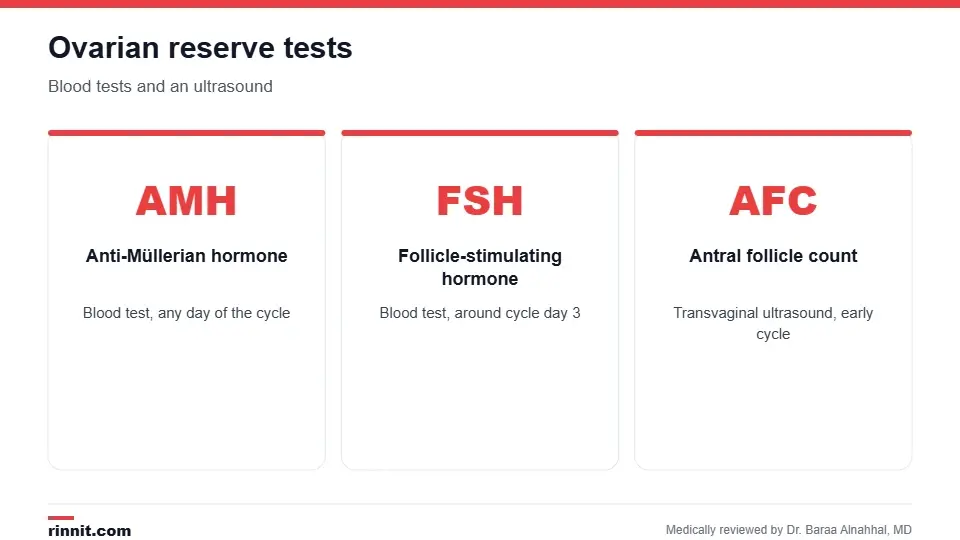
AMH, FSH and AFC are often combined.
Test | How it's done | When |
Blood test | Any day of the cycle | |
FSH (follicle-stimulating hormone) | Blood test | Around day 3 of the cycle |
Antral follicle count (AFC) | Transvaginal ultrasound counts small follicles | Usually within the first four days of the cycle |
AMH levels below about 1 ng/mL may suggest a declining egg supply, but they don't predict whether you can get pregnant. Normal ranges vary by lab and age. Sources: [1]
Who should get tested?
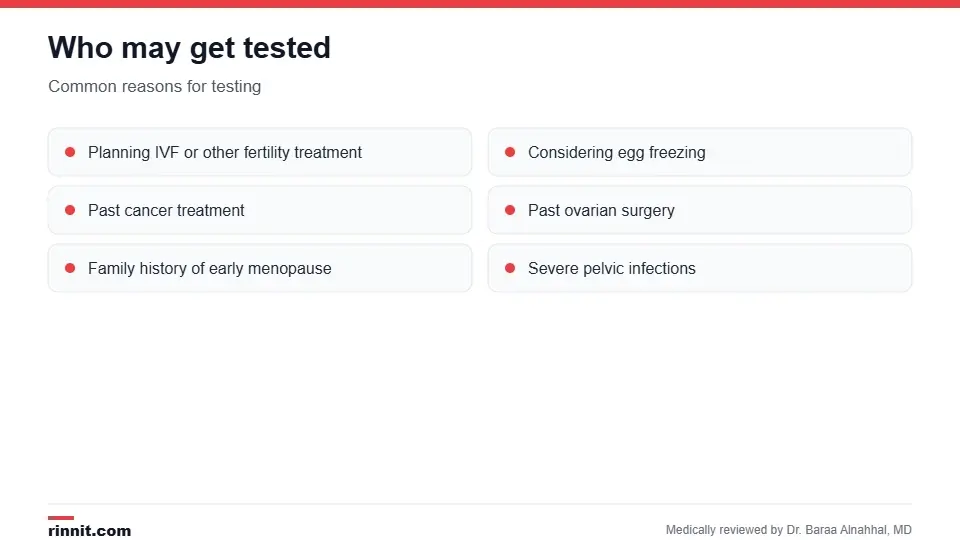
Testing helps plan fertility treatment.
People planning IVF or other fertility treatment.
People considering egg freezing or other fertility preservation.
People who've had chemotherapy, radiation or ovarian surgery.
People with a family history of early menopause or a history of severe pelvic infections. Sources: [1]
How the tests are done
The blood tests are simple draws from a vein in your arm. For the antral follicle count, a small ultrasound probe is placed in the vagina to view the ovaries and count follicles. The tests have no risks. Sources: [1]
Understanding your results

Results guide treatment but don't predict natural pregnancy.
Results usually come back within about a week and are compared with people your age. They can show whether your egg supply is lower than expected, but they can't give an exact egg count or say when you'll reach menopause. Your provider looks at all your fertility results together, because no single test predicts pregnancy or treatment success. Sources: [1, 2, 3]
Testing doesn't measure egg quality, which generally declines after age 35.
It can't tell you with certainty whether you can conceive naturally.
It doesn't check other causes of infertility. Sources: [1, 2]
What affects ovarian reserve?
Age is the biggest factor. Others include ovarian surgery or ovarian problems, chemotherapy or radiation, severe pelvic infections and a family history of early menopause. You can't increase your egg count, but a healthy diet, enough sleep, not smoking and avoiding alcohol may support egg quality. Sources: [1]
Conclusion
Ovarian reserve testing gives a useful snapshot of your egg supply and helps fertility specialists plan treatment. It's best viewed as one part of a fuller fertility picture, not a prediction of whether you'll get pregnant.
Frequently asked questions
What is ovarian reserve testing?
Tests that estimate your egg supply compared with others your age.
Which tests are included?
Usually AMH, FSH and an antral follicle count.
When is FSH tested?
Around day 3 of the menstrual cycle.
Can AMH be tested any day?
Yes.
Does a low AMH mean I can't get pregnant?
No. It doesn't predict natural pregnancy.
Does it measure egg quality?
No.
Who should get tested?
People planning IVF, egg freezing or after treatments that affect the ovaries.
How long do results take?
Usually about a week.
Are there risks?
No. The tests are blood draws and an ultrasound.
Can I increase my egg count?
No, but healthy habits may support egg quality.
Related Reading
Anti-Müllerian Hormone (AMH) Test: Normal Levels by Age and What Results Mean the most common ovarian reserve blood test.
Diminished Ovarian Reserve (Low Egg Count): What It Means for Your Fertility what a low egg count means.
In Vitro Fertilization (IVF): A Comprehensive Patient Guide fertility treatment guided by these tests.
Female Infertility: Causes, Signs, and Treatment Options Explained other causes of trouble getting pregnant.
Understanding Fertility Preservation: Options and Benefits options like egg freezing.
References
Cleveland Clinic. Ovarian Reserve Testing: Range, Purpose & Results. Cleveland Clinic. Last updated July 24, 2023. https://my.clevelandclinic.org/health/diagnostics/25142-ovarian-reserve-testing
Steiner AZ, Pritchard D, Stanczyk FZ, et al. Association between biomarkers of ovarian reserve and infertility among older women of reproductive age. JAMA. 2017;318(14):1367-1376. PMID 29049585. https://doi.org/10.1001/jama.2017.14588
Broer SL, Dólleman M, Opmeer BC, et al. AMH and AFC as predictors of excessive response in controlled ovarian hyperstimulation: a meta-analysis. Hum Reprod Update. 2011;17(1):46-54. PMID 20667894. https://doi.org/10.1093/humupd/dmq034
Medical disclaimer
This article is for general education only and does not replace advice from a qualified healthcare professional. Talk to your doctor about your own diagnosis and treatment, and seek emergency care right away for severe or sudden symptoms.



Comments