Anti-Müllerian Hormone (AMH) Test: Normal Levels by Age and What Results Mean

Updated: 2 days ago
Written and medically reviewed by Dr. Baraa Alnahhal, MD · Last reviewed: November 2026 · How we review
Quick Answer: What is an AMH test?
An anti-Müllerian hormone (AMH) test is a blood test that measures AMH, a hormone made by the follicles in the ovaries that reflects how many eggs you have left. An average level is 1.0 to 3.0 ng/mL, and below 1.0 ng/mL is low. AMH does not predict whether you can get pregnant or when menopause will start. [1]
What the research says
A low AMH did not lower the chance of natural pregnancy. In 750 women aged 30 to 44 trying to conceive without known infertility, those with low AMH (below 0.7 ng/mL) were as likely to conceive within 6 cycles (65%) as those with normal AMH (62%), and within 12 cycles (84% vs 75%). (Steiner et al., JAMA, 2017) [2]
AMH helps but cannot diagnose PCOS on its own. A meta-analysis of 82 studies for the 2023 international PCOS guideline found AMH identified PCOS in adults with 79% sensitivity and 87% specificity, but concluded AMH alone is not enough to diagnose PCOS and no single cut-off could be recommended. (van der Ham et al., Fertility and Sterility, 2024) [3]
Key takeaways
AMH is made by the follicles in the ovaries and roughly reflects how many eggs remain. [1]
Levels rise in the teen years, peak around age 25 and then decline. [1]
An average level is 1.0 to 3.0 ng/mL; below 1.0 ng/mL is low. [1]
The test can be done any day of your cycle and needs no preparation. [1]
AMH does not predict your fertility or when menopause will happen. [1]
What is anti-Müllerian hormone (AMH)?
Everyone makes AMH, but providers mainly test it in women. Before birth, AMH helps the sex organs develop: male fetuses have higher levels, which stops female reproductive organs from forming, while female fetuses need only a small amount. [1]
In females, AMH is made by cells in the ovarian follicles, the fluid-filled sacs that hold and release eggs. AMH levels track with ovarian reserve: higher levels suggest more eggs, and lower levels suggest fewer. [1]
Why is an AMH test done?
To estimate ovarian reserve. It gives a sense of how many eggs remain and whether your ovaries may be aging faster than expected, which may suggest a shorter window for pregnancy. [1]
Before IVF. It may show how well you will respond to injectable fertility medicines that help several eggs mature. [1]
To check an ovarian tumor. It can help show whether an ovarian mass is a granulosa cell tumor, whether treatment is working and whether the tumor has come back. [1]
How do you prepare for an AMH test?
No preparation is needed. Unlike other reproductive hormones, AMH changes little during the month, so the test can be done on any day of your menstrual cycle. [1]
What happens during an AMH test?
It is a simple blood draw. A provider uses a thin needle to take blood from a vein in your arm, which takes just a few minutes. If the sample goes to a lab, results may take a few days. Your provider usually schedules a follow-up to go over your results and plan next steps. [1]
What are normal AMH levels?
AMH is measured in nanograms per milliliter (ng/mL). Experts still debate the exact normal ranges, and results can vary slightly between labs because they use different equipment. [1]

AMH level | What it suggests |
1.0 to 3.0 ng/mL | Average |
Below 1.0 ng/mL | Low |
0.4 ng/mL | Severely low |
Sources: [1]
AMH levels by age
AMH rises during the teen years, peaks around age 25 and then naturally declines. Lower-end estimates by age are: [1]

Age | Lower-end AMH level |
25 | 3.0 ng/mL |
30 | 2.5 ng/mL |
35 | 1.5 ng/mL |
40 | 1.0 ng/mL |
45 | 0.5 ng/mL |
Sources: [1]
What do high and low AMH results mean?
A low AMH suggests a lower egg supply and may mean a shorter window for pregnancy. [1]
A higher AMH is not always better. AMH can be high in some people with polycystic ovary syndrome (PCOS), and the 2023 international PCOS guideline now uses AMH to help define polycystic ovaries in adults. [1] [3]
What can't an AMH test tell you?
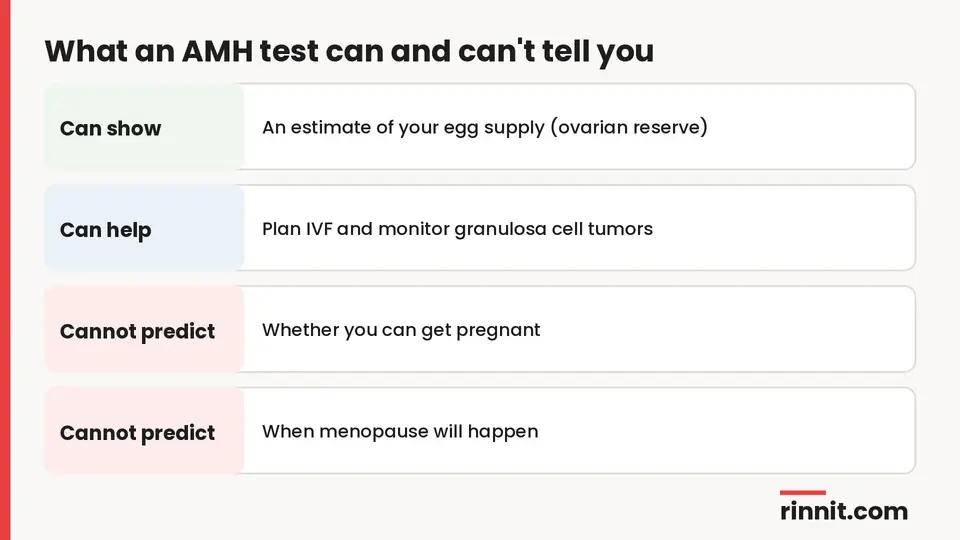
AMH does not predict your fertility, with or without treatment, and it does not predict when menopause will happen. [1]
Many other factors affect your chance of getting pregnant even when AMH is typical, including: [1]
Age
Medical conditions
Smoking
Sperm count and motility
Ovulation problems
Blocked fallopian tubes or pelvic scarring
Endometriosis
Uterine problems such as fibroids
Are at-home AMH tests reliable?
At-home AMH tests, usually done with a finger prick, are sold in stores and online. Because fertility needs a full evaluation, it is best to have a specialist interpret your result. [1]
Conclusion
An AMH test is a simple blood test that estimates your remaining egg supply and helps plan fertility treatment such as IVF. Levels fall with age, and a low result may point to a shorter window for pregnancy.
AMH is only one piece of the picture. If you are trying to conceive or want to understand your reproductive health, see a specialist for a full fertility evaluation.
Keep learning: Read our guide to IVF and our transvaginal ultrasound guide. For more background, see the MedlinePlus page on the anti-Müllerian hormone test.
FAQ
What is an AMH test?
A blood test that measures anti-Müllerian hormone to estimate how many eggs remain in your ovaries. [1]
What is a normal AMH level?
An average level is 1.0 to 3.0 ng/mL; below 1.0 ng/mL is low. [1]
What is a normal AMH level by age?
Lower-end estimates are about 3.0 ng/mL at 25, 2.5 at 30, 1.5 at 35, 1.0 at 40 and 0.5 at 45. [1]
When should I take an AMH test in my cycle?
Any day; AMH changes little during the menstrual cycle. [1]
Do I need to fast for an AMH test?
No preparation is needed. [1]
Can AMH predict if I can get pregnant?
No; AMH does not predict fertility with or without treatment. [1]
Does AMH predict menopause?
No; it does not predict when menopause will happen. [1]
What does a low AMH mean?
It suggests fewer eggs remain and may mean a shorter window for pregnancy. [1]
What does a high AMH mean?
A higher level is not always better and can be seen in some people with PCOS. [1]
Why is AMH tested before IVF?
It may show how well you will respond to injectable fertility medicines. [1]
Related Reading
Diminished Ovarian Reserve (Low Egg Count): What It Means for Your Fertility explains what a low AMH result can mean.
Polycystic Ovary Syndrome (PCOS): Symptoms, Causes, Diagnosis, and Treatment covers a condition linked to high AMH.
Granulosa Cell Tumor: What It Is, Why It Happens, and How It's Treated explains the ovarian tumor AMH can help monitor.
Female Infertility: Causes, Signs, and Treatment Options Explained covers the wider fertility evaluation AMH is part of.
Endometriosis: Symptoms, Causes, and Treatment explains a condition that affects fertility even with a typical AMH.
Understanding Premature and Early Menopause: Causes, Symptoms, and Management covers early loss of ovarian function.
Ovarian Reserve Testing: AMH, FSH and Antral Follicle Count explains the AMH, FSH and follicle count tests that estimate egg supply.
References
Cleveland Clinic. Anti-Mullerian Hormone (AMH) Test: Purpose, Levels & Results. Cleveland Clinic. Last updated April 7, 2022. https://my.clevelandclinic.org/health/diagnostics/22681-anti-mullerian-hormone-test
Steiner AZ, Pritchard D, Stanczyk FZ, et al. Association Between Biomarkers of Ovarian Reserve and Infertility Among Older Women of Reproductive Age. JAMA. 2017;318(14):1367-1376. PMID 29049585. https://doi.org/10.1001/jama.2017.14588
van der Ham K, Laven JSE, Tay CT, et al. Anti-müllerian hormone as a diagnostic biomarker for polycystic ovary syndrome and polycystic ovarian morphology: a systematic review and meta-analysis. Fertil Steril. 2024;122(4):727-739. PMID 38944177. https://doi.org/10.1016/j.fertnstert.2024.05.163
Medical disclaimer
This article is for general education only and does not replace advice from a qualified healthcare professional. Talk to your doctor about your own diagnosis and treatment, and seek emergency care right away for severe or sudden symptoms.



Comments