Understanding Premature and Early Menopause: Causes, Symptoms, and Management

Updated: 2 days ago
Medically reviewed by Dr. Baraa Alnahhal, MD · Last reviewed: October 2026
Premature menopause is the permanent end of periods before age 40, and early menopause is the permanent end of periods before age 45. They affect roughly 1 in 100 and 1 in 20 women, respectively. Symptoms mirror natural menopause but can be more intense. Causes include genetics, autoimmune disease, cancer treatment, and surgery, though in about half of cases the cause is unknown. Hormone replacement therapy (HRT) is the standard treatment to relieve symptoms and protect long-term health.
Quick Answer: What is premature menopause?
Premature menopause is the permanent end of menstrual periods before age 40, while early menopause occurs between ages 40 and 45. They affect about 1 in 100 and 1 in 20 women, respectively. Symptoms mirror natural menopause but can be stronger. Treatment usually involves hormone replacement therapy to ease symptoms and lower risks such as osteoporosis and heart disease. [1]
What the research says
Earlier menopause is linked to more heart disease. In a meta-analysis of 32 studies including 310,329 women, menopause before age 45 (compared with age 45 or older) was associated with a higher risk of overall coronary heart disease (relative risk 1.50, 95% CI 1.28–1.76) and cardiovascular mortality (RR 1.19, 1.08–1.31) (Muka et al., JAMA Cardiol, 2016).
Premature menopause is tied to higher mortality. A meta-analysis of 16 articles covering 321,233 women found early natural menopause was associated with higher all-cause mortality (hazard ratio 1.08, 95% CI 1.03–1.14); for premature menopause (before 40) the hazard ratio was 1.10 (1.01–1.21), and a cardiovascular mortality link appeared only for premature menopause in follow-up-adjusted analyses (HR 1.09, 1.00–1.19) (Huan et al., Biomed Res Int, 2021).
Expert guidance backs blood-test confirmation and hormone therapy. An expert position statement on premature ovarian failure (menopause before 40) recommends confirming the diagnosis with FSH above 40 IU/L and estradiol below 50 pmol/L, notes that untreated early ovarian failure raises the risk of osteoporosis, cardiovascular disease, and dementia, and advises continuing hormone therapy until the average age of natural menopause (Vujovic et al., Maturitas, 2010).
Research summaries are based on article abstracts retrieved from PubMed.
Defining Premature and Early Menopause
Menopause is the stage that marks the end of the reproductive years, confirmed after 12 consecutive months without a menstrual period. The average age of natural menopause is about 51, but some people reach it much sooner. What separates premature from early menopause is the age at which it happens.
Condition | Age of Onset | Prevalence |
Premature Menopause | Before age 40 | Approximately 1 in 100 women |
Early Menopause | Before age 45 | Approximately 1 in 20 women |
Natural Menopause | Average age 51 | Majority of women |
It is important to tell these conditions apart from Primary Ovarian Insufficiency (POI). POI also involves periods stopping at an early age, but periods may return. Premature and early menopause, by contrast, are a permanent end to menstruation and fertility. [1]

Recognizing the Symptoms
Symptoms of premature and early menopause are clinically similar to natural menopause, though they can be more intense. The first sign is often a change in the menstrual cycle, such as cycles becoming much shorter or longer, or spotting between periods.
Common symptoms of early estrogen loss include:
Vasomotor symptoms: Hot flashes and night sweats that can disrupt daily life.
Urogenital changes: Vaginal dryness, discomfort during intimacy, and more frequent urinary tract infections (UTIs) or urgency to urinate.
Cognitive and mood shifts: Trouble concentrating, forgetfulness, mood swings, and changes in libido.
Physical changes: Dry skin, eyes, or mouth, and unexplained weight gain or loss. [1]
Causes and Risk Factors
In about half of all cases, the exact cause of early or premature menopause is never found. Still, several medical, genetic, and lifestyle factors are known to damage the ovaries or interrupt estrogen production and bring on an earlier transition. [1]
Category | Potential Causes and Factors |
Medical Treatments | Chemotherapy or radiation therapy for cancer; surgical removal of the ovaries or uterus |
Genetic Conditions | Chromosomal abnormalities such as Turner syndrome or Fragile X syndrome |
Systemic Health | Autoimmune diseases (such as rheumatoid arthritis or thyroid disease), HIV/AIDS, or certain infections like mumps |
Lifestyle and History | Smoking cigarettes (the only known lifestyle factor); family history of early menopause; starting menstruation before age 11 |
Most causes, including genetic predisposition and necessary medical treatment, are outside a person's control. Smoking is the main modifiable risk factor that may speed up the onset of menopause. [1]

Long-Term Health Implications
Menopause at a younger age means more years without the protective effects of estrogen, a hormone that helps maintain bone density and cardiovascular health. As a result, premature and early menopause carry a higher risk of several long-term complications:
Bone health: A significantly higher risk of osteoporosis.
Cardiovascular health: Greater susceptibility to heart disease.
Neurological health: A possible increase in the risk of dementia and Parkinson's disease.
Mental health: A higher rate of depression and anxiety related to the hormonal transition. [1]
Diagnosis and Management
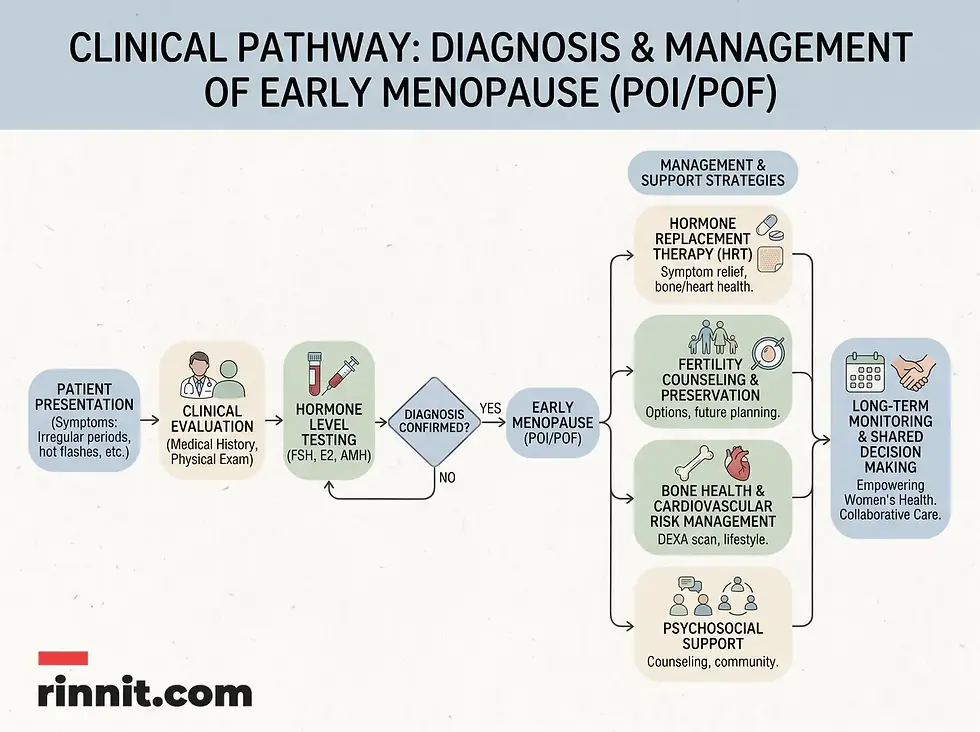
If menopause symptoms appear before age 45, a clinical evaluation is needed. Providers typically do a physical exam, a pelvic ultrasound, and blood tests to measure hormone levels and rule out other conditions, such as thyroid dysfunction. [1]
Menopause itself cannot be reversed, so management focuses on relieving symptoms and protecting long-term health. The primary treatment is hormone replacement therapy (HRT), which replaces the lost hormones. Providers generally recommend continuing HRT until at least age 51, the average age of natural menopause, unless there are specific reasons not to. For people concerned about fertility, options such as in vitro fertilization (IVF) with donor or frozen eggs, surrogacy, or adoption can be explored with a specialist. [1]
Conclusion
Premature and early menopause are significant shifts that arrive earlier than expected. The transition can be hard because symptoms may be stronger and long-term health risks are higher, but early diagnosis and proactive management can greatly improve quality of life. Working closely with your healthcare provider on strategies like HRT is the key step in navigating it well.
Frequently Asked Questions
Can I still get pregnant if I have premature menopause?
Pregnancy is difficult because ovulation is irregular, but it is possible until you have gone 12 consecutive months without a period. [1]
Is premature menopause the same as POI?
No. Primary Ovarian Insufficiency (POI) may be temporary, whereas premature menopause is a permanent cessation of periods. [1]
What is the average age for natural menopause?
The average woman reaches natural menopause around age 51. [1]
Can smoking cause early menopause?
Yes, smoking is the only lifestyle factor known to potentially cause early menopause. [1]
How is early menopause diagnosed?
Early menopause is diagnosed through a physical exam, pelvic ultrasound, and blood tests to check hormone levels. [1]
What is the main treatment for early menopause?
Hormone Replacement Therapy (HRT) is the primary treatment used to replace lost hormones and reduce symptoms. [1]
How long should I stay on HRT?
Healthcare providers typically recommend staying on HRT until age 51, the average age of natural menopause. [1]
Are symptoms worse in early menopause?
Yes, symptoms can often be stronger or more intense when menopause occurs earlier than expected. [1]
Does early menopause increase the risk of heart disease?
Yes, the early loss of estrogen increases the long-term risk of heart disease and osteoporosis. [1]
Can early menopause be reversed?
No, menopause is a permanent biological change and cannot be reversed. [1]
Related Reading
Anti-Müllerian Hormone (AMH) Test: Normal Levels by Age and What Results Mean explains how AMH estimates ovarian reserve and what results mean.
References
Cleveland Clinic. Premature and Early Menopause. Cleveland Clinic Health Library. Accessed October 11, 2026. https://my.clevelandclinic.org/health/diseases/21138-premature-and-early-menopause
Muka T, Oliver-Williams C, Kunutsor S, et al. Association of Age at Onset of Menopause and Time Since Onset of Menopause With Cardiovascular Outcomes, Intermediate Vascular Traits, and All-Cause Mortality: A Systematic Review and Meta-analysis. JAMA Cardiol. 2016;1(7):767-776. PMID: 27627190. https://doi.org/10.1001/jamacardio.2016.2415
Huan L, Deng X, He M, et al. Meta-analysis: Early Age at Natural Menopause and Risk for All-Cause and Cardiovascular Mortality. Biomed Res Int. 2021;2021:6636856. PMID: 33816624. https://doi.org/10.1155/2021/6636856
Vujovic S, Brincat M, Erel T, et al. EMAS position statement: Managing women with premature ovarian failure. Maturitas. 2010;67(1):91-93. PMID: 20605383. https://doi.org/10.1016/j.maturitas.2010.04.011
Medical disclaimer
This article is for informational purposes only and is not a substitute for professional medical advice, diagnosis, or treatment. Always seek the advice of your physician or other qualified health provider with any questions you may have about a medical condition.



Comments