What Is Caroli Disease? Symptoms, Causes, Diagnosis, and Treatment

Updated: 3 days ago
Medically reviewed by Dr. Baraa Alnahhal, MD · Last reviewed: October 17, 2026
Quick Answer: What is Caroli disease?
Caroli disease is a rare genetic liver disorder that causes abnormal widening of the bile ducts inside the liver, affecting about 1 in 1 million people. [4] The widened ducts can be blocked by stones, leading to infection, inflammation and cysts, with symptoms such as jaundice. [4] It is not preventable, but with treatment and monitoring people can live a full lifespan. [4]
Key takeaways
Caroli disease is a rare genetic liver disorder that causes abnormal widening (dilation) of the bile ducts inside your liver. [4]
It affects about 1 in 1 million people, and symptoms typically start by age 30 but can happen at any age. [4]
Widened bile ducts let bile build up, forming small stones that block the ducts and cause infection and inflammation (cholangitis). [4]
There are two types: Caroli disease (only affects the bile ducts) and Caroli syndrome (more severe, also causes liver scarring called fibrosis). [4]
There is no cure, but treatment can manage symptoms and prevent complications, including surgery, antibiotics, bile-flow medication, biliary bypass, or liver transplant. [4]
With proper treatment for cholangitis and regular monitoring, people with Caroli disease can live a full lifespan. [4]
What the research says
Surgery can give long-term control when the disease is confined to part of the liver. A multi-center review of 33 people with congenital widening of the bile ducts inside the liver (including Caroli disease) found the disease was limited to one lobe in 26 of them. Liver resection was performed in 27 patients and transplantation in 5. There were no deaths after surgery, complications occurred in 16 of 32 operated patients (50%), and 27 patients (87%) had a satisfactory late outcome over a median follow-up of 80 months. Six patients (30%) developed recurrent intrahepatic stones. This was a retrospective study of a rare condition (Mabrut et al., Ann Surg, 2007) [1].
Liver transplant works well for advanced disease. Of 78,124 people who received a liver transplant in the United States between 1987 and 2006, 104 had Caroli disease. Patient survival was 86.3% at 1 year, 78.4% at 3 years, and 77% at 5 years (graft survival 79.9%, 72.4%, and 72.4%). The authors concluded that transplant is an excellent option for advanced disease and should be considered in a timely way to prevent refractory cholangitis and bile duct cancer. This was a retrospective registry analysis (Millwala et al., Liver Transpl, 2008) [2].
Bile duct cancer is an uncommon but real risk. In a single-center series of 21 people with Caroli disease or syndrome treated with liver resection (19) or transplantation (2), cholangiocarcinoma was confirmed in four. Surgery carried acceptable complication rates and there was no death over a median follow-up of more than five years, and the authors advise operating early to avoid repeated cholangitis or cancer. These patients were all selected for surgery, so the figures do not apply to everyone with Caroli disease (Fahrner et al., J Visc Surg, 2019) [3].
What Is Caroli Disease?
Caroli disease is a rare genetic liver disorder that causes abnormal widening (dilation) of the bile ducts inside your liver. [4] These bile ducts are tubes that carry a digestive fluid called bile from your liver to your small intestine. When the bile ducts are widened, they can become blocked by bile duct stones, which can lead to infection and inflammation. Cysts can also form. [4]
Bile needs to be able to move through your bile ducts without getting stuck. When the bile ducts become too wide, bile can build up easily. As bile builds up over time, the collection can cause small stones to form. [4]
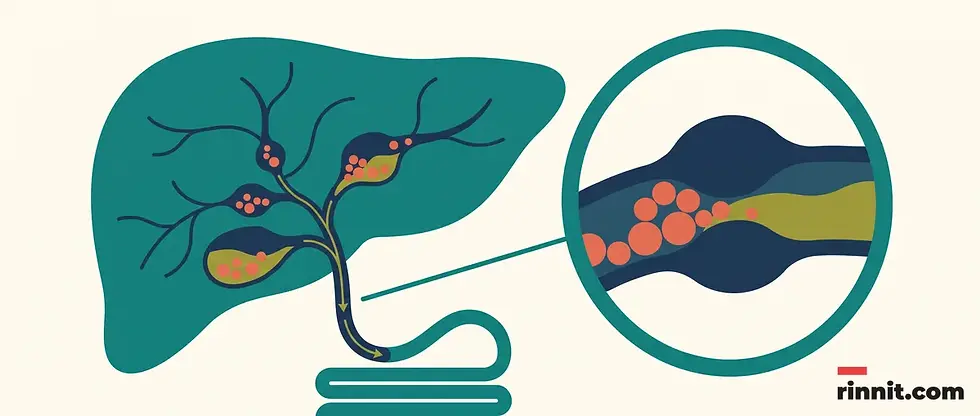
If you have Caroli disease, you may experience many symptoms of the condition over your lifetime. Symptoms typically start by the age of 30 but can happen at any age. [4] You may notice yellowing of your skin and whites of your eyes (jaundice) and begin to develop flu-like symptoms. The condition can take a toll on your health and well-being, but treatment is available to help you manage your symptoms.
Types of Caroli Disease
Type | What It Involves |
Caroli disease | Only affects your bile ducts and doesn't cause any other liver problems |
Caroli syndrome | A more severe type that also causes scarring of your liver (fibrosis) |
How Common Is Caroli Disease?
Caroli disease is a very rare condition, affecting about 1 in 1 million people. [4]
Symptoms of Caroli Disease
Small stones typically don't cause symptoms, but they can block a bile duct and make it swell (cholangitis). [4] This causes the symptoms described below.

Symptom | What It Looks Like |
Right-side pain | Pain on the right side of your body |
Vomiting | Nausea and vomiting |
Fever and chills | Flu-like signs of infection |
Jaundice | Yellowing of your skin and the whites of your eyes |
Itchy skin | Persistent itching |
Rarely, tumors called cholangiocarcinomas can develop in the bile duct due to the collection of bile. [4]
Causes of Caroli Disease
Caroli disease is a genetic condition that usually occurs randomly (sporadically). But there have been reports of it occurring in an autosomal dominant manner in some families. [4]
Cause Factor | Details |
Genetic condition | It is inherited in some families and occurs randomly in others |
Random occurrence | Most cases occur sporadically, with no family history |
Autosomal dominant pattern | Reported in some families, where one parent passes the change to a child |
PKHD1 gene | A mutation in this gene causes Caroli syndrome; it makes a protein that helps build bile ducts and kidneys during fetal development |
A genetic mutation (change) in the PKHD1 gene causes Caroli syndrome. This gene is responsible for making a protein that helps build your bile ducts and kidneys during fetal development. Since Caroli disease is associated with Caroli syndrome, researchers believe the PKHD1 gene may be linked to Caroli disease, as well. But more research is needed. [4]
How Is Caroli Disease Diagnosed?
Your healthcare provider will perform a physical examination and ask you about your symptoms. They may request a comprehensive metabolic panel (CMP), which includes liver enzymes. A certain pattern of enzyme elevation suggests a blocked duct. [4]
Diagnostic Test | What It Checks |
Physical examination | Examines your symptoms and medical history |
Comprehensive metabolic panel (CMP) | Blood test including liver enzymes; a certain pattern suggests a blocked duct |
Abdominal ultrasound | Imaging of the liver and bile ducts |
CT scan | Computed tomography scan for detailed internal images |
MRI scan | Magnetic resonance imaging for internal imaging |
ERCP | An endoscope is passed through your mouth into your stomach so your provider can look at your bile ducts and liver for masses or scars |
MRCP | A special type of MRI that measures how wide your bile ducts are and sees if you have bile duct stones |
In addition to blood work, your provider will request several imaging (radiology) tests, including abdominal ultrasound, CT scan, and MRI scan. [4] Your provider may also request an ERCP (endoscopic retrograde cholangiopancreatography). With this procedure, they pass a small, flexible tube (endoscope) through your mouth and into your stomach. Using ERCP, your provider can look at your bile ducts and liver to see if there are any masses or scars. [4] Your provider may also request an MRCP (magnetic resonance cholangiopancreatography). This special test can measure how wide your bile ducts are and can also see if you have any bile duct stones. [4]
Treatment for Caroli Disease
There's no cure available for Caroli disease, but treatment can help manage the symptoms and prevent complications. [4] You may work with a team of healthcare providers, including a geneticist, gastroenterologist, liver specialist, urologist, nephrologist, radiologist, and transplant surgeon. [4]
Caroli disease treatment depends on where the widened (dilated) bile ducts are located inside of your liver.

Treatment | When It's Used | What It Involves |
Hemi-hepatectomy | When dilated bile ducts are on the left or right half of your liver | Surgical removal of that section of your liver; people typically don't experience future symptoms |
Antibiotics | When widened bile ducts are located throughout your liver | Helps prevent cholangitis (bile duct infection) |
Ursodeoxycholic acid | For certain problems the disease causes | A medication that helps with bile-related problems |
Internal biliary bypass | To help get bile out of your liver | A surgery that reroutes bile flow |
Liver transplant | For more severe cases | Replacing the damaged liver with a healthy one |
If the dilated bile ducts are on the left or right half of your liver, your provider can remove that section of your liver through surgery. This is called a hemi-hepatectomy. People who have part of their liver removed to treat Caroli disease typically don't experience future symptoms. [4]
If the widened bile ducts are located throughout your liver, your provider may treat your condition using antibiotics to help prevent cholangitis. [4] A medication called ursodeoxycholic acid can help with certain problems that Caroli disease causes. [4] Your provider may also perform a surgery called an internal biliary bypass to help get the bile out of your liver. [4] For more severe cases, a liver transplant may be the best treatment option. [2] [4]
Outlook and Prognosis
How Long Is Life Expectancy With Caroli Disease?
Caroli disease itself doesn't directly determine life expectancy. The impact on lifespan comes from potential complications. [4] With proper treatment for cholangitis and regular monitoring for complications, people with Caroli disease can live a full lifespan. [4]
Complication | Why It Matters |
Cholangitis | Acute cholangitis can result from retained stones in the duct. It is a medical emergency that can be fatal within hours to days. |
Bile duct cancer (cholangiocarcinoma) | Chronic inflammation and blocked bile ducts can lead to bile duct cancer. Early detection and treatment are important for better outcomes. |
Liver failure | Prolonged bile duct inflammation can eventually lead to more serious diseases like liver failure. |
Prevention
Caroli disease is a genetic condition, so it's not preventable. [4]
Living With Caroli Disease
When Should I See My Healthcare Provider?
If you develop symptoms of Caroli disease, like pain in your right side, vomiting, fever, and jaundice, see your healthcare provider.
Questions to Ask Your Healthcare Provider
Question | Why It Matters |
What type do I have? | To know if you have Caroli disease or the more severe Caroli syndrome |
How severe is my case? | Based on the imaging results |
What's the recommended treatment plan? | To understand your personalized plan |
Are there medications that can help? | To manage symptoms or prevent complications |
Is surgery a possibility? | And if so, what type of surgery would be necessary |
What are the risks and benefits of surgery? | For your specific case |
What signs of complications should I watch for? | To catch problems early |
Caroli Disease vs. Similar Conditions
Caroli Disease vs. Polycystic Liver Disease
Both polycystic liver disease (PCLD) and Caroli disease affect the bile ducts in your liver, but they have some key differences. PCLD causes multiple cysts to grow throughout your liver. These cysts are abnormal sacs filled with fluid. While Caroli disease may cause cysts, it primarily involves the widening (dilation) of specific bile ducts inside your liver. [4]
Feature | Caroli Disease | Polycystic Liver Disease (PCLD) |
Main feature | Widening (dilation) of specific bile ducts inside the liver | Multiple cysts growing throughout the liver |
Cysts | May occur, but not the main feature | Abnormal fluid-filled sacs are the defining feature |
Affected area | Specific bile ducts | The whole liver |
Caroli Disease vs. Choledochal Cysts
Caroli disease affects the intrahepatic bile ducts, meaning the bile ducts inside your liver. Intrahepatic bile duct cysts are a type of choledochal cyst, and when you have multiple, it's called Caroli disease. So, Caroli disease falls under choledochal cysts. [4]
Conclusion
Caroli disease is a rare genetic liver disorder that causes abnormal widening (dilation) of the bile ducts inside your liver. These bile ducts are the tubes that carry bile, a digestive fluid, from your liver to your small intestine. When the ducts become too wide, bile builds up easily instead of flowing freely, and over time the pooled bile forms small stones. Those stones can block a bile duct and make it swell, causing an infection called cholangitis, along with inflammation throughout the affected area. Cysts can also form.
The condition is very rare, affecting about 1 in 1 million people, and symptoms typically start by age 30, though they can appear at any age. There are two types: Caroli disease, which only affects the bile ducts and doesn't cause other liver problems, and Caroli syndrome, a more severe form that also causes scarring of the liver (fibrosis). The disease is genetic. It usually occurs randomly (sporadically), though some families report an autosomal dominant pattern. A mutation in the PKHD1 gene causes Caroli syndrome; this gene makes a protein that helps build your bile ducts and kidneys during fetal development, and researchers believe it may be linked to Caroli disease as well.
Symptoms include pain on the right side of your body, vomiting, fever and chills, yellowing of your skin and the whites of your eyes (jaundice), and itchy skin. Rarely, tumors called cholangiocarcinomas can develop in the bile duct due to bile collection. Diagnosis involves a physical examination, a comprehensive metabolic panel (CMP) to check liver enzymes, and imaging tests including abdominal ultrasound, CT scan, MRI, ERCP, and MRCP, a special MRI that measures how wide the bile ducts are and detects stones.
There is no cure, but treatment depends on where the widened ducts sit. If they're limited to one half of the liver, surgery to remove that section (hemi-hepatectomy) often prevents future symptoms. If they're spread throughout the liver, antibiotics help prevent cholangitis, ursodeoxycholic acid addresses bile-related problems, and internal biliary bypass surgery helps drain bile. For severe cases, a liver transplant may be the best option. A care team may include a geneticist, gastroenterologist, liver specialist, urologist, nephrologist, radiologist, and transplant surgeon. The most serious complications are acute cholangitis (a medical emergency that can be fatal within hours to days), bile duct cancer, and liver failure. But with proper treatment and regular monitoring, people with Caroli disease can live a full lifespan.
Want to explain health topics like this one visually? Infographics make complex concepts easy for readers of every age. Rinnit's infographic templates help you build clear, patient-friendly visuals for your own audience.
Frequently Asked Questions
What is Caroli disease?
Caroli disease is a rare genetic liver disorder that causes abnormal widening (dilation) of the bile ducts inside your liver. These bile ducts are tubes that carry a digestive fluid called bile from your liver to your small intestine. [4]
What are bile ducts?
Bile ducts are tubes that carry a digestive fluid called bile from your liver to your small intestine. [4]
Why do widened bile ducts cause problems?
Bile needs to be able to move through your bile ducts without getting stuck. When the bile ducts become too wide, bile can build up easily, and over time the collection can cause small stones to form. [4]
What happens when a bile duct gets blocked?
Blocked bile ducts can lead to infection and inflammation. Cysts can also form. [4]
What is cholangitis?
Cholangitis is what happens when a bile duct swells after being blocked. Small stones can block a bile duct and make it swell. [4]
Are small bile duct stones always symptomatic?
No. Although small stones typically don't cause symptoms, they can block a bile duct and cause it to swell. [4]
How rare is Caroli disease?
Caroli disease is a very rare condition, affecting about 1 in 1 million people. [4]
What are the two types of Caroli disease?
The two types are Caroli disease (only affects your bile ducts) and Caroli syndrome (a more severe type that also causes scarring of your liver, called fibrosis). [4]
What is the difference between Caroli disease and Caroli syndrome?
Caroli disease only affects your bile ducts and doesn't cause any other liver problems. Caroli syndrome is a more severe type that also causes scarring of your liver (fibrosis). [4]
When do symptoms of Caroli disease typically start?
Symptoms typically start by the age of 30 but can happen at any age. [4]
What are the symptoms of Caroli disease?
Symptoms include pain on the right side of your body, vomiting, fever and chills, yellowing of your skin and the whites of your eyes (jaundice), and itchy skin. [4]
Does Caroli disease cause jaundice?
Yes. You may notice yellowing of your skin and the whites of your eyes (jaundice). [4]
What does Caroli disease pain feel like?
Caroli disease can cause pain on the right side of your body. [4]
Why does Caroli disease cause fever and chills?
Blocked bile ducts can lead to infection and inflammation (cholangitis), which causes fever and chills. [4]
Can Caroli disease cause tumors?
Rarely, tumors called cholangiocarcinomas can develop in the bile duct due to the collection of bile. [4]
What is cholangiocarcinoma?
Cholangiocarcinoma is a tumor that can develop in the bile duct due to the collection of bile. [4]
Is Caroli disease genetic?
Yes. Caroli disease is a genetic condition that usually occurs randomly (sporadically). But there have been reports of it occurring in an autosomal dominant manner in some families. [4]
What is autosomal dominant inheritance?
Autosomal dominant inheritance means a person needs only one changed copy of a gene, passed down from one parent, to be affected. This pattern has been reported in some families with Caroli disease. [4]
What gene causes Caroli disease?
A genetic mutation (change) in the PKHD1 gene causes Caroli syndrome. Since Caroli disease is associated with Caroli syndrome, researchers believe the PKHD1 gene may be linked to Caroli disease as well, but more research is needed. [4]
What does the PKHD1 gene do?
The PKHD1 gene is responsible for making a protein that helps build your bile ducts and kidneys during fetal development. [4]
How is Caroli disease diagnosed?
Your healthcare provider will perform a physical examination and ask you about your symptoms. They may request a comprehensive metabolic panel (CMP) including liver enzymes, along with several imaging tests. [4]
What is a CMP and how does it help?
A comprehensive metabolic panel (CMP) includes liver enzymes. A certain pattern of enzyme elevation suggests a blocked duct. [4]
What imaging tests are used to diagnose Caroli disease?
Your provider will request an abdominal ultrasound, a CT scan (computed tomography scan), and an MRI scan (magnetic resonance imaging scan). [4]
What is ERCP?
ERCP (endoscopic retrograde cholangiopancreatography) is a procedure where your provider passes a small, flexible tube (endoscope) through your mouth and into your stomach. Using ERCP, your provider can look at your bile ducts and liver to see if there are any masses or scars. [4]
What is MRCP?
MRCP (magnetic resonance cholangiopancreatography) is a special type of MRI that can measure how wide your bile ducts are. It can also see if you have any bile duct stones. [4]
Is there a cure for Caroli disease?
No. There's no cure available for Caroli disease, but treatment can help manage the symptoms and prevent complications. [4]
Can Caroli disease be treated?
Yes. The condition is manageable with treatment, which depends on where the widened bile ducts are located inside your liver. [4]
What is a hemi-hepatectomy?
A hemi-hepatectomy is surgery that removes the section of your liver where the dilated bile ducts are located. If the dilated ducts are on the left or right half of your liver, your provider can remove that section. People who have part of their liver removed typically don't experience future symptoms. [4]
Do people have future symptoms after a hemi-hepatectomy?
People who have part of their liver removed to treat Caroli disease typically don't experience future symptoms. [4]
How is Caroli disease treated when the widened ducts are throughout the liver?
Your provider may use antibiotics to help prevent cholangitis. A medication called ursodeoxycholic acid can help with certain problems the disease causes. [4]
What is ursodeoxycholic acid?
Ursodeoxycholic acid is a medication that can help with certain problems that Caroli disease causes. [4]
What is an internal biliary bypass?
An internal biliary bypass is a surgery that helps get the bile out of your liver. [4]
When is a liver transplant used for Caroli disease?
Who is on the care team for Caroli disease?
You may work with a geneticist, gastroenterologist, liver specialist, urologist, nephrologist, radiologist, and transplant surgeon. [4]
Can Caroli disease be prevented?
No. Caroli disease is a genetic condition, so it's not preventable. [4]
What is the life expectancy with Caroli disease?
Caroli disease itself doesn't directly determine life expectancy. With proper treatment for cholangitis and regular monitoring for complications, people with Caroli disease can live a full lifespan. [4]
Is cholangitis an emergency?
Yes. Acute cholangitis, which can result from retained stones in the duct, is a medical emergency that can be fatal within hours to days. [4]
Can Caroli disease cause bile duct cancer?
Yes. Chronic inflammation and blocked bile ducts can lead to bile duct cancer (cholangiocarcinoma). Early detection and treatment are important for better outcomes. [4]
Can Caroli disease cause liver failure?
Yes. Prolonged bile duct inflammation can eventually lead to more serious diseases like liver failure. [4]
How does Caroli disease affect life expectancy?
The impact on lifespan comes from potential complications like cholangitis, bile duct cancer, and liver failure, not the disease itself. With proper management, a full lifespan is possible. [4]
When should I see my healthcare provider?
If you develop symptoms of Caroli disease, like pain in your right side, vomiting, fever, and jaundice, see your healthcare provider. [4]
What questions should I ask my healthcare provider?
Useful questions include: What type of Caroli disease do I have (Caroli disease or Caroli syndrome)? How severe is my case based on the imaging results? What's the recommended treatment plan? Are there medications that can help manage symptoms or prevent complications? Is surgery a possibility, and what type? What are the risks and benefits of surgery? What are the signs and symptoms of complications I should be aware of? [4]
What is the difference between polycystic liver disease and Caroli disease?
Both affect the bile ducts in your liver, but polycystic liver disease (PCLD) causes multiple cysts to grow throughout your liver, which are abnormal sacs filled with fluid. While Caroli disease may cause cysts, it primarily involves the widening (dilation) of specific bile ducts inside your liver. [4]
Is Caroli disease a type of choledochal cyst?
Yes. Caroli disease affects the intrahepatic bile ducts, meaning the bile ducts inside your liver. Intrahepatic bile duct cysts are a type of choledochal cyst, and when you have multiple, it's called Caroli disease. So, Caroli disease falls under choledochal cysts. [4]
What do intrahepatic bile ducts mean?
Intrahepatic bile ducts are the bile ducts inside your liver, which is the area affected by Caroli disease. [4]
Related Reading
References
Mabrut JY, Partensky C, Jaeck D, et al. Congenital intrahepatic bile duct dilatation is a potentially curable disease: long-term results of a multi-institutional study. Ann Surg. 2007;246(2):236-245. PMID: 17667502. https://doi.org/10.1097/SLA.0b013e3180f61abf
Millwala F, Segev DL, Thuluvath PJ. Caroli's disease and outcomes after liver transplantation. Liver Transpl. 2008;14(1):11-17. PMID: 18161799. https://doi.org/10.1002/lt.21366
Fahrner R, Dennler SGC, Dondorf F, et al. Liver resection and transplantation in Caroli disease and syndrome. J Visc Surg. 2019;156(2):91-95. PMID: 29929811. https://doi.org/10.1016/j.jviscsurg.2018.06.001
Cleveland Clinic. Caroli Disease. Cleveland Clinic Health Library. Last updated June 24, 2024. https://my.clevelandclinic.org/health/diseases/caroli-disease
Medical disclaimer
This article is for informational purposes only and is not a substitute for professional medical advice, diagnosis, or treatment. Always seek the advice of a qualified healthcare provider with any questions about a medical condition. Never disregard professional medical advice or delay seeking it because of something you have read here. Call emergency services right away if you have symptoms of acute cholangitis, which can be fatal within hours to days.



Comments