Valgus and Varus Stress Tests: Checking Knee and Elbow Ligaments

Updated: 2 days ago
Written and medically reviewed by Dr. Baraa Alnahhal, MD · Last reviewed: November 2026 · How we review
Quick Answer
Valgus and varus stress tests are hands-on exams that check the collateral ligaments on the sides of the knee or elbow. A valgus test pushes the joint inward to check the medial collateral ligament (MCL); a varus test pushes it outward to check the lateral collateral ligament (LCL). A positive result usually leads to imaging such as MRI.
What the research says
The knee valgus test adds real diagnostic value: in 134 adults with a recent knee injury seen in general practice, pain or looseness on valgus stress at 30 degrees of knee bend was linked to MCL injury on MRI, and combining these findings with the injury history raised the positive likelihood ratio to 6.4 (Kastelein M et al., American Journal of Medicine, 2008) [2]
An elbow version is highly sensitive: in 21 people having surgery for inner elbow pain, a moving valgus stress test reproduced the pain in all 17 with an elbow MCL problem (100% sensitivity) and had 75% specificity compared with surgical findings (O'Driscoll SW et al., American Journal of Sports Medicine, 2005) [3]
Key takeaways
Physical exams that check the collateral ligaments of the knee and elbow.
Valgus tests check the inner (medial) ligament; varus tests check the outer (lateral) ligament.
Done in the office with no preparation or equipment.
A positive result suggests a sprain or tear.
A negative result doesn't fully rule out injury, so imaging may still be needed.
What are the collateral ligaments?

Valgus checks the MCL; varus checks the LCL.
Collateral ligaments are strong bands on each side of a joint that stop it from bending sideways. In the knee, the MCL runs along the inner side and the LCL along the outer side. In the elbow, the inner ligament is often called the UCL, which is commonly injured in throwing athletes. Learn more about knee ligaments. Sources: [1]
Test | Direction of pressure | Ligament checked |
Valgus stress test | Inward, toward the body | Medial collateral ligament (MCL) |
Varus stress test | Outward, away from the body | Lateral collateral ligament (LCL) |
The tests are mainly used on the knees and elbows, and less often on the wrists and ankles. Sources: [1]
Why are they done?
They're usually part of the first exam for knee or elbow pain or an injury. Signs of a collateral ligament injury include: Sources: [1]
Pain and swelling.
Bruising or discoloration.
A popping or snapping sound at the time of injury.
A loose or unstable feeling in the joint.
Weakness, trouble bearing weight or trouble moving the elbow. Sources: [1]
How are the tests done?

The tests take only a few minutes.
You lie on your back and relax your arm or leg.
Your provider lifts the limb slightly and holds it above and below the joint.
They apply light pressure just above the knee or elbow, inward for a valgus test or outward for a varus test.
The knee may be tested both straight and slightly bent.
Your provider asks about pain and feels for looseness or popping. Sources: [1]
No preparation is needed. The tests have no risks; you may feel mild discomfort, but they shouldn't cause intense pain. Sources: [1]
Understanding your results
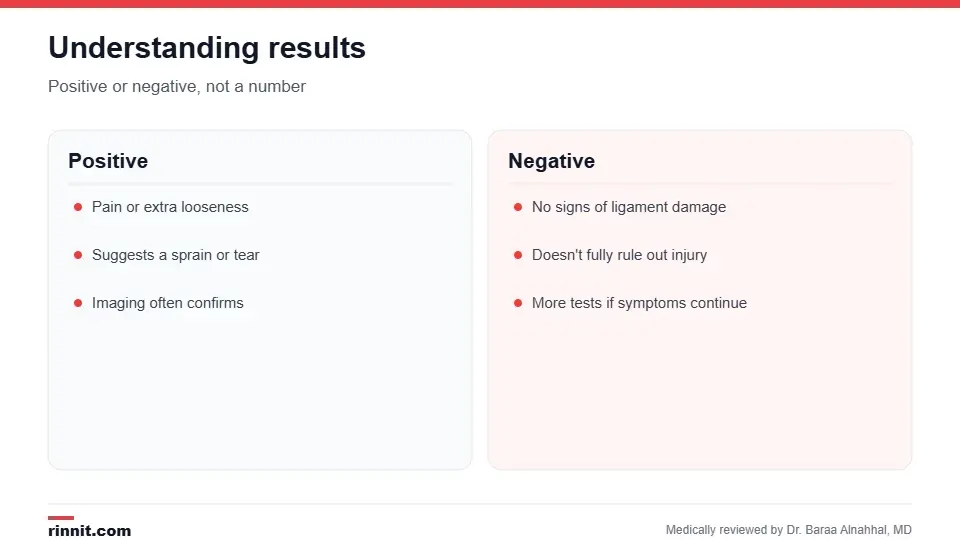
Imaging often confirms the findings.
Positive: your provider found signs of a damaged collateral ligament, such as pain or extra looseness.
Negative: no signs were found, but a ligament can still be injured, or another injury may be present. Sources: [1, 2, 3]
To confirm the diagnosis, your provider may order an X-ray, MRI or ultrasound. Sometimes knee arthroscopy is used to look inside and repair the joint. Sources: [1]
When to get care
See a provider soon after a knee or elbow injury, or if pain or swelling gets worse after a few days. Go to the emergency room for extreme pain, rapidly worsening swelling, discoloration, or if you can't move your knee or elbow. Sources: [1]
Conclusion
Valgus and varus stress tests are simple, safe first steps in finding knee and elbow ligament injuries. They guide which imaging you need and how your injury is treated.
Keep learning: read about MCL tears and Tommy John surgery.
Frequently asked questions
What is a valgus stress test?
An exam that pushes the joint inward to check the inner (medial) collateral ligament.
What is a varus stress test?
An exam that pushes the joint outward to check the outer (lateral) collateral ligament.
Which joints are tested?
Mainly the knees and elbows.
Does it hurt?
It may feel mildly uncomfortable but shouldn't be very painful.
Do I need to prepare?
No preparation is needed.
Are there risks?
No. The tests don't harm the joint.
What does a positive result mean?
There are signs of a collateral ligament sprain or tear.
Can a negative test miss an injury?
Yes. Imaging may still be needed.
What tests come next?
Often an X-ray, MRI or ultrasound.
Why is the knee tested bent and straight?
Testing in both positions helps judge which structures are injured.
Related Reading
Spurling Test: Checking for a Pinched Nerve in the Neck explains the neck exam test for a pinched nerve.
Understanding MCL Tears: Symptoms, Recovery, and Knee Health the ligament checked by the knee valgus test.
LCL Tears: Causes, Symptoms, and Recovery Guide the ligament checked by the knee varus test.
Knee Ligaments: Anatomy, Function, and Injury Prevention how the knee ligaments work.
UCL Injury (Tommy John): Symptoms, Treatment, and Recovery Guide the elbow ligament checked by the valgus test.
Tommy John Surgery (UCL Reconstruction): Procedure, Risks, and Recovery Timeline surgery for a torn elbow UCL.
References
Cleveland Clinic. Valgus and Varus Stress Tests. Cleveland Clinic. Last updated July 20, 2023. https://my.clevelandclinic.org/health/diagnostics/25145-valgus-and-varus-stress-tests
Kastelein M, Wagemakers HP, Luijsterburg PA, et al. Assessing medial collateral ligament knee lesions in general practice. Am J Med. 2008;121(11):982-988.e2. PMID 18954845. https://doi.org/10.1016/j.amjmed.2008.05.041
O'Driscoll SW, Lawton RL, Smith AM. The "moving valgus stress test" for medial collateral ligament tears of the elbow. Am J Sports Med. 2005;33(2):231-239. PMID 15701609. https://doi.org/10.1177/0363546504267804
Medical disclaimer
This article is for general education only and does not replace advice from a qualified healthcare professional. Talk to your doctor about your own diagnosis and treatment, and seek emergency care right away for severe or sudden symptoms.



Comments