Spurling Test: Checking for a Pinched Nerve in the Neck

Updated: 2 days ago
Written and medically reviewed by Dr. Baraa Alnahhal, MD · Last reviewed: November 2026 · How we review
Quick Answer
The Spurling test is a quick physical exam that helps diagnose cervical radiculopathy, a pinched nerve in the neck. The provider tilts your head toward the side of your symptoms and presses lightly on top. Pain, numbness or tingling that travels into the shoulder or arm means a positive test. A negative test doesn't fully rule it out.
What the research says
A positive test is a strong clue: a systematic review of neck provocation tests found the Spurling test has low to moderate sensitivity but high specificity for cervical radiculopathy, so a positive result is meaningful (Rubinstein SM et al., European Spine Journal, 2007) [2]
Specificity is high across studies: a later review of 5 diagnostic studies found the Spurling test's specificity ranged from 89% to 100%, while sensitivity varied widely from 38% to 97% (Thoomes EJ et al., The Spine Journal, 2018) [3]
Key takeaways
The Spurling test checks for a pinched nerve in the neck.
The provider tilts and turns your head and presses gently on top.
Pain shooting into the arm is a positive result.
A positive test strongly suggests nerve compression; a negative one doesn't fully rule it out.
It's not used if the neck may be unstable or injured.
What is cervical radiculopathy?
Nerves leave the spinal cord through small openings between the neck bones. A herniated disc or bone spur can narrow an opening and press on a nerve root, causing pain, numbness, tingling or weakness that spreads down the arm. The Spurling test briefly narrows these openings further; if a nerve is already squeezed, symptoms flare. Sources: [1]
Why it's done
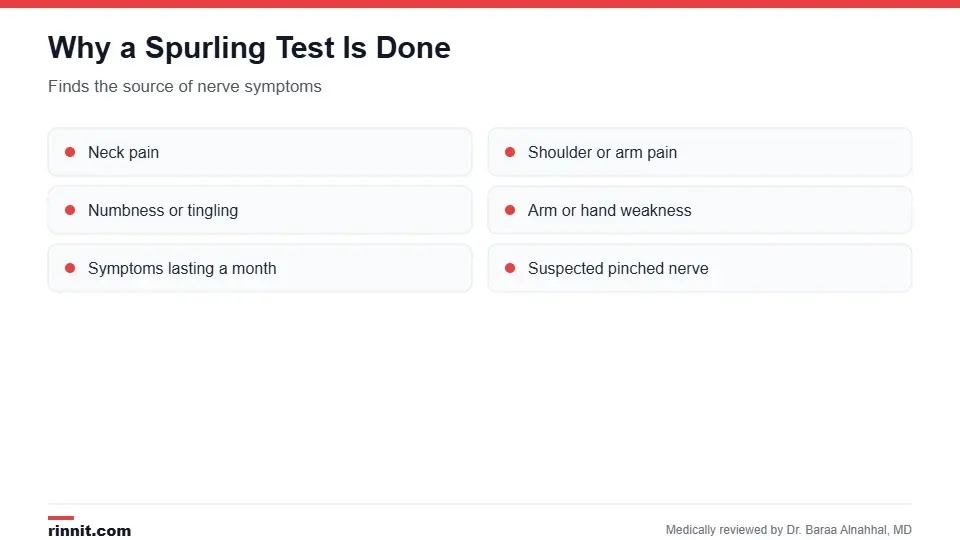
The test helps find the source of nerve symptoms.
Neck, shoulder or arm pain lasting at least a month.
Numbness or tingling in the arm or hand.
Weakness in the arm or hand. Sources: [1]
Other tests may be used instead if you have neck instability, spinal cord compression, a recent neck injury, rheumatoid arthritis or cancer in the spine. Sources: [1]
How to prepare
No special preparation is needed.
Wear loose clothing around your neck and avoid turtlenecks, scarves or heavy jewelry.
Your provider will first review your history and do a physical exam. Sources: [1]
How the test is done

The test takes only a few minutes.
You sit or stand still.
Your provider gently places their hands on your head.
They slowly tilt and turn your head toward the side with symptoms.
They press lightly down on the top of your head.
You raise a hand if you feel pain, and your provider stops or changes the movement. Sources: [1]
Risks
The test may briefly cause pain, numbness or weakness. Very rarely, it could cause lasting nerve injury, which is why it isn't done when the neck might be unstable. Sources: [1]
What the results mean

Results are known at the same visit.
Result | What happens | What it suggests |
Positive | Pain, tingling or numbness spreads into the shoulder or arm | Likely nerve root compression; MRI or CT may confirm |
Negative | No symptoms | Cervical radiculopathy is less likely, but more testing may be needed |
If radiculopathy is confirmed, treatment may include medicines, rest and activity changes, physical therapy or, in some cases, surgery. Nerve tests such as EMG may also help. Sources: [1, 2, 3]
Conclusion
The Spurling test is a fast, simple way to check whether neck and arm symptoms come from a pinched nerve. A positive result is a strong clue, and imaging can confirm the cause so treatment can begin.
Keep learning: read about EMG and nerve pain.
Frequently asked questions
What does the Spurling test check for?
A pinched nerve in the neck (cervical radiculopathy).
What is a positive Spurling test?
Pain or tingling that spreads into your arm during the test.
Does the Spurling test hurt?
It may briefly recreate your symptoms.
How long does it take?
A few minutes.
Do I need to prepare?
No. Wear loose clothing around your neck.
Is the Spurling test accurate?
A positive result is very specific, but a negative one doesn't rule out a pinched nerve.
What happens after a positive test?
An MRI or CT scan may confirm the cause.
Who shouldn't have the test?
People with a possibly unstable or injured neck.
What is another name for it?
The foraminal compression test.
How is a pinched nerve treated?
With medicines, physical therapy, activity changes or sometimes surgery.
Related Reading
EMG (Electromyography): What It Tests, What to Expect and Results a nerve test for pinched nerves.
Neuropathic Pain: Symptoms, Causes, and Relief Strategies nerve pain and how it's treated.
Valgus and Varus Stress Tests: Checking Knee and Elbow Ligaments other physical exam tests.
Patellar Grind Test (Clarke's Sign): Checking Kneecap Pain another hands-on exam test.
References
Cleveland Clinic. Spurling Test: What It Is, Procedure & Positive Results. Cleveland Clinic. Last updated July 8, 2024. https://my.clevelandclinic.org/health/diagnostics/spurling-test
Rubinstein SM, Pool JJ, van Tulder MW, et al. A systematic review of the diagnostic accuracy of provocative tests of the neck for diagnosing cervical radiculopathy. European Spine Journal. 2007;16(3):307-319. PMID 17013656. https://doi.org/10.1007/s00586-006-0225-6
Thoomes EJ, van Geest S, van der Windt DA, et al. Value of physical tests in diagnosing cervical radiculopathy: a systematic review. The Spine Journal. 2018;18(1):179-189. PMID 28838857. https://doi.org/10.1016/j.spinee.2017.08.241
Medical disclaimer
This article is for general education only and does not replace advice from a qualified healthcare professional. Talk to your doctor about your own diagnosis and treatment, and seek emergency care right away for severe or sudden symptoms.



Comments