UCL Injury (Tommy John): Symptoms, Treatment, and Recovery Guide

Updated: 2 days ago
Medically reviewed by Dr. Baraa Alnahhal, MD · Last reviewed: October 2026
Quick Answer
A UCL injury is damage to the ulnar collateral ligament, a strong band of tissue on the inner side of the elbow, from repetitive stress or sudden trauma. It ranges from a stretch to a complete tear. Symptoms include inner elbow pain, reduced throwing power and instability. Severe tears in athletes may require Tommy John surgery. [1]

What the research says
Most athletes who skip surgery return to sport. A meta-analysis of 15 studies covering 365 athletes (mean age about 20) found an overall return-to-sport rate of 79.7% after nonoperative treatment, and 77.9% returned to their previous level of play. Higher injury grades were linked to lower return rates, and proximal tears did far better than distal tears (89.7% vs 41.2%). Adding platelet-rich plasma (PRP) injections made no significant difference (Gopinatth et al., American Journal of Sports Medicine, 2023). [3]
Tommy John surgery works well, and the type of graft does not change the odds. A systematic review of 6 studies with 2,154 elbows found that, on average, 84.1% of athletes returned to sport and 79.0% returned to the same level after UCL reconstruction. There was no significant difference between palmaris and hamstring tendon grafts (odds ratio 1.06, 95% CI 0.77 to 1.46), and the combined complication rate was 18.2% (Trofa et al., Orthopaedic Journal of Sports Medicine, 2021). [4]
Pain is the main reason some athletes do not return after surgery. A meta-analysis of 26 studies with 1,019 athletes estimated that 11.4% did not return to sport after UCL surgery. Persistent pain was the most common reason, accounting for 28.2% of those who failed to return (Fathi et al., Orthopaedic Journal of Sports Medicine, 2022). [2]
Key Takeaways
Feature | Details |
Medical Name | Ulnar Collateral Ligament (UCL) Injury |
Common Nickname | Tommy John Injury |
Primary Cause | Repetitive overhead throwing or overuse |
Defining Symptom | Inner elbow pain and instability |
Grades of Injury | Grade 1 (Stretched), Grade 2 (Partial Tear), Grade 3 (Full Tear) |
Diagnosis | Physical exam, Valgus Stress Test, and MRI/Arthrogram |
Treatment | PRICEMM protocol, PRP injections, or surgery |
Recovery Time | Weeks to months (nonsurgical); about 1 year (surgical) |
What is a UCL injury (Tommy John injury)?
The ulnar collateral ligament (UCL) is a critical stabilizer of the elbow joint, located on the inner (medial) side of the arm, near the pinky finger. Its primary role is to provide support during strenuous overhead arm movements, such as throwing a ball. Because of this, UCL injuries are most prevalent in sports like baseball, javelin, and volleyball.
The condition is widely known as a "Tommy John" injury, named after the Major League Baseball pitcher who was the first to successfully return to professional play after a pioneering ligament reconstruction surgery in 1974. While it is synonymous with elite athletes, anyone who performs repetitive overhead motions or experiences a significant fall on an outstretched arm can suffer from a UCL injury.
What are the symptoms and severity grades of a UCL injury?
UCL injuries are graded from 1 to 3, ranging from a stretched ligament to a complete tear, and symptoms vary with the severity of the damage. [1]
Recognizing the Grades of Injury
Healthcare providers categorize UCL damage into three distinct grades based on the extent of the ligament damage.
In rare and severe cases, a Grade 3 tear may involve an avulsion fracture, where the ligament pulls a small fragment of bone away from its attachment point. [1]
Common Signs to Watch For
The symptoms of a UCL injury vary depending on the severity of the damage. For mild to moderate injuries, patients often notice a gradual decline in performance.
Symptom Type | Common Indicators |
Performance | Decreased throwing speed, accuracy, or power. |
Pain & Tenderness | Sharp or dull ache on the inner elbow during or after activity. |
Instability | A feeling that the elbow is "loose" or weak. |
Severe Indicators | A sudden "pop" followed by intense pain and inability to throw. |
Neurological | Tingling or numbness in the pinky and ring fingers. |

What causes UCL injuries, and who is at risk?
Repetitive stress is the leading cause of UCL injuries. The act of throwing puts immense tension on the inner elbow, which can lead to microscopic tears that eventually weaken the ligament. [1]
Overuse: Repeatedly performing high-velocity overhead throws without adequate rest.
Traumatic Injury: A sudden fall on an outstretched arm (FOOSH) can force the elbow joint into an unnatural position, tearing the UCL. [1]
Joint Trauma: Elbow dislocations or fractures can simultaneously damage the surrounding ligaments. [1]
Improper Technique: Poor mechanics during sports can place unnecessary strain on the medial elbow structures.
How is a UCL injury diagnosed, and what clinical tests are used?
If a UCL injury is suspected, a specialist, typically an orthopedic or sports medicine physician, will perform a comprehensive evaluation.
Physical Examination: The doctor will assess the elbow's range of motion, strength, and overall stability. [1]
Valgus Stress Test: A specific maneuver where the physician applies outward pressure to the elbow to see if the joint opens up excessively, indicating a loose or torn ligament. [1]
Imaging Studies: X-rays are used to rule out bone issues, while an MRI or an arthrogram (an MRI with contrast dye injected into the joint) provides a detailed view of the soft tissues.
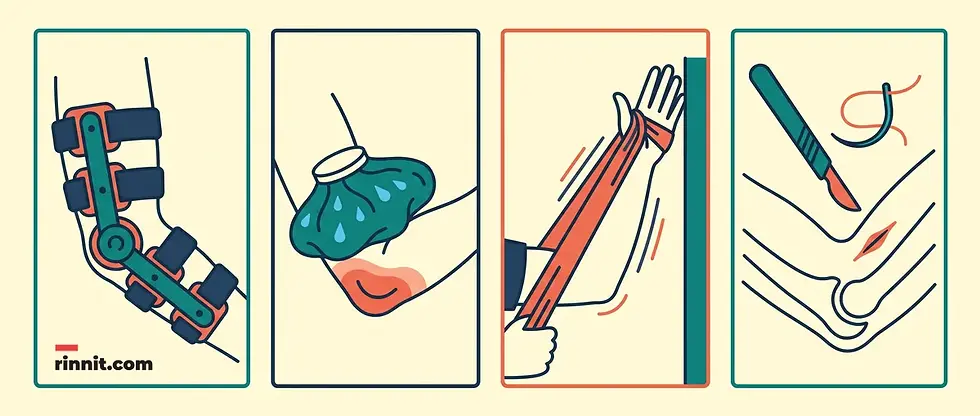
What are the treatment and recovery options for a UCL injury?
The choice of treatment depends heavily on the grade of the injury and the patient's lifestyle goals.
Nonsurgical Management (PRICEMM)
For most Grade 1 and many Grade 2 injuries, a conservative approach is successful. The PRICEMM protocol is often recommended:
Protection: Using a hinged-elbow brace to stabilize the joint. [1]
Rest: Avoiding all overhead activities for a set period. [1]
Ice: Applying cold packs to manage inflammation and pain. [1]
Compression: Using an elastic wrap to help limit swelling.
Elevation: Keeping the arm raised above heart level to help reduce swelling.
Medication: Utilizing NSAIDs like ibuprofen to reduce swelling. [1]
Modalities: Engaging in physical therapy to strengthen the forearm and shoulder muscles, which take pressure off the UCL. [1]
Advanced and Surgical Treatments
If conservative measures fail or the tear is complete (Grade 3), more intensive options are considered.
PRP Injections: Platelet-rich plasma therapy uses the patient's own blood to stimulate healing in the ligament. [1]
UCL Direct Repair: A surgical procedure to reattach the original ligament to the bone. [1]
Tommy John Surgery: A reconstruction where a healthy tendon from another part of the body (or a donor) is used to replace the damaged UCL. [1]
How can UCL injuries be prevented?
Preventing a UCL injury is largely a matter of workload management and proper conditioning. Athletes should adhere to pitch counts and mandatory rest periods. Strengthening the muscles surrounding the elbow and maintaining proper throwing mechanics are also essential for long-term joint health. [1]
Conclusion
A UCL injury can be a significant setback, but with modern diagnostic tools and treatment options, most individuals can return to their daily activities and sports. Whether through conservative care or surgical reconstruction, the goal is to restore stability and function to the elbow.
Frequently Asked Questions
What exactly is the UCL?
The ulnar collateral ligament is a band of tissue on the inner side of the elbow that connects the humerus (upper arm bone) to the ulna (forearm bone).
Can I have a UCL injury if I don't play baseball?
Yes. Any repetitive overhead motion, such as in tennis, javelin, or even certain construction jobs, can cause a UCL injury.
Does every UCL tear require Tommy John surgery?
No. Many partial tears (Grade 1 and 2) can heal with rest, physical therapy, and sometimes PRP injections.
What does a UCL "pop" feel like?
It is often described as a sudden, sharp snap on the inside of the elbow, usually followed by immediate pain and weakness.
How long is the recovery after Tommy John surgery?
For competitive athletes, the recovery process typically takes about 12 months to return to full competition.
Is a UCL injury the same as "Tennis Elbow"?
No. Tennis elbow affects the outer side of the elbow, while a UCL injury affects the inner side.
Can children get UCL injuries?
Yes, especially young pitchers who throw too many innings or use improper mechanics.
What is PRP therapy?
Platelet-rich plasma therapy involves injecting a concentrated dose of the patient's own platelets into the injured area to speed up healing.
Why is it called Tommy John surgery?
It is named after the first professional baseball player to undergo the procedure and successfully return to pitching.
Can I still lift weights with a UCL injury?
You should avoid any exercises that put stress on the inner elbow until cleared by a doctor or physical therapist.
What is the Valgus Stress Test?
It is a physical exam maneuver where a doctor checks for joint laxity by applying pressure to the side of the elbow.
Does an MRI always show a UCL tear?
While very accurate, sometimes an arthrogram (MRI with dye) is needed to see smaller, hidden tears.
Can a UCL injury cause numbness?
Yes, a severe injury can irritate the ulnar nerve, leading to tingling in the pinky and ring fingers.
What is a "FOOSH" injury?
It stands for "Fall On an OutStretched Hand," which is a common way to traumatically tear the UCL.
Are there different types of Tommy John surgery?
Surgeons may use different techniques and graft sources (like the palmaris longus tendon) depending on the patient's needs.
How do I know if my inner elbow pain is serious?
If you feel instability, hear a pop, or have persistent pain that prevents overhead movement, you should see a specialist.
Can physical therapy fix a torn UCL?
It can help Grade 1 and 2 tears heal and strengthen the surrounding muscles to support the joint.
What are pitch counts?
They are limits on the number of balls a pitcher throws in a game to prevent overuse injuries like UCL tears.
Can I prevent a UCL injury with stretching?
Stretching can help, but overall conditioning, strengthening the forearm and shoulder, good throwing technique, and rest are what best protect the ligament.
Is the surgery painful?
Like any surgery, there is post-operative discomfort, but it is managed with medication and a structured rehabilitation plan.
Can a UCL injury heal on its own?
Mild stretches can heal with rest, but complete tears usually require surgical intervention for full stability.
What is an avulsion fracture?
It is when the ligament is pulled so hard that it breaks off a small piece of the bone it is attached to.
How common are UCL injuries?
They are very common in overhead athletes but relatively rare in the general population.
What is a hinged-elbow brace?
It is a brace that allows the elbow to move up and down but prevents it from moving side-to-side, protecting the UCL.
Can I drive with a UCL injury?
Usually, yes, but you may need to avoid using the affected arm for steering if the injury is acute or severe.
Does icing help a UCL tear?
Ice helps reduce the initial swelling and pain but does not "fix" the tear itself.
What is the success rate of Tommy John surgery?
The success rate is generally high. A systematic review found that on average about 84% of athletes returned to sport after UCL reconstruction and about 79% returned to their previous level of play.
Can I re-tear my UCL after surgery?
Yes, it is possible to re-injure the reconstructed ligament if overuse continues.
What is a "partial tear"?
It means some fibers of the ligament are torn, but the ligament is still partially attached.
How do I find a UCL specialist?
Look for orthopedic surgeons who specialize in sports medicine or upper extremity (hand and elbow) care.
What is an arthrogram?
It is a diagnostic test where a contrast liquid is injected into the joint before an MRI to make tears easier to see.
Can poor posture cause UCL issues?
Poor posture is not a direct cause, but poor shoulder and throwing mechanics can increase stress on the elbow during throwing.
Is there an age limit for Tommy John surgery?
There is no strict age limit, but the decision is based on the patient's health and activity goals.
Can a UCL injury affect my grip strength?
Yes, many patients notice a significant decrease in their ability to squeeze or hold objects.
What is the "medial" side of the elbow?
It is the side of the elbow closest to your body when your palm is facing forward.
Can I use ibuprofen for the pain?
Yes, NSAIDs are commonly used to manage the inflammation associated with UCL injuries.
How long do I need to wear a brace?
This varies, but most patients wear a protective brace for several weeks following an injury or surgery.
Can I play golf with a UCL injury?
Golf can put stress on the inner elbow, so you should consult your doctor before returning to the course.
What is a "graft" in surgery?
A graft is a piece of healthy tissue (tendon) taken from elsewhere to replace the damaged ligament.
Does the surgery leave a large scar?
Modern techniques use relatively small incisions, but a scar on the inner elbow is typical.
Can a UCL injury cause permanent damage?
If left untreated, a complete tear can lead to chronic instability and early-onset arthritis in the elbow.
What is the "Tommy John" rehabilitation timeline?
It usually involves months of range-of-motion work, followed by strengthening, and finally a throwing program.
Can I get a UCL injury from a car accident?
Yes, any high-impact trauma to the arm can result in a ligament tear.
Is the surgery done as an outpatient?
Most UCL repairs and reconstructions are performed as outpatient procedures, meaning you go home the same day.
What is the difference between a ligament and a tendon?
Ligaments connect bone to bone (like the UCL), while tendons connect muscle to bone.
Can I return to work with a UCL injury?
If your job doesn't involve heavy lifting or overhead reaching, you can usually return quickly.
Does smoking affect UCL healing?
Yes, smoking impairs blood flow and can significantly slow down the healing of ligaments and tendons.
What is "Little League Elbow"?
It is a related overuse injury in young athletes that affects the growth plates in the elbow.
Can a UCL injury be seen on an X-ray?
Usually no, as X-rays only show bones. An MRI is needed to see the ligament.
Should I get a second opinion for surgery?
It is always a good idea to consult with a specialist who has extensive experience in elbow reconstruction.
Related Reading
Learn more in our guide to Elbow Surgery: Types, Procedure, Risks and Recovery.
Valgus and Varus Stress Tests: Checking Knee and Elbow Ligaments explains the exams used to check the knee and elbow collateral ligaments.
References
Cleveland Clinic. UCL (Tommy John) Injury: What It Is, Symptoms & Treatment. Cleveland Clinic Health Library. Last updated June 19, 2025. https://my.clevelandclinic.org/health/diseases/22760-ulnar-collateral-ligament-ucl-injuries
Fathi A, Haratian A, Treloar J, et al. Pain is the most frequently cited reason athletes fail to return to sport after ulnar collateral ligament surgery: a systematic review and meta-analysis. Orthop J Sports Med. 2022;10(10):23259671221128257. PMID 36313005. https://doi.org/10.1177/23259671221128257
Gopinatth V, Batra AK, Khan ZA, et al. Return to sport after nonoperative management of elbow ulnar collateral ligament injuries: a systematic review and meta-analysis. Am J Sports Med. 2023;51(14):3858-3869. PMID 36876746. https://doi.org/10.1177/03635465221150507
Trofa DP, Constant M, Crutchfield CR, et al. Return-to-sport outcomes after primary ulnar collateral ligament reconstruction with palmaris versus hamstring tendon grafts: a systematic review. Orthop J Sports Med. 2021;9(12):23259671211055726. PMID 34881347. https://doi.org/10.1177/23259671211055726
Disclaimer
This article is for informational purposes only and does not constitute medical advice. Always seek the advice of your physician or other qualified health provider with any questions you may have regarding a medical condition.



Comments