Turbinate Reduction: Procedure, Recovery, Risks and Success Rate

Updated: 6 days ago
Written and medically reviewed by Dr. Baraa Alnahhal, MD · Last reviewed: October 2026 · How we review
Quick Answer: What is turbinate reduction?
Turbinate reduction is a same-day surgery that shrinks or removes swollen tissue on the turbinates, small bony structures inside the nose, to improve airflow in people with chronic nasal congestion. It is usually considered when steroid sprays or antihistamines fail. Most people return to routine within a day to a week, and the success rate is about 82%. [1][3]
What the research says
Some techniques bleed less than others. In a study of 751 patients, 7.5% returned to the emergency room with bleeding after turbinate surgery: 8.4% after partial turbinectomy, 10.7% after submucosal reduction and 3.0% after endoscopic turbinoplasty, which also had the lowest need for a procedure to stop bleeding. (Levy et al., J Laryngol Otol, 2022) [4]
Adding turbinate reduction to septoplasty may not add benefit for everyone. In a randomized trial of 74 patients, septoplasty with radiofrequency turbinate reduction and septoplasty alone both improved airflow and symptom scores at three months, with no significant difference between the groups. (Seden et al., J Laryngol Otol, 2022) [5]
What are turbinates, and why do they swell?
Turbinates are small bony structures inside the nose that clean, warm and humidify the air you breathe before it reaches your lungs. [2][3]
They can swell when the nose is irritated, during allergies, or with an infection. This swelling is usually temporary. [1]
In some people, though, the swelling never fully goes down. Doctors call this chronic swelling turbinate hypertrophy. The enlarged tissue narrows the airway and causes nasal congestion that does not clear. [1]

Swollen inferior turbinates narrow the lower airway and block airflow.
Who needs turbinate reduction surgery?
Turbinate reduction is for people whose chronic nasal blockage has not improved with medication. [1]
Before surgery, your doctor will:
Examine your nose during a physical exam.
Look inside with a nasal endoscope, a thin camera, if needed.
Try medicine first, usually steroid nasal sprays, antihistamines, or both.
Surgery is usually considered when nasal obstruction causes:
Ongoing congestion
Post-nasal drip
Sleep apnea or other breathing problems during sleep
Turbinate reduction is a common procedure. It can be done on its own or together with septoplasty to straighten a deviated septum, or rhinoplasty to reshape the nose or fix breathing problems. When both sides of the nose are treated, it is called bilateral turbinate reduction. [1]
How is turbinate reduction performed?
Turbinate reduction is performed by an ENT (ear, nose and throat) surgeon as a same-day procedure in a hospital, surgery center or outpatient clinic. Most people receive general anesthesia, though some need only local anesthesia. [1]
The surgeon reduces the excess tissue around the turbinates using one of five main techniques.
Turbinate reduction techniques at a glance
Technique | How it works | Removes bone? |
Cauterization | A heated probe closes some blood vessels, reducing blood flow so the tissue shrinks | No |
Radiofrequency reduction | A thin probe delivers heat that forms scar tissue, which shrinks the turbinate | No |
Coblation (controlled ablation) | Heat energy like radiofrequency, but at a lower temperature to protect nearby tissue | No |
Microdebrider submucosal resection | Tissue is removed through a small opening; the outer lining stays in place and the turbinate shrinks as it heals | No |
Partial resection | A small piece of turbinate is removed, including soft and hard tissue | Yes |
Partial resection is the only one of these methods that removes bone. [1]
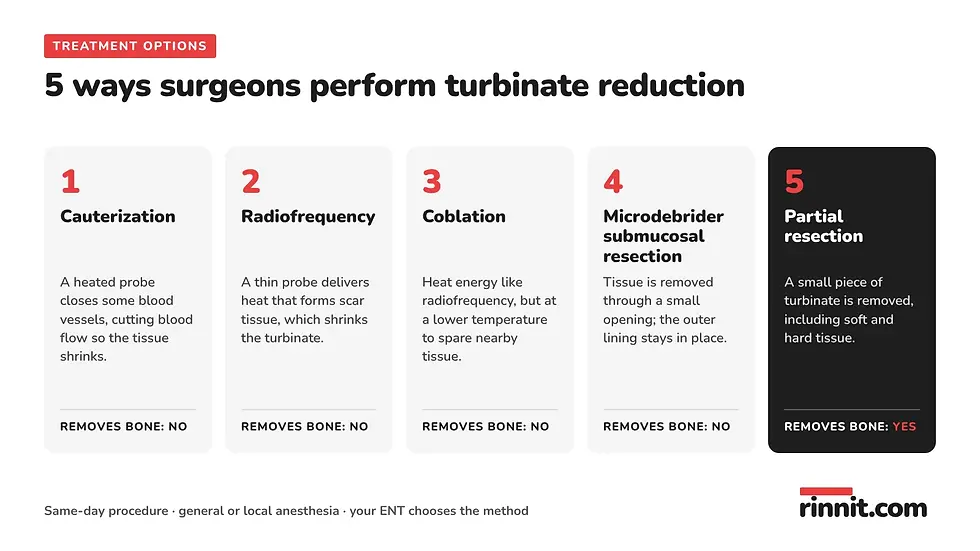
Five techniques surgeons use to shrink or remove swollen turbinate tissue.
Does turbinate reduction hurt?
Turbinate reduction usually causes only mild discomfort that lasts a few days. [1]
Pain may be stronger if turbinate reduction is combined with another nose surgery. Take any pain medicine exactly as prescribed. [1]
Crusting is normal. Discharge can dry into crusts inside the nose while it heals, and this may last up to three weeks. To ease it, your provider may suggest: [1]
Saline nasal spray
A cool-mist humidifier
Petroleum jelly applied around the nose
You will get detailed aftercare instructions before you go home. Some people also find nasal irrigation helpful, but ask your surgeon before rinsing after surgery.
What are the benefits and risks of turbinate reduction?
Turbinate reduction opens the nasal airway and improves breathing, with an overall success rate of about 82%. [1]
Benefits | Possible risks |
Outpatient, same-day procedure | Empty nose syndrome (very rare) |
Opens the nasal airway and improves breathing | Chronic nasal dryness |
Reduces snoring | |
Can help treat severe nasal allergies | Tissue can regrow over time |
What is empty nose syndrome? Empty nose syndrome is a very rare condition in which a person cannot feel air moving through the nose, even though the airway is open. [1]
The turbinate tissue can eventually grow back, but many people are still satisfied with their results. Talk through the risks with your surgeon to decide whether the procedure is right for you. [1]
How long is turbinate reduction recovery?
Turbinate reduction recovery ranges from about one day to six weeks, depending on how the procedure was done. [1]
Recovery milestone | Typical time |
Back to work, school and routine after an in-office procedure | About 1 day |
Back to routine after surgery under general anesthesia | About 1 week |
Crusting inside the nose | Up to 3 weeks |
Full recovery (provider monitors healing) | Up to 6 weeks |

Most people are back to routine within a day to a week; full healing takes up to six weeks.
When should you call a doctor after turbinate reduction?
Call your doctor after turbinate reduction if you notice signs of a complication: [1]
Fever
Bleeding
Severe pain
Difficulty breathing
Key takeaways
Turbinates clean, warm and humidify air; chronic swelling (hypertrophy) can block breathing.
Surgery is usually offered only after steroid sprays or antihistamines fail.
Five main techniques exist; only partial resection removes bone.
Recovery takes about 1 day to 1 week for daily life, and up to 6 weeks to heal fully.
The success rate is about 82%; empty nose syndrome is a very rare risk.
Conclusion
Chronic nasal congestion can seriously affect your breathing and quality of life. When sprays and antihistamines are not enough, turbinate reduction is a common, same-day option that opens the airway, with most people back to routine within a week. [1]
Next step: Take this guide to your ENT appointment and ask which technique they recommend, whether it should be combined with septoplasty, and what your recovery plan looks like. For more on breathing problems, read our guides to nasal congestion, nonallergic rhinitis and the paranasal sinuses.
FAQ
What is turbinate reduction?
Turbinate reduction is a surgery that shrinks or removes swollen tissue on the turbinates, small bony structures inside the nose, to improve airflow. It treats chronic nasal congestion that has not improved with medication.
Is turbinate reduction a major surgery?
Turbinate reduction is a same-day outpatient procedure, so most people go home the same day. It is usually done under general anesthesia, though some people need only local anesthesia.
How painful is turbinate reduction?
Turbinate reduction usually causes minimal discomfort that lasts a few days. Pain may be greater if it is combined with another nose surgery such as septoplasty.
How long does it take to recover from turbinate reduction?
Turbinate reduction recovery takes about one day after an in-office procedure and about one week after surgery under general anesthesia. Full healing can take up to six weeks.
What is the success rate of turbinate reduction?
Turbinate reduction has an overall success rate of about 82%. The tissue can eventually regrow, but many people remain satisfied with their results.
Can turbinates grow back after reduction?
Turbinate tissue can grow back over time after reduction. Even so, many people find the results satisfactory.
What are the risks of turbinate reduction?
Turbinate reduction risks include nosebleeds, chronic nasal dryness and, very rarely, empty nose syndrome, where a person cannot feel air moving through the nose.
When should I call a doctor after turbinate reduction?
Call a doctor after turbinate reduction if you have a fever, bleeding, severe pain or difficulty breathing.
Will turbinate reduction help with snoring?
It may help if a blocked nose is part of the cause of your snoring. It is not a treatment for sleep apnea on its own, so tell your doctor if you have loud snoring with pauses in breathing.
Is turbinate reduction done with septoplasty?
Often yes. Turbinate reduction is commonly done during the same operation as septoplasty when a crooked septum also blocks airflow.
Related Reading
Understanding Septoplasty: A Guide to Nasal Airway Surgery explains how septoplasty straightens the nasal septum to improve breathing.
Nasal Congestion: Causes, Symptoms, and Effective Relief Strategies covers common causes of a stuffy nose and practical ways to relieve it.
Allergic Rhinitis (Hay Fever): Symptoms, Triggers, and Treatment That Actually Works explains hay fever triggers and treatments that ease nasal swelling.
Chronic Sinusitis (Chronic Rhinosinusitis): Symptoms, Causes, and Treatment describes long-lasting sinus inflammation, its symptoms and treatment options.
References
Cleveland Clinic. Turbinate Reduction Surgery: What It Is, Procedure & Recovery. Cleveland Clinic. Last updated April 19, 2022. https://my.clevelandclinic.org/health/treatments/22805-turbinate-reduction
Freeman SC, Karp DA, Kahwaji CI. Physiology, Nasal. In: StatPearls. Treasure Island (FL): StatPearls Publishing. Last updated May 1, 2023. PMID 30252342. https://www.ncbi.nlm.nih.gov/books/NBK526086/
Fakoya AO, Hohman MH, Georgakopoulos B, et al. Anatomy, Head and Neck, Nasal Concha. In: StatPearls. Treasure Island (FL): StatPearls Publishing. Last updated June 22, 2024. PMID 31536243. https://www.ncbi.nlm.nih.gov/books/NBK546636/
Levy E, Ronen O, Sela E, et al. Inferior turbinate reduction: comparing post-operative bleeding between different surgical techniques. J Laryngol Otol. 2022;136(5):427-432. PMID 34702378. https://doi.org/10.1017/S0022215121003297
Seden N, Araz Server E, Yigit O, et al. Does turbinate reduction combined with septoplasty have better outcomes than septoplasty alone? A randomised, controlled study. J Laryngol Otol. 2022;136(1):55-59. PMID 34702382. https://doi.org/10.1017/S0022215121003340
Medical disclaimer
This article is for general education and does not replace advice from your doctor. Talk to a qualified healthcare provider about your symptoms and treatment options. If you have severe bleeding or trouble breathing, seek emergency care.



Comments