Paranasal Sinuses: Anatomy, Function, Types and Common Problems

Updated: 3 days ago
Medically reviewed by *Dr. Baraa Alnahhal, MD* · Last reviewed: October 2026
Quick Answer: What are the paranasal sinuses?
The paranasal sinuses are four paired, air-filled spaces inside the bones of the face: the frontal, sphenoid, ethmoid and maxillary sinuses. They make mucus that drains into the nasal cavity, helping clear germs and allergens. They may also warm and humidify inhaled air, reduce skull weight, absorb some impact and influence the sound of your voice.
What the research says
Antibiotics offer only a marginal overall benefit in adults with clinically diagnosed acute rhinosinusitis, and it is hard to predict who benefits. An individual participant data meta-analysis of nine double-blind, placebo-controlled trials (2,539 adults) found that models using demographics and common signs and symptoms could not reliably predict the probability of cure (c-statistic 0.58) or distinguish people who did and did not benefit from antibiotics (c-for-benefit 0.50) (Hoogland et al., Diagn Progn Res, 2023). [2]
In adults with chronic rhinosinusitis and immunodeficiency, endoscopic sinus surgery was linked to improvement, while antibiotic monotherapy was not. In a systematic review of 13 studies, the 8 that reported endoscopic sinus surgery outcomes found that surgery was associated with better symptoms, quality of life, endoscopy scores and radiographic scores, with an average reported revision rate of 14%, whereas antibiotic monotherapy was not linked with significant improvement. Study heterogeneity prevented a meta-analysis, and the findings apply to this specific group (Samargandy et al., Int Forum Allergy Rhinol, 2021). [3]

What are the paranasal sinuses?
The paranasal sinuses are four paired, air-filled spaces inside the bones of your face. “Paranasal” means near the nose, so these are the sinuses most people mean when they talk about their sinuses.
Each sinus group has a left and right side. Together, the cavities form a mucus drainage system that empties into the nasal cavity, the air-filled space behind the nose.
You may not notice your sinuses when they are working normally. A cold, infection or allergy flare can make them noticeable through pressure, congestion or drainage.
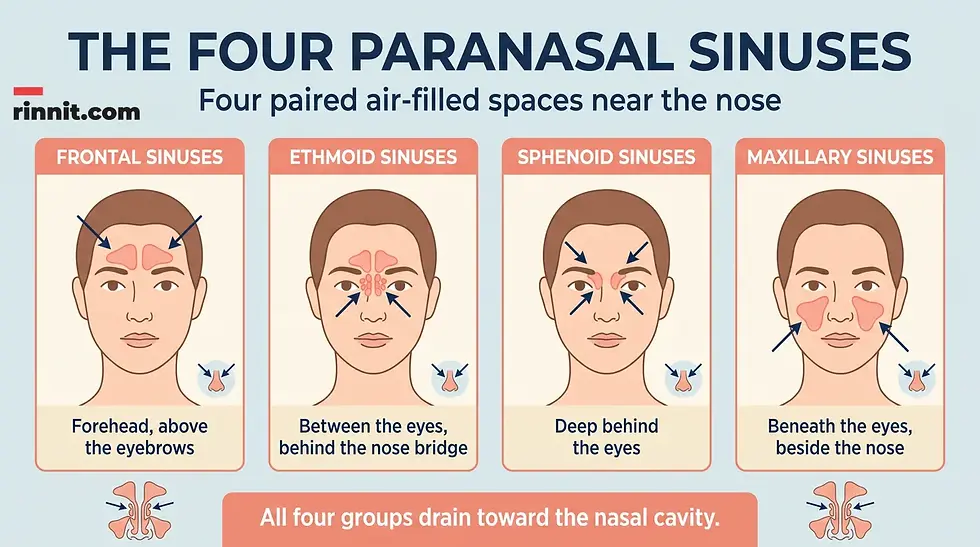
What are the four types of paranasal sinuses?
Each sinus group is named for the facial bone where it is located. Their positions differ, but all participate in the larger system of air spaces and mucus drainage.
Sinus group | Where it is | Key features |
Frontal sinuses | In the forehead area, above the eyebrows | Often triangle-shaped and rarely symmetrical; an average adult cavity holds about 4 to 7 mL of air |
Sphenoid sinuses | Deep inside the sphenoid bone, behind the eyes | The deepest sinus group; size varies with age, sex and ethnicity |
Ethmoid sinuses | Between the eyes, behind the bridge of the nose | Made of many tiny spaces called air cells; each side holds about 2 to 3 mL of air |
Maxillary sinuses | Beneath the eyes and beside the nose, in the upper-jaw bone | The largest sinuses; pyramid-like; a common starting site for sinus infection; each holds about 15 to 20 mL of air |
Frontal sinuses
The frontal sinuses sit in the frontal bone above the eyebrows. They are usually triangle-shaped, but the left and right sides are rarely perfectly symmetrical.
Sphenoid sinuses
The sphenoid sinuses are behind the eyes and deep inside the head. Their size varies considerably among people.
Ethmoid sinuses
The ethmoid sinuses sit between the eyes and behind the bridge of the nose. Instead of one open cavity on each side, they contain many small pockets called air cells.
Maxillary sinuses
The maxillary sinuses are in the upper-jaw bone, beneath the eyes and on either side of the nose. They are the largest paranasal sinuses and a common place for a sinus infection to start.
A thin bone separates the maxillary sinuses from the upper teeth. Because of this close connection, a dental infection can spread into a maxillary sinus.
What do the paranasal sinuses do?
The sinuses are not only spaces that become uncomfortable during a cold. Their functions are still being studied, but they may support several processes.
Possible function | How it works |
Help clear germs and allergens | Mucus drains into the nasal cavity and nose, carrying away material that might otherwise contribute to illness |
Warm and humidify inhaled air | The cavities help transform dry, cold air into air that is warmer and wetter for the airways and lungs |
Reduce skull weight | Air-filled spaces make some facial and skull bones lighter than solid bone would be |
Absorb some impact | The cavities may act as “crumple zones” that absorb part of the force during head trauma and help protect deeper structures such as the brain |
Influence voice quality | The cavities act as resonators; sound waves bounce from their walls and contribute to the character of a person’s voice |
These functions are connected to the sinuses’ structure: hollow spaces lined with tissue that produces mucus and drains toward the nose.
How does paranasal sinus drainage work?
Mucus made in the sinus cavities drains through passages into the nasal cavity. This drainage helps move germs and allergens out of the sinus spaces. [1]
A key drainage region is the ostiomeatal complex. It is a pathway made of multiple structures and drains the frontal, ethmoid and maxillary sinuses.
When this area becomes blocked, swelling and infection are more likely. Blockage can interfere with normal mucus movement and create a setting where inflammation persists.
What conditions can affect the paranasal sinuses?
Most sinus conditions are related to inflammation, allergies or infection. Abnormal growths can also occur. These growths are often benign, but some can be precancerous or cancerous.
Sinusitis
Sinusitis is inflammation of the tissue lining the sinuses. Acute sinusitis typically lasts up to 4 weeks, subacute sinusitis lasts 4 to 12 weeks, and chronic sinusitis lasts more than 12 weeks. Recurrent sinusitis involves several attacks within a year. [1]
Viruses and bacteria are common causes. Fungal sinusitis occurs when a fungus causes the inflammation.
Common cold
A common cold is an upper respiratory infection involving the sinuses, throat and windpipe. More than 200 viruses can cause a cold; rhinovirus is the most common cause.
Nasal and paranasal tumors
Benign and cancerous growths can form in the nose or sinuses. Nasal polyps are common benign growths. Cancers that can affect the paranasal sinuses include squamous cell carcinoma and adenocarcinoma.
A persistent or unusual symptom does not automatically mean a tumor. An evaluation is needed to understand the cause.
Silent sinus syndrome
Silent sinus syndrome is rare. A blockage in a maxillary sinus can cause the sinus to sink, which may make the eye appear sunken.
Dental infections
Because the maxillary sinuses are close to the upper teeth and separated by only a thin bone, a dental infection can spread into a maxillary sinus.
What are the common symptoms of a paranasal sinus condition?
Simple paranasal sinus conditions may cause sinus pressure, a runny or stuffy nose, discolored drainage, postnasal drip and a reduced sense of smell.
Sinus pressure.
Runny nose.
Discolored drainage.
Postnasal drip.
Stuffy nose.
Reduced sense of smell, also called hyposmia.
The location of discomfort can sometimes correspond with the inflamed sinus, but symptom location alone cannot establish a diagnosis.
Area of discomfort | Sinus that may correspond with the location |
Forehead | Frontal sinus |
Behind the eyes or in the ears | Sphenoid sinus |
Bridge of the nose | Ethmoid sinus |
Cheekbones or upper teeth | Maxillary sinus |
How are paranasal sinus conditions evaluated?
Healthcare professionals can often identify common sinus problems by considering symptoms and performing a physical exam. The history of how symptoms began and changed also matters. [1]
Imaging may be used in some situations. A clinician may recommend it when more information about the sinus spaces or surrounding structures is needed.
Nasal endoscopy
Nasal endoscopy may help when a closer look at the nasal passages or sinuses is needed. During the procedure, a clinician inserts a thin, flexible tube with a camera into the nose. The camera sends images to a screen, and the clinician may also collect a sinus culture when appropriate.
How are paranasal sinus conditions treated?
Many common sinus symptoms are mild and improve on their own. Treatment should match the underlying cause rather than rely on symptoms alone.
Care option | When it may be considered |
Pain relievers or nonsteroidal anti-inflammatory drugs | To help manage discomfort when appropriate |
Nasal decongestants | To help with congestion in selected situations |
Nasal irrigation | To help rinse the nasal passages when used appropriately |
Corticosteroids | To help manage inflammation in selected cases |
Antibiotics | May be prescribed for a bacterial infection; they do not treat every cause of sinus symptoms |
Sinus surgery | May be needed for chronic problems, a lesion or a serious infection that spreads to the eye or brain |
Do not assume that an antibiotic is needed for every sinus problem. A clinician can help determine whether the likely cause is viral, bacterial, allergic, inflammatory, structural or something else.
When should sinus symptoms be evaluated?
Arrange professional evaluation when symptoms persist, recur, interfere with daily life or do not fit a simple cold or allergy pattern.
Prompt care matters when a sinus infection becomes serious or spreads toward the eye or brain. New vision changes, significant swelling around the eye, severe worsening symptoms or other concerning changes should not be managed only with home care.
A dental evaluation may also be relevant when upper-tooth symptoms occur with one-sided maxillary sinus symptoms.

How can you support paranasal sinus health?
Paranasal sinus health can be supported by washing your hands, avoiding allergens and smoke, eating well, exercising, sleeping enough, cleaning surfaces and using a humidifier when appropriate.
Wash your hands regularly or use hand sanitizer.
Avoid allergens such as pollen, dust, mold and pet dander when possible.
Eat nutritious food, exercise regularly and get enough sleep.
Avoid smoking and secondhand smoke.
Clean frequently touched surfaces.
Use a humidifier in your home when appropriate.
These habits can support general health, but they cannot prevent every sinus infection or structural condition.
What questions should you ask a healthcare professional about paranasal sinus problems?
Useful questions about paranasal sinus problems cover what condition fits your symptoms, how long to monitor them, which tests and treatments you need and when to seek prompt follow-up.
Could my symptoms fit a cold, allergy, sinusitis or another condition?
How long should I monitor these symptoms before arranging an appointment?
Do I need a physical exam, imaging or nasal endoscopy?
Could a dental problem be contributing to upper-jaw or cheek symptoms?
Which treatments are appropriate for my likely cause?
What symptoms would mean that I need prompt follow-up?
How can I reduce exposure to allergens, smoke or other irritants?
Conclusion
The paranasal sinuses are four paired cavities inside the facial bones: frontal, sphenoid, ethmoid and maxillary. They produce mucus that drains into the nasal cavity and may help clear germs and allergens, warm and humidify inhaled air, reduce skull weight, absorb some impact and influence voice resonance.
Sinus pressure, stuffiness, runny nose, drainage, postnasal drip and reduced smell can occur with common conditions such as colds, allergies and sinusitis. Persistent, recurring or concerning symptoms deserve professional evaluation because treatment depends on the cause.
Frequently Asked Questions
What are the paranasal sinuses?
The paranasal sinuses are four paired, air-filled spaces inside the facial bones. The four groups are the frontal, sphenoid, ethmoid and maxillary sinuses.
Why are they called paranasal sinuses?
“Paranasal” means near the nose. The term distinguishes these facial sinuses from other air-filled spaces that can exist in bones or tissues elsewhere in the body.
Which sinus is the largest?
The maxillary sinuses are the largest paranasal sinuses. They are beneath the eyes and beside the nose in the upper-jaw bone.
Where are the frontal sinuses?
The frontal sinuses are in the forehead area above the eyebrows, inside the frontal bone.
Where are the sphenoid sinuses?
The sphenoid sinuses are deep inside the head, behind the eyes, in the sphenoid bone.
Where are the ethmoid sinuses?
The ethmoid sinuses are between the eyes and behind the bridge of the nose. Each side contains multiple small air cells.
Where are the maxillary sinuses?
The maxillary sinuses are beneath the eyes and beside the nose, inside the upper-jaw bone. They are the largest sinus group and a common place for sinus infection to begin.
What do the paranasal sinuses do?
The paranasal sinuses make mucus that drains into the nose and may help clear germs and allergens. They also help warm and humidify inhaled air, reduce skull weight, absorb some head-trauma force and influence voice resonance.
What is the ostiomeatal complex?
The ostiomeatal complex is a multi-part drainage pathway for the frontal, ethmoid and maxillary sinuses. Blockage there can make swelling and infection more likely.
What does sinusitis mean?
Sinusitis means inflammation of the tissue lining the sinuses. Acute sinusitis typically lasts up to 4 weeks, subacute sinusitis 4 to 12 weeks, and chronic sinusitis more than 12 weeks.
Can dental problems affect the sinuses?
Yes. A thin bone separates the upper teeth from the maxillary sinuses, so a dental infection can spread into a maxillary sinus.
What symptoms can sinus problems cause?
Common symptoms include pressure, runny nose, discolored drainage, postnasal drip, stuffiness and reduced sense of smell. The symptoms do not identify the cause by themselves.
How are sinus problems evaluated?
A healthcare professional may use a symptom history and physical exam. Imaging or nasal endoscopy may be used in some situations.
Do sinus problems always need antibiotics?
No. Antibiotics may be prescribed for bacterial infections, but they do not treat every cause of sinus symptoms. Treatment should match the cause.
When can sinus surgery be needed?
Surgery may be considered for chronic sinus problems, a lesion or a serious infection that spreads to the eye or brain. The decision requires professional evaluation.
How can I support sinus health?
Handwashing, avoiding allergens, adequate sleep, regular activity, avoiding smoke, cleaning frequently touched surfaces and using a home humidifier when appropriate can support sinus health.
Related guides
Related guides on paranasal sinus problems cover sinus headaches, nasal irrigation, nasal polyps, nasal and paranasal tumors, allergic rhinitis and tooth abscesses.
References
National Library of Medicine. Sinusitis. MedlinePlus. Last updated June 29, 2025. https://medlineplus.gov/sinusitis.html
Hoogland J, Takada T, van Smeden M, et al. Prognosis and prediction of antibiotic benefit in adults with clinically diagnosed acute rhinosinusitis: an individual participant data meta-analysis. Diagn Progn Res. 2023;7(1):16. PMID 37667327. https://doi.org/10.1186/s41512-023-00154-0
Samargandy S, Grose E, Chan Y, Monteiro E, Lee JM, Yip J. Medical and surgical treatment outcomes in patients with chronic rhinosinusitis and immunodeficiency: a systematic review. Int Forum Allergy Rhinol. 2021;11(2):162-173. PMID 32668102. https://doi.org/10.1002/alr.22647
Disclaimer
This article is for general educational purposes and is not a substitute for professional medical advice, diagnosis or treatment. Always seek the advice of a qualified healthcare professional with any questions about a medical condition or treatment.
This article explains paranasal-sinus anatomy, functions, common symptoms and general care pathways. It does not diagnose sinusitis, identify which sinus is affected, determine whether an infection is viral or bacterial, recommend a medication or replace professional evaluation. Persistent, worsening or concerning symptoms should be discussed with a qualified healthcare professional.



Comments