Transfemoral Carotid Artery Stenting: Procedure, Risks and Recovery

Updated: 3 days ago
Medically reviewed by Dr. Baraa Alnahhal, MD · Last reviewed: October 2026
Quick Answer: What is transfemoral carotid artery stenting?
Transfemoral carotid artery stenting is a minimally invasive procedure that places a mesh stent in a narrowed carotid artery to improve blood flow and lower stroke risk. A catheter is guided from the groin or arm to the neck. It takes less than two hours. Call 911 or your local emergency number right away for possible stroke signs.
What the research says
In a large randomized trial, stenting and surgery had similar overall outcomes but different short-term risks. Among 2,502 patients with symptomatic or asymptomatic carotid stenosis, the estimated 4-year rate of stroke, heart attack or death (including events around the procedure) was 7.2% with stenting and 6.8% with endarterectomy (hazard ratio 1.11; P = 0.51). Around the procedure, stroke was more frequent with stenting (4.1% vs 2.3%; P = 0.01), while heart attack was more frequent with endarterectomy (2.3% vs 1.1% with stenting; P = 0.03) (Brott et al., N Engl J Med, 2010).
In people with recently symptomatic stenosis, early risk was higher with stenting. In the International Carotid Stenting Study interim analysis (1,713 patients), the 120-day rate of stroke, death or procedural heart attack was 8.5% with stenting and 5.2% with endarterectomy (hazard ratio 1.69; 95% CI 1.16–2.45; P = 0.006). Cranial nerve palsy was less frequent with stenting (1 event vs 45) (Ederle et al., Lancet, 2010).
For re-narrowing after earlier carotid surgery, a registry compared transfemoral stenting with TCAR. Among 3,508 patients (1,834 TfCAS and 1,674 TCAR), 30-day stroke or death occurred in 2.7% after TfCAS and 1.6% after TCAR (P = .025). After adjustment, only the odds of TIA remained lower with TCAR (adjusted odds ratio 0.17; 95% CI 0.04–0.74); stroke, death and heart attack outcomes were otherwise similar (Chang et al., J Vasc Surg, 2022).

What is transfemoral carotid artery stenting?
Transfemoral carotid artery stenting is also called TFCAS. It is a minimally invasive procedure to open a blocked or narrowed carotid artery by placing a stent in the affected section. A stent is a small mesh tube that helps hold the artery open and improve blood flow.
The carotid arteries run on each side of the neck and carry blood to the brain, face and neck. When plaque builds up inside an artery, the artery can harden and narrow. This narrowing is called stenosis.
A blocked or narrowed carotid artery can increase stroke risk. Treating the right problem with the right approach can lower that risk, but the best option is an individualized clinical decision based on the person's health and artery anatomy.
Why might TFCAS be used?
Carotid artery disease occurs when cholesterol-and-fat plaque deposits build up inside one or both carotid arteries. Plaque can cause atherosclerosis, reduce blood flow to the brain and narrow the artery. Untreated carotid artery disease increases the risk of TIAs, sometimes called mini-strokes, and strokes.
A clinician considers more than the presence of narrowing. Overall health, the shape of the arteries and the location of disease help determine whether a stent is possible.
Clinical consideration | Why it may matter to the procedure decision |
Blockage in a hard-to-reach area | The location may affect which treatment route is practical. |
Other health conditions | Obesity, heart disease or lung disease may affect the comparison of options. |
Neck scar tissue | Previous surgery or radiation therapy can affect the neck. |
Vocal-cord nerve damage | Existing nerve damage is one factor that may influence comparison with another procedure. |
Overall health, artery shape and disease location | These factors help determine whether a stent is possible. |
How does TFCAS compare with other procedures?
Depending on the person's anatomy and health, other treatment options may include carotid endarterectomy, or CEA, and transcarotid artery revascularization, or TCAR. CEA uses a larger neck incision and opens the carotid artery to remove plaque. TCAR uses a stent delivered through a tube placed in the carotid artery through a small incision at the base of the neck.
TFCAS delivers a stent remotely from the groin or arm. It has had a higher non-disabling stroke risk than CEA or TCAR. The comparison should be discussed with the treating team rather than inferred from a general article.
How should you prepare for TFCAS?
Preparation depends on the care team's instructions and the planned procedure. It may include health testing, imaging, medication review, clot-prevention medication and fasting.
Possible preparation step | What it involves |
Blood tests and health exams | Used to review health before the procedure. |
Heart evaluation | An echocardiogram or stress test may be used to evaluate the heart. |
Vascular imaging | Carotid angiography, vascular ultrasound or magnetic resonance angiography may be used to view the blockage. |
Medication and supplement list | The care team may ask for a complete list. |
Clot prevention | Aspirin or another medication may be recommended to help prevent blood clots. |
Fasting | The care team may instruct you not to eat or drink for a specified time before the procedure. |
Follow the specific instructions from the treating team. Do not start, stop or change aspirin, antiplatelet medicines or any other prescribed treatment based on this article.
What happens during the procedure?
A specially trained provider performs TFCAS. The care team may use anesthesia or may give a small amount of medicine to help the person relax while remaining awake.
The access point can be in the groin or arm. From there, the team guides a catheter to the common carotid artery in the neck with a special X-ray machine. A filter, balloons and a self-expanding stent are part of the procedure.
The main steps
The team makes a puncture in the groin and guides a catheter toward the common carotid artery using X-ray imaging.
A filter is placed beyond the blockage to capture debris or plaque that could break off when the artery expands.
A smaller catheter with a deflated balloon is guided to the narrowed area.
The balloon is inflated at the blockage, pushing plaque against the artery wall, then deflated and removed.
A self-expanding stent is inserted and expanded at the blockage. It remains in place to help keep the artery open and improve blood flow.
A second, larger balloon may be expanded at the blockage to open the artery back toward its normal size, then deflated and removed.
The filter is removed, the catheter system is withdrawn and the access site is closed with a special device and pressure.

How long does TFCAS take?
A transfemoral carotid artery stenting procedure takes less than two hours. The total time at the facility also includes preparation, recovery-room monitoring and hospital observation.
What happens after TFCAS?
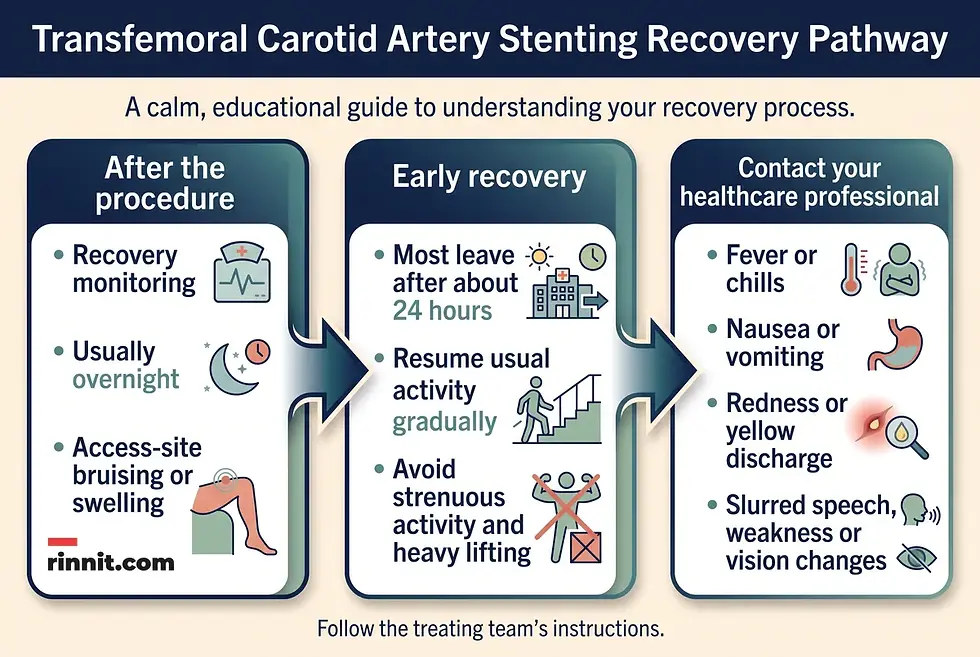
After the procedure, a care team typically monitors the person in a recovery room for two to six hours and then in the hospital overnight. Medicine may be provided for discomfort. An antiplatelet medicine may be prescribed to prevent blood clots from forming around the stent.
Early recovery topic | What to expect |
Recovery-room monitoring | Typically two to six hours. |
Hospital observation | Usually overnight. |
Leaving the hospital | Most people can leave about 24 hours after the procedure. |
Access-site effects | Bruising, swelling and mild discomfort may last a few days. |
Activity | Usual activities can typically begin to resume after 24 hours, but strenuous activity and heavy lifting should be avoided during this time. |
Medicines | An antiplatelet medicine may be prescribed to prevent clots around the stent. |
Always follow the treating team's instructions for activity, wound care and medicines. If pain-control questions arise, ask the treating team which over-the-counter options are safe for you.
What are the benefits of TFCAS?
The stent can improve blood flow to the brain and lower stroke risk from carotid artery disease. The procedure is minimally invasive, uses a small access site and people can typically return to usual activities within a few days.
A potential benefit does not mean the procedure is appropriate for every person. The treating team weighs the potential benefits against anatomy, health conditions and procedure-specific risks.
What are the risks and complications of TFCAS?
The treating team should explain the risks and complications that apply to the individual procedure. Serious complications are uncommon, but in large trials about 4 in 100 people had a stroke around the time of stenting. Potential problems include infection, bleeding, blood-vessel injury, in-stent restenosis, stroke, heart attack and death.
Potential issue | Explanation |
Infection | An infection can occur at or around the access site. |
Bleeding | Bleeding is a possible procedure-related complication. |
Blood-vessel injury | Catheter-based work can injure a blood vessel. |
In-stent restenosis | Scar tissue can form under the stent and narrow the treated section again. |
Stroke | Plaque pieces can break off and travel through a blood vessel; the embolic-protection device helps catch debris and reduce this risk. |
Heart attack | A heart attack is a listed potential complication. |
Death | Death is a listed potential complication. |
A low overall complication rate does not remove the need for individualized consent. Ask the treating team how the expected benefits and risks apply to the planned procedure.
What is recovery like after TFCAS?
Most people can leave the hospital about 24 hours after TFCAS. The access site may be bruised, swollen or mildly uncomfortable for a few days. People can usually begin to resume activities after 24 hours, while avoiding strenuous activities and heavy lifting during this early period.
The broader goal after carotid treatment is to lower the risk of future carotid artery disease problems. Health measures include heart-healthy foods, help to stop using tobacco products, a healthy weight, physical activity and statins or other medicines to lower cholesterol.
These measures should be tailored to the person's health and medication plan. Do not change a cholesterol medicine or any other prescribed treatment without discussing it with the prescribing professional.
When should you call a healthcare professional?
Contact the treating healthcare professional for fever or chills, nausea or vomiting, or signs of infection at the incision such as redness or yellow discharge. For possible stroke signs, such as slurred speech, weakness or paralysis, or vision changes, call 911 or your local emergency number right away.
Warning sign after TFCAS | What to know |
Fever or chills | May warrant contact with the healthcare professional. |
Nausea or vomiting | Contact the care team if these occur after the procedure. |
Incision changes | Redness or yellow discharge can be signs of infection. |
Possible stroke sign | Slurred speech, weakness or paralysis, or vision changes. |
If a possible stroke sign is occurring, seek urgent medical attention according to local emergency guidance rather than waiting for an online response. This article does not diagnose the cause of any symptom.
What questions should you ask before transfemoral carotid artery stenting (TFCAS)?
A procedure discussion can be easier when questions are written down in advance.
Topic | Example question |
Reason for treatment | What features of my carotid artery disease make this procedure worth considering? |
Options | How does TFCAS compare with CEA or TCAR for my anatomy and overall health? |
Preparation | Which tests, medicines, supplements or fasting instructions apply to me? |
Procedure | Where will the catheter enter, and what role do the filter, balloons and stent play? |
Recovery | When can I walk, work, exercise or lift objects? |
Follow-up | What symptoms should prompt a call, and who should I contact? |
Conclusion: Know the procedure, the alternatives and the warning signs
Transfemoral carotid artery stenting is a minimally invasive, catheter-based way to place a mesh stent in a narrowed carotid artery. It may improve blood flow to the brain and lower stroke risk from carotid artery disease, but the procedure decision depends on individual health, artery shape and disease location.
The procedure takes less than two hours, and recovery usually includes several hours of monitoring followed by an overnight hospital stay. Most people can leave after about 24 hours, although access-site bruising, swelling or mild discomfort may last a few days.
If TFCAS has been proposed, bring a written medication and supplement list and ask the treating team to explain the reason for the procedure, alternatives, expected recovery and warning signs. Report fever, chills, nausea or vomiting, or incision redness or yellow discharge to a healthcare professional, and call 911 right away for slurred speech, weakness or vision changes.
Frequently Asked Questions
Is TFCAS the same as carotid artery stenting?
TFCAS is one form of carotid artery stenting. The stent is delivered remotely through a catheter from an access point in the groin or arm to a narrowed carotid artery.
Why does carotid artery disease increase stroke risk?
Plaque can narrow a carotid artery and decrease blood flow to the brain. Plaque pieces can also break off and travel through a blood vessel. Untreated carotid artery disease increases the risk of TIAs and stroke.
Where does the catheter enter during TFCAS?
The catheter is guided from a puncture in the groin, and the device may be delivered remotely from the groin or arm. The treating team can explain the planned access route.
Is a carotid stent permanent?
The self-expanding mesh stent remains in place to help keep the artery open and improve blood flow.
How long does TFCAS take?
The procedure itself takes less than two hours. Preparation, recovery-room monitoring and overnight observation add time at the facility.
How long do people stay in the hospital?
Recovery-room monitoring typically lasts two to six hours, followed by an overnight hospital stay. Most people can leave about 24 hours after the procedure.
When can normal activities resume?
Usual activities can typically begin to resume after 24 hours, but strenuous activity and heavy lifting should be avoided during this early period.
What complications can occur?
Potential complications include infection, bleeding, blood-vessel injury, in-stent restenosis, stroke, heart attack and death. Serious complications are uncommon, but in large trials about 4 in 100 people had a stroke around the time of stenting.
What is in-stent restenosis?
In-stent restenosis is narrowing that happens when scar tissue forms under the stent, which can restrict blood flow again. It can also occur with carotid endarterectomy.
How does TFCAS compare with CEA and TCAR?
Carotid endarterectomy opens the artery through a larger neck incision, and TCAR delivers a stent through a small incision at the base of the neck. TFCAS has had a higher non-disabling stroke risk than either.
What access-site changes are normal during recovery?
Bruising, swelling and mild discomfort can occur for a few days. Redness or yellow discharge can be a sign of infection and should prompt contact with a healthcare professional.
How do I prepare for TFCAS?
Preparation may include blood tests and health exams, an echocardiogram or stress test, and imaging such as carotid angiography, vascular ultrasound or magnetic resonance angiography. [1] Give your provider a list of your medicines and supplements, take aspirin or other clot-preventing medicines as directed, and fast for the period your team tells you. [1]
Does TFCAS hurt, and what anesthesia is used?
Most people receive anesthesia, while some instead get a small amount of medicine to relax while staying awake. [1] Bruising, swelling and mild discomfort at the incision are common for a few days; you receive medicine for discomfort in the hospital, and you should ask which over-the-counter pain relievers are safe for you afterward. [1]
What stroke signs should be reported after TFCAS?
Slurred speech, weakness or paralysis, and vision changes are possible stroke signs. Seek urgent medical attention according to local emergency guidance.
Related guides
Carotid Artery Disease: The Silent Stroke Risk in Your Neck, Explained
Stroke: Symptoms, Causes, Diagnosis, and Treatment — A Complete Guide
Transient Ischemic Attack (TIA): The Mini-Stroke That Is Actually a Warning
Arteriosclerosis & Atherosclerosis: Symptoms, Causes, Diagnosis & Treatment — Complete Guide
Heart Disease: What It Is, How It Is Diagnosed, and How It Is Treated
Blood Clots Explained: Symptoms, Emergency Signs, and Treatment Options
High Blood Cholesterol: What Your Numbers Mean, Why It Matters, and How to Lower It
Related Reading
Transcarotid Artery Revascularization (TCAR): Procedure and Recovery explains TCAR carotid revascularization.
Carotid Artery Stenting: Procedure, Recovery and Results explains carotid artery stenting.
Carotid Endarterectomy: Surgery, Risks and Recovery explains carotid artery surgery to prevent stroke.
References
Cleveland Clinic. Transfemoral Carotid Artery Stenting: Procedure & Outlook. Cleveland Clinic. Last updated December 10, 2024. https://my.clevelandclinic.org/health/procedures/transfemoral-carotid-artery-stenting
Brott TG, Hobson RW, Howard G, et al. Stenting versus endarterectomy for treatment of carotid-artery stenosis. N Engl J Med. 2010;363(1):11-23. PMID 20505173. https://doi.org/10.1056/NEJMoa0912321
Ederle J, Dobson J, Featherstone RL, et al. Carotid artery stenting compared with endarterectomy in patients with symptomatic carotid stenosis (International Carotid Stenting Study): an interim analysis of a randomised controlled trial. Lancet. 2010;375(9719):985-997. PMID 20189239. https://doi.org/10.1016/S0140-6736(10)60239-5
Chang H, Rockman CB, Veith FJ, et al. Outcomes of transfemoral carotid artery stenting and transcarotid artery revascularization for restenosis after prior ipsilateral carotid endarterectomy. J Vasc Surg. 2022;75(2):561-571.e3. PMID 34506900. https://doi.org/10.1016/j.jvs.2021.07.245
Disclaimer
This article is for general educational purposes and is not a substitute for professional medical advice, diagnosis or treatment. Always seek the advice of a qualified healthcare professional with any questions about a medical condition or treatment.



Comments