Carotid Artery Stenting: Procedure, Recovery and Results

Updated: 2 days ago
Written and medically reviewed by Dr. Baraa Alnahhal, MD · Last reviewed: November 2026 · How we review
Quick Answer
Carotid artery stenting is a minimally invasive procedure that places a small metal mesh tube (stent) in a narrowed carotid artery in the neck to improve blood flow to the brain and lower stroke risk. It takes one to two hours with an overnight stay. Studies show results similar to carotid endarterectomy over 10 years.
What the research says
Stenting and surgery had similar 10-year results: in the CREST trial of 2,502 people, stroke, heart attack or death over 10 years occurred in 11.8% after stenting versus 9.9% after endarterectomy, a difference that wasn't significant (Brott TG et al., New England Journal of Medicine, 2016) [2]
Results matched surgery in people without symptoms: in the ACST-2 trial of 3,625 people without symptoms, 1% had disabling stroke or death from either procedure, and 5-year fatal or disabling stroke outside the procedure period was 2.5% in both groups (Halliday A et al., Lancet, 2021) [3]
Key takeaways
Carotid stenting opens a narrowed neck artery with a stent.
It lowers the risk of stroke.
The procedure takes one to two hours.
You'll take two antiplatelet medicines.
Results are similar to surgery over the long term.
What is carotid artery stenting?
The carotid arteries carry blood to your brain. In carotid artery disease, plaque narrows them. The stent stays in permanently, and the artery heals around it over several weeks. The FDA approved carotid stents starting in 2004. Sources: [1]
Who needs it
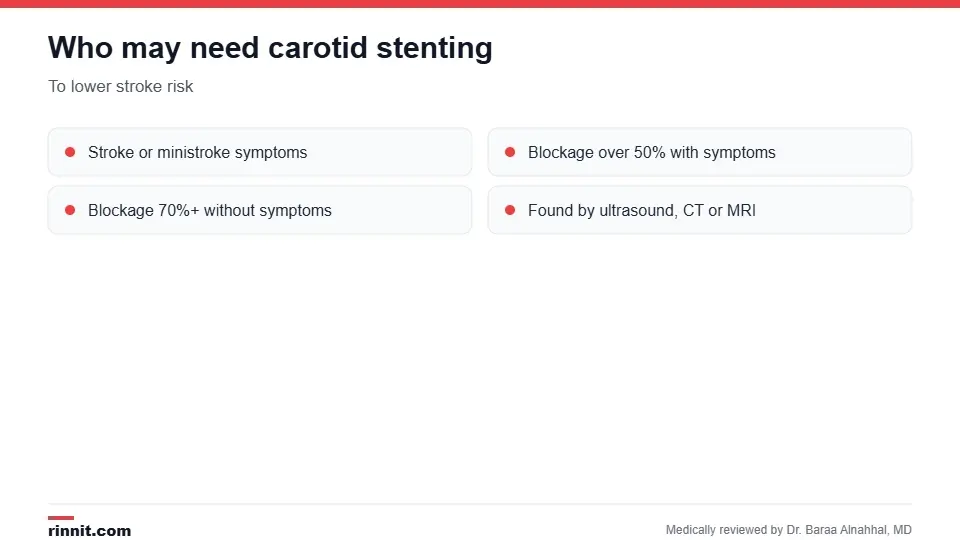
It's less invasive than carotid endarterectomy.
Stroke or ministroke (TIA) symptoms with a blockage over 50%.
A blockage of 70% or more without symptoms. Sources: [1]
The blockage is found with a carotid ultrasound, CT or MRI. Sources: [1]
Stenting vs. endarterectomy

Long-term results are similar.
Feature | Stenting | Endarterectomy |
Approach | Catheter and stent | Plaque removed through a neck incision |
Incision | Small or none | Larger neck incision |
Neck nerve damage | Lower risk | Higher risk |
Minor stroke | Slightly higher chance | Lower chance |
Learn more about carotid endarterectomy. Sources: [1, 2, 3]
Ways to reach the artery
Transfemoral: through an artery in your leg.
Transradial: through an artery in your arm.
TCAR: through the carotid artery just above the collarbone. Sources: [1]
Learn more about TCAR. Sources: [1]
How to prepare
Take aspirin plus a second antiplatelet medicine, such as clopidogrel, for 3 to 5 days before.
Skipping them can delay your procedure.
Follow eating and drinking instructions. Sources: [1]
What happens during the procedure

The procedure takes about one to two hours.
You get a blood thinner such as heparin.
A catheter is guided to the narrowed carotid artery.
The stent is placed and expanded.
An angiogram confirms it's fully open.
You keep your leg or arm still for two to six hours. Sources: [1]
Risks
Low or high blood pressure, or a slow heart rate.
Bleeding at the insertion site.
Damage to the artery.
Blood clots.
Stroke or brain bleeding.
Rarely, death. Sources: [1, 2]
Recovery
You'll usually stay overnight.
Don't lift more than 20 pounds for a week.
Don't soak the puncture site for 7 days; showering is fine.
Bruising should fade within a week.
Most return to full activity by the end of the week.
Keep taking antiplatelets for at least a month, often six months or more. Sources: [1]
Outlook
The artery can narrow again in 11% to 40% of people, but fewer than 5% need another procedure, and over 95% of repairs likely last a lifetime. Stenting doesn't cure carotid disease, so control blood pressure, cholesterol and blood sugar, quit tobacco and keep follow-up ultrasounds. Sources: [1, 2]
When to get help
Call 911 for stroke signs: facial drooping, trouble speaking, or weakness or numbness.
Contact your provider for bleeding or drainage at the puncture site. Sources: [1]
Conclusion
Carotid artery stenting opens a narrowed neck artery to help prevent stroke with a short recovery. Medicines and healthy habits afterward help keep the artery open for life.
Keep learning: read about carotid endarterectomy and stroke.
Frequently asked questions
What is carotid artery stenting?
A procedure that places a stent in a narrowed neck artery.
Why is it done?
To improve blood flow to the brain and lower stroke risk.
Who needs it?
People with significant carotid blockages, with or without symptoms.
How long does it take?
About one to two hours.
Will I stay in the hospital?
Usually overnight.
Is stenting better than surgery?
Long-term results are similar; stenting is less invasive.
What medicines will I take?
Aspirin plus a second antiplatelet medicine.
Can the artery narrow again?
Yes, but fewer than 5% need another procedure.
When can I lift heavy things?
After about a week.
Is the stent permanent?
Yes.
Related Reading
Transcarotid Artery Revascularization (TCAR): Procedure and Recovery explains TCAR carotid revascularization.
Carotid Endarterectomy: Surgery, Risks and Recovery the surgical alternative.
Transfemoral Carotid Artery Stenting: Procedure, Risks and Recovery stenting through the leg.
Carotid Artery Disease: The Silent Stroke Risk in Your Neck, Explained the condition it treats.
Carotid Ultrasound: Why It's Done, What to Expect and What Results Mean a test that finds blockages.
References
Cleveland Clinic. Carotid Artery Stenting: Procedure & Recovery. Cleveland Clinic. Last updated February 19, 2024. https://my.clevelandclinic.org/health/treatments/16850-carotid-artery-disease-carotid-stenting
Brott TG, Howard G, Roubin GS, et al. Long-term results of stenting versus endarterectomy for carotid-artery stenosis. New England Journal of Medicine. 2016;374(11):1021-1031. PMID 26890472. https://doi.org/10.1056/NEJMoa1505215
Halliday A, Bulbulia R, Bonati LH, et al. Second asymptomatic carotid surgery trial (ACST-2): a randomised comparison of carotid artery stenting versus carotid endarterectomy. Lancet. 2021;398(10305):1065-1073. PMID 34469763. https://doi.org/10.1016/S0140-6736(21)01910-3
Medical disclaimer
This article is for general education only and does not replace advice from a qualified healthcare professional. Talk to your doctor about your own diagnosis and treatment, and seek emergency care right away for severe or sudden symptoms.



Comments