Carotid Artery: Anatomy, Function, and Stroke Prevention

Updated: 2 days ago
Medically reviewed by Dr. Baraa Alnahhal, MD · Last reviewed: October 2026
Quick Answer
The carotid arteries are major blood vessels in the neck that send oxygen-rich blood to the brain, face and neck. [1] Each common carotid artery divides into an internal branch supplying the brain and eyes and an external branch supplying the neck and face. [1] Plaque or a clot blocking a carotid artery is a leading cause of stroke and TIA.
What the research says
A carotid bruit is a modest warning sign for stroke and TIA. A meta-analysis of 28 prospective studies (17,913 adults without symptoms) found that, in studies that compared groups directly, people with a carotid bruit had about 2.5 times the stroke rate (rate ratio 2.5, 95% CI 1.8 to 3.5) and 4 times the TIA rate (rate ratio 4.0, 95% CI 1.8 to 9.0) of people without one (PubMed: Pickett et al., Stroke, 2010) [2].
Evidence for drug treatment of symptom-free carotid stenosis is still limited. A Cochrane review of 34 randomized trials (11,571 participants, mean follow-up 2.5 years) found no high-certainty evidence for aspirin, blood pressure drugs, warfarin or lipid-lowering drugs, and the authors noted this does not mean the treatments do not work (PubMed: Clezar et al., Cochrane Database Syst Rev, 2023) [3].
For selected people with a 70% or greater narrowing and no symptoms, guidelines favor procedure plus medical therapy. The 2022 Society for Vascular Surgery guideline, based on a systematic review and meta-analysis, recommends carotid endarterectomy with best medical therapy over medical therapy alone for low-surgical-risk patients with asymptomatic stenosis of 70% or more, when the perioperative stroke and death risk is not above 3% (PubMed: AbuRahma, J Vasc Surg, 2024) [4].
Where is the carotid artery, and how is it structured?

The carotid arteries are located primarily in the neck, beginning in the upper chest just below the neck and traveling upward toward the skull. [1] The left common carotid artery arises directly from the aortic arch, whereas the right common carotid artery arises from the brachiocephalic trunk. [1] As each common carotid artery rises, it divides, or bifurcates, into the internal and external carotid arteries. [1]
The internal carotid artery travels up the neck to the base of the skull (the cervical, or C1, segment) and then passes through the carotid canal, an opening that separates the parts outside and inside the skull. [1] Inside the skull it follows a winding path and supplies the brain and eyes. [1] Providers divide the intracranial part into six segments, C2 to C7, giving seven segments in all. [1] The external carotid artery stays outside the skull, travels toward the ear and gives rise to eight branches that supply the neck and face. [1]
Artery | Primary Target Area | Key Branches |
Internal carotid | Brain and eyes | Ophthalmic, posterior communicating, anterior cerebral and middle cerebral arteries |
External carotid | Face and neck | Superior thyroid, ascending pharyngeal, lingual, facial, occipital, posterior auricular, maxillary and superficial temporal arteries |
Common carotid | Head and neck (main supply) | Divides into the internal and external carotid arteries |
What does the carotid artery do in the circulatory system?
The main job of the carotid arteries is to send oxygen-rich blood from the heart to the organs and tissues of the head and neck, most importantly the brain. [1] This constant supply of oxygen and nutrients supports neurological function and overall health.
Ideally, blood flows through these vessels smoothly. A blood clot or a narrowing of the vessel wall can interrupt that supply, and because the brain is so sensitive to oxygen deprivation, even a temporary blockage can lead to a serious medical emergency. [1]
What are common carotid artery conditions and disorders?

Several conditions can affect the carotid arteries:
Carotid artery disease (carotid artery stenosis): Narrowing of the arteries, usually from atherosclerosis, the buildup of plaque along the artery walls. Plaque often forms near the bifurcation and raises the risk of TIA and stroke, because clots can form on the plaque and break off, or a piece of plaque itself can rupture and travel to the brain. [1]
Carotid artery aneurysm: A weak artery wall can bulge and may grow over time. Clots can form in the aneurysm and interfere with blood flow to the brain, and a large aneurysm can rupture. [1]
Carotid artery dissection: A tear in the lining of the artery that can slow or stop blood flow to the brain and lead to stroke. [1]
Fibromuscular dysplasia (FMD): A disorder affecting how the layers of the blood vessels develop, which can cause narrowing, aneurysms or dissections. [1]
Condition | Primary Cause or Mechanism | Potential Complications |
Stenosis | Plaque buildup (atherosclerosis) | TIA, stroke |
Aneurysm | Weakened vessel wall | Rupture, blood clots |
Dissection | Tear in the artery lining | Reduced blood flow, stroke |
FMD | Abnormal development of vessel layers | Narrowing, aneurysms, dissections |
What are carotid artery emergency symptoms, and how is it tested?
Carotid artery conditions usually cause no symptoms until an emergency such as a TIA or stroke, which needs a 911 call, and testing may include ultrasound, CT and angiography. [1] Call 911 or your local emergency number if you or someone else has:
Drooping or paralysis of one side of the face. [1]
Slurred speech or difficulty forming words. [1]
Sudden loss of vision in one or both eyes, like a dark shade coming down over your field of vision. [1]
Weakness or loss of muscle strength on one or both sides of the body. [1]
Loss of feeling on one or both sides of the body. [1]
Depending on the symptoms, a person may not be able to call for help, so it helps to teach loved ones these warning signs. [1]
To check the carotid arteries, a provider may use a stethoscope to listen for a “bruit,” a whooshing sound that points to turbulent blood flow and can be a hint of plaque. [1] If a bruit is heard, or there are other reasons to suspect a problem, imaging tests may follow:
Carotid ultrasound: Uses sound waves to show blood flow and check for plaque.
CT scan: Gives detailed images of the arteries and surrounding structures.
Carotid angiogram: Uses injected dye to show how blood moves through the vessels.
Magnetic resonance angiogram (MRA): Uses magnetic fields to create detailed images of the carotid arteries.
How are carotid artery problems treated and prevented?
Carotid artery blockages may be treated with antiplatelet, blood pressure and cholesterol-lowering medicines, plus procedures for severe blockages and heart-healthy lifestyle steps. [1] For severe blockages, procedures may be needed:
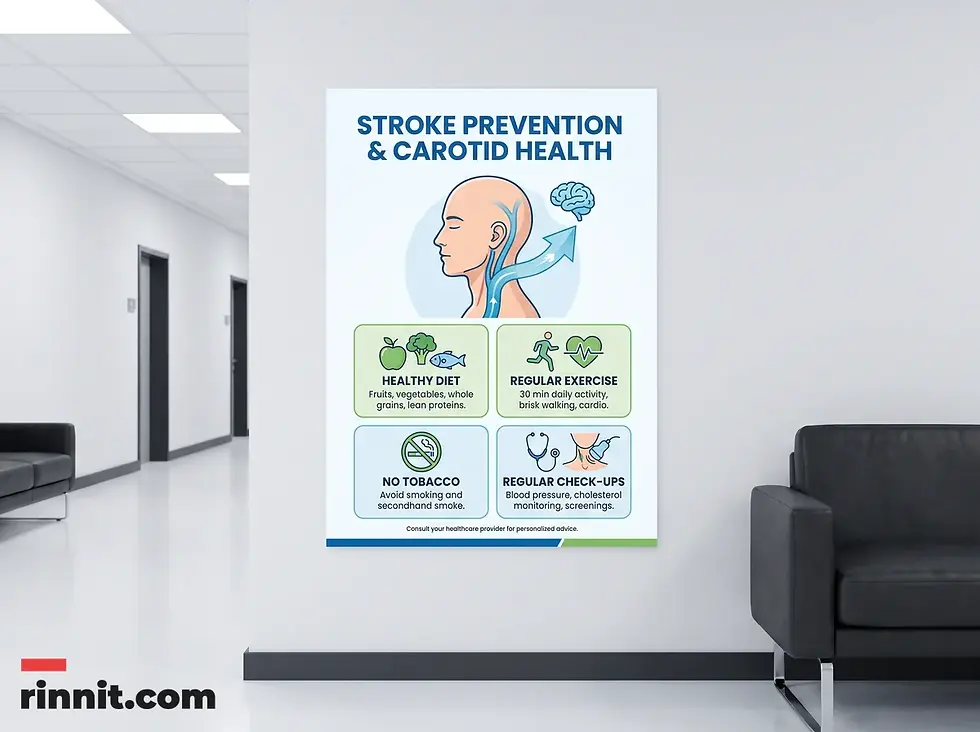
To keep your carotid arteries healthy, you may need to lower your cholesterol, and your provider may prescribe medicine to help. [1] Lifestyle steps that support your blood vessels and heart include:
Conclusion
The carotid arteries are the main routes for oxygen-rich blood to the brain, so their health matters for neurological function. Carotid artery disease often develops silently, but understanding the anatomy and the risks of plaque buildup supports early detection and prevention. Managing cardiovascular risk factors and knowing the emergency symptoms can significantly lower the risk of stroke.
Take action for vascular health: If you have risk factors for heart disease or stroke, ask a healthcare provider whether screening for carotid artery disease is right for you. Lifestyle changes and medicine can help prevent serious complications.
Frequently Asked Questions
1. Where are the carotid arteries located?
The carotid arteries are on both sides of the neck, traveling from the upper chest toward the skull.
2. What is the difference between the internal and external carotid arteries?
The internal carotid supplies the brain and eyes, while the external carotid nourishes the face and neck.
3. What is carotid artery stenosis?
Stenosis is narrowing of the carotid arteries, usually caused by plaque buildup from atherosclerosis.
4. How does a carotid artery blockage cause a stroke?
A blockage can restrict blood flow, or a piece of plaque or a blood clot can break off and travel to the brain, blocking blood flow there.
5. What are the segments of the internal carotid artery?
Seven segments: cervical (C1) in the neck, then six inside the skull — petrous (C2), lacerum (C3), cavernous (C4), clinoid (C5), ophthalmic (C6) and communicating (C7).
6. What is a carotid bruit?
A bruit is a whooshing sound heard through a stethoscope that indicates turbulent blood flow, which can be a hint of plaque.
7. Can carotid artery disease be treated without surgery?
Many cases are managed with medicines such as antiplatelet drugs, blood pressure medications and cholesterol-lowering drugs, along with lifestyle changes. Your provider decides what is right for you.
8. What is a carotid endarterectomy?
A carotid endarterectomy is a surgery that removes plaque from the carotid artery and restores blood flow.
9. What are the emergency signs of a carotid-related stroke?
Call emergency services for facial drooping or paralysis on one side, slurred speech, sudden vision loss in one or both eyes, or weakness or numbness on one or both sides of the body.
10. What is fibromuscular dysplasia (FMD)?
FMD is a disorder in which the layers of the blood vessels develop abnormally, leading to narrowing, aneurysms or dissections in arteries such as the carotid.
Related Reading
Learn more in our guide to Carotid Ultrasound: Why It's Done, What to Expect and What Results Mean.
References
Cleveland Clinic. Carotid Artery. Cleveland Clinic. Oct. 11, 2022. https://my.clevelandclinic.org/health/body/21492-carotid-artery
Pickett CA, Jackson JL, Hemann BA, et al. Carotid bruits and cerebrovascular disease risk: a meta-analysis. Stroke. 2010;41(10):2295-2302. PMID 20724720. https://doi.org/10.1161/STROKEAHA.110.585554
Clezar CN, Flumignan CD, Cassola N, et al. Pharmacological interventions for asymptomatic carotid stenosis. Cochrane Database Syst Rev. 2023;8(8):CD013573. PMID 37565307. https://doi.org/10.1002/14651858.CD013573.pub2
AbuRahma A. An analysis of the recommendations of the 2022 Society for Vascular Surgery clinical practice guidelines for patients with asymptomatic carotid stenosis. J Vasc Surg. 2024;79(5):1235-1239. PMID 38157995. https://doi.org/10.1016/j.jvs.2023.12.041
Medical Disclaimer
This article is for informational purposes only and does not constitute medical advice. Always seek the advice of your physician or other qualified health provider with any questions you may have regarding a medical condition. Never disregard professional medical advice or delay in seeking it because of something you have read here.



Comments