Carotid Endarterectomy: Surgery, Risks and Recovery

Updated: 2 days ago
Written and medically reviewed by Dr. Baraa Alnahhal, MD · Last reviewed: November 2026 · How we review
Quick Answer
A carotid endarterectomy is surgery to remove plaque from inside a carotid artery in the neck, restoring blood flow to the brain and lowering stroke risk. It's usually recommended when the artery is at least halfway blocked, especially after a TIA or mild stroke. Surgery takes one to two hours, and most people go home the next day.
What the research says
Surgery prevented strokes over 10 years: in the ACST-1 trial of 3,120 people with carotid narrowing but no symptoms, endarterectomy cut 10-year stroke risk from 16.9% to 10.8%, with a 3.0% risk of stroke or death around the time of surgery (Halliday A et al., Lancet, 2010) [2]
Surgery and stenting had similar long-term results: in the CREST trial of 2,502 people followed for 10 years, stroke, heart attack or death occurred in 9.9% after endarterectomy versus 11.8% after stenting, a difference that wasn't significant (Brott TG et al., New England Journal of Medicine, 2016) [3]
Key takeaways
Carotid endarterectomy removes plaque from a neck artery to prevent stroke.
It's usually done when the artery is at least 50% blocked.
Surgery takes one to two hours through a 4-inch neck incision.
Most people go home the next day.
Most return to normal activities in one to two weeks.
What is a carotid endarterectomy?
Your carotid arteries carry blood to your brain. In carotid artery disease, plaque narrows these arteries and can cause a stroke. Endarterectomy clears the plaque so blood flows freely. Stroke is the fifth leading cause of death in the U.S. Sources: [1]
Why it's done

The goal is to prevent a future stroke.
A carotid artery at least halfway blocked on carotid ultrasound.
A TIA (mini-stroke) or mild stroke.
Severe narrowing or blockage without symptoms. Sources: [1]
Types of surgery
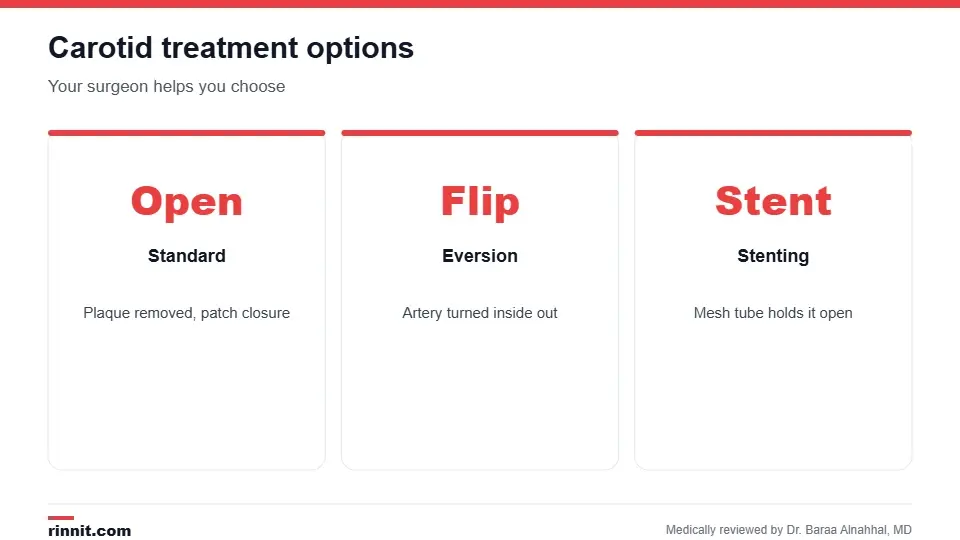
Your surgeon recommends the best option for you.
Type | How it works |
Standard endarterectomy | The artery is opened lengthwise, the plaque is removed and the artery is closed, often with a patch |
Eversion endarterectomy | The artery is turned inside out to remove the plaque; may be quicker and avoid a patch |
A mesh tube holds the artery open after balloon angioplasty |
Another option for some people is TCAR. Sources: [1, 3]
How to prepare
You may have a carotid angiogram, CT angiography or MR angiography.
Tell your provider about all medicines and supplements.
You may need to stop certain medicines, though most people keep taking aspirin.
Stop using tobacco. Sources: [1]
What happens during surgery

Surgery takes about one to two hours.
You get general anesthesia, or local anesthesia with relaxing medicine.
The surgeon makes a 4-inch cut in your neck over the blockage.
A small temporary tube may keep blood flowing to your brain.
The artery is opened, and the plaque is removed.
The artery is closed, usually with a patch, and blood flow is restored. Sources: [1]
Risks
Risk | Notes |
Stroke or heart attack | The most serious risks |
Bleeding, infection, blood clots | Uncommon |
Nerve damage | Can cause numbness near the jaw or ear |
Seizures or brain injury | Rare |
Future blockage | Uncommon in the same artery |
Risk is higher with severe disease, a past stroke, heart or kidney disease, diabetes and older age. Women may have a higher complication risk. Sources: [1, 2]
Recovery
Most people stay one night and go home the next day.
A small neck drain is usually removed after a day.
Neck pain lasts about two weeks; over-the-counter pain medicine helps.
You'll take aspirin or another medicine to prevent clots.
Most people return to work in one to two weeks.
Numbness near the jaw or earlobe can last 6 months to a year. Sources: [1]
Follow-up ultrasounds are usually done at 1 month, every 6 months for 2 years, then yearly. Healthy habits and cholesterol medicine help protect your arteries. Sources: [1]
When to get help
Call 911 for headache, confusion, trouble speaking or weakness, which may mean a stroke.
Chest pain or shortness of breath.
Trouble swallowing or seeing.
Fever, chills, or redness or discharge from the incision.
Swollen legs. Sources: [1]
Conclusion
Carotid endarterectomy is a proven way to lower stroke risk when a neck artery is badly narrowed. Following your medicine plan, keeping up with ultrasounds and living a heart-healthy life help keep your arteries clear.
Keep learning: read about carotid artery disease and TCAR.
Frequently asked questions
What is a carotid endarterectomy?
Surgery to remove plaque from a carotid artery in the neck.
Why is it done?
To lower the risk of stroke.
When is surgery recommended?
Usually when the artery is at least 50% blocked.
How long does surgery take?
About one to two hours.
Will I be awake?
It can be done under general or local anesthesia.
How long is the hospital stay?
Usually one night.
How long is recovery?
Most people return to normal activities in one to two weeks.
Is endarterectomy better than a stent?
Long-term results are similar; your surgeon helps you choose.
Can the artery narrow again?
It usually doesn't in the same artery.
What are the risks?
Stroke, heart attack, bleeding, infection and nerve damage.
Related Reading
Transcarotid Artery Revascularization (TCAR): Procedure and Recovery explains TCAR carotid revascularization.
Carotid Artery Stenting: Procedure, Recovery and Results explains carotid artery stenting.
Carotid Artery Disease: The Silent Stroke Risk in Your Neck, Explained the condition the surgery treats.
Transfemoral Carotid Artery Stenting: Procedure, Risks and Recovery stenting the carotid artery.
Endarterectomy: Procedure, Types, Risks and Recovery Explained plaque-removal surgery in other arteries.
Carotid Ultrasound: Why It's Done, What to Expect and What Results Mean the test that finds carotid narrowing.
References
Cleveland Clinic. Carotid Endarterectomy: Surgery & Recovery. Cleveland Clinic. Last updated February 27, 2025. https://my.clevelandclinic.org/health/treatments/16849-carotid-endarterectomy
Halliday A, Harrison M, Hayter E, et al. 10-year stroke prevention after successful carotid endarterectomy for asymptomatic stenosis (ACST-1): a multicentre randomised trial. Lancet. 2010;376(9746):1074-1084. PMID 20870099. https://doi.org/10.1016/S0140-6736(10)61197-X
Brott TG, Howard G, Roubin GS, et al. Long-term results of stenting versus endarterectomy for carotid-artery stenosis. New England Journal of Medicine. 2016;374(11):1021-1031. PMID 26890472. https://doi.org/10.1056/NEJMoa1505215
Medical disclaimer
This article is for general education only and does not replace advice from a qualified healthcare professional. Talk to your doctor about your own diagnosis and treatment, and seek emergency care right away for severe or sudden symptoms.



Comments