Thyroplasty (Medialization Laryngoplasty): Procedure, Recovery, Risks and Results

Updated: 6 days ago
Written and medically reviewed by Dr. Baraa Alnahhal, MD · Last reviewed: October 2026 · How we review
Quick Answer: What is thyroplasty?
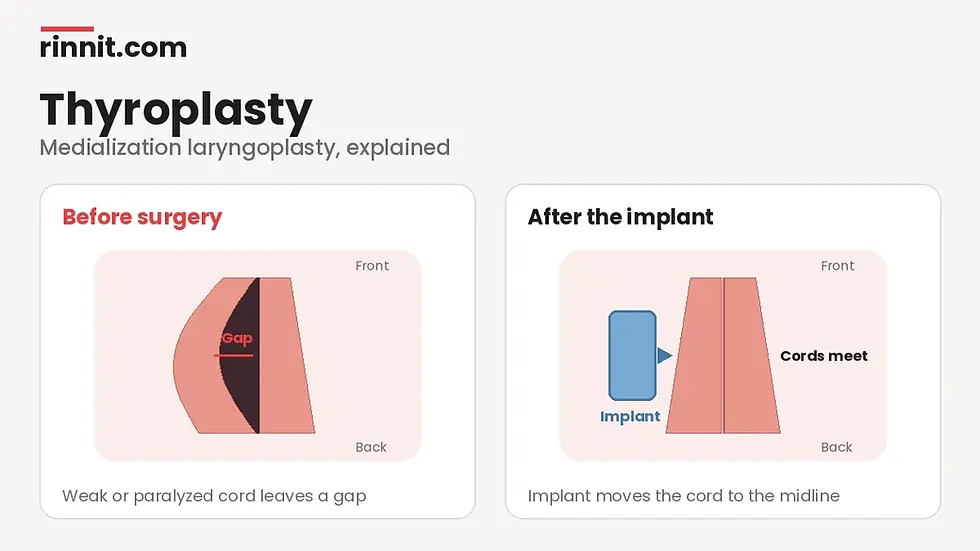
Thyroplasty, also called medialization laryngoplasty or Type I thyroplasty, is surgery that treats a paralyzed or weak vocal cord by placing an implant in the voice box. The implant pushes the affected cord toward the healthy one so both can close, which can make a breathy, weak voice stronger. It is usually done awake under local anesthesia. [1][5]
What the research says
Serious complications are uncommon. A systematic review of 46 studies covering 2,426 patients found an overall complication rate of 10.5%, with 4.5% classed as major. The most common problem was a non-blocking blood collection (hematoma) in 2.4%, and 429 patients sent home the same day had no linked adverse events. (Valley et al., The Laryngoscope, 2024) [2]
Implant surgery and injection give similar voice gains. A meta-analysis of 13 studies with 896 patients found that thyroplasty and injection laryngoplasty improved voice handicap scores, voice clarity and how long a person can hold a note to a comparable degree within six months. (Baali et al., European Archives of Oto-Rhino-Laryngology, 2025) [3]
Both common implant materials work. Across 55 papers, silicone implants lengthened the time patients could sustain a sound by 7.8 seconds on average (1,038 patients) and Gore-Tex implants by 5.7 seconds (245 patients); voice handicap scores fell by 62.2% and 73.5%. (Vance et al., The Laryngoscope, 2025) [4]
Key takeaways
Thyroplasty moves a weak or paralyzed vocal cord closer to the healthy one so the two can meet again. [1]
You stay awake under local anesthesia, and the surgery takes about 90 minutes. [1]
Your surgeon asks you to speak during the operation to check that your voice is stronger. [1]
Recovery starts with three days of complete voice rest and two weeks without heavy lifting or strenuous exercise. [1]
The implant is often permanent; removal or repositioning is rarely needed. [1]
Thyroplasty at a glance
Question | Answer |
Other names | Medialization laryngoplasty, Type I thyroplasty [1] |
What it treats | A paralyzed or weak vocal cord on one side [1] |
Anesthesia | Local; you are awake but feel no pain [1] |
How long it takes | About 90 minutes [1] |
Hospital stay | Often same day; some people stay one night for monitoring [1] |
Voice rest | Complete rest for the first three days [1] |
Activity limits | No lifting over 15 lb (about 7 kg) or strenuous exercise for two weeks [1] |
Is it permanent? | Often; very rarely the implant is removed or repositioned [1] |
Why does a gap between the vocal cords weaken the voice?
A gap between the vocal cords weakens the voice because the two cords must touch to make sound. [1] Your vocal cords are two bands of tissue inside your voice box, or larynx. They open when you breathe and close when you speak. [1]
When one cord cannot move or is weak, air leaks through the space between them. Your voice may sound scratchy or breathy, and in some people whispering becomes the only way to talk. [1]
That gap can cause more than voice changes. It can also lead to:
Who needs thyroplasty?
Thyroplasty is for people with paralysis of one vocal cord or a vocal cord that is weak. [1] It is one of the surgical treatments for vocal cord paralysis. [1]
The goal is to close the gap so both cords can meet. Unlike injection treatments, thyroplasty does not add bulk to the weak cord. It simply moves the cord closer to its healthy partner. [5]
How should you prepare for thyroplasty?
Preparing for thyroplasty means following your surgical team's instructions closely. [1] Common steps include:
Step | Why it matters |
Fast before surgery | Your team tells you how long to avoid food and drink [1] |
Quit smoking | Part of standard pre-surgery advice [1] |
Review medicines and supplements | You may need to stop certain medicines, vitamins and herbal products [1] |
Plan how you will communicate | You cannot talk for the first three days, so prepare a notepad or phone app [1] |
Tell your team if you take blood thinners. In a large health-records study of 1,157 matched patients per group, people on anticoagulants around the time of thyroplasty had higher odds of airway problems (odds ratio 2.38) and swallowing difficulty (odds ratio 2.14) after surgery, though overall bleeding and hematoma rates did not differ. [6]
What happens during thyroplasty?
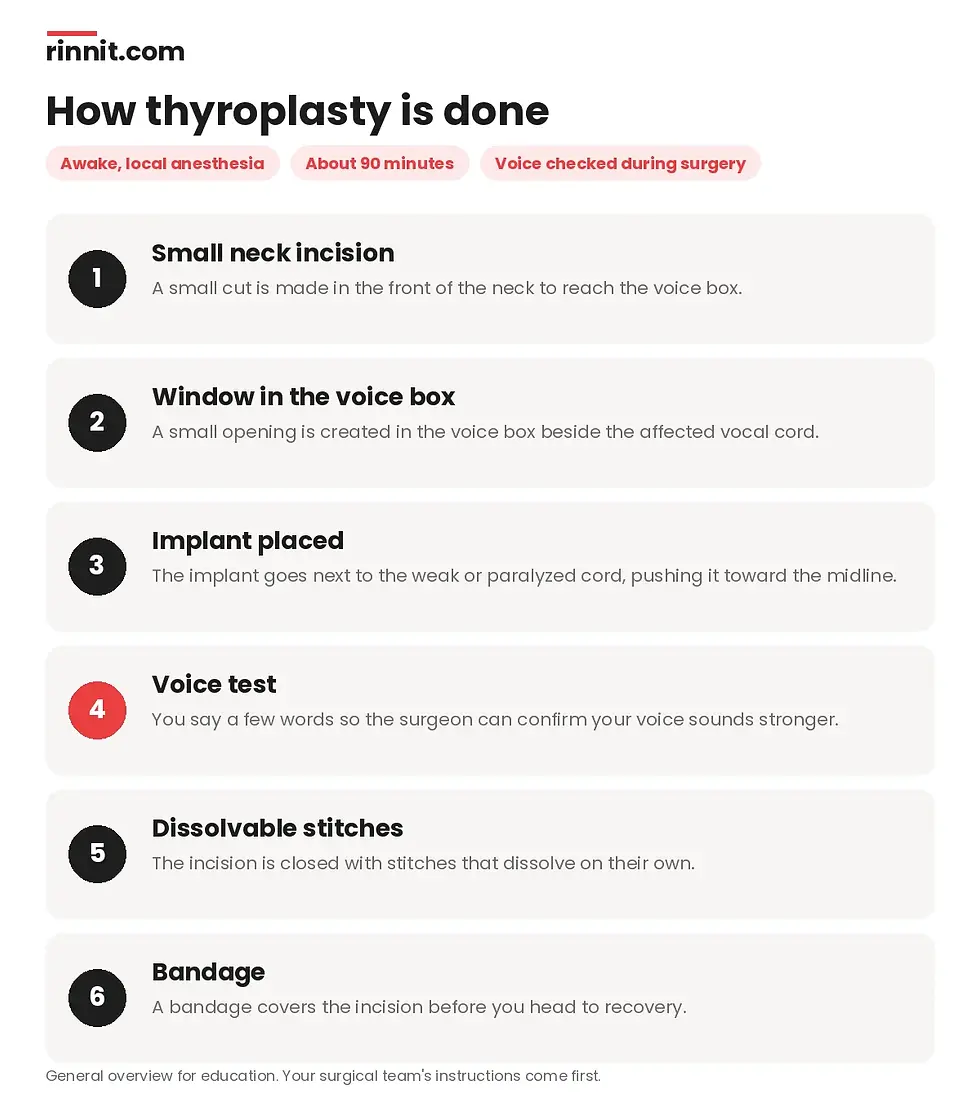
Thyroplasty is done under local anesthesia, so you are awake but do not feel pain. [1] Learn more about how anesthesia types differ. Your surgeon will:
Make a small cut (incision) in the front of your neck and locate the voice box. [1]
Create a small window in the voice box next to the vocal cord. [1] This window is cut into the thyroid cartilage, the shield-shaped front of the larynx. [5]
Place the implant beside the affected vocal cord. [1]
Ask you to say a few words to check that the implant makes your voice stronger. [1]
Close the incision with dissolvable stitches. [1]
Cover the incision with a bandage. [1]
The whole procedure takes about 90 minutes. [1] Some surgeons use general anesthesia instead, depending on the case. [5]
What are the benefits and risks of thyroplasty?
The main benefit of thyroplasty is a stronger, clearer voice, and many people notice a significant improvement in vocal function. [1] It can also ease other symptoms of vocal cord paralysis. [1]
Across 2,426 patients in published studies, implant extrusion occurred in 0.99% and implant displacement in 0.62%. [2] Bleeding (1.5%) and a non-blocking hematoma (2.4%) were the most common complications. [2]
What is recovery like after thyroplasty?
Recovery after thyroplasty begins with voice rest and a gradual return to normal activity. [1] You may go home once the anesthesia wears off, or your surgeon may keep you overnight to watch for problems. [1]
Your team will give you specific instructions. In general, you should:
Rest your voice for three days. No talking, whispering or laughing. After that, avoid long conversations for a while. [1]
Take medicines as prescribed. These may include pain relievers, antibiotics and steroids. [1]
Care for the bandage. You may remove it two days after surgery, but keep your neck dry for three days. Baths are fine; showers are not. [1]
Eat and drink gently. Drink plenty of fluids and choose soft foods if your throat is sore. [1]
Limit lifting. Avoid anything heavier than 15 lb (about 7 kg) for two weeks. [1]
Pause hard exercise. Skip running or cycling for two weeks. Walking is fine. [1]
If your voice needs extra support afterward, speech therapy is one option to discuss with your care team.

Is a thyroplasty implant permanent?
A thyroplasty implant is often permanent. [1] In very rare cases, the surgeon may need to remove or reposition it. [1]
When should you call a doctor after thyroplasty?
Call your doctor after thyroplasty if you notice any of these signs: [1]
Difficulty breathing
Severe pain
Signs of infection, such as white discharge from the incision or a fever above 101°F (38.4°C)
Swelling or bleeding at the incision
Trouble breathing after neck surgery can become an emergency. If it is severe or getting worse, seek emergency care right away.
What are the other types of thyroplasty?
Thyroplasty is a family of voice box surgeries used to treat voice disorders, vocal cord problems or to change voice pitch. [1] Type I (medialization laryngoplasty) is the main type; healthcare providers rarely perform the others. [1]
Type | What it does | Used for |
Type I | Moves a weak or paralyzed cord toward the midline with an implant | Vocal cord paralysis or weakness [1] |
Type II | Sets the vocal cords apart and readjusts their supporting tissue | Spasmodic dysphonia [1] |
Type III | Shortens the vocal cords | Making the voice deeper [1] |
Type IV | Lengthens the vocal cords | Making the voice higher [1] (see voice feminization surgery) |
Conclusion
A weak or paralyzed vocal cord can turn your voice into a faint whisper, even when you feel like you are shouting. Thyroplasty closes that gap by moving the affected cord toward its partner, and published studies show meaningful voice gains with a low rate of serious complications. [1][2][3][4]
Recovery is short but structured: three days of silence, two weeks of light activity, and quick action if warning signs appear. If hoarseness or a breathy voice has lasted for weeks, talk to an ear, nose and throat specialist about whether thyroplasty or another treatment fits your situation.
Keep learning: Read our plain-language guide to vocal cord paralysis to understand causes and all treatment options, and explore our full guide to voice disorders. For a public-health overview, see the NIDCD page on vocal fold paralysis.
FAQ
Is thyroplasty a major surgery?
Thyroplasty is done through a small incision in the front of the neck while you are awake under local anesthesia, and it takes about 90 minutes. You may go home the same day, although some people stay one night so the care team can watch for problems.
Are you awake during thyroplasty?
Thyroplasty is usually done with you awake under local anesthesia, so you feel no pain. Staying awake lets the surgeon ask you to speak and check that the implant makes your voice stronger before closing the incision.
How long does thyroplasty take?
Thyroplasty takes about 90 minutes from start to finish. Recovery from the anesthesia comes afterward, before you go home or move to an overnight room.
How long should I rest my voice after thyroplasty?
Voice rest after thyroplasty lasts for the first three days, with no talking, whispering or laughing. After that, you can speak again but should avoid long conversations for a while.
Is a thyroplasty implant permanent?
A thyroplasty implant is often permanent. In very rare cases, the surgeon may need to remove or reposition it.
What are the risks of thyroplasty?
Thyroplasty can cause temporary side effects such as a sore neck, hoarseness or voice changes, and difficulty breathing or swallowing. In a review of 2,426 patients, 10.5% had a complication and 4.5% had a major one.
When can I exercise after thyroplasty?
Strenuous exercise after thyroplasty, such as running or cycling, should wait two weeks. Walking is fine, but avoid lifting anything heavier than 15 lb (about 7 kg) during those two weeks.
When should I call my doctor after thyroplasty?
Call your doctor after thyroplasty if you have trouble breathing, severe pain, swelling or bleeding at the incision, white discharge from the wound, or a fever above 101°F (38.4°C). Severe or worsening breathing trouble needs emergency care.
How soon will my voice improve after thyroplasty?
Many people notice a stronger voice right after thyroplasty. The voice may change over the next few weeks as swelling settles, and your doctor will check it at follow-up visits.
Can a thyroplasty implant be adjusted or removed?
Yes. If needed, the implant can be adjusted or removed in another procedure. Your surgeon will discuss this if your voice does not improve as expected.
Related Reading
What Is Vocal Cord Paralysis? A Plain-Language Guide to the Voice Problem That Can Also Make Breathing and Swallowing Hard explains vocal cord paralysis causes, symptoms and treatment options.
Voice Therapy: Exercises, Uses and What to Expect describes how voice therapy strengthens and protects your voice.
Laryngoscopy: What It Is, Why It's Done, Types, Procedure and Results explains how doctors look at the voice box and vocal cords.
Hoarseness (Dysphonia): Causes, Symptoms, and Voice Recovery covers causes of hoarseness and when to see a doctor.
References
Cleveland Clinic. Thyroplasty (Medialization Laryngoplasty): Types & Procedure. Cleveland Clinic. Last updated March 16, 2026. https://my.clevelandclinic.org/health/treatments/22748-thyroplasty
Valley ZA, Karp A, Garber D. Safety and Adverse Events of Medialization Thyroplasty: A Systematic Review. Laryngoscope. 2024;134(5):1994-2004. PMID 37916789. https://doi.org/10.1002/lary.31141
Baali MH, Bukhari MA, Almohizea MI, et al. Injection laryngoplasty versus medialization thyroplasty for unilateral vocal cord paralysis: a comprehensive systematic review and meta-analysis. Eur Arch Otorhinolaryngol. 2025;282(12):6321-6334. PMID 41136562. https://doi.org/10.1007/s00405-025-09716-y
Vance DG, Allen DZ, Leming AB, et al. Systematic Review and Meta-Analysis of Outcomes in Type 1 Thyroplasty Comparing Silastic to Gore-Tex. Laryngoscope. 2025;135(4):1236-1247. PMID 39503469. https://doi.org/10.1002/lary.31867
Prasad VMN, Remacle M. Medialization Thyroplasty and Arytenoid Adduction for Management of Neurological Vocal Fold Immobility. Adv Otorhinolaryngol. 2020;85:85-97. PMID 33166967. https://doi.org/10.1159/000456686
Bertoni DG, Kim J, Tibbetts KM. Risk of Complications After Injection Laryngoplasty and Medialization Thyroplasty on Anticoagulation. J Voice. 2025. Epub ahead of print. PMID 40858473. https://doi.org/10.1016/j.jvoice.2025.07.047
Disclaimer
This article is for general education and does not replace advice from your doctor or surgical team. Always follow the specific instructions you are given before and after surgery. If you have trouble breathing, seek emergency care immediately.



Comments