Physical Exam: What to Expect, What to Bring and How Often You Need One

Updated: 2 days ago
Written and medically reviewed by Dr. Baraa Alnahhal, MD · Last reviewed: November 2026 · How we review
Quick Answer: What is a physical exam?
A physical exam is a checkup of your overall health done by a primary care provider. The provider checks your vital signs, height and weight, reviews your medical history and medicines, and examines your body. It focuses on prevention: updating vaccines and looking for underlying conditions. Most providers recommend one every year, and it takes about 30 minutes. [1]
What the research says
General health checks on their own haven't been shown to lower death rates. A Cochrane review of 15 trials with 251,891 adults found that general health checks had little or no effect on deaths from any cause or from cancer, and probably little or no effect on deaths from heart disease. (Krogsbøll et al., Cochrane Database of Systematic Reviews, 2019) [2]
Population-wide screening and counselling didn't cut heart disease. In a Danish trial of 59,616 adults aged 30 to 60, inviting people to screening and repeated lifestyle counselling over five years made no difference to heart disease, stroke or deaths after 10 years. (Jørgensen et al., BMJ, 2014) [3]
Key takeaways
A physical exam is an evaluation of your overall health, done by a primary care provider. [1]
You don't have to be sick to get one; it focuses on preventive care. [1]
Most providers recommend a physical exam every year, and it takes about 30 minutes. [1]
Bring a list of your medicines, allergies, symptoms, past test results and questions. [1]
Your provider listens to, looks at, feels and taps on your body to check each organ system. [1]
You may need follow-up tests such as blood work, an EKG or an X-ray, or a referral to a specialist. [1]
What is a physical exam?
A physical exam is an evaluation of your overall health. A primary care provider performs it, and it focuses on preventive care so you can get to good health or stay there. If you or your provider have a health concern, they may offer tests or refer you to a specialist to learn more. You don't have to be ill to get a physical exam. [1]
Other names for a physical exam include: [1]
Well-check or wellness check
Checkup
Preventive care visit
Annual physical exam
Routine physical exam
Pre-employment physical exam
What does a physical exam check?
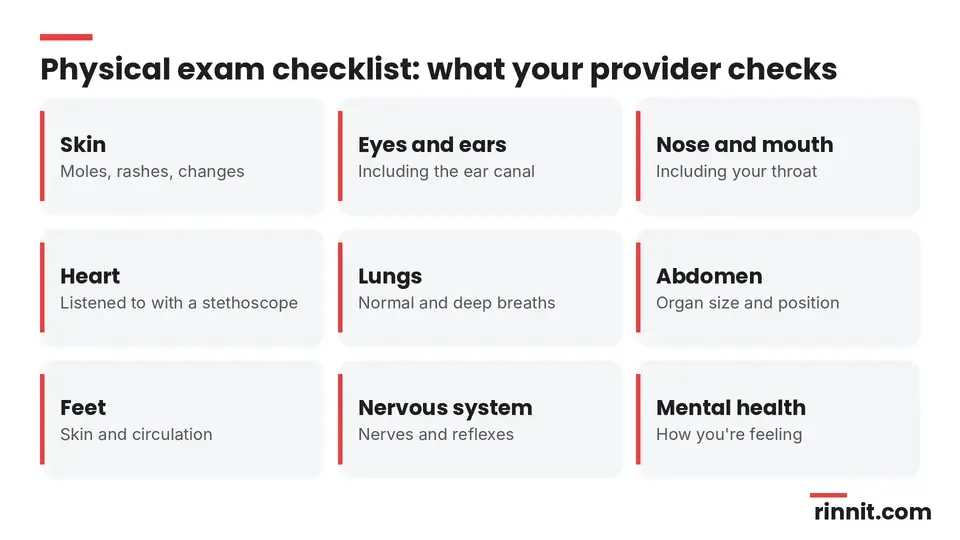
A healthcare provider checks your general health, including your: [1]
Body area | What it covers |
Skin | Moles, rashes, breakouts and other changes |
Eyes and ears | Including a look into your ear canal |
Nose and mouth | Including a look at your throat |
Heart and lungs | Listening with a stethoscope |
Abdomen | The location and size of your organs |
Feet | Skin, circulation and other foot concerns |
Nervous system | How your nerves and reflexes work |
Mental health | How you're feeling emotionally |
Sources: [1]
Depending on your age and anatomy, your provider may also check your genitals, prostate or breasts. [1]
Why do you need a physical exam?
The purpose of a physical exam is to: [1]
Check your general health
Make recommendations about how you can reach or maintain good health
Look for underlying conditions or address any symptoms you have
Give you immunizations or vaccines
Answer your questions about your health
Confirm you're healthy enough for a job that requires a pre-employment physical or a sport that requires a sports physical
How often do you need a physical exam?
Most healthcare providers recommend a physical exam once a year (annually). [1]
Sports physical vs. annual physical
A sports physical focuses on your current health and whether you're healthy enough to play a sport. It mainly checks your height and weight, vision and hearing, and muscle and bone health, and your provider may examine your flexibility and strength, which usually aren't checked during an annual physical. [1]
What should you bring to your physical exam?
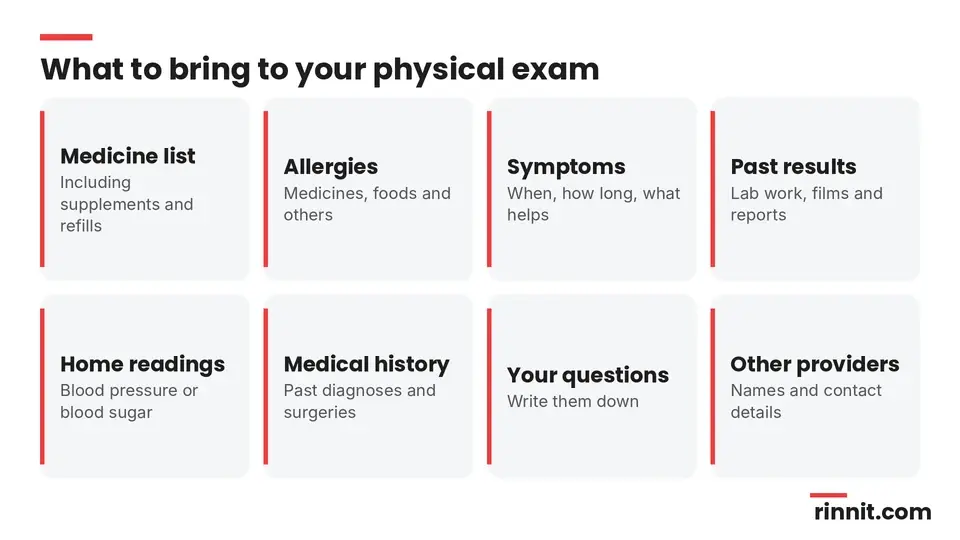
Make a list of the following and bring it to your appointment: [1]
Any medicines or supplements you take, including prescriptions that need a refill
Your allergies
Your symptoms: what they are, when they happen, how long they last and what relieves them
Results from earlier tests and lab work, including films and reports
Any measurements your provider asked you to track, such as blood pressure or blood sugar readings
Your medical and surgical history
Questions you'd like answered
Names and contact details of other doctors and specialists you see, if you want reports sent to them
For a sports physical or pre-employment exam, bring the paperwork from your coach or employer for your provider to sign. [1]
What happens during a physical exam?
Your provider will start by asking how you're feeling and whether you have any symptoms, questions or concerns. If the exam is for a sport or a job, mention it at the start so they can fill out the paperwork. [1]
Before you see your provider
A member of your care team will: [1]
Measure your height and weight
Check your vital signs
Review your medical history and family medical history
Note which medicines or supplements you take
Ask how your social environment affects your health, such as smoking or substance use
Discuss your medical care preferences, such as a do-not-resuscitate (DNR) status or a living will
Review any personal health concerns or symptoms
Questions about pain or discomfort
If you have pain, your provider may ask where it is, what it feels like (dull, achy, pressure or sharp), how bad it is on a scale of 1 to 10, how long it lasts, what brings it on, and what relieves it, such as rest, medicine or a change in position. [1]
The four exam techniques
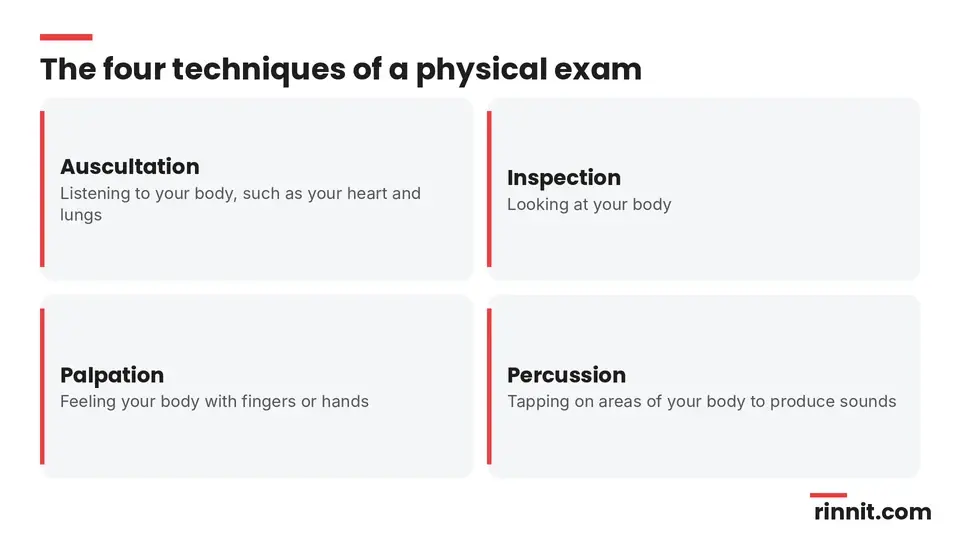
Technique | What your provider does |
Auscultation | Listens to your body, such as your heart and lungs |
Inspection | Looks at your body |
Palpation | Feels your body with their fingers or hands |
Percussion | Taps on specific areas of your body to produce sounds |
Sources: [1]
What your provider checks
During the exam, your provider will: [1]
Listen to your heart and lungs with a stethoscope while you breathe normally or take deep breaths
Look into your ears with an otoscope
Look into your mouth with a tongue depressor and a light while you say "ah"
Gently press on the lymph nodes in your neck to check for swelling
Feel your abdomen to check the location and size of your organs, usually while you lie down
Check your skin for unusual moles, rashes, breakouts or other changes
Do a breast and pelvic exam, or a genital and prostate exam, depending on your age and anatomy
Give you any vaccines you need
The exam can vary with your age and the reason for your visit, and your provider may look more closely at any area you're concerned about. A physical exam takes about 30 minutes. [1]
What happens after a physical exam?
You can go about your day as usual. Your provider will share the results of your exam, sign any paperwork for your employer or coach, and point out any areas of concern. They may refer you to a specialist or recommend more tests, such as: [1]
An X-ray
An electrocardiogram (EKG)
A urinalysis
What results do you get from a physical exam?
A physical exam is a snapshot of your overall health. When it's done, your provider will let you know if: [1]
There are any health concerns you should know about
You need more testing
You need to see a specialist
There are steps you can take to improve your health
You're in good health
If your provider notices anything that affects your general health, they may want to see you sooner than in a year. Testing may need its own appointment, plus a follow-up visit to go over results. [1]
When should you call your doctor?
Contact your provider if you: [1]
Have questions about your health or test results
Have new or worsening symptoms
Notice changes in your body, such as a lump or a new skin growth
Questions to ask your provider
Which screenings or vaccines are due for someone my age?
Are my blood pressure and weight in a healthy range?
Do I need any blood tests this year?
Is there anything I should change about my diet, activity or sleep?
When should I come back?
Conclusion
A physical exam is a yearly check of your overall health that focuses on prevention. In about 30 minutes, your provider reviews your history, checks your vital signs and examines each body system, then recommends any tests, vaccines or lifestyle steps you need.
Bring your medicine list, symptoms, past results and questions, so the visit is tailored to you. A regular checkup also builds a relationship with a provider who knows you if you ever get sick or hurt.
Keep learning: Read our guides to the complete blood count (CBC), the lipid panel, normal blood pressure by age and the eye exam.
FAQ
What is a physical exam?
A physical exam is an evaluation of your overall health by a primary care provider, focused on preventive care. [1]
How often should I get a physical exam?
Most healthcare providers recommend a physical exam once a year. [1]
How long does a physical exam take?
A physical exam takes about 30 minutes. [1]
What should I bring to a physical exam?
Bring a list of your medicines, allergies, symptoms, past test results, health measurements, medical history and questions. [1]
What does a doctor check during a physical?
Your provider checks your vital signs, skin, eyes, ears, nose, mouth, heart, lungs, abdomen, feet, nervous system and mental health. [1]
What are the four techniques used in a physical exam?
Auscultation (listening), inspection (looking), palpation (feeling) and percussion (tapping). [1]
What is the difference between a sports physical and an annual physical?
A sports physical focuses on whether you're healthy enough to play a sport, checking height, weight, vision, hearing, muscles, bones, flexibility and strength. [1]
Do I need to be sick to get a physical exam?
No. A physical exam focuses on prevention, so you don't have to be ill. [1]
What tests might I need after a physical exam?
Your provider may order an X-ray, a complete blood count, an EKG, a stress test, a urinalysis or a lipid panel. [1]
When should I call my doctor after a physical exam?
Call if you have questions about your results, new or worsening symptoms, or changes like a lump or new skin growth. [1]
Related Reading
Learn more in our guide to High Blood Pressure: Silent Symptoms, Serious Risks, and Proven Ways to Lower It.
Learn more in our guide to Understanding Hyperlipidemia: Managing High Cholesterol for Heart Health.
Learn more in our guide to Prediabetes: Symptoms, Causes, and Treatment.
Learn more in our guide to Obesity: Symptoms, Causes, Complications and Treatment — A Complete Guide.
References
Cleveland Clinic. Physical Examination: What Is a Physical Exam?. Cleveland Clinic. Last updated April 14, 2023. https://my.clevelandclinic.org/health/diagnostics/17366-physical-examination
Krogsbøll LT, Jørgensen KJ, Gøtzsche PC. General health checks in adults for reducing morbidity and mortality from disease. Cochrane Database Syst Rev. 2019;1(1):CD009009. PMID 30699470. https://doi.org/10.1002/14651858.CD009009.pub3
Jørgensen T, Jacobsen RK, Toft U, et al. Effect of screening and lifestyle counselling on incidence of ischaemic heart disease in general population: Inter99 randomised trial. BMJ. 2014;348:g3617. PMID 24912589. https://doi.org/10.1136/bmj.g3617
Medical disclaimer
This article is for general education only and does not replace advice from a qualified healthcare professional. Talk to your doctor about your own diagnosis and treatment, and seek emergency care right away for severe or sudden symptoms.



Comments