Meatoplasty and Meatotomy: Purpose, Procedure, Recovery and Risks

Updated: 6 days ago
Written and medically reviewed by Dr. Baraa Alnahhal, MD · Last reviewed: October 2026 · How we review
Quick Answer: What is meatoplasty (meatotomy)?
Meatoplasty is a minor surgery that widens the urethral meatus, the opening at the tip of the penis where urine leaves the body. It mainly treats meatal stenosis in circumcised boys, takes under an hour, and is usually an outpatient procedure. Most children feel better within a week. Seek emergency care for fever, heavy bleeding, or trouble peeing. [1]
What the research says
Most families report clear improvement after meatotomy. In a survey of 182 families, 79% said their son's symptoms were "much improved" and 16% "somewhat improved" six weeks after surgery; 4.9% had minor complications (Varda et al., Journal of Pediatric Urology, 2018). [2]
Repeat surgery is uncommon. Among 4,373 boys diagnosed with meatal stenosis, the re-operation rate was 3.5% after office meatotomy and 0.2% after meatoplasty under general anesthesia (Godley et al., Journal of Pediatric Urology, 2015). [3]
Meatoplasty had no re-operations in a large series. Of 2,211 children (1,906 meatotomy, 305 meatoplasty), 0.58% needed another surgery after meatotomy and 3.6% needed the opening gently spread at the first visit; no child needed re-operation after meatoplasty, and complication rates did not differ (Dothan et al., Urology, 2023). [4]
Key takeaways
Meatoplasty and meatotomy both widen a narrow urethral opening; many doctors use the two names interchangeably. [1]
The main reason for surgery is meatal stenosis, which usually appears between ages 3 and 7 and almost only in circumcised boys. [1]
The operation usually takes less than an hour, and most children go home the same day. [1]
Stinging when peeing for one to two weeks is normal; fever, heavy bleeding, or a dry diaper is not. [1]
Outlook is excellent, and follow-up treatment is seldom needed. [1]

What is the difference between meatoplasty and meatotomy?
Meatoplasty and meatotomy are two very similar operations that both enlarge the urethral meatus, but meatoplasty also remodels the tissue. [1]
In a meatoplasty, the surgeon opens the tip of the penis and reshapes the opening. The edges may then be closed with stitches. [1]
A meatotomy is less complex. The surgeon widens the opening but may not reconstruct the tissue or use stitches. [1]
Feature | Meatoplasty | Meatotomy |
What is done | Opening is cut and remodeled | Opening is widened only |
Stitches | May be used to close the edges | Often none |
Setting | Operating room, child asleep | Operating room, or sometimes a clinic with numbing cream |
Complexity | More involved | Simpler |
What conditions does meatoplasty treat?
Meatoplasty treats meatal stenosis, a condition in which the opening at the tip of the penis is too narrow. [1]
Meatal stenosis can be present at birth. It can also develop later, usually between ages 3 and 7, and it almost only affects circumcised boys. [1]
A narrow opening can cause:
Trouble aiming the urine stream
A stream that is thin, fast, or goes upward or sideways
Urine that sprays in different directions
Peeing more often than expected
Pain or burning while peeing
Doctors may also use meatoplasty in babies with a mild form of hypospadias, a birth condition in which the urethral opening forms below the tip of the penis. [1]
What causes meatal stenosis?
Meatal stenosis is caused by irritation that leads to scarring around the urethral opening. [1]
Common triggers include:
Trigger | How it causes narrowing |
Circumcision | Removing the foreskin leaves the opening exposed to irritation |
Diaper friction | Rubbing against a diaper irritates the tip of the penis |
Long-term urinary catheters | A tube in place for a long time can scar the opening |
Learn more about how catheters are used and cared for in our guide to urinary catheterization.
At what age can a child have meatoplasty?
Meatoplasty can be recommended for children as young as 3 months old. [1]
Adults can have the surgery too, though it is less common. In adults, the opening may narrow after surgery on or near the urethra, or after long-term use of a urinary catheter. [1] A narrowing deeper inside the tube is a different problem, called a urethral stricture.
How should you prepare your child for meatoplasty?
Preparation for meatoplasty starts with a visit to your child's healthcare provider, who checks general health and examines the penis. [1]
The exam may include:
Looking at the opening and measuring its width
Asking which way the urine flows and whether it sprays
Watching your child pee to see if the stream is straight
Measuring how strong the urine stream is (flow rate)
Tell the provider about:
Bleeding disorders in your child's history
All medicines, including over-the-counter drugs and herbal supplements. Anti-inflammatory painkillers (NSAIDs) and some supplements can raise bleeding risk during surgery.
Allergies to medicines, latex, foods, or skin cleaners such as iodine or isopropyl alcohol [1]
Children read their parents' body language. Staying calm, watching your tone of voice, and reading a favorite book or playing with a favorite toy before surgery can help your child relax. [1]
Who is on the meatoplasty team?
Team member | Role |
Pediatric urologist | Surgeon who treats children's urinary and reproductive conditions |
Pediatric anesthesiologist | Doctor who gives your child anesthesia so they feel no pain |
Surgical nurses | Care for your child before, during, and after surgery and assist the surgeon |
Source: [1]

How is meatoplasty performed?
Meatoplasty is performed while your child is asleep under anesthesia, after the penis is cleaned and a numbing cream is applied. [1]
Once your child is asleep, the pediatric urologist will:
Pass a soft tube into the opening to measure it.
Make a small V-shaped cut on the underside of the penis, below the opening, to enlarge it.
Use surgical glue or, if needed, stitches to bring the tissue together.
Check for any other narrow areas.
Place a urinary catheter only if your child needs help peeing. [1]
Can meatotomy be done without general anesthesia?
Meatotomy can sometimes be done in a clinic without general anesthesia if your child can tolerate it. A numbing cream is left on the penis for 30 to 60 minutes. The provider then clamps the tissue and makes a small cut to widen the opening. No stitches are used. [1]
How long does meatoplasty take, and is it painful?
Meatoplasty usually takes less than an hour. [1]
Your child feels no pain during the operation. Afterward, some stinging or burning when peeing is normal and can last one to two weeks. A small amount of bloody drainage is also normal. [1]
What happens right after meatoplasty?
After meatoplasty, nurses move your child to a recovery room and watch them closely as they wake up. [1]
Most children go home the same day. Children treated for severe meatal stenosis may need to stay in the hospital for a few days. [1]
Your care team will give you home-care instructions for the first week and may prescribe pain medicine. [1]
How successful is meatoplasty?
Meatoplasty has a good success rate, and the overall outlook for children who have it is excellent. Complications after healing are rare, and follow-up treatment is seldom needed. [1]
The main benefits are:
A larger urethral opening
Fewer peeing problems, such as trouble aiming and spraying [1]
What are the risks of meatotomy?
Meatotomy is generally safe, but like any surgery it carries some risks. [1]
Risk type | Examples |
At the surgical site | Bleeding, irritation, inflammation, bacterial infection, scarring |
While healing | Spraying when peeing, stinging or burning when peeing |
General | Blood clots |
From anesthesia | Tiredness, headache, nausea and vomiting, difficulty peeing |
Source: [1]
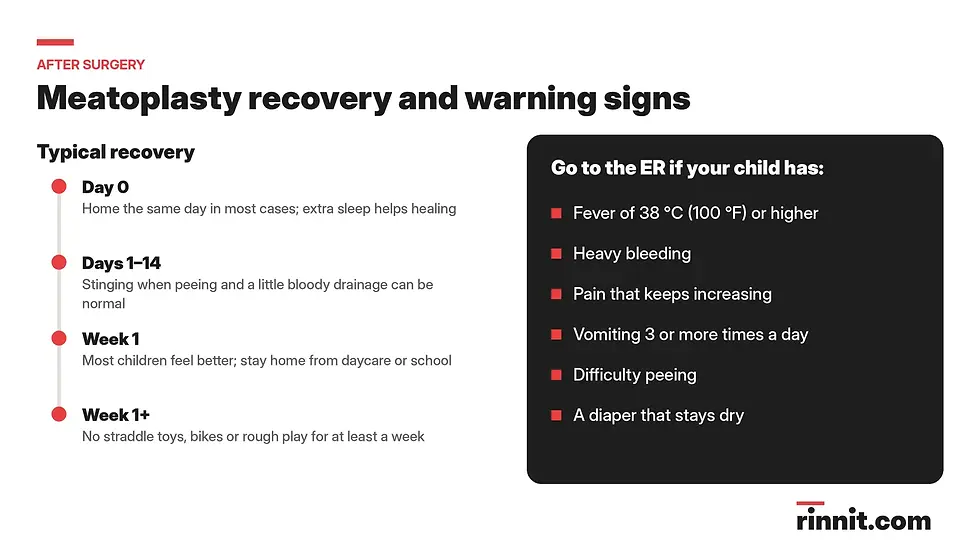
How long does meatoplasty recovery take?
Meatoplasty recovery usually takes about a week, and most children start to feel better within that time. [1]
Time after surgery | What to expect |
Day of surgery | Most children go home; extra sleep is normal and helps healing |
First 1–2 weeks | Stinging or burning when peeing; a little bloody drainage |
First week | Keep your child home from daycare or school |
At least one week | No straddling toys (bicycle, rocking horse, swing, see-saw), sports, or rough play |
Source: [1]
How do you care for a child after meatotomy?
Care after meatotomy focuses on pain relief, ointment, and keeping the area clean. [1]
Do | Avoid |
Use pain relief your care team recommends, such as children's acetaminophen (paracetamol) or ibuprofen | Aspirin — it can increase bleeding |
Apply antibiotic ointment or petroleum jelly at least three times a day | Tight underwear |
Wash your hands with soap and water before changing bandages | Leaving diapers on for long stretches |
Dress your child in loose underwear; change diapers often and give a few diaper-free hours each day | Rubbing the area dry |
Bathe gently with warm water and soap, then pat the penis dry | Returning to daycare or school before one week |
Source: [1]
Book regular follow-up visits so the provider can confirm the penis is healing as expected. [1]
When should you go to the ER after meatoplasty?
Go to the nearest emergency room right away if your child shows any of these signs after meatoplasty: [1]
Fever of 38 °C (100.4 °F) or higher
Heavy bleeding
Pain that keeps increasing
Vomiting three or more times a day
Difficulty peeing
A diaper that stays dry
Burning with urination plus fever can also point to an infection; see our guide to urinary tract infection (UTI) for the signs.
Conclusion
Meatoplasty and meatotomy are short, common, and safe operations that widen a narrow urethral opening. Most children go home the same day, feel better within a week, and have no further problems. Careful home care, a week of rest from school and straddle toys, and quick action on warning signs give your child the smoothest recovery. [1]
Next step: If your son has a spraying, deflected, or painful urine stream, book a visit with a pediatric urologist to check for meatal stenosis. Then explore our related guides on hypospadias and urethral stricture to understand your child's urinary health.
FAQ
What is meatoplasty?
Meatoplasty is a surgery that enlarges the urethral meatus, the opening at the tip of the penis where urine leaves the body. The surgeon opens and remodels the opening and may close the edges with stitches.
What is the difference between meatoplasty and meatotomy?
Meatoplasty remodels the opening and may use stitches, while meatotomy only widens it and often uses no stitches. Many doctors use the two terms interchangeably.
Why would a child need meatoplasty?
A child needs meatoplasty most often for meatal stenosis, a narrowing of the urethral opening. Signs include trouble aiming, spraying, a thin or upward stream, peeing more often, and burning when peeing.
How long does meatoplasty take?
Meatoplasty usually takes less than an hour. Most children go home the same day.
How long does meatotomy recovery take?
Meatotomy recovery takes about a week for most children. Stinging when peeing can last one to two weeks, and children should stay home from daycare or school for at least a week.
Is meatotomy painful?
Meatotomy is done under anesthesia or numbing cream, so pain during the procedure is limited. Afterward it can be bothersome: stinging or burning when peeing and slight bloody drainage are normal for one to two weeks.
Can adults have meatoplasty?
Adults can have meatoplasty, though it is less common than in children. In adults, the opening may narrow after urethral surgery or long-term catheter use.
When should I take my child to the ER after meatoplasty?
Go to the ER for a fever of 38 °C (100.4 °F) or higher, heavy bleeding, increasing pain, vomiting three or more times a day, difficulty peeing, or a diaper that stays dry.
What is meatal stenosis?
Meatal stenosis is a narrowing of the opening at the tip of the penis, caused by irritation that leads to scarring. Signs include trouble aiming, a spraying or thin stream and burning when peeing.
Can meatotomy be done without general anesthesia?
Sometimes. In some children, a meatotomy can be done in the office using a numbing cream, while others are treated asleep under anesthesia. The urologist will recommend the best option for your child.
Related Reading
Understanding Meatal Stenosis: Symptoms, Causes, and Treatment explains why the urethral opening narrows and how it is treated.
Hypospadias Repair: Surgery, Recovery & Risks Explained covers surgery to correct the position of the urethral opening.
Circumcision: Procedure, Methods, Recovery and Risks explains how circumcision is done and how to care for the area afterward.
The Urethra: Anatomy, Function, and Urinary Health explains how the urethra works and common urinary problems.
References
Cleveland Clinic. Meatotomy & Meatoplasty: Purpose, Procedure & Recovery. Cleveland Clinic. Last updated November 8, 2023. https://my.clevelandclinic.org/health/treatments/16360-meatoplasty-meatotomy
Varda BK, Logvinenko T, Bauer S, et al. Minor procedure, major impact: Patient-reported outcomes following urethral meatotomy. J Pediatr Urol. 2018;14(2):165.e1-165.e5. PMID 29221617. https://doi.org/10.1016/j.jpurol.2017.10.012
Godley SP, Sturm RM, Durbin-Johnson B, et al. Meatal stenosis: a retrospective analysis of over 4000 patients. J Pediatr Urol. 2015;11(1):38.e1-38.e6. PMID 25703201. https://doi.org/10.1016/j.jpurol.2014.09.006
Dothan D, Noyman Y, Perez D, et al. Surgical Treatment of Meatal Stenosis: Lessons Learned from the Pediatric Urology Practice. Urology. 2023;171:201-204. PMID 35981660. https://doi.org/10.1016/j.urology.2022.08.006
Disclaimer
This article is for general education and does not replace advice from a qualified healthcare professional. Always consult your child's doctor or a pediatric urologist about symptoms, surgery, and aftercare. If your child has a fever, heavy bleeding, or cannot pee after surgery, seek emergency care immediately.



Comments