Understanding Meatal Stenosis: Symptoms, Causes, and Treatment

Updated: 3 days ago
Medically reviewed by Dr. Baraa Alnahhal, MD · Last reviewed: October 2026
Meatal stenosis is a narrowing of the urethral opening at the tip of the penis, most commonly occurring as a complication after circumcision. Symptoms include painful urination, spraying of the urine stream, and difficulty fully emptying the bladder. While it cannot correct itself, the condition is highly treatable through a minor surgical procedure called a meatotomy or, in some cases, topical steroid creams. With proper care, the success rate for treatment is high, leading to resolution of urinary symptoms in most people [1].
Quick Answer: What is meatal stenosis?
Meatal stenosis is a narrowing of the urethral opening, typically developing in children aged 3 to 7 after circumcision. Symptoms include a narrow or spraying urine stream, painful urination and frequent urges to pee. A physical exam usually confirms it. The main treatment is a meatotomy, a successful surgery to enlarge the opening, and most patients recover completely. [1]
What the research says
Meatal stenosis after circumcision is uncommon, and petroleum jelly lowers the risk. A meta-analysis of 27 studies (350 cases among 1,498,536 males) estimated the risk of meatal stenosis in circumcised males at 0.656% (95% CI 0.435%–0.911%); three randomized trials found that applying petroleum jelly to the glans after circumcision was associated with a lower risk (relative risk 0.024, 95% CI 0.0048–0.12), and weak evidence suggested the risk might be higher in circumcised boys than in uncircumcised boys (Morris and Krieger, Urology, 2017 [2]).
Meatotomy resolves symptoms in most boys. In a prospective study of 15 evaluable boys with symptomatic meatal stenosis after neonatal circumcision, all had complete symptom resolution at short-term follow-up and 12 of 15 at long-term follow-up (average 43 months), and abnormal uroflowmetry patterns fell from 53% before surgery to 13% (Neheman et al., Urology, 2019 [3]).
A meatotomy can be done in the clinic with topical anesthesia. In a retrospective study of 55 boys who had a clinic meatotomy after applying EMLA anesthetic cream, 78% had no pain during the procedure, and at a median follow-up of 1.6 months 75% had resolved symptoms, 16% had improved symptoms, and 5% were unchanged (Fronczak and Villanueva, J Pediatr Urol, 2017 [4]).
Meatal stenosis is a relatively common urological condition where the opening at the end of the penis, known as the meatus, becomes abnormally narrow. This narrowing can impede the natural flow of urine, leading to discomfort and various urinary irregularities. While it can be present at birth, it most frequently develops in young boys between the ages of 3 and 7. Reported rates vary widely between studies, and a large meta-analysis estimated the risk at under 1% of circumcised males, but awareness and timely medical care still matter [1].
What are the symptoms of meatal stenosis?
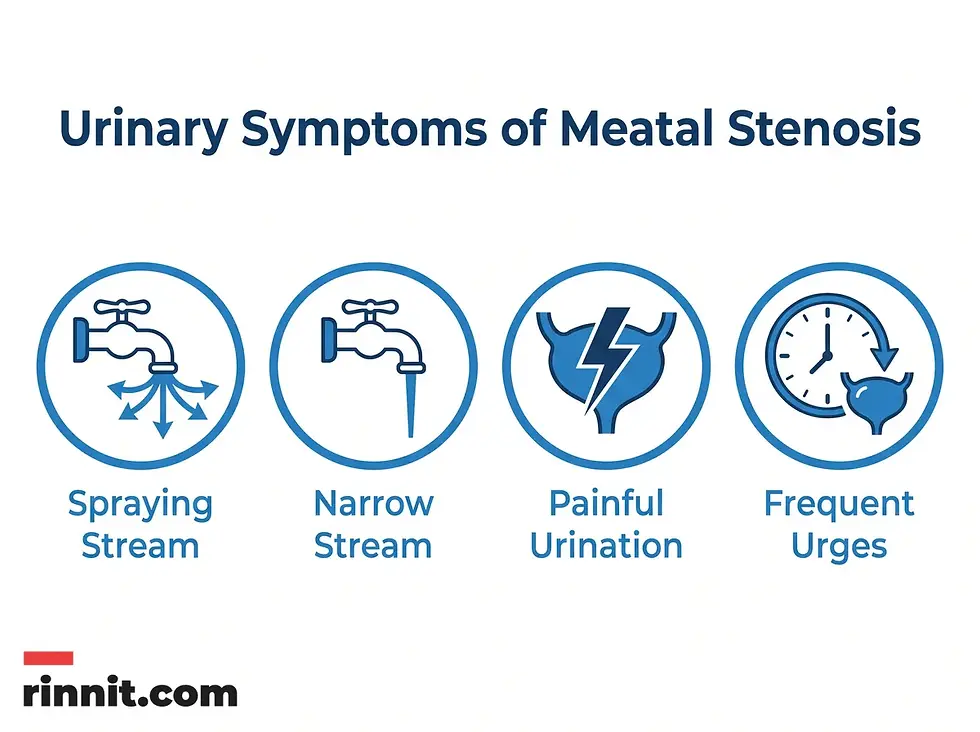
The primary indicator of meatal stenosis is a visibly small or narrow opening at the tip of the penis. Because this narrowing affects the exit point of the urethra, it directly impacts how a person urinates. Patients and parents should look for specific changes in urinary patterns and physical discomfort during urination [1].
Symptom category | Specific sign | Description |
Urinary stream | Spraying | The urine flow may spray upward or be difficult to aim. |
Urinary stream | Narrow stream | A very thin, fast, or small stream of urine. |
Physical sensation | Dysuria | A burning or painful feeling while urinating. |
Bladder control | Frequency | A sudden or frequent urge to pee, often with incomplete emptying. |
Post-urination | Hematuria | A small drop of blood appearing at the tip after peeing. |
What causes meatal stenosis and who is at risk?
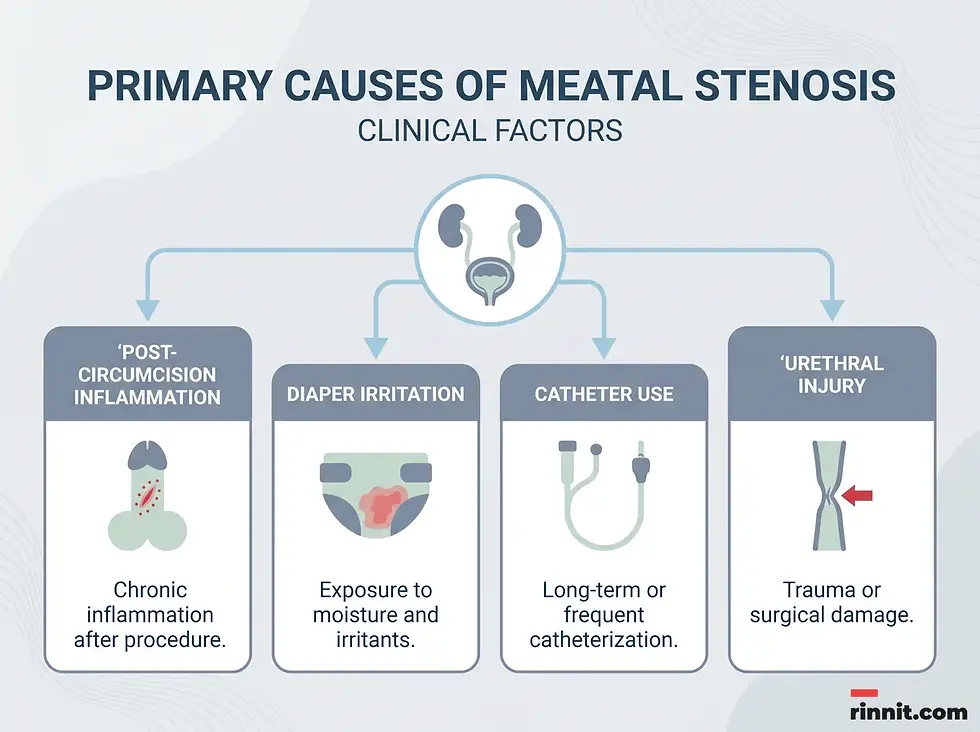
The most prevalent cause of meatal stenosis is a complication following circumcision. It is notably rare in individuals who have not undergone the procedure. In infants, the newly exposed tip of the penis may become inflamed due to rubbing against diapers or exposure to the ammonia and uric acid found in wet diapers. Over time, this inflammation can lead to the formation of scar tissue, which gradually narrows the meatal opening [1].
Other Contributing Factors
Medical procedures: Long-term use of urinary catheters can irritate the urethra and lead to narrowing.
Trauma or injury: Physical injury to the penis or surgical instruments inserted into the urethra can cause scarring.
Autoimmune conditions: In adults, conditions like lichen sclerosus can contribute to the development of stenosis.
Congenital factors: In rare cases, the condition is present from birth.
How is meatal stenosis diagnosed and treated?
A healthcare provider can typically diagnose meatal stenosis through a straightforward physical examination. During this exam, the provider will measure the width of the meatus and may observe the urine stream to check for spraying or reduced flow strength. It is important to note that meatal stenosis does not correct itself over time and requires active management to resolve [1].
Effective Treatment Options
The gold standard for treating meatal stenosis is a meatotomy, a minor surgical procedure designed to permanently enlarge the urethral opening. This procedure has a very high success rate and a low risk of recurrence. For milder cases, a healthcare provider might recommend a topical corticosteroid cream applied over several months to reduce inflammation and widen the opening [1].
Treatment method | Procedure details | Success and recovery |
Meatotomy | Surgical widening of the meatus. | High success; recovery takes only a few days. |
Steroid cream | Topical application to reduce inflammation. | Used for mild cases; requires consistent use. |
Post-op care | Warm baths and skincare ointments. | Helps prevent scarring and speeds up healing. |

What is the bottom line on meatal stenosis?
Meatal stenosis is a manageable condition that, while uncomfortable, responds well to medical treatment. Early diagnosis helps relieve symptoms and may help prevent complications such as urinary tract infections or bladder issues, although experts differ on how often these develop. Parents who notice changes in their child's urinary stream or complaints of pain should consult a urologist promptly [1].
Frequently Asked Questions
What is the most common cause of meatal stenosis?
The most common cause is a complication following circumcision, often due to inflammation or irritation from diapers.
Can meatal stenosis happen in adults?
Yes, though it is less common. In adults, it usually results from catheter use, injury, or autoimmune conditions.
Is a meatotomy a major surgery?
No, it is a minor surgical procedure with a very high success rate and a quick recovery period of just a few days.
What does urinary spraying mean in this context?
Urinary spraying refers to a urine stream that is difficult to aim or sprays in multiple directions, often upward, due to the narrow opening.
Can meatal stenosis go away on its own?
No, the condition does not correct itself and requires medical treatment like a meatotomy or steroid cream.
How common is meatal stenosis worldwide?
Estimates vary widely; a large meta-analysis put the risk at under 1% of circumcised males, and it most often appears between the ages of 3 and 7.
Are there risks if meatal stenosis is left untreated?
Some experts believe it can lead to urinary tract infections or kidney issues, though opinions in the medical community vary.
How is the condition diagnosed?
Diagnosis is typically made through a physical examination and by observing the strength and direction of the urine stream.
What is post-operative care like?
Post-operative care usually involves warm baths, pain relievers, and applying protective ointments like Vaseline to the area.
Can meatal stenosis be prevented?
Applying protective ointments after circumcision may help, and the condition is rarely seen in uncircumcised individuals.
Related Reading
Circumcision: Procedure, Methods, Recovery and Risks explains the procedure, the Gomco, Mogen and Plastibell methods, aftercare and recovery.
References
Cleveland Clinic. Meatal Stenosis. Cleveland Clinic. March 27, 2024. https://my.clevelandclinic.org/health/diseases/16295-meatal-stenosis
Morris BJ, Krieger JN. Does circumcision increase meatal stenosis risk? A systematic review and meta-analysis. Urology. 2017;110:16-26. PMID 28826876. https://doi.org/10.1016/j.urology.2017.07.027
Neheman A, Rappaport YH, Darawsha AE, et al. Uroflowmetry before and after meatotomy in boys with symptomatic meatal stenosis following neonatal circumcision: a long-term prospective study. Urology. 2019;125:191-195. PMID 30552933. https://doi.org/10.1016/j.urology.2018.12.005
Fronczak CM, Villanueva CA. Clinic meatotomy under topical anesthesia. J Pediatr Urol. 2017;13(5):499.e1-499.e3. PMID 28365169. https://doi.org/10.1016/j.jpurol.2017.02.014
Medical disclaimer
This article is for informational purposes only and is not a substitute for professional medical advice, diagnosis, or treatment. The clinical information in this guide reflects source material last reviewed in March 2024.



Comments