Hysteroscopy: Procedure, Recovery, Risks and What to Expect

Updated: 6 days ago
Written and medically reviewed by Dr. Baraa Alnahhal, MD · Last reviewed: October 2026 · How we review
Quick Answer: What is a hysteroscopy?
A hysteroscopy is a procedure in which a surgeon passes a thin, lighted scope through the vagina and cervix to see inside the uterus. It is mainly used to diagnose and treat causes of abnormal uterine bleeding, including polyps, fibroids and scar tissue. It is minor surgery, and an overnight hospital stay is usually not needed. [1]
What the research says
Serious problems are rare, especially with a diagnostic look. In a study of 13,600 hysteroscopies across 82 hospitals, complications occurred in 0.28% of procedures — 0.13% for diagnostic and 0.95% for operative hysteroscopy. (Jansen et al., Obstet Gynecol, 2000) [2]
Polyp removal in a clinic works almost as well as removal in hospital. In a trial of 507 women with abnormal bleeding and polyps, bleeding was successfully treated at 6 months in 73% after clinic (outpatient) removal versus 80% after hospital removal under general anesthesia — within the trial's non-inferiority margin. Polyps were incompletely removed more often in the clinic (19% vs 7%). (Clark et al., Health Technol Assess, 2015) [3]
A simple painkiller before an office hysteroscopy can reduce pain. A review of 22 randomized trials (16 pooled) found that taking a nonsteroidal anti-inflammatory drug (NSAID) by mouth before the procedure significantly reduced pain during and after it, without more side effects than control. (De Silva et al., J Minim Invasive Gynecol, 2020) [4]
Key takeaways
A hysteroscopy looks inside the uterus through the vagina and cervix — no cut in the abdomen. [1]
Diagnostic hysteroscopy finds problems; operative hysteroscopy removes them, often in the same session. [1]
It takes from about 5 minutes to over an hour, depending on what is done. [1]
Mild cramping and light bleeding for a few days afterward are common. [1]
Call your doctor for fever, severe abdominal pain or heavy vaginal bleeding. [1]

What is a hysteroscopy used for?
A hysteroscopy is used mainly to find and treat the cause of abnormal uterine bleeding. [1] The scope lets the surgeon see the inside of the uterus directly, so growths and structural problems can be identified and, in many cases, removed. [1]
Problem found inside the uterus | What it is | Hysteroscopic treatment |
Growths on the uterine lining | Hysteroscopic polypectomy | |
Fibroids | Non-cancerous growths of the uterine wall | Hysteroscopic myomectomy |
Adhesions (Asherman's syndrome) | Scar tissue inside the uterus | Removal of scar tissue |
Uterine septum | A wall of tissue dividing the uterus, present from birth | Removal of the septum |
A hysteroscopy can also help: [1]
Investigate repeated miscarriages or fertility problems.
Find and remove an intrauterine device (IUD) that has moved out of place.
Remove placental tissue left in the uterus after childbirth.
For heavy menstrual bleeding, a related procedure called endometrial ablation destroys the uterine lining to reduce bleeding. [1]
What is the difference between diagnostic and operative hysteroscopy?
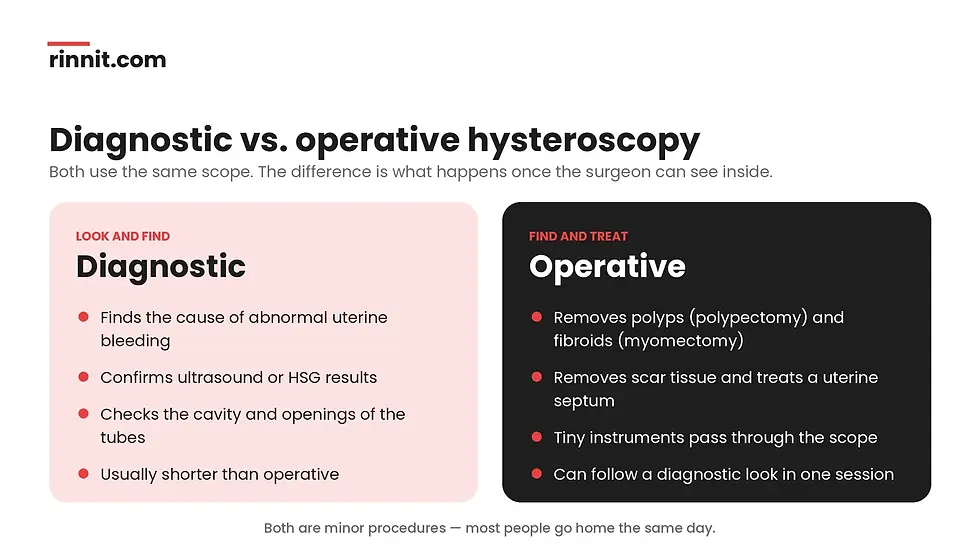
Diagnostic hysteroscopy is used to find a problem inside the uterus, while operative hysteroscopy is used to treat it. [1] Both use the same scope, and an operative procedure can follow the diagnostic look in a single session, which avoids a second surgery. [1]
Diagnostic hysteroscopy | Operative hysteroscopy | |
Main goal | Find structural problems in the uterus | Remove or correct what was found |
Typical use | Explain abnormal bleeding; confirm ultrasound or hysterosalpingography (HSG) results | Remove polyps, fibroids, scar tissue or a septum |
Instruments | Scope only | Small surgical tools passed through the scope |
Length | Usually shorter | Usually longer |
Hysterosalpingography is an X-ray test that uses dye to check whether the fallopian tubes are blocked. [1]
Who should not have a hysteroscopy?
A hysteroscopy is generally not recommended for people who are pregnant or who have a pelvic infection, such as pelvic inflammatory disease. [1] Your surgeon decides whether the procedure is right for you based on your medical history and current health. [1]
When is the best time to schedule a hysteroscopy?
The best time to schedule a hysteroscopy, for people with regular periods, is usually the first week after period bleeding stops, because this gives the surgeon the clearest view of the uterus. [1]
Your situation | Usual timing |
Regular periods | First week after bleeding stops |
Irregular periods | Agreed with your surgeon |
After menopause | Any time |
How do you prepare for a hysteroscopy?
Preparing for a hysteroscopy starts with a review of your medical history and every medicine you take, including vitamins and supplements. [1] Tell your care team about blood-thinning medicines, including aspirin, because you may need to stop them before the procedure. [1]
Before the procedure, you may also have: [1]
A physical exam and a pelvic exam.
A pregnancy test.
Blood tests or other diagnostic tests.
Your care team will tell you what to wear, whether you need to stop eating and drinking beforehand, and to arrange a ride home. [1]
What happens during a hysteroscopy?
During a hysteroscopy, the surgeon gently opens the cervix, passes the scope into the uterus and fills the uterus with liquid to get a clear view. [1] You will first empty your bladder and change into a gown, and you may receive anesthesia or sedation. [1]
The steps are: [1]
Pelvic exam — the doctor examines the pelvis.
Cervix opened — the cervix is gently widened (dilated).
Scope inserted — the hysteroscope passes through the vagina and cervix into the uterus.
Uterus expanded — a liquid fills the uterus to widen it and clear away blood or mucus.
Inside checked — the surgeon looks at the uterine lining and the openings of the fallopian tubes.
Treatment if needed — small surgical tools passed through the scope remove any abnormal tissue.
A hysteroscopy can take from about 5 minutes to more than an hour. [1] Diagnostic procedures are usually shorter than operative ones. [1]

What type of anesthesia is used for a hysteroscopy?
The type of anesthesia used for a hysteroscopy depends on where it is done (hospital or office) and whether other procedures are done at the same time. [1] Read more in our guide to anesthesia types and safety.
Type | What it does | Awake? |
Local | Numbs a small area for a short time | Yes |
Regional | Numbs a larger area for a few hours | Yes |
General | Affects the whole body | No — you are asleep |
You may need to stop eating and drinking for a set time before general anesthesia. [1]
What happens right after a hysteroscopy?
Right after a hysteroscopy, you may be watched in a recovery area for several hours if you had anesthesia. [1] Feeling faint or sick to your stomach right afterward is not unusual. [1]
Mild cramping or light bleeding for a few days is common. [1] Most people do not stay overnight, although an overnight stay may be needed if there is concern about how you reacted to the anesthesia. [1]
What are the benefits of a hysteroscopy?
The main benefit of a hysteroscopy is that diagnosis and treatment can happen in one procedure. [1] It is also minimally invasive and precise, so abnormal tissue can be removed with little damage to the healthy tissue around it. [1]
What are the risks of a hysteroscopy?
A hysteroscopy is considered safe, with complications in fewer than 1% of cases. [1] Large studies show the rate is lower for diagnostic procedures than for operative ones. [2]
Possible complications include: [1]
Infection.
Heavy bleeding.
Scarring inside the uterus.
A reaction to the anesthesia.
Injury to the cervix, uterus, bowel or bladder.
A reaction to the liquid used to expand the uterus.
How long does it take to recover from a hysteroscopy?
Recovery time after a hysteroscopy depends on how extensive the procedure was. [1] Your surgeon may advise you to avoid the following for about two weeks: [1]
Douching.
Sex.
Putting anything into the vagina, including tampons.
Baths, swimming and hot tubs.
Always follow the specific instructions your surgeon gives you. [1]
When should you call a doctor after a hysteroscopy?
You should call your doctor after a hysteroscopy if you develop any of these warning signs: [1]
Warning sign | Why it matters |
Fever | Can be a sign of infection |
Severe abdominal pain | Pain beyond mild cramping is not expected |
Heavy vaginal bleeding | Only light bleeding is expected |
How is a hysteroscopy different from a D&C?
A hysteroscopy differs from a dilation and curettage (D&C) in that the surgeon can see growths directly and remove them precisely. [1] Both procedures can remove tissue from the uterus. [1]
Hysteroscopy | D&C | |
How tissue is removed | Seen through the scope, then removed precisely | Gentle scraping of the uterine lining |
Best for | Targeting specific growths | Collecting larger tissue samples |
Is a hysteroscopy major or minor surgery?
A hysteroscopy is minor surgery, because it is done through the vagina and usually does not require an overnight hospital stay. [1] This is different from procedures such as a hysterectomy, which removes the uterus.
Conclusion
A hysteroscopy gives your surgeon a direct look inside the uterus, and often the chance to fix what they find in the same visit. [1] It is minor, usually same-day surgery with a low complication rate. [1][2] Expect some cramping and light bleeding for a few days, follow your surgeon's recovery advice, and call your doctor right away for fever, severe pain or heavy bleeding. [1]
Have a hysteroscopy coming up? Write down your questions about timing, anesthesia and recovery and take them to your pre-procedure appointment. Then keep learning with our clear, doctor-reviewed guides to uterine polyps, heavy menstrual bleeding and endometrial ablation.
FAQ
What is a hysteroscopy used for?
A hysteroscopy is used mainly to find and treat causes of abnormal uterine bleeding, such as polyps, fibroids and scar tissue. It can also help investigate repeated miscarriages or fertility problems and locate an IUD. [1]
Is a hysteroscopy major surgery?
A hysteroscopy is minor surgery. The procedure is done through the vagina instead of through an opening in the abdomen and usually does not need an overnight hospital stay. [1]
How long does a hysteroscopy take?
A hysteroscopy takes from about five minutes to more than an hour. Diagnostic hysteroscopy is usually shorter than operative hysteroscopy, and any extra procedure done at the same time adds time. [1]
Does a hysteroscopy hurt?
Pain during a hysteroscopy varies from person to person. Procedure length, previous childbirth and anxiety beforehand can all affect how much pain you feel, so ask your surgeon what to expect and which anesthesia options suit you. [1]
Will I be asleep during a hysteroscopy?
Being asleep during a hysteroscopy depends on the anesthesia you receive. General anesthesia puts you to sleep, while local or regional anesthesia only numbs part of your body. [1]
How long does bleeding last after a hysteroscopy?
Light bleeding and cramping after a hysteroscopy can last a few days. Heavy vaginal bleeding is not expected and is a reason to call your doctor. [1]
What are the warning signs after a hysteroscopy?
The warning signs after a hysteroscopy are fever, severe abdominal pain and heavy vaginal bleeding. Contact your doctor promptly if any of these develop. [1]
Can I use tampons or have sex after a hysteroscopy?
Tampons, douching and sex are often avoided for about two weeks after a hysteroscopy. Follow your surgeon's specific advice, which depends on how extensive your procedure was. [1]
When is the best time to schedule a hysteroscopy?
For people with regular periods, the best time is usually the first week after period bleeding stops. This gives the doctor the clearest view of the inside of the uterus.
What is the difference between diagnostic and operative hysteroscopy?
Diagnostic hysteroscopy looks for a problem inside the uterus, while operative hysteroscopy treats it, for example by removing a polyp. Both can often be done in the same session.
Related Reading
Uterine Polyps: Complete Guide to Symptoms, Causes, and Treatment explains uterine polyps, their symptoms and how they are removed.
Dilation and Curettage (D&C): A Comprehensive Guide describes how a D&C is done and what recovery involves.
Endometrial Ablation: How It Works, Recovery and Risks explains how endometrial ablation treats heavy menstrual bleeding.
Endometrial Biopsy: Why It's Done, What to Expect, Pain, Recovery and Results explains how a sample of the uterine lining is taken and tested.
References
Cleveland Clinic. Hysteroscopy: Purpose, Procedure, Risks & Recovery. Cleveland Clinic. Last updated September 12, 2022. https://my.clevelandclinic.org/health/treatments/10142-hysteroscopy
Jansen FW, Vredevoogd CB, van Ulzen K, et al. Complications of hysteroscopy: a prospective, multicenter study. Obstetrics and Gynecology. 2000;96(2):266-270. PMID 10908775. https://doi.org/10.1016/s0029-7844(00)00865-6
Clark TJ, Middleton LJ, Cooper NA, et al. A randomised controlled trial of Outpatient versus inpatient Polyp Treatment (OPT) for abnormal uterine bleeding. Health Technology Assessment. 2015;19(61):1-194. PMID 26240949. https://doi.org/10.3310/hta19610
De Silva PM, Mahmud A, Smith PP, et al. Analgesia for Office Hysteroscopy: A Systematic Review and Meta-analysis. Journal of Minimally Invasive Gynecology. 2020;27(5):1034-1047. PMID 31982584. https://doi.org/10.1016/j.jmig.2020.01.008
Disclaimer
This article is for general education and does not replace advice from your own doctor. Talk to your healthcare provider about your symptoms, your test results and whether a hysteroscopy is right for you. If you have heavy bleeding, severe pain or fever after a procedure, seek medical care promptly.



Comments