Endometrial Biopsy: Why It's Done, What to Expect, Pain, Recovery and Results

Updated: 4 days ago
Written and medically reviewed by Dr. Baraa Alnahhal, MD · Last reviewed: November 2026 · How we review
Quick Answer: What is an endometrial biopsy?
An endometrial biopsy is a short office procedure in which a provider passes a thin tube through the cervix and uses suction to remove a small piece of the uterine lining (endometrium). A pathologist then checks the cells for cancer and other changes. It takes 5 to 15 minutes and usually causes cramping similar to a period. [1]
What the research says
The common office biopsy device finds nearly all endometrial cancers after menopause. A meta-analysis of 39 studies with 7,914 women found the Pipelle device detected 99.6% of endometrial cancers in postmenopausal women and 91% in premenopausal women, with specificity above 98% for all devices. (Dijkhuizen et al., Cancer, 2000) [2]
Bleeding after menopause deserves a check, but it is usually not cancer. Across 129 studies of 40,790 women, 9% of women with postmenopausal bleeding had endometrial cancer, while 91% of women with endometrial cancer had postmenopausal bleeding. (Clarke et al., JAMA Internal Medicine, 2018) [3]
Key takeaways
An endometrial biopsy samples the uterine lining to look for cancer or other abnormal cells. [1]
It is the most common and accurate test to diagnose endometrial cancer. [1]
It is done in the office, usually without anesthesia, in 5 to 15 minutes. [1]
Cramping and light bleeding for a few days are normal; results take up to a week. [1]
It cannot be done during pregnancy. [1]
Why is an endometrial biopsy done?
A provider may recommend an endometrial biopsy to find the cause of symptoms or to look more closely at something seen on an ultrasound or Pap test. [1]
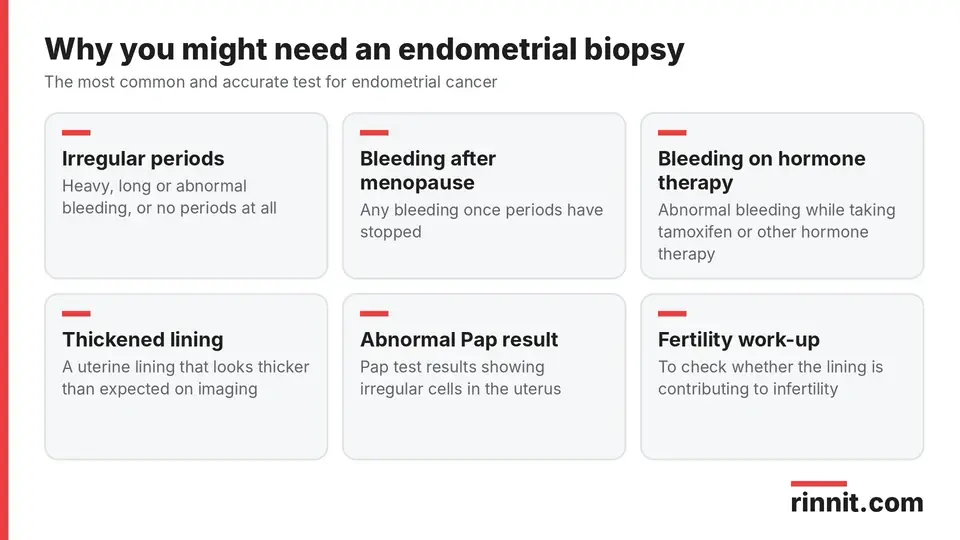
Abnormal bleeding is the most common reason for an endometrial biopsy.
Reasons include: [1]
Irregular periods, including heavy, long or abnormal bleeding, or no periods at all
Bleeding after menopause
Abnormal bleeding while taking tamoxifen or other hormone therapy
A thickened uterine lining
Pap test results that show irregular cells in the uterus
People over 35 are the most likely to have this test. People having trouble getting pregnant may also have one to see whether the lining is contributing to infertility. It cannot be done during pregnancy. [1]
How do you prepare for an endometrial biopsy?
You usually do not need to do much. Tell your provider about your medicines, supplements and allergies, and ask whether to stop any medicine before the biopsy. [1]
What happens during an endometrial biopsy?
The biopsy usually happens in your provider's office or another outpatient setting, without anesthesia. [1]
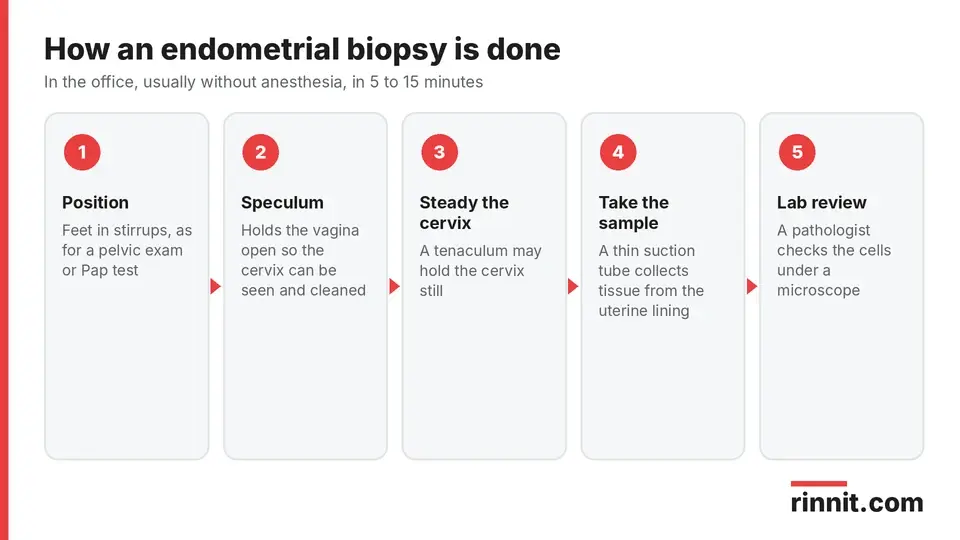
The whole procedure usually takes 5 to 15 minutes.
You undress from the waist down and cover yourself with a sheet.
You lie back with your feet in stirrups, as for a pelvic exam or Pap test.
Your provider places a speculum in the vagina to see the cervix and cleans the cervix with a special solution.
They may hold the cervix steady with an instrument called a tenaculum; some people find this the most painful step.
A very thin suction tube is passed through the cervix into the uterus to collect the sample.
The tissue goes to a pathologist, who examines the cells.
Sources: [1]
Does an endometrial biopsy hurt?
Mild cramping like menstrual cramps during and after the procedure is normal. Pain tolerance varies, but providers generally do not consider it a very painful procedure. Contact your provider if pelvic pain lasts several days. [1]
What is recovery like after an endometrial biopsy?
You can dress, rest for a few minutes and usually drive yourself home shortly afterward. Soreness and cramping for 48 hours are normal, and full recovery takes no more than a few days. [1]
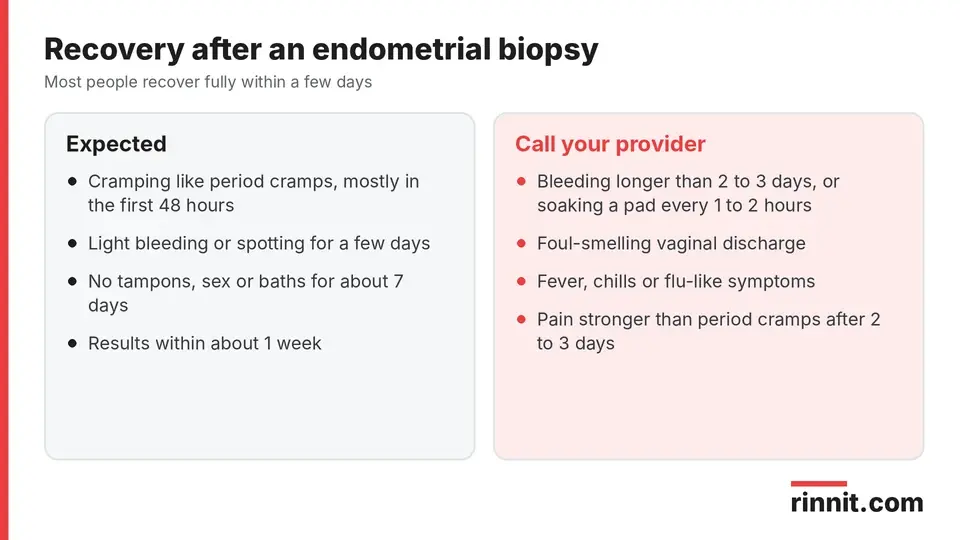
Most people recover within a few days.
Topic | What to expect |
Bleeding | Light bleeding and spotting; a sanitary pad is fine |
Cramping | Use ibuprofen or acetaminophen as needed |
Tampons and douching | Avoid for 7 days |
Sex | Avoid for at least 7 days, or as your provider advises |
Activity | Avoid strenuous exercise, heavy lifting, swimming, hot tubs and baths for several days |
Sources: [1]
What are the risks of an endometrial biopsy?
An endometrial biopsy is generally very low-risk and safe. Possible risks include: [1]
Infection
Bleeding
Spotting and cramping that last several days
A tear or hole in the uterus or cervix (rare)
What do endometrial biopsy results mean?
Results usually take up to one week. [1]
Normal: no abnormal cells were found. [1]
Abnormal: abnormal cells were found. Causes include endometrial cancer, uterine polyps or fibroids, an infection of the lining or a hormonal imbalance. [1]
Inconclusive: your provider may recommend a dilation and curettage (D&C) to remove a larger tissue sample. [1]
An abnormal result does not always mean cancer, and treatment is not always needed. Your provider will review the results with you and plan next steps. [1]
When should you call your doctor?
Contact your provider if you have: [1]
Bleeding for more than 72 hours, or heavy bleeding that soaks a pad every one to two hours
Foul-smelling vaginal discharge
Fever, chills or other flu-like symptoms
Cramping or pain that lasts several days or is stronger than period cramps after two to three days
Normal results but continued symptoms such as irregular bleeding
Conclusion
An endometrial biopsy is a quick, low-risk office test that gives a clear answer about what is happening in the uterine lining. It is the main way to diagnose endometrial cancer, but most abnormal bleeding turns out to have other causes.
Expect period-like cramps and light bleeding for a few days. If you keep having symptoms after a normal result, go back to your provider.
Keep learning: Read our endometrial cancer guide or our guide to atypical endometrial hyperplasia. For more background, see the MedlinePlus endometrial biopsy overview.
FAQ
What is an endometrial biopsy?
It is an office procedure that removes a small piece of the uterine lining so a pathologist can check the cells under a microscope.
Why would I need an endometrial biopsy?
Common reasons are irregular or heavy periods, bleeding after menopause, bleeding on tamoxifen or hormone therapy, a thickened lining or abnormal Pap results.
Does an endometrial biopsy hurt?
Most people feel cramping like period cramps; some find it mildly painful, especially when the cervix is held steady.
How long does an endometrial biopsy take?
The procedure itself usually takes 5 to 15 minutes.
How do I prepare for an endometrial biopsy?
Tell your provider about your medicines, supplements and allergies; some suggest ibuprofen beforehand or a medicine to prepare the cervix.
Can I drive home after an endometrial biopsy?
Yes, most people can drive home shortly after the procedure.
Is bleeding normal after an endometrial biopsy?
Light bleeding and cramping are expected for a few days; avoid tampons and sex for about seven days.
How long until I get my results?
Results usually take up to one week.
What does an abnormal result mean?
It means abnormal cells were found, which can come from cancer, polyps, fibroids, infection or a hormonal imbalance.
When should I call my doctor after an endometrial biopsy?
Call for bleeding beyond 72 hours, soaking a pad every one to two hours, fever, foul discharge or pain that lasts several days.
Related Reading
Endometrial Cancer: Symptoms, Diagnosis, Treatment and Support explains the cancer an endometrial biopsy is most often used to rule out.
Atypical Endometrial Hyperplasia: What a Thickened Uterine Lining Means for Your Cancer Risk — Symptoms, Causes, and Treatment — A Complete Guide covers a precancerous change a biopsy can find.
Uterine Polyps: Complete Guide to Symptoms, Causes, and Treatment describes a common benign cause of abnormal results.
References
Cleveland Clinic. Endometrial Biopsy: Pain, Procedure, Results & Recovery. Cleveland Clinic. Last updated April 17, 2023. https://my.clevelandclinic.org/health/diagnostics/15676-endometrial-biopsy
Dijkhuizen FP, Mol BW, Brölmann HA, et al. The accuracy of endometrial sampling in the diagnosis of patients with endometrial carcinoma and hyperplasia: a meta-analysis. Cancer. 2000;89(8):1765-1772. PMID 11042572. https://pubmed.ncbi.nlm.nih.gov/11042572/
Clarke MA, Long BJ, Del Mar Morillo A, et al. Association of Endometrial Cancer Risk With Postmenopausal Bleeding in Women: A Systematic Review and Meta-analysis. JAMA Intern Med. 2018;178(9):1210-1222. PMID 30083701. https://doi.org/10.1001/jamainternmed.2018.2820
Medical disclaimer
This article is for general education only and does not replace advice from a qualified healthcare professional. Talk to your doctor about your own diagnosis and treatment, and seek emergency care right away for severe or sudden symptoms.



Comments