Atypical Endometrial Hyperplasia: What a Thickened Uterine Lining Means for Your Cancer Risk — Symptoms, Causes, and Treatment — A Complete Guide

Updated: 2 days ago
Medically reviewed by Dr. Baraa Alnahhal, MD · Last reviewed: October 2026
Quick Answer
Atypical endometrial hyperplasia, also called endometrial intraepithelial neoplasia (EIN), is a thickened uterine lining whose cells have a high chance of becoming cancerous. [1] Its main symptom is abnormal uterine bleeding, and it is caused by too much estrogen and not enough progesterone. [1] Progestin therapy treats most cases, and hysterectomy is the only way to cure it and eliminate cancer risk. [1]
What the research says
About one in three women with atypical hyperplasia already have cancer, and the yearly progression rate is high. A systematic review and meta-analysis of 36 articles found that, across 11 studies of atypical hyperplasia, the pooled prevalence of concurrent endometrial cancer (found within three months of diagnosis) was 32.6% (95% CI 24.1% to 42.4%). In five studies, the annual incidence of progression to cancer in atypical hyperplasia was 8.2% (95% CI 3.9% to 17.3%). The authors noted that few studies were available and that population-based estimates are needed (PubMed: Doherty et al., PLoS One, 2020 [2]).
A hormonal IUD probably reverses hyperplasia better than oral progestogens in the short term. A Cochrane review of 13 randomized trials (1,657 women) found that the levonorgestrel-releasing IUD probably improves regression of endometrial hyperplasia compared with non-intrauterine progestogens at up to six months (odds ratio 2.94; 95% CI 2.10 to 4.13; 10 trials, 1,108 participants; moderate-quality evidence). All trials lasted six months or less, and there was insufficient evidence on device-related adverse effects (PubMed: Mittermeier et al., Cochrane Database Syst Rev, 2020 [3]).
What Is Endometrial Hyperplasia?
Endometrial hyperplasia is when the lining of your uterus (endometrium) becomes too thick. It often causes abnormal uterine bleeding. [1] In some cases, it can lead to endometrial cancer, a type of uterine cancer.
Endometrial hyperplasia most commonly affects people who are transitioning to or have just completed menopause (when you stop getting a period). [1] Hormone therapy helps manage most cases, though other treatments may be needed.

Types of endometrial hyperplasia
Healthcare providers classify endometrial hyperplasia based on the number of cells and the presence of cell changes in your endometrium:
Type | What the cells look like | Cancer risk | Treatment |
Endometrial hyperplasia without atypia | Cells look normal | Not likely to become cancerous | May improve without treatment; hormonal treatment may be recommended; the most common type |
Endometrial intraepithelial neoplasia (EIN), also called atypical endometrial hyperplasia | Cells have a high chance of becoming cancerous | High | Treatment is necessary to prevent endometrial cancer; hysterectomy is the only way to cure it |
Providers may also use the terms "simple" or "complex." Simple means the cells are mildly crowded. Complex means the cells are highly crowded. [1]
Symptoms: What Does Endometrial Hyperplasia Feel Like?
The main symptom of endometrial hyperplasia, a thickened uterine lining, is abnormal uterine bleeding. This can look like:

Bleeding pattern | What it means |
Bleeding between periods | Abnormal uterine bleeding and a key warning sign |
Short menstrual cycles | Fewer than 21 days between periods |
Heavy menstrual bleeding | Excessive flow that can lead to anemia |
A longer period than usual | Periods that run longer than your normal pattern |
Bleeding after menopause | Never normal; always worth reporting to a provider |
Many of these symptoms are common when you go into menopause. [1] It's important to talk to your healthcare provider about your symptoms and medical history. They can determine whether checking for a thickened endometrium is necessary.
Causes: What Causes Endometrial Hyperplasia?
Endometrial hyperplasia happens when your body has too much estrogen and not enough progesterone.
As a result, your uterus doesn't shed its lining. Instead, the lining continues to grow and thicken. The cells that make up the lining can grow close together and become irregular. [1]
Risk factors
You're more likely to develop endometrial hyperplasia if you're in perimenopause or menopause. It rarely occurs in people younger than 35. [1] Other risk factors include:
Risk factor | How it raises risk |
Perimenopause or menopause | The most common window for the condition |
Obesity | Associated with higher estrogen exposure |
Early menstruation (under 12 years) | Longer lifetime exposure to estrogen |
Late onset of menopause (over 55 years) | Longer lifetime exposure to estrogen |
Long history of irregular or absent periods | Estrogen without regular progesterone balance |
Polyendocrine metabolic ovarian syndrome (PMOS, formerly PCOS) | Hormone imbalance with insufficient progesterone |
Estrogen-secreting tumors | Directly raise estrogen levels |
Lynch syndrome | Inherited condition raising cancer risk |
Never being pregnant (nulliparity) | The uterus never experienced pregnancy-related hormonal shifts |
Complications
All types of endometrial hyperplasia can cause heavy bleeding that leads to anemia, making you feel weak, tired, and dizzy. Anemia needs treatment. [1] Untreated atypical endometrial hyperplasia may become cancerous.
Diagnosis: How Is Endometrial Hyperplasia Diagnosed?
Diagnosing endometrial hyperplasia can take testing, because many conditions can cause abnormal uterine bleeding. To find what's causing your symptoms, your healthcare provider may recommend one or more of these tests:
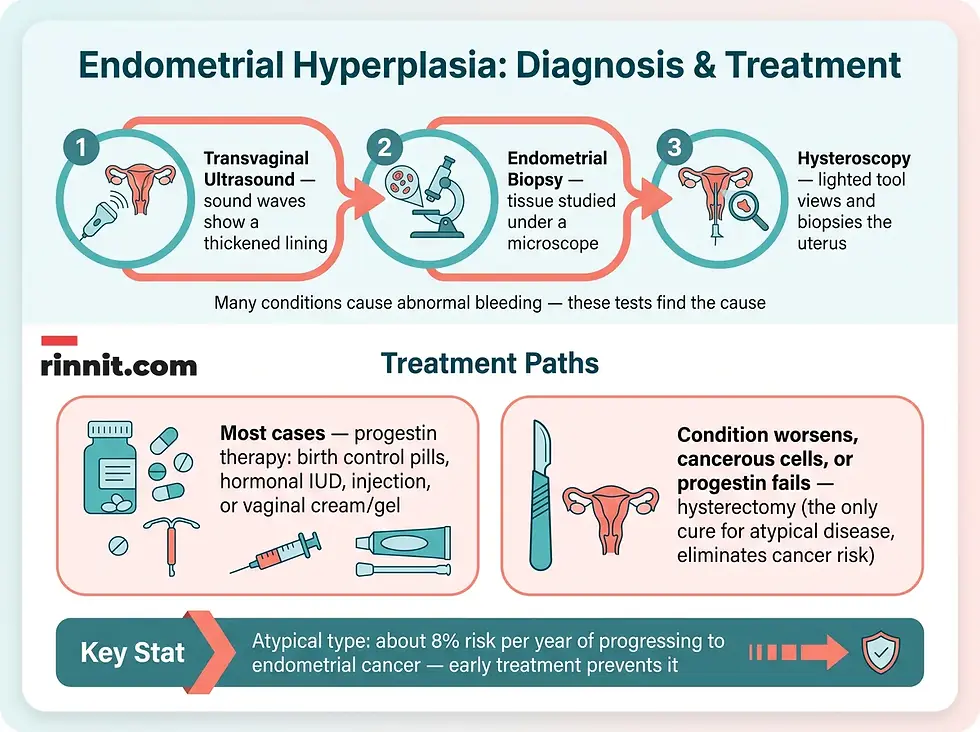
The diagnostic tests
Test | How it works | What it shows |
Transvaginal ultrasound | Your provider inserts a small, thin wand into your vagina that uses sound waves to create pictures | Whether you have a thickened endometrium |
Endometrial biopsy | Your provider removes tissue samples from your uterine lining | Pathologists study the cells under a microscope to classify the hyperplasia |
Hysteroscopy | Your provider uses a thin, lighted tool to look inside your uterus | Abnormalities, with biopsy of any suspicious areas |
Treatment: How Is Endometrial Hyperplasia Treated?
Atypical endometrial hyperplasia can only be cured with a hysterectomy, while most other cases are treated with progestin, the manufactured version of progesterone. [1] It comes in many forms:
Progestin form | Delivery |
Birth control pills | Oral daily medication |
Hormonal intrauterine device (IUD) | Long-acting device placed in the uterus |
Injection (Depo-Provera) | Periodic injection |
Vaginal cream or gel | Topical local treatment |
When is hysterectomy recommended?
Your healthcare provider may recommend a hysterectomy to remove your uterus if the condition worsens or cancerous cells develop, or if the condition doesn't improve with progestin treatment. [1] For atypical endometrial hyperplasia, hysterectomy is the only way to cure it.
Outlook and prognosis
Endometrial hyperplasia often responds well to progestin treatments. Your provider may recommend more frequent ultrasound exams and biopsies to keep an eye on cell changes, and may recommend a hysterectomy to eliminate the chances of atypical endometrial hyperplasia turning into cancer. [1]
One study shows the risk of atypical endometrial hyperplasia progressing to endometrial cancer is about 8% per year after diagnosis, but each case is different. [1] [2]
How can people live with endometrial hyperplasia?
Living with endometrial hyperplasia can be stressful, but it doesn't always lead to cancer, and early diagnosis and treatment can prevent endometrial cancer from ever forming. [1]
Should you be worried about cancer?
Learning that you have a condition that may turn into cancer can be stressful. But endometrial hyperplasia doesn't always lead to cancer, and the risk is much higher only when it's atypical. Early diagnosis and treatment can prevent endometrial cancer from ever forming. Your healthcare provider will be by your side to answer any questions. Together, you'll decide on the treatment plan that's best for you.
When should I see my healthcare provider?
If you experience bleeding between periods, heavy or prolonged periods, cycles shorter than 21 days, or any bleeding after menopause, schedule an appointment. These bleeding changes deserve evaluation, especially if you're in perimenopause or menopause or carry risk factors like obesity or a history of irregular periods.
Questions to ask your healthcare provider
Question | Why it matters |
Which type of hyperplasia do I have? | Atypia versus no atypia drives all treatment decisions |
Do I need progestin therapy, or watchful waiting? | Determines your treatment plan |
What form of progestin do you recommend? | Pills, IUD, injection, or cream each have different profiles |
How often will we re-check my lining? | Sets your monitoring schedule |
Would hysterectomy be right for me? | Cures atypical disease and eliminates cancer risk |
What symptoms should prompt an urgent call? | Catches anemia or worsening bleeding early |
Conclusion
Endometrial hyperplasia is a thickening of the uterine lining, most often driven by excess estrogen around menopause and announced through abnormal bleeding. The version without atypia is common and usually manageable with hormone therapy, but the atypical form, endometrial intraepithelial neoplasia, is a different conversation: its cells are far more likely to become cancerous, progressing at roughly 8% per year if untreated. Progestin in its many forms tames most cases, and for atypical disease, hysterectomy is curative and removes the cancer risk entirely. The single most important step is reporting abnormal bleeding promptly, especially after menopause, because early diagnosis is what stops this condition before it ever turns into cancer.
Call to action: If you're noticing bleeding between periods, heavier or longer periods, or any bleeding after menopause, don't wait and don't brush it off as "just menopause." Schedule an appointment with your healthcare provider for an evaluation. An ultrasound and biopsy can quickly show whether your uterine lining is thickened, and whether you need hormone therapy, closer monitoring, or surgery. Early action is what keeps atypical endometrial hyperplasia from becoming endometrial cancer.
Frequently Asked Questions
1. What is atypical endometrial hyperplasia?
Atypical endometrial hyperplasia, also called endometrial intraepithelial neoplasia (EIN), is a type of thickened uterine lining whose cells have a high chance of becoming cancerous. Treatment is necessary to prevent endometrial cancer, and hysterectomy is the only way to cure it. [1]
2. What is the difference between atypia and no atypia?
In endometrial hyperplasia without atypia, the cells look normal and aren't likely to become cancerous. It is the most common type and may improve without treatment. [1] In atypical hyperplasia (EIN), the cells have a high chance of becoming cancerous and require treatment. [1]
3. How likely is atypical endometrial hyperplasia to become cancer?
Endometrial hyperplasia doesn't always lead to cancer, but the risk is higher when it's atypical. One study shows the risk of atypical endometrial hyperplasia progressing to endometrial cancer is about 8% per year after diagnosis, though each case is different. [1] [2]
4. What causes endometrial hyperplasia?
Endometrial hyperplasia happens when your body has too much estrogen and not enough progesterone. Without the balancing effect of progesterone, the uterus doesn't shed its lining, so the lining continues to grow and thicken, and cells become crowded and irregular. [1]
5. What are the symptoms of endometrial hyperplasia?
The main symptom is abnormal uterine bleeding: bleeding between periods, short cycles under 21 days, heavy menstrual bleeding, longer-than-usual periods, and bleeding after menopause. [1] Many of these are also common around menopause, so evaluation matters.
6. Who is at risk for endometrial hyperplasia?
People in perimenopause or menopause, rarely under 35. Other risk factors include obesity, early menstruation (under 12), late menopause (over 55), long irregular or absent periods, PMOS (formerly PCOS), estrogen-secreting tumors, Lynch syndrome, and never being pregnant (nulliparity). [1]
7. How is endometrial hyperplasia diagnosed?
Through a transvaginal ultrasound (a thin wand using sound waves shows a thickened endometrium), an endometrial biopsy (tissue samples studied under a microscope), or a hysteroscopy (a thin lighted tool examines the uterus and biopsies suspicious areas). [1]
8. How is endometrial hyperplasia treated?
Most cases are treated with progestin, the manufactured version of progesterone, delivered as birth control pills, a hormonal IUD, an injection (Depo-Provera), or a vaginal cream or gel. Hysterectomy may be recommended if the condition worsens, cancerous cells develop, or progestin doesn't help. [1]
9. Does endometrial hyperplasia go away on its own?
Hyperplasia without atypia may improve without treatment, or your provider may recommend hormonal treatment. [1] Atypical hyperplasia does not resolve on its own, and treatment is necessary to prevent endometrial cancer.
10. Can complications develop from endometrial hyperplasia?
Yes. All types can cause heavy bleeding that leads to anemia, making you feel weak, tired, and dizzy, and anemia needs treatment. [1] Untreated atypical endometrial hyperplasia may become cancerous.
11. Can I keep my uterus if I have atypical endometrial hyperplasia?
Hysterectomy is the only way to cure atypical endometrial hyperplasia and eliminate the chance of it turning into cancer. [1] Discuss your options, goals, and risk factors with your healthcare provider to decide the best plan.
External Resources
Related Reading
Endometrial Biopsy: Why It's Done, What to Expect, Pain, Recovery and Results explains the office test used to sample the uterine lining and diagnose this condition.
References
Cleveland Clinic. Endometrial Hyperplasia: Causes, Symptoms & Treatment. Cleveland Clinic. Aug. 5, 2026. https://my.clevelandclinic.org/health/diseases/16569-atypical-endometrial-hyperplasia
Doherty MT, Sanni OB, Coleman HG, et al. Concurrent and future risk of endometrial cancer in women with endometrial hyperplasia: a systematic review and meta-analysis. PLoS One. 2020;15(4):e0232231. PMID 32343732. https://doi.org/10.1371/journal.pone.0232231
Mittermeier T, Farrant C, Wise MR. Levonorgestrel-releasing intrauterine system for endometrial hyperplasia. Cochrane Database Syst Rev. 2020;9(9):CD012658. PMID 32909630. https://doi.org/10.1002/14651858.CD012658.pub2
Medical Disclaimer
This article is for informational purposes only and does not constitute medical advice. Always seek the advice of your physician or other qualified health provider with any questions you may have regarding a medical condition. Never disregard professional medical advice or delay in seeking it because of something you have read here.



Comments